CBSE (clinical Bedside swallow evaluation) and Compensatory Treatments
 Call Kai
 Learn
 Practice Test
 Spaced Repetition
 Match
 Flashcards
 Knowt Play
1/39

There's no tags or description
Looks like no tags are added yet.
40 Terms
Compensatory vs. Rehabilitative
Compensatory tx strategies: aim to improve the swallow safety or efficiency w/o changing the underlying physiological impairment
we are changing: pt’s body positioning, how food or liquid moves, or the conditions under which swallowing occurs
working around the impairment not directly restoring the impaired physiologcial function
Rehabilitative strategies aim to improve the pt’s underlying swallowing physiology (i.e., exercises or interventions to improve: strength, movement, or functional performance)
Compensatory v. Rehabilitative examples
Patient A: the clinician identifies a posture that improves swallowing safety during an instrumental assessment. the patient uses this posture when eating. COMPENSATORY
Patient B: The clinician develops a targeted exercise program intended to improve the physiological function contributing to the swallowing impairment. REHABILITATIVE
can do both! But compensation can also be one option :)
Purpose of Bedside
Purpose:
safe to eat? what consistency liquids, solids, meds
Fast enough to eat meals?
Need instrumental exam of swallow? Fees Vs. MBSS
Speech/lang/cog: Does this need to be worked on?
Bedside Exam
Always begin w/ quick check of Speech, language, and Cognition
Are they Alert and oriented (A&O?) times what (1-4→ person, place, time, situation); are they alert/awake
DOB (goes with A&O)
Casual convo: see what’s going on, build rapport with them
1,2,3 step commands
Repeat
Object naming
Bedside Exam Step 2: Oral Mech Exam
Oral A&P and CN Exam
Abnormal Anatomy?
Smile: Facial droop? ROM? Strength?
Sensation on both side of face
Pucker
Blow up cheeks with air
Lingual Deviation? Lingual ROM? Lingual Strength?
Laryngeal Function (VF)
/aaa/, /ooo/, volitional cough
Dry swallow- palpate? (feeling pt’s throat during dry swallow)
Straws vs no straws
Does it matter?
Can help with less anterior spillage if have unilateral/one sided labial weakness
or can help with pt’s who can’t open jaw all the way
Syringe Feeding?
When is it appropriate to feed or teach a pt how to feed self via use of syringe?
any kind of oral sx; a lot of head and neck cancer pt’s, lingual cancers (e.g., post-glossectomy→ good compensatory strategy)
Based off oral mech, phmx, current dx, convo (or lack thereof) w pt can often make a
decent guesstimate of how the pt will perform on bedside swallow eval. Now we can start with PO trials
note: don’t always start w/ the same consistency; good to start at consistency they think they will pass on!!! so there are no lingering aspiration effects (e.g., is this residue from the liquid or the nectar)
never start with solid!! won’t rlly give you anything
she normally starts with thin, nectar, or purree
thin
nectar
honey
puree
soft solid
solid
mixed consistency
What are we looking for during PO trials? 2
Oral: Bolus acceptance, bolus containment, AP transit (how long it takes to finish what you gave them, can give decent estimate of ap transit), mastication (rotary or munching movement, how long chewing is taking), oral residue (is there anything left in mouth, are they pocketing, are they aware of it?
Pharyngeal:
Delayed swallow trigger (through palpation (feeling throat can give us good idea- is it in mouth for really long time or is it out of their mouth and you still didnt feel a swallow?),
S/S of aspiration (coughing, choking, watery eyes, change in vocal quality, RR change, monitor O2 saturations)
How do we make clinical reccomendations
Case study: 30 yr old femail phmx: DM. Presents 8/10 w/ stroke like symptoms; L side weakness, dysarthria, aphasia. NIH 12. Upon arrival to ED, NIH 2. Clear CT. MRI pending. MD requesting ST evaluation prior to diet initiation.
first introduce self, do A & O q's, may start with any consistency, if she is fine with thin, nectar, solids, etc. would recommend regular diet.
Case Study: 85 yo male pmhx: previous CVA w/ residual L sided deficits in LLE, WC bound at baseline, dementia, HTN, DM, HLD, OSA (obstructed sleep apnea), CKD on dialysis M,W,F. Presents 8/15 w/ worsening L side weakness, new dysarthra, new aphasia. NIH 12. CT R MCA
if they have high flow nasal cannula, wet voice, dense facial droop, intermittently following commands for oral mech: may start with puree (most restrictive diet suggestion), ice chips, maybe nothing?
Recommendations we can make (4)
NPO: nothing by mouth
NPO w/ short means of nutrition/hydration (Dobhoff or NGT)
NPO with Long term means of nutrition/hydration (PEG of J Tube)
Diet:
thin/nectar (mildly thick)
Puree/Minced and moist/soft sized/easy to chew/Regular solids
Honey??? controversial→ never recommend this at discharge, can also cause dehydration.
DHT vs. NG (short term means of nutrition)
Note: we are not the ones who reccomend if a pt needs a DHT or NG
Dobhoff Tube: small bore feeding tube inserted through nose and extends to stomach
Nasogastric Tube: large bore feeding tube inserted through nose to stomach used for both feeding and suctioning
PEG vs. J Tube (Longerm means of nutrition)
PEG: feeding tube placed directly into stomach
J Tube: feeding tube directly into stomach (specifically Jejunum)
AGAIN: we don’t recommend either
IDDSI
International dysphagia diet standard initiative:
Foods:
Regular→ Soft and bite sized (ST6)→ Minced and Moist (MM5) → Pureed ( PU4) (same as extremely thick liquid/pudding)→ Liquidised (same as moderately thick→ note if pt can only have liquids, would just recc moderately thick liquids (honey) since not rlly a recc’d)
Drinks:
Thin→ Slightly thick → Mildly thick (nectar) → Moderately thick (honey) → Extremely thick ( same as pureed)
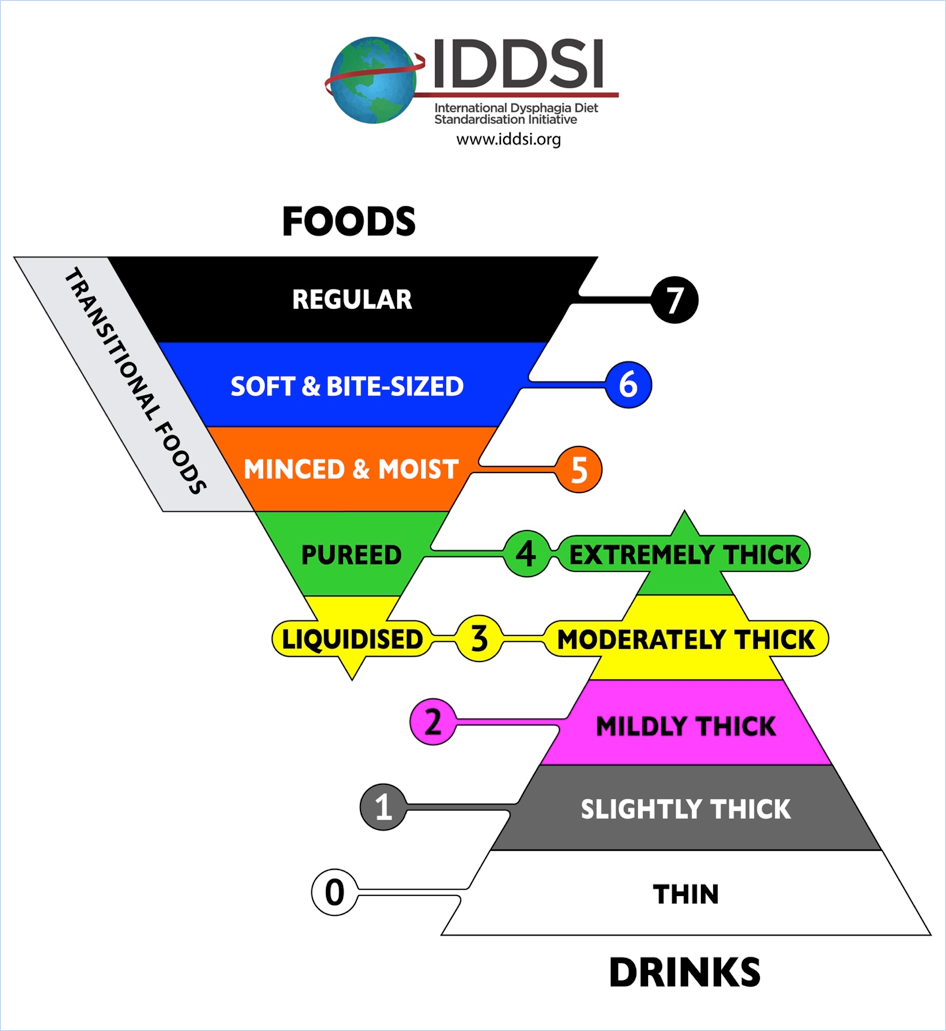
Regular Solids
no restrictions whatsoever, can eat whatever they want

Easy to Chew
one step below regular, still normal foods but cut up and softer; not all facilities use this
IDDSI page: Normal, everyday foods of soft/tender textures (boiled potato cut up, pasta noodles,

Soft and Bite Sized
can be smashed w/ fork, spoon, or chopsticks
knife not required to cut food
soft, tender, moist w/no separate think liquid; chewing still required, but biting is not required (still need tongue control and force to move it and mash)
salmon, fruits (peaches), boiled veggies (carrots)
Minced and moist/ground solids
finely minced, or chopped served in mildly, moderately or extremely thick, smooth, sauce or gravy
think moist ground beef
NO separate thick liquid (not a mixed consistency)
minimal chewing required, biting not required
actual tongue can smash and form it

Puree Solids (extremely thick liquid)
mashed potatoes, yogurt, anything puréed
Normally eaten w/ spoon (cannot be from cup or straw)
No chewing at all, no lumps,
can be piped, layered, b/c it retains its shape
if tongue control is sig. reduced, this category can be easiest to control; requires less propulsion effort than other levels,
Thin Liquids
water, soda, apple juice, you know what this is, flows like water

Slightly thick
normally see this for pediatric pts., not really adults (think baby formula)
not a recommendation for adults
Mildly thick (nectar thick)
can drink from straw (needs more effort)
pours quickly from spoon
are some naturally nectar thick (mango nectar, V8)→ has some viscosity to it, moves a bit slower than thin

Moderately thick (honey)
can be drunk from cup, maybe straw (like drinking milkshake from straw- a lot of pressure needed)
no chewing required
can be eaten with spoon but not fork
allows some time for oral control
does need some tongue propulsion
Extremely Thick/Pudding (pureed)
As thick as pudding
Can recommend a puréed and extremely thick diet; everything will be the same consistency
Flow test
Can do a flow test to know what consistency a liquid is
Pros/cons of thickened liquids
Pros:
Thicker liquids move slower→ good for delayed swallow trigger
Thicker liquids are easier to control orally
improved timing, control and sensation (more viscous, can feel it better)
Overall, CAN (not will) reduce the risk of aspiration for pt’s w/ dysphagia
Cons:
Often pt’s on thicker liquids consume less liquids than pt’s on thin liquids→ dehydration concerns
QOL impact → changes quality of life
Type of thickener and how much is used ~can ~impact absorption of medications
noncompliance to follow diet reccs (have to know if pt will actually comply)
not everything can be thickened→ some supplements cannot be safely thickened
Thicker does NOT equal Safer
If a pt coughs w/ thin liquids; but isnt coughing with nectar, does NOT automatically mean the pt is not aspirating nectar
It is WORSE to aspirate on Thickened liquids than thin liquids: more difficult to get out
is it ok to reccomend thickened liquids w/o instrumental (MBSS or FEES?)
some slps say yes, some say no; not always efficient/practical in every facility)
Different Postural Strategies (5)
change the position of the head, neck, or body to alter bolus movements or configuration of the swallowing structures
Head back posture
Chin tuck and neck flexion
head rotation
head tilt
side lying
Head Back
Tilting the head backward uses gravity to assist movement of the bolus towards the posterior oral cavity
Useful for: pt’s w/ oral structure deficits following sx who may have difficulty transporting the bolus posteriorly
Inappropriate for: if pt has difficulty controlling the bolus or initiating pharyngeal swallow→ gravity may move the bolus into the pharynx before the pt is ready to swallow
Chin Tuck & Neck Flexion
changes in head and neck position alter the configuration of oral and pharyngeal structures, which can chance how the bolus travels
different combinations of head and neck flexion can produce different anatomical outcomes
Useful for: Chin tuck benefits pt’s w/ delay in swallow trigger and/or reduced laryngeal elevation
Chin tuck is NOT universally effective
Head Rotation
Turning the head can redirect bolus flow and change pharyngeal mechanics
Head rotation:
increases pharyngeal contraction pressure on the side of ration
increases diamteter and duration of UES opening
closes off the pharynx on the side of rotation, directing bolus down the opposite side
Useful for: May be appropriate for pt’s with unilateral pharyngeal weakness or pharyngeal residue on one side
Direction of head turn matters: TURN TO WEAK SIDE ( so directs bolus to stronger side by closing off weak side?)
Side lying (questionable)
Potential strategy for pt’s w/ weak pharyngeal muscle function and residue throughout the pharynx
position can reduce the influence of gravity on residue movement and may reduce aspiration after swallow
evidence supporting this strategy is quite limited
Breath-holding for airway protection (also questionable)
deliberate breath holding before and during swallowing as a way to increase airway protection thru VF closure
NOT A TON OF RESEARCH FOR THIS
Sensory enhancement
Review

Mechanical assessment
if pt’s have glossectomy’s (parts of tongue removed) have hole in face, nothing rehab will help, permanent compensatory strategies may be used here
usually a given. if there is a hole in face, probably need mechanical assistance.

What do we do with all of this information (5 steps)
•Step 1: Identify the impairment
•What is happening during the swallow?
•Delayed initiation of the pharyngeal swallow.
•Reduced pharyngeal contraction.
•Difficulty transporting the bolus through the oral cavity.
•Impaired airway protection.
•Residue remaining in the pharynx.
•Step 2: Determine the physiological explanation
•Why is this impairment occurring?
•Ex: residue in the pharynx? à why? Reduce pharyngeal stripping wave?
•Step 3: Develop a Tx hypothesis
•Bc the pt demonstates X, I hypothesize that Y may improve the swallowing by Z
•Example: Because the patient demonstrates difficulty transporting the bolus posteriorly following oral surgery, I hypothesize that an appropriately selected head position (i.e., head back) may assist bolus movement through the oral cavity.
example #2: if pt has anterior spillage, I hypothesize thickened liquids may improve swallowing because of improved control of bolus
•Step 4: Evaluate the strategy
•Determine whether the strategy actually produces the intended result
•Have them complete the strategy while under fluoro/during a fees/while watching at bedside dependent on which is most appropriate
•Step 5: Evaluate the overall outcome
•Not just did this limit aspiration but, ask:
•Is swallowing safer?
•Is bolus clearance improved?
•Does residue increase or decrease?
•Is the strategy physically and cognitively feasible?
•Can the patient use it consistently? (Any physical or cognitive constraints?)
•Is there a less restrictive alternative?** want to always give least restrictive diet possible.
Case Study #1
•A 62-year-old patient s/p hemi glossectomy 2/2 lingual CA. The patient demonstrates difficulty transporting the bolus posteriorly.
•Which part of swallowing appears to be impaired? AP/bolus transport
•How might the structural change affect bolus transport? Tongue can’t push bolus back posteriosly, can’t make ramp, spillage (tongue can’t contain/hold bolus)
•What compensatory approaches might be considered? Head back
•What factors would determine whether a head-back posture is appropriate? Do they have a c-collar, can they physically do that, and does it actually help them!! test it out
•Why would it be important to assess the patient's pharyngeal swallowing function before selecting this strategy? If they have any pharyngeal issue, throwing stuff back won’t help, maybe then we try thickening liquids maybe that is better. good for oral phase deficiencies
note: diet modification is a compensatory strategy
Case study #2
A 70-year-old patient following a neurological injury demonstrates delayed initiation of the pharyngeal swallow and aspiration during an instrumental examination.
What additional information would you want from the instrumental examination? is it consistent, it it gross aspiration or just a little, what consistency are we aspirating on?
What physiological changes might a postural adjustment produce?
Will a chin tuck eliminate aspiration? if it is due to hyolaryngeal elevation can help
How might sensory characteristics of the bolus influence swallowing?
How would you determine whether a proposed strategy is effective? Try it! do it with a fees and see if works
Case study #3
A patient following a stroke demonstrates unilateral pharyngeal weakness and persistent residue in the pharynx.
How might unilateral weakness affect bolus clearance? affect constriction (stripping wave, can get stuck in pyriform sinuses)
What is the physiological rationale for considering head rotation? closing off weakside, so can’t be residue if it is closes
How could head rotation influence bolus flow?
What findings would indicate that the strategy was beneficial? Less pharyngeal residue
Why is it important to evaluate the effect rather than rely solely on the diagnosis of stroke?
Case Study #4
•A older adult pt demonstrates improved swallowing during a clinician-directed strategy trial but has difficulty remembering instructions and becomes fatigued during meals.
•Which patient factors are relevant to treatment selection? Fatigue, difficulty following instructions, probably won’t do rehab strategy bc of fatigue
•How should cognitive ability influence the plan?
•How should fatigue be considered?
•What would make a strategy practical or impractical outside the clinic?
•How might a caregiver support influence implementation?