Reproduction Variances and High Risk Maternal-Child
 Call Kai
 Learn
 Practice Test
 Spaced Repetition
 Match
 Flashcards
 Knowt Play
1/81

There's no tags or description
Looks like no tags are added yet.
82 Terms
Spontaneous Abortion
Termination of pregnancy before 20 weeks gestation. May occur before 4 wks
Incidence of Spontaneous Abortion
10-15% of confirmed pregnancies
Probably much higher may be as much as 40%
80% occur before 12 weeks gestation
Etiology Spontaneous Abortion
50% d/t chromosomal abnormalities
Medical disorders(DM, thyroid dz, Obesity
Environmental toxins, AMA,ETOH consumption & Caffeine
Recurrent Pregnancy Loss- 3 or more consecutive pregnancy losses
Threatened Spontaneous Abortion
Spotting of blood but cervical os is closed.

Inevitable Spontaneous Abortion
Moderate bleeding cervical os is open. Often accompanied by Rupture of membranes. Mild to severe uterine cramping may be present.

Incomplete Spontaneous Abortion
Moderate bleeding tissue may be present cervical os is open. Often involves expulsion of the fetus with retention of the placenta.

Complete Spontaneous Abortion
The cervix has closed and the fetal tissue has all been expelled. Mild to severe uterine cramping may be present.

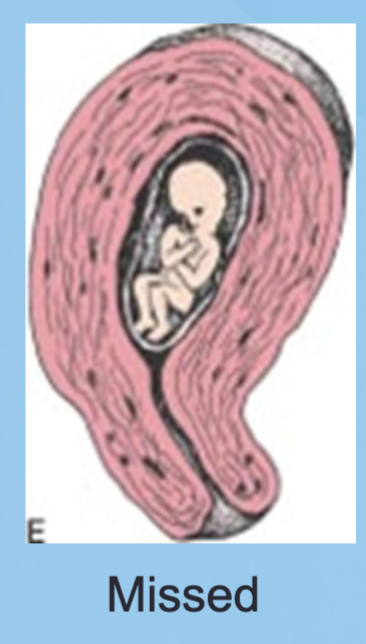
Missed miscarriage Spontaneous Abortion
A pregnancy where fetus has died and the products of conception are retained. May be no bleeding or cramping. Cervical os remains closed.
Care Assessment for Spontaneous Abortion
Pregnancy History & Vital signs
Abdominal pain/Cramping, bleeding
Speculum exam
Ultrasound
Psychosocial
Interventions for Spontaneous Abortion
Spontaneous expulsion vs. medical management vs Dilation & Evacuation-second trimester
Dilation &Curettage: uses vacuum aspiration and surgical instruments
Induction of labor with prostaglandins: Misoprostol
Rhogam if indicated
Psychosocial with grief care
Ectopic Pregnancy
Implantation of fertilized ovum in a site other than uterine lining
Incidence of Ectopic Pregnancy
2% of all pregnancies in US
3% of all pregnancy –related maternal deaths
Related to postpartum hemorrhage.
Leading cause of infertility
90% Occur in uterine tube
Risk Factors of Ectopic Pregnancy
Past surgery for prior tubal pregnancy
STI or other tubal infections
Smoking
Assisted reproductive technologies
Certain contraceptive methods such as IUD’s
Clinical Manifestation of Ectopic Pregnancy
Abdominal pain or Pelvic pain: Sharp cramp like pain on one side. If progresses: may ruptures and will have referred should pain-Shoulder pain due to diaphragmatic irritation
Delayed menses:1-2 weeks late
Abnormal vaginal bleeding (spotting): Lighter then usual & dark red or brown or irregular bleeding
Warning signs of Tubal Rupture
Tubal Rupture= Internal bleeding
Rigid & tender abdomen-Sudden severe pain
Syncope/dizziness
Shoulder tip pain-will have referred should pain- Shoulder pain due to diaphragmatic irritation
Hypovolemic Shock
Assessments for Ectopic Pregnancy
Last Normal Menstrual Period(LNMP)
Lab work- Hct and Hgb, HCG & progesterone level
Vaginal Bleeding: Pelvic exam with caution, ultrasound
Interventions for Ectopic Pregnancy
Pain Management
Methotrexate-educate
O.R.: salpingostomy vs salpingectomy
Rhogam if indicated
Hydatidiform Mole (Molar Pregnancy)
Gestational Trophoblastic Neoplasia; Pregnancy-related cancers w/o viable fetus
Incidence of Hydatidiform Mole (Molar Pregnancy)
1 in 1000 pregnancies
Asian, Hispanic & Native American higher
Cause Unknown-potential ovular defect, extreme age, nutritional deficiency
Clinical Manifestation of Hydatidiform Mole (Molar Pregnancy)
Presumptive signs of pregnancy-nausea and vomiting, large uterus
Early onset of Preeclampsia (prior to 24 weeks)
70% have signs and symptoms of preeclampsia
Vaginal Discharge “Prune Juice” or Bright Red= grape like-vesicles passing
Vaginal bleeding can be scant or large
Assessment of Hydatidiform Mole (Molar Pregnancy)
Transvaginal Ultrasound-snowstorm pattern-diffuse
HCG levels persistent higher than usual intrauterine mass with or without fetus
HCG levels start to lower after 100 days.
Intervention of Hydatidiform Mole (Molar Pregnancy)
Dilatation & Curettage
Hysterectomy if childbearing complete.
F/U for 1 year: HCG levels, pelvic exam, and work-up for invasive cancer metastasis
Placenta Previa
Placenta partially or completely covers cervical os
Incidence of Placenta Previa
1 in 200 pregnancies at term
Risk factors for Placenta Previa
Previous trauma/scarring to endometrial lining
Previous cesarean birth
Multiparity
Advanced maternal age (AMA)
Smoking
Living in higher altitude
Multiple gestation
Potential Outcomes of Placenta Previa
Mortality r/t maternal/fetal hemorrhage
Premature delivery
Cesarean delivery
Clinical Manifestation of Placenta Previa
Uterus is relaxed and non-tender
PAINLESS vaginal bleeding after 20 weeks
Bleeding may be bright red, intermittent or gushes
Bleeding has little relationship to activity
Placenta Previa Assessments
Ultrasound: NO VAGINAL/PELVIC EXAMS until Previa ruled out!
Placenta Previa Interventions
Depend on type of previa, gestational age, stability of maternal & fetus
Observation & Bedrest at home or hospital
Antenatal corticosteroids if <34 wks.
NST and/or BPP
Cesarean Birth
Abruptio Placentae
Premature detachment of part or all of the placenta from the implantation site
Abruptio Placentae Incidence
1% of all pregnancies and 1/3 of antepartum bleeding
Usually occurs after 20th week of pregnancy
High Incidence of reoccurrence
Risk factors for Abruptio Placentae
Hypertension
Multiple gestation
Trauma
Smoking, Cocaine
PPROM
Potential Outcomes for Abruptio Placentae
Hypovolemic shock
Hysterectomy
Fetal death likely if 50% or more placenta involved
Abruptio Placentae Clinical Manifestations
Usually no warning/sudden onset of pain
Hemorrhage may be hidden or visible
Uterus tender and hard “board-like”
Uterine tachysystole contractions
Fetal heart tones reflect uteroplacental insufficiency
Abruptio Placentae Assessments
Symptom history (uterine, fetal)
Ultrasound will dx 50%
Abruptio Placentae Interventions
Dependent on extent and maternal/fetal status
Corticosteroids <34 weeks
IV fluids & Oxygen
Hct & Hgb
Decide when/how to deliver
Postpartum Hemorrhage
Any cumulative blood loss >500 ml in a vaginal delivery or >1000ml in a Cesarean section or bleeding associated with S&S of hypovolemia within 24hrs of birth
Incidence of Postpartum Hemorrhage
3-5% of all pregnancies
EBL 50% often underestimated; Need to do QBL (quantified blood loss)
Four T’s Risk factors for Postpartum Hemorrhage
Tone: uterine atony most common cause- 70% of cases
Trauma: laceration, hematoma, inversion of uterus, rupture of uterus
Tissue: retained placental tissue or invasive placenta (placenta accreta, increta, percreta)
Thrombin: coagulopathy problem, inherited blood disorders, DIC
Risk factors for Postpartum Hemorrhage
Prolonged use of Oxytocin (Pitocin)
Prolonged labor
Use of Magnesium Sulfate or Terbutaline
Operative delivery-vacuum or forceps delivery
Chorioamnionitis
Macrosomia
Multiple gestation or grand multiparity
Placenta previa, abruption or retention
Shoulder Dystocia
Previous uterine surgery
Previous history of postpartum hemorrhage
Clinical Manifestation of Postpartum Hemorrhage
Clinical signs usually don’t appear till nearly 2L of blood loss
Assessments of Postpartum Hemorrhage
Frequent vital signs (tachycardia, hypotension –S&S for shock-clammy, pallor, dyspnea)
Shock Emergency can lead to death of organs
Fundal massage & Bladder assessment
Quantitative peripad/chux pad count/weight
Interventions for Postpartum Hemorrhage
Fundal Massage
Empty Bladder: consider straight cath or Foley as needed
Start large bore IV 16 or 18 Gauge for fluids, volume expanders & meds; Should have second IV site
Administer medications; Pitocin, Misoprostol, Methylergonovine (not with HTN), Carboprost ( not with asthma), TXA
Lab with Hct & Hgb, Plt, PTT; Type & Crossmatch for Blood as needed
Surgical
Emotional support
Bakri Balloon Purpose
Controls uterine bleeding through intrauterine balloon tamponade
How Bakri Balloon works
The balloon is placed inside the uterus and filled with sterile fluid,
creating outward pressure against the uterine wall to help control bleeding
JADA System Purpose
Controls postpartum bleeding caused by uterine atony
How JADA System works
Uses low-level intrauterine vacuum to encourage the uterus to collapse and contract, helping control bleeding
Early Postpartum Hemorrhage
first 24 hrs
Uterine Atony (most common)
Retained Placenta
Abnormal Placental attachment
(accreta, increate, precreta)
Lacerations/Episiotomy-
Hematomas, Ruptured Uterus Coagulation concerns
Late Postpartum Hemorrhage
after 24hrs to 6wks
Uterine Atony
Retained Placenta
Abnormal Placental attachment (accreta, increate, precreta)
Main goals for Hypertensive Disorders
Prevent eclampsia and enhance oxygenation and perfusion
Interventions for Hypertensive Disorders
Environment: quiet & non-stimulating
Seizure precautions
Medications
Hydralazine
Labetalol
Nifedipine
Magnesium Sulfate
Delivery
Hypertensive Disorders fetal monitor
Minimal variability, decrease in accelerations, late decelerations
outcomes of newborn with Hypertensive Disorders
Small for gestational size due to decrease in perfusion of nutrients and oxygenation
Eclampsia Premonitory signs & symptoms
Headache, vision changes, right upper quadrant pain
Magnesium Sulfate administration assessment
Respiratory assessment: Lungs sounds & Respiratory rate and Oxygen saturation
DTR’S
LOC
Urinary output
Blood Pressure
If still pregnant Fetal Assessment
Antidote to Magnesium Sulfate Toxicity
Calcium Gluconate
Preterm Labor
cervical change and uterine contractions occurring between 20 and 36 6/7th weeks of pregnancy
75% are spontaneous preterm birth occur with intact membranes with dilation or spontaneous rupture of membranes that lead to delivery.
25% indicated due to medical obstetric for mother, fetus or both.
Preterm Birth
any birth that occurs before the 37th completed week of pregnancy
Late Preterm Birth
any birth that occurs between 34 -36 wks gestation
Spontaneous Preterm Birth
occurs following an early initiation of the labor process
Indicated Preterm Birth
occurs to resolve maternal or fetal risk directly related to the continuation of the current pregnancy
Incidence of Preterm Labor
9.85% of all pregnancies in United states
Rates increasing due to fertility practices with multiple gestation pregnancies
African American 13.77%
Asian 8.63%
15 million/year preterm births worldwide
Spontaneous Risk Factors of Preterm Labor
Hx of UTI, Amnionitis, & Periodontal dz
African-American Race
Bleeding of uncertain origin
Hx of spontaneous preterm birth
Uterine Anomaly
Multifetal gestation & assisted reproduction technology
Late entry into prenatal care, BMI <19.6 and >30
Indicated Causes of Preterm Labor
Diabetes or GDM
Chronic HTN or Preeclampsia
Vertical c-section or placenta disorders
Advance maternal age
Medical disorders.
Fetal compromise of poor fetal growth, abnormal NST or BPP, Excessive or Inadequate amniotic fluid
Preterm Labor Assessments
All women should be considered at risk for preterm labor
Listen to complaints
Cervical length
Fetal Fibronectin Test- Negative more predictive no labor next 2 wks
Preterm Labor Interventions
Prevention: health promotion, progesterone supplement, pelvic rest
Early recognition of PTL: better neonate outcomes; Start antibiotics, Antenatal glucocorticoids, Magnesium sulfate
Tocolytics
Beta-Adrenergic agonist = Brethine (terbutaline): only for 24 hrs. Cardiac complications, hold if HR> 120
Prostaglandin synthetase Inhibitors= Indomethacin. Use only if <32 wks due to premature closure of PDA
Calcium Channel Blockers= Nifedipine
Antenatal Glucocorticoid Therapy
Betamethasone: stimulates/promotes fetal lung maturity. Increase hyperglycemia and infections
Premature (Prelabor) Rupture of Membranes (PROM)
Spontaneous rupture of the amniotic sac and leakage of amniotic fluid beginning before the onset of labor at any gestational age
Preterm Premature (Prelabor) Rupture of Membranes (PPROM)
membranes rupture before the 37 completed week of pregnancy
3% of all pregnancies
PROM/PPROM
Unknown in most cases
Most likely cause: pathologic weakening of the amniotic membranes caused by inflammation, stress from uterine contractions or other factors that cause increase intrauterine pressure.
Smoking
Infection: Chorioamnionitis- 25% of preterm births; UTI or Genital infections
Maternal Assessments for PROM/PPROM
Vitals
COAT
Color: Clear is expected. Note green/meconium, yellow, pink, or bloody fluid.
Odor: Normally mild or odorless. Foul-smelling fluid may indicate infection.
Amount: Document the amount of fluid: scant, small, moderate, large, or continuous leaking.
Time: Document the time the membranes ruptured. The longer the interval after rupture, the greater the concern for ascending infection.
Fetus Assessments for PROM/PPROM
Fetal monitoring (PROM), NST (PPROM)
BPP (PPROM)
Fetal movement (PPROM)
Interventions for PROM/PPROM
PROM- Augmentation
PPROM- Antibiotics, Glucocorticoids
Shoulder Dystocia
Fetus head is born but anterior should cannot pass under pubic arch
Incidence of Shoulder Dystocia
Up to 3% of all births
Has increased in recent years d/t larger birth & documentation
Risk factors for Shoulder Dystocia
Large Birth weight 4000 grams
Maternal pelvic abnormalities
Gestational DM
Hx Shoulder Dystocia
Prolong labor
Potential Outcomes of Shoulder Dystocia
Fetal Injury: Asphyxia, Clavicle Fracture, Brachial Plexus injury
Maternal Complications: PPH, Rectal injuries, PTSD
Clinical Manifestation of Shoulder Dystocia
Slowing The progress of the 2nd stage of labor
Formation of Caput Succedaneum that increases in sized
Retraction of the fetal head against the perineum immediately following its emergence “Turtle Sign”
Interventions for Shoulder Dystocia
“HELPERR”
Place stool at bedside
Assist with maternal positioning & provider with interventions
Documentation
Educate and reduce anxiety and fear in patient
Newborn & Maternal Assessment
HELPERR
Help: Call for additional assistance: OB provider, anesthesia, neonatal team, additional nurses
Evaluate for episiotomy: Consider if additional room is needed for internal maneuvers
Legs: McRoberts maneuver: hyperflex the mother's legs toward her abdomen
Pressure: Apply suprapubic pressure to dislodge the anterior shoulder
Enter: Perform internal rotational maneuvers, such as Rubin or Woods screw
Remove posterior arm: Deliver the posterior arm to reduce the shoulder-to-shoulder diameter
Roll: Move the patient onto hands and knees (gaskin maneuver)
Zavanelli Maneuver
Rare, Last-resort emergency maneuver for severe shoulder dystocia when standard maneuvers have failed.
The provider flexes and carefully replaces the delivered fetal head back into the vagina/uterus, followed by an emergency cesarean birth.
Only after other shoulder dystocia interventions—such as McRoberts, suprapubic pressure, internal rotational maneuvers, posterior arm delivery, and maternal repositioning—have been unsuccessful.
HIGH mortality rate