Full Chemistry Solutions Unit
 Call Kai
 Learn
 Practice Test
 Spaced Repetition
 Match
 Flashcards
 Knowt Play
1/39

Earn XP
Description and Tags
ignore the random ass images are just to keep me sane. i hope u like spamtenna
40 Terms

Concentration is…
the amount of solute relative to the amount of solvent

dilute means…
low solute, high solvent

concentrated means…
high solute, low solvent

There are three types of percent concentration…
Volume by volume (V by V), Mass by Volume (m/V), and Mass by Mass (m/m)

Concentration (little “c”) is…
ratio of quantity of solute to quantity of solution
Very low concentrations use…
Parts per million (ppm)

molarity is…
number of moles of solute per litre of solvent

Molarity formula
C = n/V

How to calculate the ions in a solution….
once you have the dissociation equation, you calculate it using the mole ratio (anion: negative ions and cation: positive ions.)

a solution of a known concentration is called a
standard solution

There are two ways to make a solution
Dissolve ( pure solute
in a certain volume of
solvent)
Dilute a standard solution

To prepare a solution of known concentration from a solid solute…
calculate the mass of a volume required to achieve a specific concentration and volume.

Procedure (to prepare a solution from a solid solute):
Measure ____ grams of (a specific solute)
Dissolve the solute in _____ mL of water (half the volume)
Transfer the solute to a ____mL volumetric flask
Swirl then fill the flask to ____mL (final volume) using a pipette, at eye level, then mix and cap.

dilution is…
decreasing the concentration by adding more solvent (water)

Dilution formula (the number of moles stays consistent)
Ci Vi = Cf Vf

Qualitative Analysis is…
is a process used to identify the presence of specific substances in solution, it identifies the amount of a specific substance too. There are different techniques used like ion colour, flame tests, and precipitation reactions.

Ion colour in solutions…
aqueous solutions of certain anions and cations have certain colours (which can be sued to identify if the solution contains that ion)

Flame tests are…
when metals have a certain flame colour when they’re heated, heat excites the electrons and moves them up an energy level, when they move back down they emit a visible light.

A precipitation reaction is…
a double replacement reaction where a solid is formed. You can add a known solution to an unknown solution to see if a precipitate forms.
All matter is…
either a pure substance or a mixture

Solutions are…
Homogenous mixtures (which have uniform composition), which means the different components are not visible. They’re also composed of at least one substance dissolved in another. (orange juice, steel, rain..)
Heterogenous mixtures are…
two r more substances that have non uniform composition. the parts of the substance are distinct and separatable. (sandwich, cereal in milk, blood…)

Colloids are…
when there are tiny insoluble particles in a substance that do not settle, and cant be filtered easily (like gelatin, milk, smoke…)
The solvent is…
the dissolver, and usually the substance present in the larger quantity.
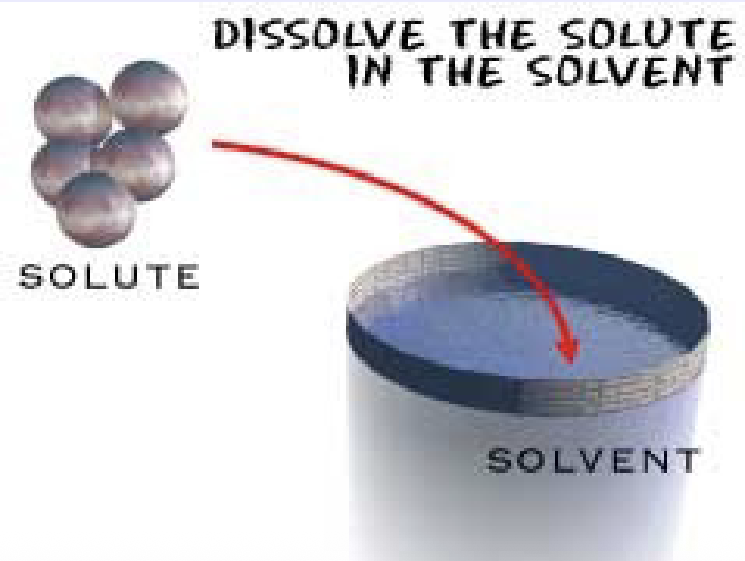

The solute is..
what is dissolved in the solvent.
An aqeous solution is…
any solution in which water s the solvent. Water is called the universal solvent.
the solubility of a solutions is…
the amount of a solute that dissolves in a given quantity of solvent at a given temperature

an unsaturated solutions is…
is a solution that does not have the maximum amount of solute dissolved in it
a saturated solution is…
is a solution that contains the maximum amount of a dissolved solute
at a given temperature (the solution may still be able to dissolve other solutes)

a supersaturated solution is…
a solution that contains more dissolved solute than its solubility at a given
temperature

A saturated solution is said t be in a state of equilibrium, equilibrium is when…
a process (dissolving) and the reverse process take (crystallization)
place at the same rate
As temperature increases, the solubility of a solid…
increases
the solubility of most liquids is
not affected by temperature or pressure.
as temperature increases, the solubility of a gas…
decreases.
as pressure increases, the solubility of a gas
increases.

When dissolving occurs, the bonds of a solid solute…
break, and the ions or molecules of the solute become attracted to the solvent particles.

The 3 processses of dissolving are..
bonds broken, always endothermic (requires energy)
IMFs broken between molecules, always endothermic
IMFs form between molecules or ions of the solute and solvent, always exothermic.
(the overall energy change in dissovling is equal to the sum of three steps, if more energy is released than required its exothermic; if less energy is released its endothermic)

Electrolytes (weak and strong) are..
aqueous solutions that conduct electricity (non-electrolytes dont conduct electricity)

dissociation occurs when..
ionic compounds break apart into their ions when they are dissolved in an aqueous solution. Dissociation are used ot show what happens to a substance when it’s put into water.

The tyndall effect is
when a beam of light is scattered by tiny particles in a colloid suspension.