Sepsis dr bay
 Call Kai
 Learn
 Practice Test
 Spaced Repetition
 Match
 Flashcards
 Knowt Play
1/83

There's no tags or description
Looks like no tags are added yet.
84 Terms
what are two types of inflammation
acute
chronic
what is acute inflammation
a short-term response to sudden body
damage
what does acute inflammation look like what are some examples?
Redness (erythema), swelling (edema), heat, pain (at site of injury), loss of function
cuts, wounds, allergy, muscle tears, microbial infections
what is Chronic inflammation
a long-term response lasting for prolonged periods (months to years)
what are causes of chronic inflammation
Diseases: arthritis, heart disease, Crohn’s/ Colitis, Lupus, etc
Acute inflammation Symptoms
redness
swelling
heat
pain
loss of function
chronic inflammation symptoms (6)
body pain
constant fatigue and insomnia
depression anxiety and mood disorders
problems with digestion
weight gain
frequent infections
what are the 3 most common causes of inflammation
• Microbial Infections → bacteria, viruses, parasites, fungi
• External injuries → cuts, wounds, tears, sprains
• Chemical or radiation exposure
what response does tissue injury trigger?
leukocyte activation:
• Leukocytes: are white blood cells (WBC)/ immune cells
made in bone marrow and found in the lymphatic system
what are two categories of Leukocytes
Agranulocytes
Granulocytes
what are examples of Agranulocytes (2)
Lymphocytes (T cells, B cells, NK cells) - (20-25% total WBCs
Monocytes (can develop into macrophages) - Macrophages +
Dendritic cells (3-8% total WBCs)
what are examples of Granulocytes
Basophil (0.5-1%)
Neutrophil (60-70%)
Eosinophils (2-4% WBC
what does neutrophils
Usually the first major WBCs recruited to sites of acute inflammation. They engulf and destroy microbes.
what does Macrophage do
Engulf pathogens, remove damaged cells and release inflammatory signals.
what does Basophils do
Release histamine and participate in allergic inflammation.
what does Eosinophils:
Important for parasitic infections and allergic responses.
what does Lymphocytes: do
Involved in immune defense, especially adaptive immunity through T cells and B cells.
what does an inflammatory response involve
involves a highly coordinated
network of many leukocytes of the innate immune system
• Activated macrophages, granulocytes, and neutrophils mediate
local responses to tissue damage and infection
• innate immunity is the body’s 1st line of defense against pathogens
and damage
• results in a non-specific immune response, including inflammation
How does inflammation begin?
When tissue is damaged, nearby cells release chemical signals that activate the immune system.
(histamines and prostaglandins) along with cytokines/
chemokines and growth factors that activate innate immune cells and result in eventual adaptive immunity
Innate vs. adaptive immunity
Innate immunity | Adaptive immunity |
|---|---|
First line of defense | More specialized defense |
Responds rapidly | Takes longer during first exposure |
Recognizes general danger patterns | Recognizes specific antigens |
Includes neutrophils and macrophages | Includes T cells and B cells |
No antigen-specific memory | Produces immunological memory |
when does Adaptive immunity activate
develops weeks after infection resulting in WBCs that recognize the infection → involved in vaccination- mediated immunity


How does acute inflammation happen?
Imagine you cut your finger and bacteria enter the wound.
Your body responds through several steps:

What is diapedesis?
Diapedesis is when white blood cells squeeze between endothelial cells to leave blood vessels and enter injured tissues.
what is Histamines and what molecule releases it
Histamines are chemicals released by mast cells,
which increase blood vessel permeability and
stimulate/ facilitate other WBCs to arrive
How does your body recognize injury?
PAMPs and DAMPs.
what is PAMPs
(Pathogen-Associated Molecular Patterns)
are small molecules often conserved on microbial surfaces that triggerinnate immune responses
what are Examples of PAMPS
• Bacterial: lipopolysaccharides, peptidoglycan, flagella, pilus, etc.
• Viral: spike proteins, capsid, glycoproteins, DNA/RNA
PAMPs = Pathogens.
what is DAMPs
(Damage-Associated Molecular Patterns)
molecules within damage or dying host cells that when released, trigger innate immune response
what are ex of DAMPS (2)
• E.g. Human cell nucleus has cytokine IL-1a, when a cell is damaged it is released and triggers innate immune responses
• E.g. Release of cell materials that are normally internalized: DNA, ATP, K+ ions, uric acid
what are PAMPs & DAMP recognized by
are recognized by monocyte Toll-like receptors (TLRs) and pattern recognition receptors (PRR
Mediators involved in leukocyte recruitment
In addition to histamines these also drive leukocyte recruitment
Prostaglandins
Platelet activating factor (PAF)
Thromboxane A2
Bradykinin
what are Prostaglandins
host-derived lipids made at sites of tissue damage or infection that control processes such as inflammation, blood flow, the formation of blood clots
what are Platelet activating factor (PAF)
is a potent phospholipid
activator that causes platelet aggregation, degranulation and
vasoconstrictor (narrowing of blood vessels
what is Thromboxane A2
a lipid vasoconstrictor released by
activated platelets that stimulates activation of new platelets
as well as increases platelet aggregation
what is Bradykinin
is a peptide that promotes inflammation by
causing arterioles to dilate and makes veins constrict
(increases capillary bed leakage
what are the main cells involved in phagocytosis
Macrophages
Neutrophils
Dendritic cells
How does phagocytosis work? (5)

what is Phagosome
Vesicle containing the engulfed pathogen.
what is Lysosome
Organelle containing digestive enzymes.
what is Phagolysosome:
Fusion of the phagosome and lysosome, where digestion occurs.
what is Neutrophil extracellular traps (NETs)
NETs are another way neutrophils defend your body against infections.
Instead of engulfing pathogens, neutrophils can release a web-like structure made of DNA and antimicrobial proteins.
how does NETS work
It releases DNA mixed with antimicrobial proteins.
The DNA forms a sticky web that traps pathogens.
The trapped pathogens can then be killed by antimicrobial substances and cleared by immune cells.
NET formation can involve neutrophil death (NETosis), although some NET release occurs without killing the neutrophil.
Important: NETs can also trap platelets and red blood cells, potentially promoting blood clot formation.

what leukyocytes are involved in wound healing
macrophages,
neutrophils, and fibrocytes
repair damaged tissues to
form scar tissue (fibrin)
Leukocyte wound healing = (hemostasis)
what chemical do they release to hasten that process
Release growth factors to stimulate tissues to regenerate, repair enzymes and recruit
fibrocytes for scar formation
Fibrocytes are cells involved in tissue repair, wound healing, and maintaining connective tissue.
For Diagnosis of acute inflammation what are factors you look at first
Acute inflammation is usually diagnosed through a patient's medical history, symptoms, and physical examination.
For non-obvious history/ symptoms tests may include (3)
Joint examination
Blood tests
X-rays
how does Joint examination work
for acute inflammation symptoms (to determine arthritis) → MRI, CT scans and X-rays
how can Blood tests help diagnose
to measure biomarkers → typically, done for
higher risk patients check for
C-reactive protein (CRP)
Erythrocyte sedimentation rate (ESR)
Erythrocyte sedimentation rate (ESR
measures how quickly red blood cells settle in a test tube
Low ESR: Usually indicates little or no systemic inflammation.
High ESR: Suggests inflammation may be present.
what is what is C-reactive protein (CRP)
a liver protein that increases in blood with inflammation
High CRP = Higher inflammation
Low CRP = little to no inflammation
how can X-rays help determine acute inflammation
are only used to determine muscle or bone damage (if it is suspected) as local inflammation cannot be confidently assessed on X-ray film
what are treatment methods for acute inflammation (4)
Ice/ cold compresses → reduces heat
Rest and immobilization of the injury → allows damaged area to heal/ clot
Wound care → purulent vs non-purulent care (see SSTI lecture)
Treatment with non-steroidal anti-inflammatory drugs
(NSAIDs) - reduces pain/ swelling
what do nsaids do
NSAIDs are inhibitors of cyclooxygenase (COX) enzymes that synthesize prostaglandins
when are Corticosteroid used
(cortisone, prednisone) are reserved for chronic inflammation treatments
what is sepsis
Sepsis is a life-threatening systemic (bloodstream) illness
attributed to a dysregulated host response to infection
It is a rapidly progressing disease that impacts multiple organ systems causing potentially irreversible organ shutdown
stats of sepsis

How does sepsis develop?
Sepsis is an inflammatory response caused by the body’s release of key cytokines

what are some pro inflammatory cytokines
Tumor necrosis
factor (TNF)
Interleukins
(IL)-1, IL-6, IL-
12
what are some Anti-inflammatory
Interleukin-1 receptor antagonist (IL-1RA), IL-4, IL-10
Sepsis definition
Life-threatening organ dysfunction caused by a dysregulated host response to infection Acute change in total SOFA score greater than or equal (>) 2 points
what is Septic shock and what are some key char
Septic shock is when sepsis becomes so severe that the patient's blood pressure remains dangerously low, even after receiving IV fluids.
Requires vasopressors: Medications such as norepinephrine constrict blood vessels to increase blood pressure.
Lactate >2 mmol/L: Indicates impaired tissue perfusion and/or altered metabolism, suggesting severe circulatory dysfunction.
Oliguria: Low urine output, which can indicate that the kidneys aren't receiving enough blood.
what is (SOFA
Sequential Organ Failure Assessment (SOFA) Score (0-4)
It evaluates how well six organ systems are functioning, including the lungs, kidneys, liver, brain, cardiovascular system and coagulation system.
what do Vasopressors do
Vasopressors are medications that increase blood pressure, mainly by constricting blood vessels.
Example: Norepinephrine is a commonly used first-line vasopressor in septic shock.
Why are they needed?
In septic shock, widespread vasodilation and vascular leakage can cause dangerously low blood pressure.
Vasopressors help restore blood pressure so vital organs receive adequate blood flow.
what is categorized as Hypotension
Systolic blood pressure below 90 mmHg.
Mean arterial pressure (MAP) below 70 mmHg.
what is Oliguria
low urinary output <400 mL/day or <20 mL/h
How is sepsis diagnosed?
Doctors first try to determine where the infection is coming from and which pathogen is responsible.
how do doctors do that?
Patient history: Previous infections, medical conditions, antibiotic use and possible exposures.
Physical examination: Looking for sources of infection, such as pneumonia, infected wounds or urinary tract infections.
Blood tests and cultures: Checking organ function and identifying potential pathogens.
Urinalysis: Looking for urinary infection or abnormalities that may suggest kidney problems.
what sofa score is considered severe
An acute increase in SOFA score of ≥2 points in a patient with suspected infection supports the diagnosis of sepsis.
increase mortality by 10%
what is The disadvantage in SOFA
requires laboratory results, such as platelet count, bilirubin and creatinine, so it takes longer to calculate.
what is Quick SOFA (qSOFA)
uses 3 elements (0-3), scores of greater than or equal to 2 need urgent care
what are the 3 elements needed for qSOFA
1. Rapid Respiratory rate ≥22 breaths/min, yes = 1
2. Altered mental status, yes = 1
3. Systolic blood pressure ≤ 100 mmHg, yes =1
In 2021 guidelines, sepsis qSOFA scores must be used
with one of the following scoring systems, name them
(NEWS
MEWS
SIRS
what is NEWS
UK system
• recorded next to the patient’s bed
• 7 parameters: respiratory rate, oxygen saturation, systolic
blood pressure, heart rate, level of consciousness, body
temperature, and oxygen supplementation
what is Modified Early Warning Result (MEWS) score
• Requires 5 parameters: blood pressure, heart rate,
respiratory rate, temperature, and level of consciousness
• A higher MEWS score indicates a higher risk of adverse outcomes
what is
Systemic inflammatory response syndrome (SIRS
Needs to satisfy two or more of the following signs to apply: abnormally high or low body temperature, a heart rate over 90 beats per minute, a respiratory rate over 20 breaths per minute, or an abnormal white blood cell count
what are initial Sepsis symptoms
general malaise or myalgia (muscle pain) and non- specific signs such as fever (or hypothermia), chills, tachycardia (heart rate >100 beats/min), tachypnea (abnormal breathing rate), or change in mental statu
symptoms of Progressive uncontrolled sepsis (septic shock)
• Arterial hypotension and oliguria, hyperventilation leading to respiratory alkalosis, hyperglycemia or hypoglycemia
• Hypoperfused (reduced blood flow) liver and kidneys results in elevated lactate levels which then contributes to metabolic acidosis
Pathogenesis of sepsis is ______ which begins
with the patient’s specific predisposition to infection
Multifactorial
who is it higher risk of sepsis
• Young <5 yrs and elderly >60 yrs high risk
• pre-existing conditions, co-morbidities
immunosuppressive diseases (eg. HIV)
Common pathogens causing sepsis from hospitalized blood work
Type | Important examples |
|---|---|
Gram-negative | E. coli, Klebsiella, Pseudomonas, Proteus, Enterobacter, Acinetobacter |
Gram-positive | Staphylococcus aureus (including MRSA), Streptococcus pneumoniae, Enterococcus |
Fungi | Candida albicans and other Candida species |
How is sepsis treated?
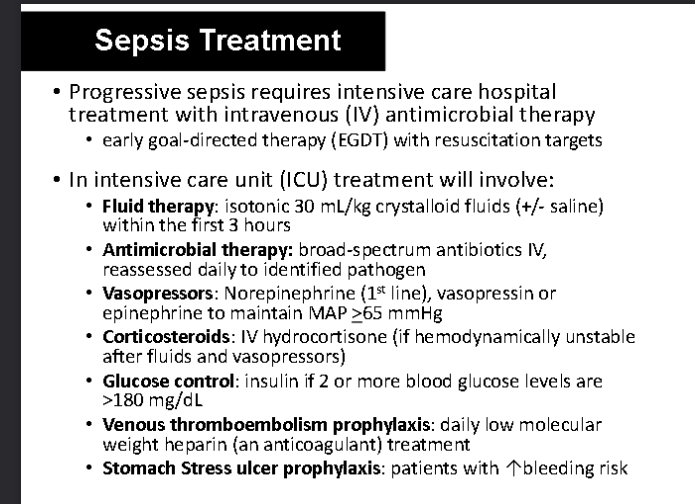
Progressive sepsis requires intensive care hospital treatment with intravenous (IV) antimicrobial therapy
• early goal-directed therapy (EGDT) with resuscitation target - Prevent further organ damage using supportive treatments.
In intensive care unit (ICU) treatment will involve? (7)
Fluid therapy
Antimicrobial therapy
Vasopressors
Corticosteroids
Glucose control
Venous thromboembolism prophylaxis
Stomach Stress ulcer prophylaxis
explain al 7