WEEK 1 LECTURE NOTES
 Call Kai
 Learn
 Practice Test
 Spaced Repetition
 Match
 Flashcards
 Knowt Play
1/41

There's no tags or description
Looks like no tags are added yet.
42 Terms
symporter vs antiporter
symporter - Moves two or more different molecules in the same direction across the membrane.
antiporter - Moves two or more different molecules in opposite directions across the membrane.
what do pumps do?
establish ion gradients!
higher extracellular concentrations of Na+, Ca2+, and Cl-
• higher intracellular concentrations of K+ and anions
what are the forces that drive ion movement?
chemical and electrical driving force
chemical driving force
diffuse down its concentration gradient (high to low)
electrical driving force
like charges repel, opposites attract
why does ion flow matter?
the flow of ions drives many important physiological processes, and predicting the directionality of ion flow allows us to infer function
membrane potential
a measure of the charge difference between the inside and outside of the cell.
what does a negative or positive membrane potential mean?
a negative membrane potential means the inside is more negative than the outside.
equilibrium potential
The membrane potential of an individual ion at which the chemical and electrical driving forces are equal and opposite
nernst equation
calculates the equilibrium potential (𝐸ion) of an ion.
→ Assumes that the plasma membrane is ONLY permeable to the ion under consideration, and not to any others

standard physiological concentrations

Goldman-Hodgkin-Katz (GHK) equation
calculates the membrane potential (𝑉m) for a cell that is permeable to multiple ions at a time

nuerotransmitters and their importance
released by the presynaptic neuron typically cause gated ion channels to open
in the membrane of the postsynaptic neuron.
how to predict driving forces and ion movement
compare the electrical and chemical driving forces and ions

how to predict overall direction of ion flow
opening an ion channel will drive the membrane potential towards that ion’s equilibrium

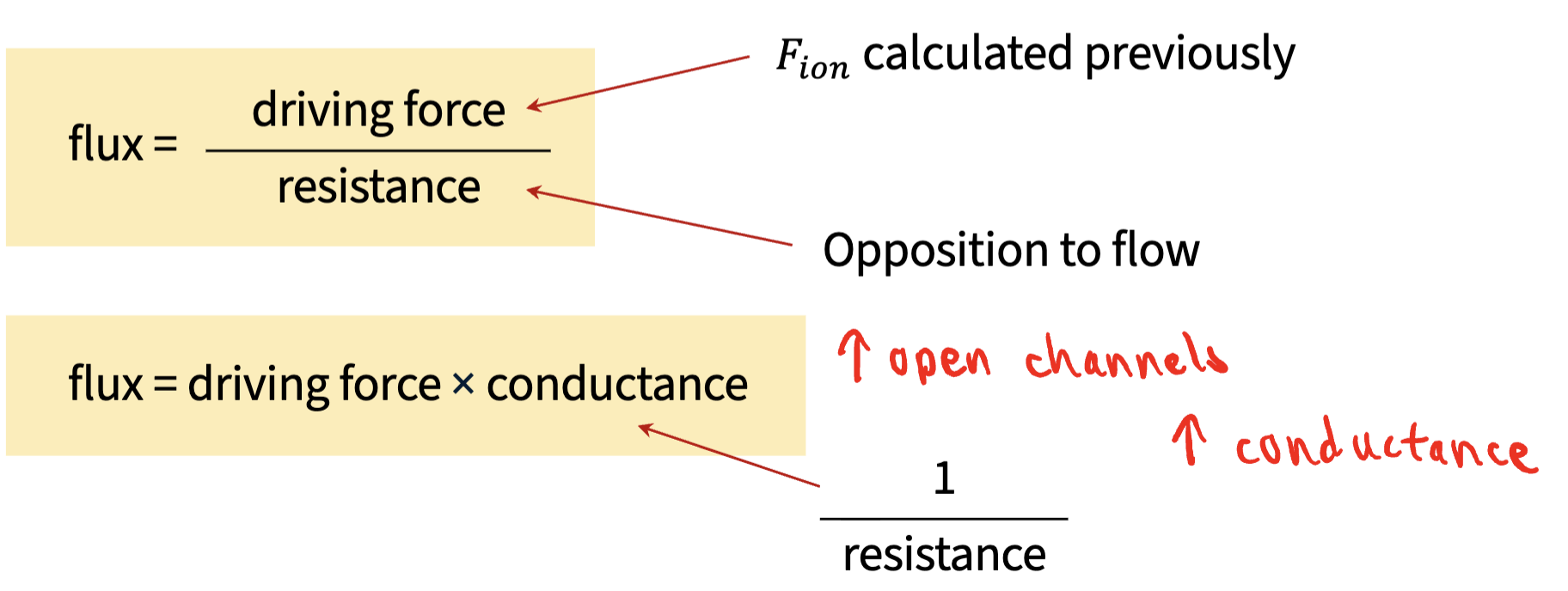
flux
the number of ions that cross the membrane per unit time
ohms law
the equation(s) to predict flux
depolarization
Making the membrane potential less negative, also called an excitatory post-synaptic
potential (EPSP)

hyperpolarization
Making the membrane potential more negative, also called an inhibitory post-synaptic
potential (IPSP)
graded potentials
short-distance, variable-strength local signals that occur in the dendrites and cell body
EPSPs and IPSPs
what does initial segment of axon do?
integrates all the graded potentials
spatial vs temporal summation
temporal - epsp summation over time
spatial - epsp summation over space

features of graded potentials
→ as graded potentials spread throughout the neuron, their amplitude decays
→ Graded potentials closer to the initial segment will more strongly influence
whether a neuron fires.
current leak
some ions leak out of the cell through leak channels
graded potentials + inital segment =
→ Graded potentials are summated at the initial segment.
→ If the initial segment reaches threshold, the neuron fires an action potential.
→ strong or weak EPSPs don’t matter as long as threshold is met
where are all channels located
ligand → cell body and dendrites
leak → everywhere
voltage gated → axon and initial segment
AP phases: before threshold
at rest

AP phases: depolarization phase
first stage, Na + channel opens and Na + enters, towards AP peak

AP phases: repolarization phase
second stage: Na + channel inactivates, K + channel opens and K + leaves cell

AP phases: hyperpolarization/undershoot phase
last stage: Na+ channel resets back to closed, K+ channel remains open, until closes after delay
absolute refractory period
a window of time in which is it physically impossible for that neuron to generate another action potential, even if depolarized back to threshold
→ na+ channels open, and then inactive,
relative refractory period
It is possible to generate another action potential, but a larger-than-usual stimulus
is needed. during hyperpolarization phase
how are AP’s conducted
Action potentials are conducted along the length of the axon.
→ They spread down the axon without any decay in amplitude
How do action potentials retain the same amplitude?
through continous conduction! When one segment of the axon fires an action potential, it depolarizes the next segment along so voltage-gated Na⁺ channels in the next segment reach threshold and fire an action potential
continous conduction
action potential is continuously regenerated at every point.

Why donʼt action potentials go backwards?
After one segment of axon generates an action potential, it becomes refractory.
→ The action potential can only spread forward, because the region behind it is refractory
myelin
a sheath of fatty insulation that is wrapped around axons
where is myelin made in PNS and CNS
PNS - schwann cells
CNS - oligondendrocytes
why is myelin useful in AP propogation
speeds up process
prevents current and ions from leaking out
nodes of ranvier
segments of myelin separated by gaps that contain voltage-gated Na+ channels
how are nodes and myelin useful?
When one node fires an action potential, the depolarization spreads to the next node.
→ Myelin prevents ions from leaking out between the nodes.
saltatory conduction
Action potential is regenerated from node to node.
