Biology A-Level #3: Enzymes
 Call Kai
 Learn
 Practice Test
 Spaced Repetition
 Match
 Flashcards
 Knowt Play
1/17

There's no tags or description
Looks like no tags are added yet.
18 Terms
What are enzymes?
Globular proteins that catalyze reactions inside cells (intracellular enzymes) or are secreted to catalyze reactions outside cells (extracellular enzymes)
What is the mode of enzyme action?
Enzymes have an active site where specific substrates bind forming an enzyme-substrate complex. The active site of an enzyme has a specific shape to fit a specific substrate. For a reaction to occur, there must be enough activation energy. The enzyme provides an alternative reaction pathway with a lower activation energy, increasing the rate of reaction. The substrate is converted into product(s), which are released from the active site, leaving the enzyme unchanged and able to catalyze another reaction.
What is enzyme specificity?
It is a result of the complementary nature between the shape of the active site and its substrate(s). The shape of the active site (and therefore the specificity of the enzyme) is determined by the complex tertiary structure of the protein that makes up the enzyme, which depends on the sequence of amino acids in the protein.
What is the lock-and-key hypothesis in enzyme specificity?
They are both rigid structures, the substrate is a complementary shape to the active site of the enzyme and fits exactly into the site, like a key going into a lock.
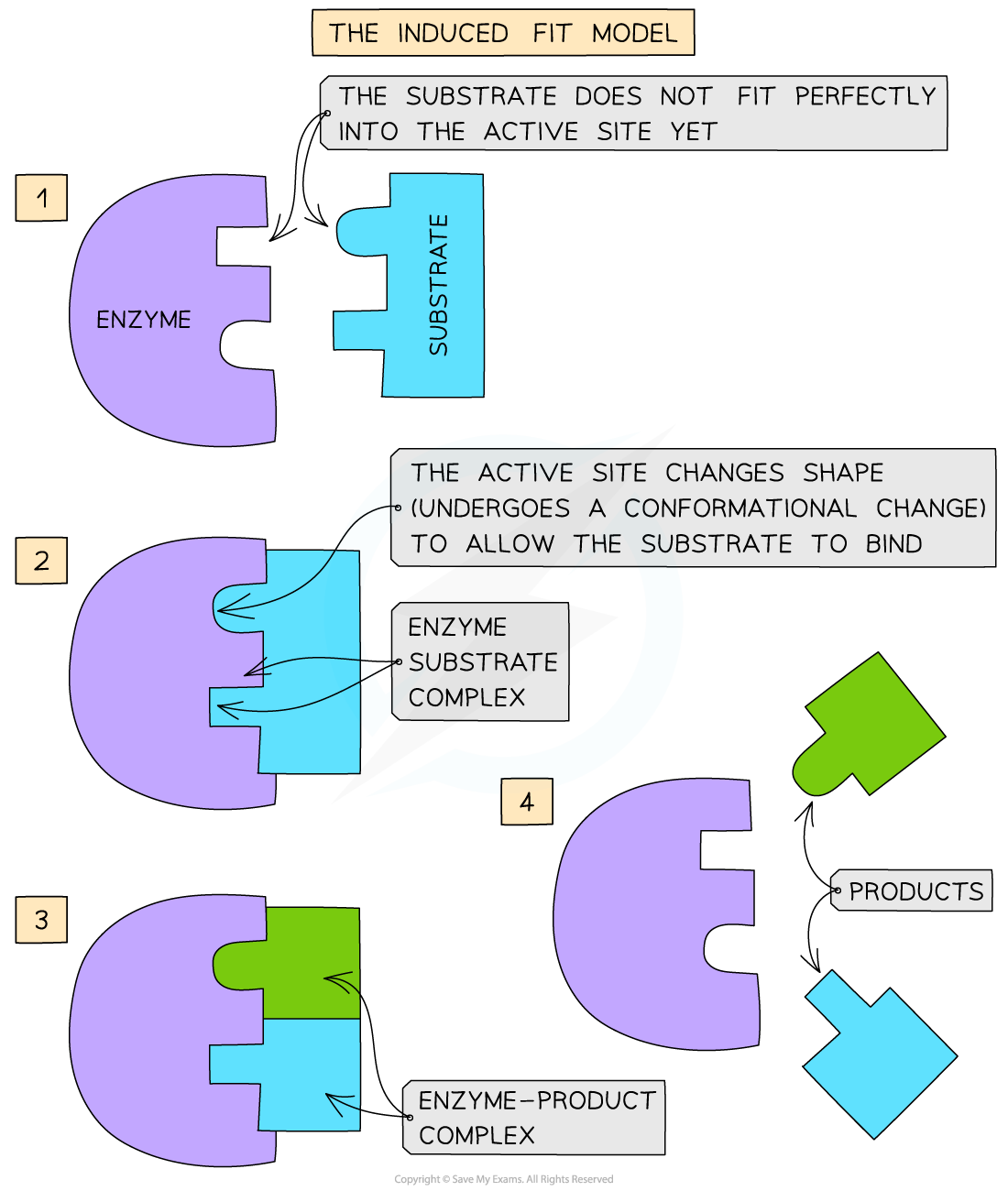
What is the induced fit hypothesis in enzyme specificity?
The enzyme and its active site (and sometimes the substrate) can change shape slightly as the substrate molecule enters the enzyme as they are not completely complementary to each other. These changes in shape are known as conformational changes, ensuring a perfect fit, maximizing the ability of the enzyme to catalyze the reaction.
How can we investigate the progress of enzyme-catalysed reactions?
By measuring the rates of formation of products using catalase and measuring the rates of disappearance of substrates using amylase.
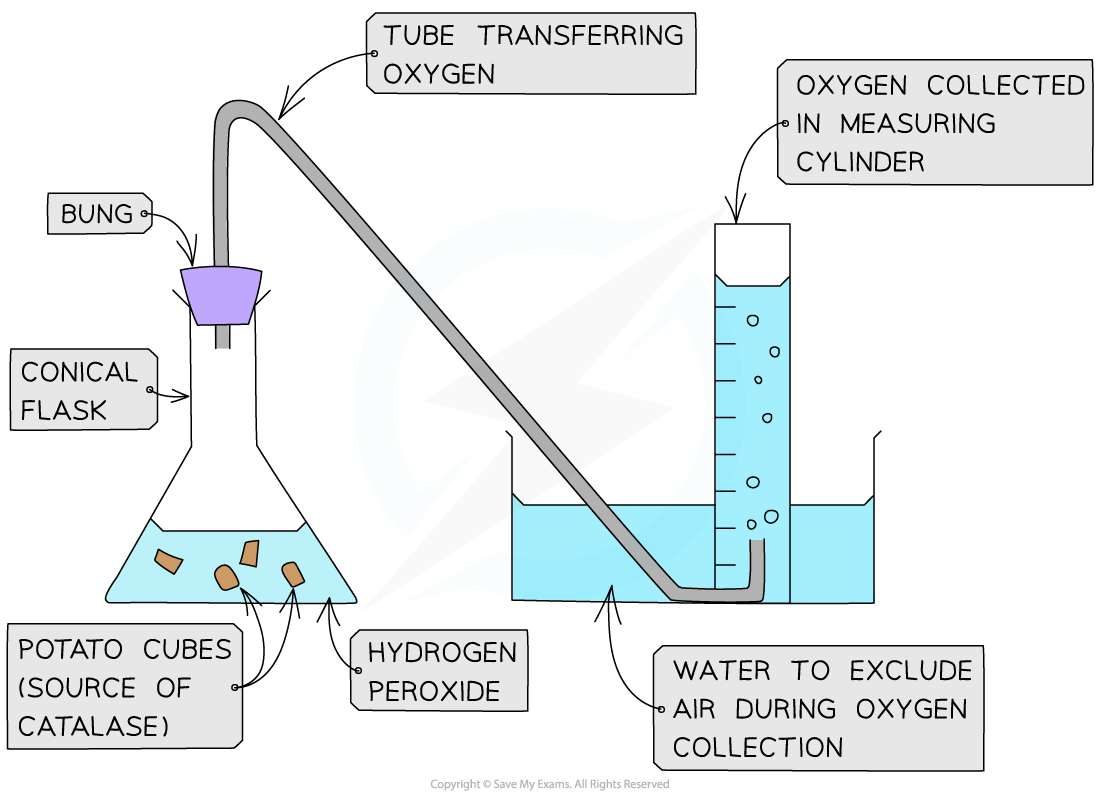
How do you investigate the progress of enzyme-catalysed reactions by measuring rates of formation of products using catalase?
Hydrogen peroxide is a common but toxic by-product of metabolism. This means it must be broken down quickly. Catalase is an enzyme found in the cells of most organisms that breaks hydrogen peroxide down into water and oxygen. Hydrogen peroxide and catalase are combined and the volume of oxygen generated is measured with a gas syringe at regular time intervals. The rate of reaction can then be calculated through Rate = Volume of O2 Produced/Time.
How can we investigate the progress of enzyme-catalysed reactions by measuring the rates of disappearance of substrate using amylase?
Amylase is a digestive enzyme that hydrolyses starch into maltose and glucose. Amylase functions best at pH 7 and 37oC . Amylase and starch are combined and this reaction mixture is then tested for starch at regular time intervals. This can be done by taking samples from the reaction mixture at each time interval and adding each sample to some iodine solution (starch forms a blue-black colour with this solution). In this way, the time taken for starch to be broken down can be measured.
What is the use of a colorimeter for measuring the progress of enzyme-catalysed reactions that involve color changes?
A colorimeter is able to measure light absorbance (how much light is absorbed) or light transmission (how much light passes through) a substance. Colorimetry can be used in any enzyme-catalysed reaction that involves color change. As the colour breaks down the transmission increases or light absorption decreases and this can be used to measure the rate of the reaction.
A blank is first used to zero the colorimeter. The enzyme and substrate are mixed to start the reaction, and samples are taken at regular time intervals. The absorbance of each sample is measured and recorded. A graph of absorbance against time is plotted, and the gradient of the initial linear section is calculated to determine the rate of reaction. An increase or decrease in absorbance indicates the formation or disappearance of the colored substance.
How does temperature affect enzyme-catalyzed reactions?
Enzymes have a specific optimum temperature at which they catalyze reactions at the maximum rate. At low temperatures, enzyme and substrate molecules have less kinetic energy and move more slowly, resulting in fewer successful collisions and fewer enzyme–substrate complexes forming, so the reaction rate is low. As temperature increases up to the optimum temperature, molecules gain kinetic energy and move faster, increasing the frequency of successful collisions and formation of enzyme–substrate complexes, so the rate increases. Above the optimum temperature, bonds maintaining the enzyme's tertiary structure begin to break, this permanently damages the active site, preventing the substrate from binding, causing the enzyme to become denatured and causing the reaction rate to decrease rapidly.
How does pH affect enzyme-catalyzed reactions?
All enzymes have a specific optimum pH at which they catalyze a reaction at the maximum rate. At extreme levels of pH cause the enzymes to denature. Below and above the optimum pH of an enzyme, solutions with an excess of H+ ions (acidic solutions) and OH- ions (alkaline solutions) can cause these bonds to break, altering the shape of the active site, which means enzyme-substrate complexes form less easily. Eventually, enzyme-substrate complexes can no longer form at all, meaning the enzyme has denatured. Buffer solutions can be used to measure the rate of reaction at different pH values. Buffer solutions each have a specific pH but they maintain this specific pH, even if the reaction taking place would otherwise cause the pH of the reaction mixture to change. A measured volume of the buffer solution is added to the reaction mixture. This same volume (of each buffer solution being used) should be added for each pH value that is being investigated
How does enzyme concentration affect enzyme-catalyzed reactions?
Enzyme concentration affects the rate of reaction because the higher the enzyme concentration in a reaction mixture, the greater the number of active sites available, meaning the greater the likelihood of enzyme-substrate complex formation. So as long as there is sufficient substrate available, the initial rate of reaction increases linearly with enzyme concentration. But if the amount of substrate is limited, at a certain point any further increase in enzyme concentration will not increase the reaction rate as the amount of substrate becomes a limiting factor.
How does substrate concentration affect enzyme-catalyzed reactions?
The greater the substrate concentration, the higher the rate of reaction as the number of substrate molecules increase, the likelihood of enzyme-substrate complex formation increases. If the enzyme concentration remains fixed but the amount of substrate is increased, past a certain point all available active sites eventually become saturated. When the active sites of the enzymes are all full, any substrate molecules that are added have nowhere to bind in order to form an enzyme-substrate complex, meaning the reaction rate will not increase any further until active sites become free again.

How does inhibitor concentration affect enzyme-catalyzed reactions?
There are 2 types of inhibitors, Competitive & Non-competitive. Competitive inhibitors have a similar shape to that of the substrate molecules, meaning they compete with the substrate for the active site. Non-competitive inhibitors bind to the enzyme at an alternative site, altering the shape of the active site, preventing the substrate from binding to it. Both types of inhibitors slow down or stop enzyme activity, reducing the rate of reaction.
For competitive inhibitors, countering the increase in inhibitor concentration by increasing the substrate concentration can increase the rate of reaction once more because more substrate molecules mean they are more likely to collide with enzymes and form enzyme-substrate complexes before the inhibitor can. But for non-competitive inhibitors, increasing the substrate concentration cannot increase the rate of reaction once more because the shape of the active site of the enzyme remains changed, so enzyme-substrate complexes are still unable to form despite the high number of substrate molecules present.
Explain that the maximum rate of reaction (Vmax) is used to derive the Michaelis–Menten constant (Km), which is used to compare the affinity of different enzymes for their substrates.
Vmax is the theoretical maximum rate of an enzyme controlled reaction, obtained when all the active sites of an enzyme are occupied. Km is the substrate concentration at which an enzyme works at half its maximum rate, used as a measure of the efficiency of an enzyme.
Km gives an indication of the enzyme's affinity for its substrate.
Low Km → high affinity
The enzyme reaches half of Vmax at a low substrate concentration.
So the enzyme doesn't need much substrate to work at a relatively high rate.
High Km → low affinity
The enzyme needs a higher substrate concentration to reach half of Vmax.
What are the effects of reversible inhibitors on enzyme activity?
Reversible inhibitors can act as regulators in metabolic pathways, as metabolic reactions must be very tightly controlled and balanced, so that no single enzyme can ‘run wild’ and continuously and uncontrollably generate more and more of a particular product. It can be controlled by using the end-product of a non-competitive, reversible inhibitor. As the enzyme converts substrate to product, the process is itself slowed down as the end-product of the reaction binds to an alternative site on the original enzyme, changing the shape of the active site and preventing the formation of further enzyme-substrate complex. The end-product can then detach from the enzyme and be used elsewhere, allowing the active site to reform and the enzyme's shape to return to an active state. This means that as product levels fall, the enzyme begins catalyzing the reaction once again, in a continuous feedback loop. This process is known as end-product inhibition.
What is the difference in activity between an enzyme immobilized in alginate and the same enzyme free in solution?
An immobilized enzyme are enzymes that have been bound to an inert, stationary and insoluble material such as alginate, whereas a free enzyme is dissolved directly in the reaction mixture.
What are the advantages of using immoblized enzymes?
There is no enzyme in the product (the product is uncontaminated) and therefore there is no need to further process or filter the end product.
The immobilised enzyme can be reused multiple times which is both efficient and cost-effective (enzymes are expensive).
Immobilised enzymes have a greater tolerance of temperature and pH changes (immobilisation often makes enzymes more stable).