Biology Midterm Exam
 Call Kai
 Learn
Learn Practice Test
 Spaced Repetition
 Match
Match Flashcards
 Knowt Play
1/127

Earn XP
Description and Tags
This overviews the three topics #1 Evoloution, #2 Lipids and Membrane Dynamics, and #3 Carbohydrates and Cell Structures
Name | Mastery | Learn | Test | Matching | Spaced | Call with Kai | Chat |
|---|
No analytics yet
Send a link to your students to track their progress
128 Terms
What are the unifying themes of biology?
Evolution
Organization
Information (genetic)
Energy
Interactions
Evolution
Through natural selection, species are able to adapt and survive to their environments.
Organization
Structures fit functions, which is in a species organization
Information
Genetic information, which is encoded in DNA, determines the appearance of a species
Energy
Energy flows one way from sun → plants → herbivore →carnivore … etc.
Matter cycles between species and environment.
Interactions
Within a system, species intract with other species and its enviroment
ex: prey and preditor
Properties of Life
Order
Evolutionary Adaptation
Regulation
Energy Processing
Growth and Development
Response to the Environment
Reproduction
Order
In a species, a highly ordered structure characterizes life.
Regulation
Regulation in a species, such as blood flow, water intake, etc.
helps maintain equilibrium
Evolutionary Adaptation
Adaptations evolve over generations by reproductive success of individuals with heritable traits which is best suited for their environments.
Reproduction
Organisms reproduce their own kind.
Response to the Environment
Organisms respond to stimuli (environmental)
ex: Venus flytrap closing to a bug being on its sensory portions of the plant, indicating food present.
Growth and Development
Inherited information carried by genes controls the pattern of growth and development in an organism.
Energy Processing
Obtaining “fuel” from something to use for regular functions
ex: eating before a run
Reductionism
Reducing complex systems to simpler components that are more manageable to study.
Powerfull strategy in Biology
Levels of Biological Organization
Biosphere
Ecosystems
Communities
Population
Organisms
Organs
Tissues
Cells
Organelles
Molecules
Biosphere
Consists of all life on Earth and places where life exists
most regions of land
most bodies of water
the atmosphere to an altitude of several kilometers
sediments below the ocean floor
Ecosystems
Consists of all living things in a particular area and all the nonliving components which life interacts with
ex: soil, water, atmospheric gases, light.
Communities
Array of organisms living in a particular ecosystem
Each forms of life belongs to a species
Populations
Consists of a species living within the bo9unds of a specified area
Organisms
Individual living things
ex: plant, animal, fungus, and bacterium..
Organ
A body part that is made up of multiple tissues and has specific functions in the body.
Tissues
A group of cells that work together, preforming a specific function.
Cells
Life’s fundamental unit of structure and function. Some have and are just one, others multiple.
Organelles
Various functional components present in cells (essentially the cell’s organs)
Molecules
A chemical structure consisting of two or more units called atoms.
Emergent Properties
Emerge from the arrangement and interaction of parts within a system
not unique to life
Novel Properties
Emerge at each level that are absent from the proceeding one.
ex: photosynthesis occurs in chloroplasts in plants, but wont occur in a test tube
Systems Biology
Exploration of a biological system by analyzing the various interactions between its parts.
Can be used to study life at all levels
Enables biologists to pose new questions
Are structure and function correlated at all?
Yes, structure and function of living organisms closely related.
The Cell theory
#1. All organisms are composed of one or more cells
Schleiden and Schwann (1838-39)
#2. The cell is the basic unit of life
Schleiden and Schwann (1838-39)
#3. All cells are produced by the division of preexisting cells
Virchow (1858)
All Cells…
Enclosed in a membrane
Use DNA as their genetic information
Eukaryotic cell
Has a membrane-enclosed organelles and is normally complex
largest is usually the nucleus
Typically big and round
Prokaryotic cell
Simpler, usually smaller, and doesn’t contain membrane-enclosed organelles.
has no nucleus

What type of cell is this?
Eukaryotic
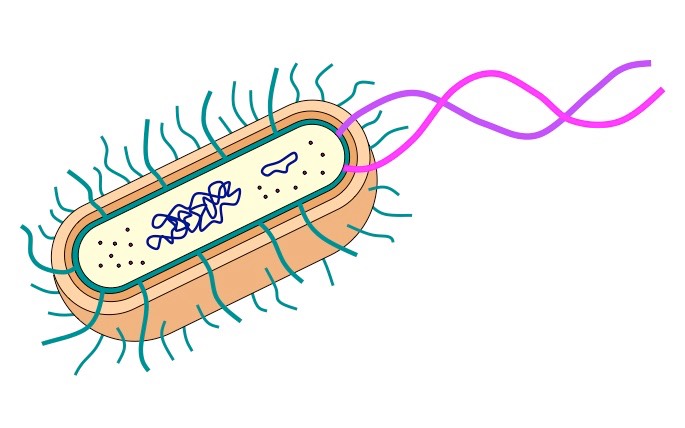
What type of cell is this?
Prokaryotic
Chromosomes contain what?
Most of the cell’s DNA (deoxyribonucleic acid)
The ability of cells to divide is the basis of ….
All reproduction
growth and repair
(Of multicellular organisms)
Genes
Contain information required for the synthesis of polypeptide chains and proteins within cells
Each chromosome has hundreds or thousands of
DNA function
Inherited by offspring from parents
Controls the development and maintenance of organisms
DNA structure
Made of two long chains that are arranged in a double helix
Each chain is made of chemical building blocs
These blocks are called nucleotides (A, G, C, T)
Gene Expression
The information in genes directs the manufacturing of cellular products in genes in this process…
In gene expression…
DNA is transcribed → RNA
RNA is translated → protein
Protien’s role in gene expression
It is involved in building, maintaining and preforming activities.
Genome
Organism’s entire set of genetic instructions.
Genomics
Study of whole sets of genes within and between species
Proteomics
Study of all the proteins encoded by a genome (called proteomes)
The Genomic approach depends on…
High technology → yields enormous amounts of data
Bioinformatics
Collaboration between interdisciplinary research teams
Bioinformatics
The use of computational tools to process a large volume of data
The input of energy from the sun and transformation of energy from one form to another make life…
Makes life possible.
When organisms use energy to preform work what type of energy is lost to the surroundings?
Heat energy
Energy flows through an ecosystem.. what does energy enter and exit as?
Light → Heat
Cells are able to coordinate various chemical pathways through what type of regulation?
Feedback Regulation
Feedback regulation
The output/product of a process that regulates that very process
Allows biological process to self-regulate
Common to all forms of life
Negative Feedback
The responce reduces the inital stimulus
Most common in living systems
Positive Feedback
Enhances initial stimulus
Interactions
Every organism interacts with other organisms and its environment ( including non-living factors)
Organisms and their environments are influenced
May be beneficial or harmful
Human Interactions
With the environment can result in harmful consequences
Generated CO2 stays in the atmosphere and contributes to major issues such as global warming
Global Warming is a major aspect of global climate change.
Why are there differences among species?
It is due to the accumulation of heritable changes.
Evolutionary mechanisms account for the unity and diversity of all species on Earth.
How many species have been identified and named to date?
1.8 million species.
Each year thousands more have been discovered
Each species is given a two-part name. How is the name formed? (What are the two components, list them in order)
#1. The name of the genus
#2. Unique to the species within that genus
What is the total number of species on Earth?
Around 10 million to over 100 million range.
Taxonomy
Branch of biology that names and classifies species into groups in an specific order.
Domain
Kingdom
Phylum
Class
Order
Family
Genus
Species
What are the three domains?
Domain Bacteria
Domain Archaea
Prokaryotic organisms
Domain Eukarya (Eukaryotic organisms)
What are the four subgroups of domain Eukarya?
Includes four subgroups
Kindom Plantae → Produce food via photosynthesis
Kindom Fungi → Absorb nutrients
Kindom Animalia → Ingest other organsisms as food (Herbivore, Carnivore, Omnivore)
Protisits (now split into several kindoms0 → Mostly single-celled, and are the most abundant eukaryotes
Domain Eukarya consists of…
Autotrophs
Heterotrophic fungi
Multicellular organisms that ingest other organisms
Mostly unicellular organisms and simple multicellular organisms
Autotrophs
Multicellular photosynthesizing land plants (make their own food).
Heterotopic
Absorb nutrients from outside.
What is the unity that underlies the diversity of life?
DNA is the universal genetic common to all organisms
In many structures of the cell, is found to be common
Charles Darwin
Published “The Origin of Species by Means of Natural Selection”
Theory explained the duality of unity and diversity
He made two main points
Decent with modification from common ancestors
Natural selection is the mechanism for decent with modification
Made observations, inferred, and named a process called Natural Selection
What was Charles Darwin’s Observations?
Individuals vary in traits, many of which are heritable
More offspring are produced than survive, competition is inevitable
Generally, species suit the environment they are in
What did Charles Darwin infer?
Those that are best suited to their environment are likely to survive, and reproduce.
Over time, individuals in a population will have advantageous traits
Why does evolution occur?
Due to the unequal reproductive success of individuals.
What does natural selection result in?
The adaptation of organisms to their environment.
The tree of life
Evolutionary relationships are often illustrated with a tree-like diagram, which starts with a common ancestor, branching off to the descendants.
Can be seen in body parts aswell
The forelimbs of a human, bat, horse etc. share a common skeletal architecture
Same structures, but have different functions
Fossils prove decent with modification
Evolution
Can be defined using “Decent with Modification” - Charles Darwin
Fossils
The remains/traces of organisms from the past
Typically found in sedimentary rock, appearing in layers of strata
Provide evidence (records)
The orgin, extinction and changes of species
Paleontology
Study of fossils
largely developed by Georges Cuvier (French Scientist)
Each boundary between strata was a sudden catastrophic event
What was Landmark’s hypothesis of evolution?
Species evolve through use and disuse of body parts and inheritance of acquired characteristics (later debunked)
ex: appendix; we have it but no longer use it
Charles Darwin’s voyage
Took place on the SMS Beagle
5-year around the world voyage
He collected specimens of South American plants and animals
Observed fossils resembled living species from nearby region
Observed the uplift of rocks
Went to the Galapagos Islands
Adaptations
Inherited characteristics of organisms that enhance their survival and reproduction in specific environments.
Origin of Species - Darwin and his three broad observations
Unity of life
Diversity of life
The match between organisms and enviorment
Artificial Selection
Humans modify other species by selecting and breeding individuals with desired traits
Darwin’s Observation and Inferences (there are two of each)
Observation #1: Members of a population vary in inherited traits
Observation #2: Species can produce more offspring than environment can support, which many offspring fail and die
Inference #1: Inherited traits give a higher probability of surviving and reproducing in a given environment, which tend to leave more offspring
Inference #2: Unequal ability of individuals to survive and reproduce lead to accumulation of favorable traits over generations
Key features of natural selection
Individuals don’t evolve; populations evolve over time
it can only increase/decrease heritable traits that vary in a population
Adaptations vary across different environments
Increases the frequency of alleles that enhance survival and reproduction
What are the four types of data that document the pattern of evolution?
Direct observations
Homology
Fossil record
Biogeography
Evolution of Drug-Resistant Bacteria
Staphylococcus aureus (S. aureus): commonly found on people
MRSA: a dangerous strain resistant to many antibiotics
Penicillin resistance developed in 1945
methicillin resistance developed in 1961
How it works:
Methicillin blocks a protein needed to build bacterial cell walls. MRSA uses a diffrent protien
Natural selection:
MRSA survives and reproduces when exposed to methicillin, while non-resistant bacteria are more likely to die
Homology
Similarity resulting from common ancestry
Homologous Structures
Anatomical resemblances representing variations on a structural theme present in a common ancestor
ex: batwing, human forelimb, horse leg are all examples
Vestigial Structures
What’s left of features that served significant functions for an organism’s ancestors
ex: Genes
Evolutionary Trees
Hypothesis about relationships among different groups
Convergent Evoloution
Evolution of similar, or analogous features in distinctly related groups.
Doesn’t provide information about ancestry
Why do analogous traits arise?
They arise when groups independently adapt to similar environments in similar ways.
Biogeography
Study of geographic distribution of species, providing evidence of evoution
What was the single continent, but was separated by a continental drift?
Pangaea
Relative Fitness
The contribution an individual makes to the gene pool of the next generation, relative to the contributions of other individuals
What are the three modes of selection?
Directional, Disruptive, and Stabilizing

Directional Selection
Favors individuals at one end of the phenotypic range

Disruptive Selection
Favors individule’s at both extremes at the phenotypic range

Stabilizing Selection
Favors intermediate variants and acts against extreme phenotypes