CHEM 321 Quiz 3
 Call Kai
 Learn
 Practice Test
 Spaced Repetition
 Match
 Flashcards
 Knowt Play
1/99

There's no tags or description
Looks like no tags are added yet.
100 Terms
what is Earths diameter?
12,756 km
what is the height of the atmosphere?
<100km
up to what height can humans live?
<8km
what are the regions of the atmosphere?
troposphere
stratosphere
mesosphere
tropopause
stratopause
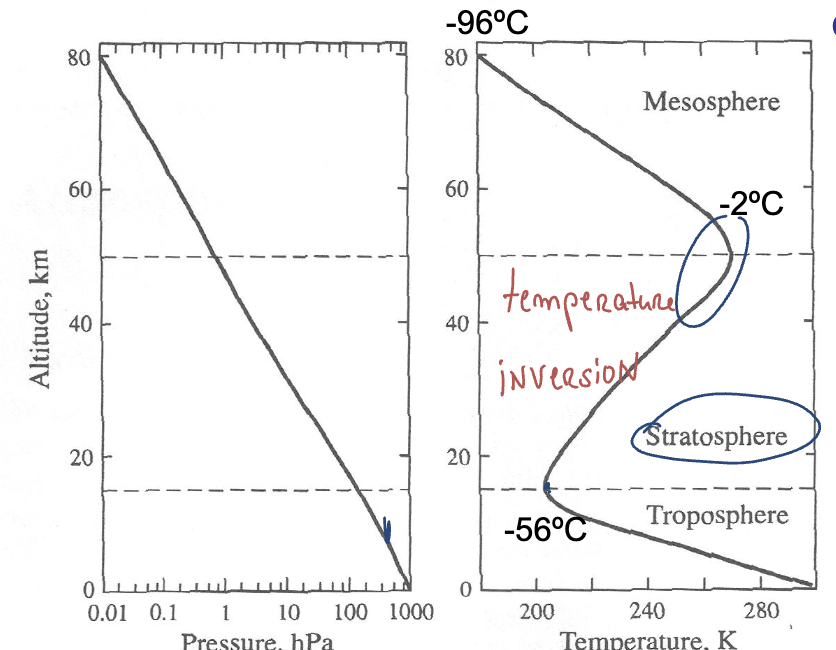
how does pressure change as we go up in space?
pressure continuously decreases as altitude increases
troposphere
0-12 km
15-18 km
humans live in 8km of it
tropopause
the boundary layer that separates the troposphere and stratosphere
contains 85% of atmospheric gas
-56 deg C
stratosphere
18-50 km
temperature ranges from -56 - -2 deg C
permanent temperature inversion
stratopause
~50 km in height
where the ozone layer is
-2 deg C
peak warmest (excluding atmosphere close to Earths surface)
mesosphere
50 - 80 km
50-100 deg C
temperature decreases as we go up atmosphere
why is it so warm at the stratopause?
because theres absorption of radiation
composition of the atmosphere

why is water not included in the standard atmosphere?
its too variable!
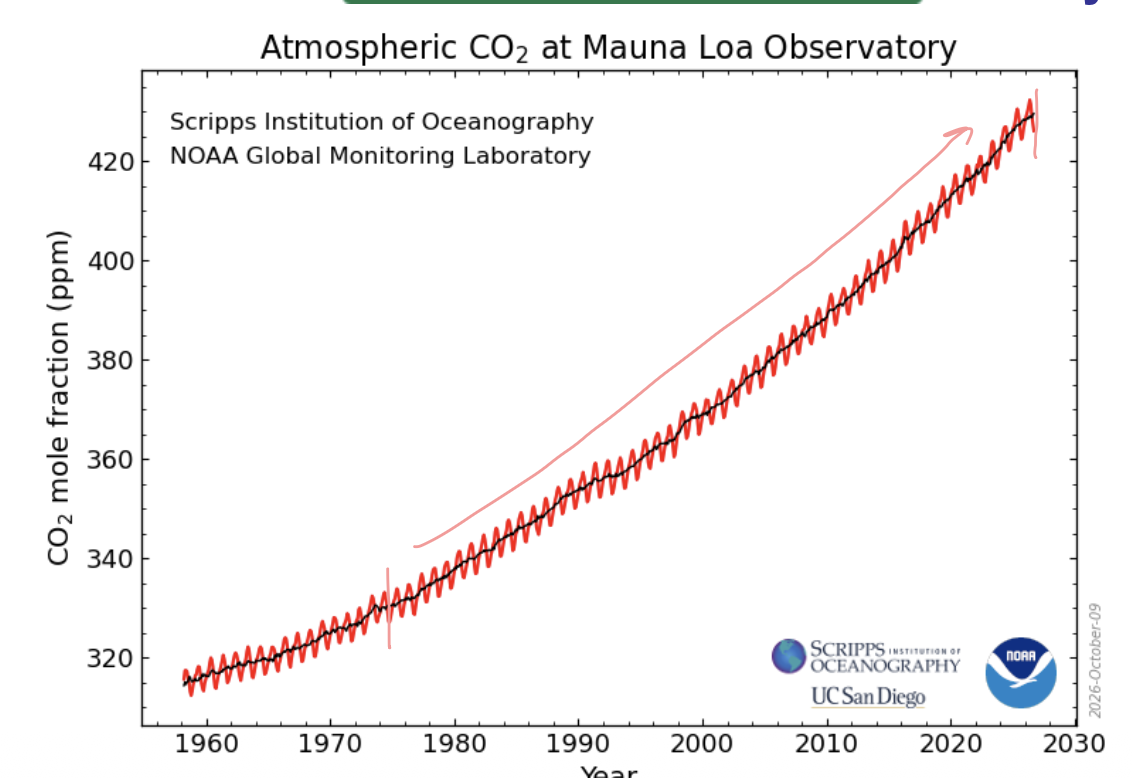
the mixing ratio of CO2 was 314 ppm in 1976, what is it today (2026)?
426.07
increase of 112 ppm in 50 years
in picture: theres a constant increase
distribution of water in the atmosphere depends on …
height!
distribution of water in the atmosphere - troposphere
up to several %
distribution of water in the atmosphere - tropopause
water vapour is contained here and does not go up to stratosphere
distribution of water in the atmosphere - stratosphere
no clouds here
because as warm, moist air from the troposphere rises (mostly via strong tropical convection), it cools down. By the time moisture reaches the top of the troposphere, the water vapor freezes into ice crystals and falls back down, leaving the air entering the stratosphere stripped of almost all moisture
VERY LITTLE water in the stratosphere!!
distribution of ozone in the atmosphere
almost no ozone in mesosphere (very minimal)
LOTS of ozone in the stratosphere = stratospheric “ozone layer”
25km above Earths surface
protects us from high solar radiations

electromagnetic radiation

as wavelength decrease…
energy increases
the major range has different effects on…
wavelengths
what effect does x-ray radiation have on molecules?
ionization (ejection of core electrons)
what effect does ultraviolet radiation have on molecules?
bonds break and molecules dissociate
(called ultraviolet because next to violet visible light!)
what effect does visible radiation have on molecules?
electronic transitions (movement of electrons between energy levels within a molecule)
rainbow!
what effect does infrared radiation have on molecules?
molecules vibrate = heat
(called infrared because next to red visible light!)
what effect does microwave radiation have on molecules?
molecules rotate
lights energy and wavelength - what was Albert Einsteins finding?
light can be considered not only a wave phenomenon but also to have particle-like properties in that it is absorbed (or emitted) by matter only in photons (aka finite packets)
lights energy and wavelength - the Einstein - Planck equation
E= hv = hc/λ
since λv = c
E = energy
v = frequency = hc/λ
h = Planck’s constant = 6.626 × 10^-34 J s
c = speed of light = 2.99 × 10^8 m/s
λ = wavelength
the shorter the wavelength of light, the …
greater the energy it may transfer to matter when absorbed
inverse relation
what is absorbed light?
lights energy is absorbed in the volume of the material
what is transmitted light?
light emerges propagating in the same direction as the incident light
what is scattered light?
light emerges in a different direction from the incident light
light pic

absorption of radiation by gases: beer-lambert law
I/I0 = e-σ x n x L
I = intensity transmitted
I0 = intensity of incident light
σ = absorption cross section (cm²/molecule) = the molecule property (the molecule absorbing the light)
n = number density of absorbing molecules (molecules/cm³) =. concentration
L = optical path length (cm)
e = euler’s number (=2.7182818)

what happens if you increase σ
more molecules absorb light more effectively = less transmitted light
what happens if you increase n?
more molecules are available to absorb light = less transmitted light
what happens if you increase L?
light travels through more gas = more opportunities for absorption = less transmitted light
scattering of radiation by gases: beer-lambert law: Rayleigh scattering
I/I0 = e-σ x n x L
I = intensity transmitted
I0 = intensity of incident light
σ = scattering cross section (cm²/molecule)
n = number density of molecules (molecules/cm³) =. concentration
L = optical path length (cm)
e = euler’s number (=2.7182818)
scattering of radiation by gases: at low wavelength…
light is scattered more efficiently than at high wavelengths
the sky is blue because blue is short wavelengths, meaning it scatters stronger
absorption and scattering of radiation by gases: beer-lambert law
I/I0 = e-(σabs x n + σraylaiegh x n ) x L
I = intensity transmitted
I0 = intensity of incident light
σabs = absorption cross section (cm²/molecule)
σrayleigh =scattering cross section (cm²/molecule)
n = number density of absorbing molecules (molecules/cm³) =. concentration
L = optical path length (cm)
e = euler’s number (=2.7182818)
solar radiation
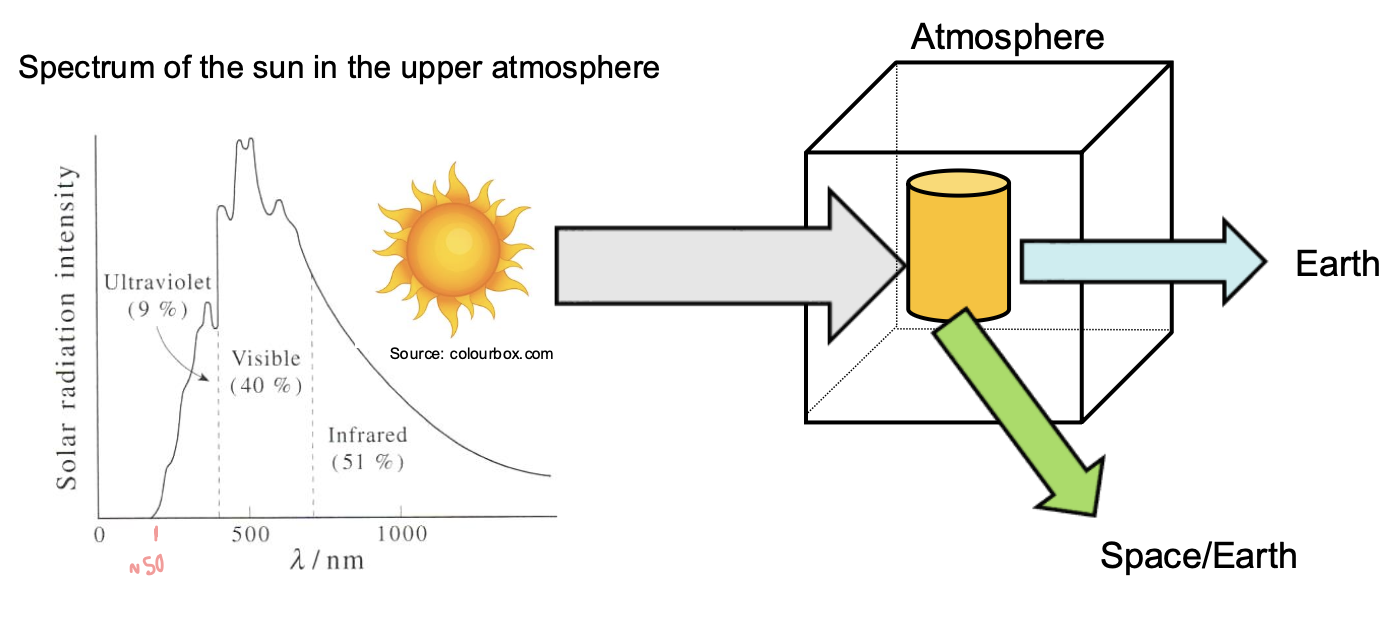
energy required to dissociate oxygen
O2 + hv → 2 O
what is the bond dissociation energy to convert O2 to 2 O
∆H rxn, 298K deg = 498.4 kJ/mol
minimum photon energy required to dissociate 1 molecule of O2 = 498,400 J/mol x (1 mol/6.023×1023 molecules) = 8.27 × 10⁻¹⁹ J/molecule
what is the minimum nm energy required to dissociate O2?
λmin = hc/E = [ (6.626×10⁻³⁴ J s) x (2.99 × 10⁸ m/s) ] / (8.27 × 10⁻¹⁹ J/molecule) = 240nm
absorption of radiation by O2
the minimum energy to dissociate O2 is 240nm
schumann - runge continuum/band and herzberg continuum:
O2 + hv → 2O
O + O2 (+M) → O3 (+M) + heat
M can be N2, H2O or O2 that carries away heat

absorption of radiation by O3
N and O in the upper atmosphere absorb high energy solar radiation, and as it does this, atomic O reacts in the atmosphere making O3
can effectively absorb between 200-290nm but not above 295!
resulting in a tail!
O3 +hv → O2 + O
sink of O3 in the upper atmosphere!

electromagnetic radiation: dissociation of O3 - what is the longest wavelength of light that has enough energy to dissociate 1 molecule of O3?
Bond dissociation energy = Hrxn,298K = 105 kJ mol-1
∆Hrxn,298K = 105,000 J / mol (1 mol / 6.023 x 10²³ molecules) = 1.74 x 10⁻¹⁹ J / molecule = minimum photon energy required to dissociate 1 molecule of O3
λmin = hc/E = [(6.626×10⁻³⁴ J s ) (2.99×10⁸ m /s )] / (1.74 10-19 J molecule-1) = 1.136 × 10 -6 m = 1136 nm = the minimum energy required to dissociate 1 molecule of O3
its in the infrared range! so not a lot of energy
the availability of light with sufficient photon energy is necessary, but…
not sufficient for a reaction to occur!
what are the requirements for O3 to dissociate?
sufficient energy required to bond dissociate
the target molecule must absorb light at the incident wavelength
do not see O3 dissociate above 295nm because it can’t absorb the light at that range!
absorption
M + photon → M* → reaction or M + photon or M +heat
absorption 2
atoms and molecules absorb light undergo a change in the organization of their electrons to an excited state M*
however, M* is unstable and returns to their ground state
ground state = the lowest energy arrangement of electrons
M* can undergo chemical reaction or release a photon or heat
absorption of radiation by N2, O2, and O3 in the upper atmosphere
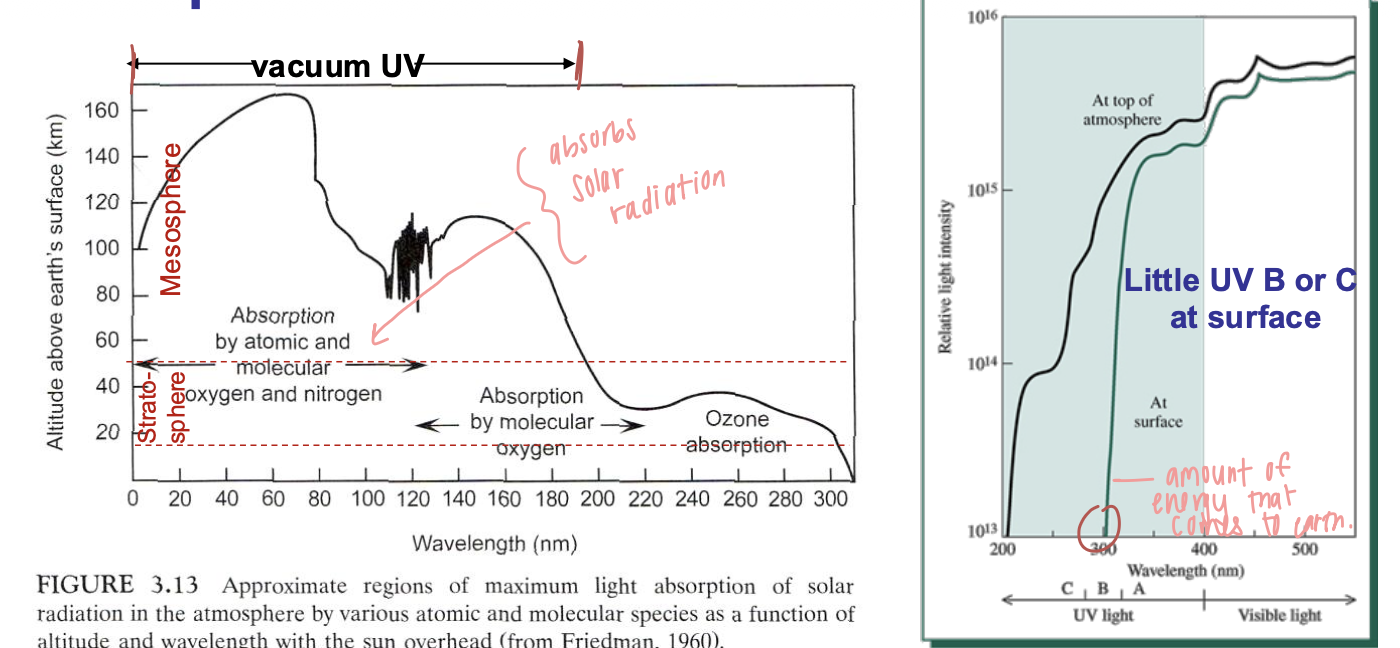
what if there was no O3 in the stratosphere (excess UV radiation)?
dna mutations, skin cancer (melanoma), death
cataracts
crop failure
what if there was no O3 in the stratosphere (excess UV radiation) - dna mutations
dna can absorb UV-B light
a 1% decrease in overhead ozone results in 2% increase of UV-B intensity at ground level
light skinned people maximum UV absorption from sunlight is at about 300nm

what if there was no O3 in the stratosphere (excess UV radiation) - skin cancer
skin cancer due to overexposure to UV-B light
highest incidence of malignant melanoma are US, Canada, South Africa, Australia, New Zealand, UK, western European countries and Scandinavia
incidence of malignant melanoma is function of latitude
sunscreen
full spectrum denotes UV-B and UV-A
they contain organic substances or particles (or both) that absorb or scatter light
zinc oxide and titanium dioxide are nanoparticles that appear transparent because of their small size
however, if they absorb light they can produce by-products
ex. for OH radicals titanium dioxide particles have coats to prevent by-products
sunscreen - what does SPF 15 mean?
15 minutes of protection against UV-B
sunscreen - what is the new effectiveness scale
rates effectiveness against UV-A
4 stars = highest protection (80%)
3 stars = high
2 stars =. medium
1 star = low
0 stars = no protection
what if there was no O3 in the stratosphere (excess UV radiation) - cataracts
front eye is exposed to uv light
the cornea and lens filter 99% UV light
absorption of UV can produce reactive molecules that attach to structural molecules in the eye and produce cataracts
can protect eyes with UV sunglasses (the goggles when you go skiing)
looks like an opaque glass and can’t see very well
what if there was no O3 in the stratosphere (excess UV radiation) - crop failure
UV-B exposure can affect photosynthesis to produce less leaf, seed, and fruit
what is a reaction mechanism?
a sequence of elementary reactions (or steps) by which overall chemical change occurs (and allows to deduce the rate law)
wat is a catalyst?
a molecule that lowers the reaction energy barrier (and speeds up the reaction) without being consumed (or created) in the net reaction
what is a catalytic cycle?
a reaction sequence in whihc a “chemical family” (catalyst) catalyzes a net reaction
the chapman mechanism
mechanism to explain stratospheric O3 concentrations
Ox ≡ O + O3 defines the “odd oxygen”
rationale: O3 and O interconvert more rapidly than they are produced or destroyed

the chapman mechanism 2 - P (formation)
the rate of formation of O atoms = 2k1[O2]+k3[O3]
look at the reactions where O is being produced (1 and 3)

the chapman mechanism 2 - L (destruction)
the rate of destruction of O atoms = k2[O2][M][O]+k4[O3][O]
look at the reactions where O is being consumed (2 and 4)
the chapman mechanism 2 - steady state
where [] stays constant over time
at steady state: rate of formation (P) = rate of destruction (L)
the chapman mechanism 2 - another way of steady state
d[O]/dt = 0 = P – L
=> 2k1[O2]+k3[O3] = k2[O2][M][O]+k4[O3][O]
solve for [O]
=> [O] = 2k1[O2]+k3[O3] / k2[O2][M]+k4[O3]
the chapman mechanism 3
d[Ox]/dt = d[O]/dt + d[O3]/dt
= rate of formation of O - rate of destruction of O + rate of formation of O3 - rate of destruction of O3
= 2k1[O2] + k3[O3] - k2[O][O2][M] - k4[O][O3] + k2[O][O2][M] - k3[O3] - k4[O][O3]
= 2k1[O2] - 2k4[O][O3] = 0
concentration of Ox = 0 and does not change over time
input
[O] = 2k1[O2]+k3[O3] / k2[O2][M]+k4[O3] to 2k1[O2] - 2k4[O][O3]
and solve for [O3]:
[O3]2 = k1/k3 k2/k4 [M][O2]2
the chapman mechanism ___ predicts ____
qualitatively, altitude dependence of O3
in pic: high at high altitude but goes to 0 because there is no light/ electromagnetic radiation as it approaches Earth
1 and 3 are dependent on light in the atmosphere

why does k1 = 0 s-1 at the surface?
in pic: high at high altitude but goes to 0 because there is no light/ electromagnetic radiation as it approaches Earth
1 and 3 are dependent on light in the atmosphere
why does the chapman mechanism predict more ozone than actually exists?
formation is overestimates
or
destruction is underestimates
and
there are additional reactions that destroy ozone (sinks) that the chapman doesn’t include

what are the 3 main catalytic cycles that cuase stratospheric O3 depletion
OH (hydroxyl radical)
NO (nitric oxide radical)
reactive halogen radicals (Cl, Br)
what are the catalyst formations (initiation) ?
OH: H2O + O → 2 OH
NO: N2O + O → 2 NO
halogen: CH3Cl → Cl + CH3
hv
the general mechanism for catalytic processes destroying stratospheric O3

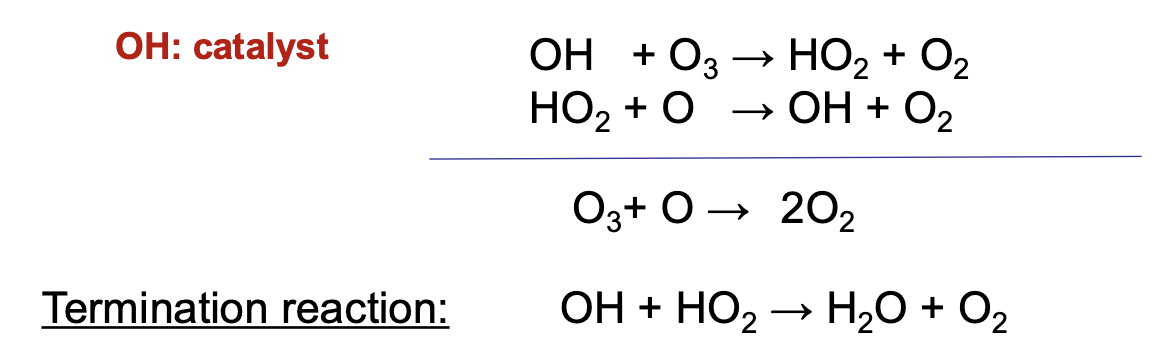
hydroxyl radical mechanism
the termination reaction is what forms if the reaction O3 +O → 2O2 keeps happening and reacts with the intermediate HO2
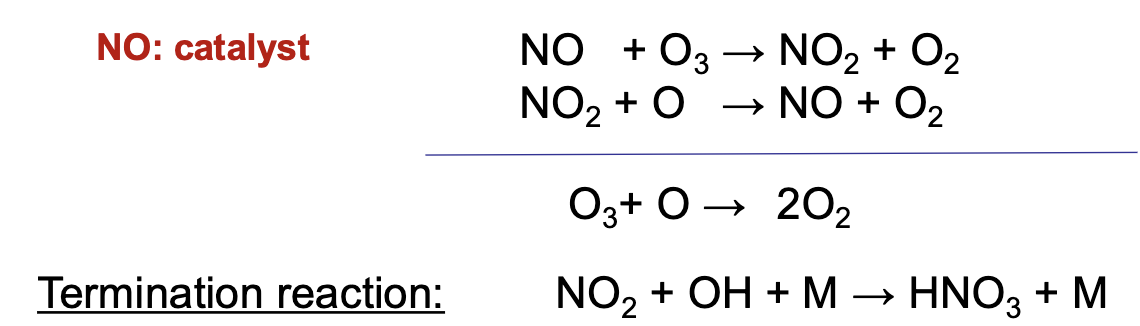
nitric oxide radicals
the termination reaction is what forms if the reaction O3 +O → 2O2 keeps happening and reacts with the intermediate NO2 reacts with OH
halogen radicals mechanism (Cl or Br)
inactive gases can be activated again to go to this reaction again:
Cl + O3 → ClO + O2
ClO + O → Cl + O2

O and O2 in the atmosphere
upper atmosphere: [O] » [O2]
high energy UV light reaches upper
oxygen molecules absorb this energy
energy breaks O2 bond
2 separate oxygen atoms form
= photodissociation
middle: [O] = [O2]
lower atmosphere: [O] < [O2]

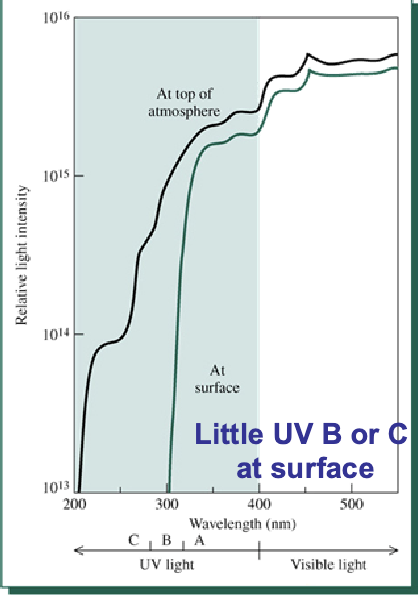
why does sunlight penetrate to different altitudes?
Type of radiation | Wavelength shown | How far it penetrates |
|---|---|---|
High-energy UV | Below 100 nm | Mainly absorbed in the upper atmosphere |
UV | 200–330 nm | Absorbed at various altitudes, especially by O₂ and O₃ |
Longer-wavelength UV, visible and infrared | Above 330 nm | Much of it reaches Earth's surface |
short wavelength UV is more energetic and gets abosorbed high in the atmosphere
black line = solar radiation at the top of atmosphere
green line = solar radiation that reaches Earths surface
radiation lost from the direct incoming sunlight through atmospheric process especially absorption
atmosphere acts like a natural UV filter
lines get closer together in visible light region
what are reservoir species?
they are catalytically inactive molecules containing chlorine, present in the stratosphere
stratospheric chlorine is tied up in the form of ___
reservoir species such as chlorine nitrate (ClNO3) and hydrochloric acid (HCl)
reservoir species life spans
relative long0lived
they ‘tie up’ large amounts of active (short-lived) species but can slowly re-release them when activated
chlorofluorocarbons (CFCs)
compounds containing only C, F, and Cl
nontoxic
nonflammable
volatile
non-bioaccumulative
inert
lifetime of 52-640+ years
widely used since the 1940s in fridges and spray cans
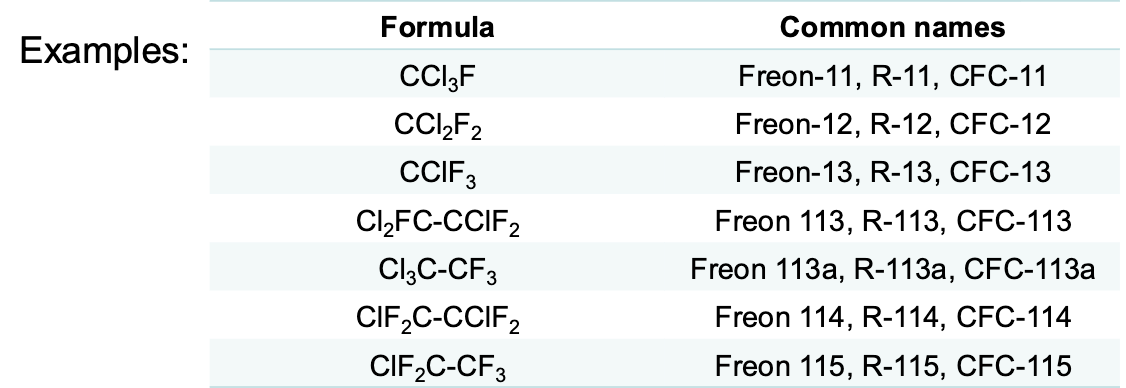
warning about CFCs in 1974
the solution to pollution was dilution
CFCs did that and spread all over the globe
but lack of tropospheric sinks (long lifetimes) meant that they eventually reached the stratosphere
in the stratosphere CFCs would photo-dissociate because of the significant amounts of UV light
CFCs are a source of reactive chlorine in the stratosphere and predicted catalytic ozone depletion
CF2Cl →CF2Cl +Cl
first observation of polar stratospheric O3 loss (1985)
large losses of total ozone in Antartica reveal seasonal ClOx/NOx interaction
first observation of polar stratospheric O3 loss (mid 1990s)
O3 depletion extended form the poles to Australia and New Zealand in the South and Canada and Russia in the North

ozone depletion graph
left:
during winter
temp is very cold
polar stratospheric clouds form
chemical reactions on these clouds convert inactive chlorine compounds into forms that can release reactive chlorine
when spring arrives
sunlight retuns
sunlight break apart chlorine-containing molecules, releasing reactive chlorine
chlorine radicals catalytically destroy ozone
= ozone depleted region
right:
ozone in 1993 < ozone in 1980-1982
reductions in stratospheric ozone were also observed at lower latitudes (outside of Antartica)
what catalytic cycles contribute to stratospheric O3 loss?
all of them !
HOx, Clx, NOx, and Ox are all involved
thie relative contributions change with altiitude

HOx cycles
contribution is particularly important in the middle and upper stratosphere
Clx cycles