Canada's Food Guide
 Call Kai
 Learn
Learn Practice Test
 Spaced Repetition
 Match
Match Flashcards
 Knowt Play
1/32

There's no tags or description
Looks like no tags are added yet.
Name | Mastery | Learn | Test | Matching | Spaced | Call with Kai | Chat |
|---|
No analytics yet
Send a link to your students to track their progress
33 Terms
What 3 pieces of information were used to make a new food guide
For population: dietary needs, health and well-being, food accessibility and supply chain (what is locally available)
It is for the entire population of Canada
Areas of concern for the Canadian 2019 Food Guide (4)
CVD, cancers, diabetes, and osteoporosis
Strengthened recommendations from rainbow 2007 food guide > 2019 (define and 2 examples)
Existed in the 2007 guideline but recommended even more now due to more evidence
↑ Fruit + vegetables = ↓ CVD risk, ↓ cancer risk
↑ Dietary fibre = ↓ CVD risk, ↓ cancer risk
New recommendations based on new findings not in previous 2007 food guide (2)
↑ glycemic index or load = ↑ risk of T2DM
↑ sugar-sweetened beverages = ↑ dental cavities in children
Why do these guidelines take so long to come out
Evidence must be solid
Does the current food guide use food groups?
NO - more geared towards macronutrients
More streamlined recommendations (proportional plate model) focused on nutrients in food vs. an arbitrary number of types of food to consume.
Dairy is reclassified as a protein-rich food, along with a general recommendation to consume more plant-based protein sources.
Are serving sizes recommended for specific foods in the new guide?
NO
replaced by “proportional plate” model
Big idea of 2019 guideline
Proportional plate model (pie chart) – relative proportions that are suggested
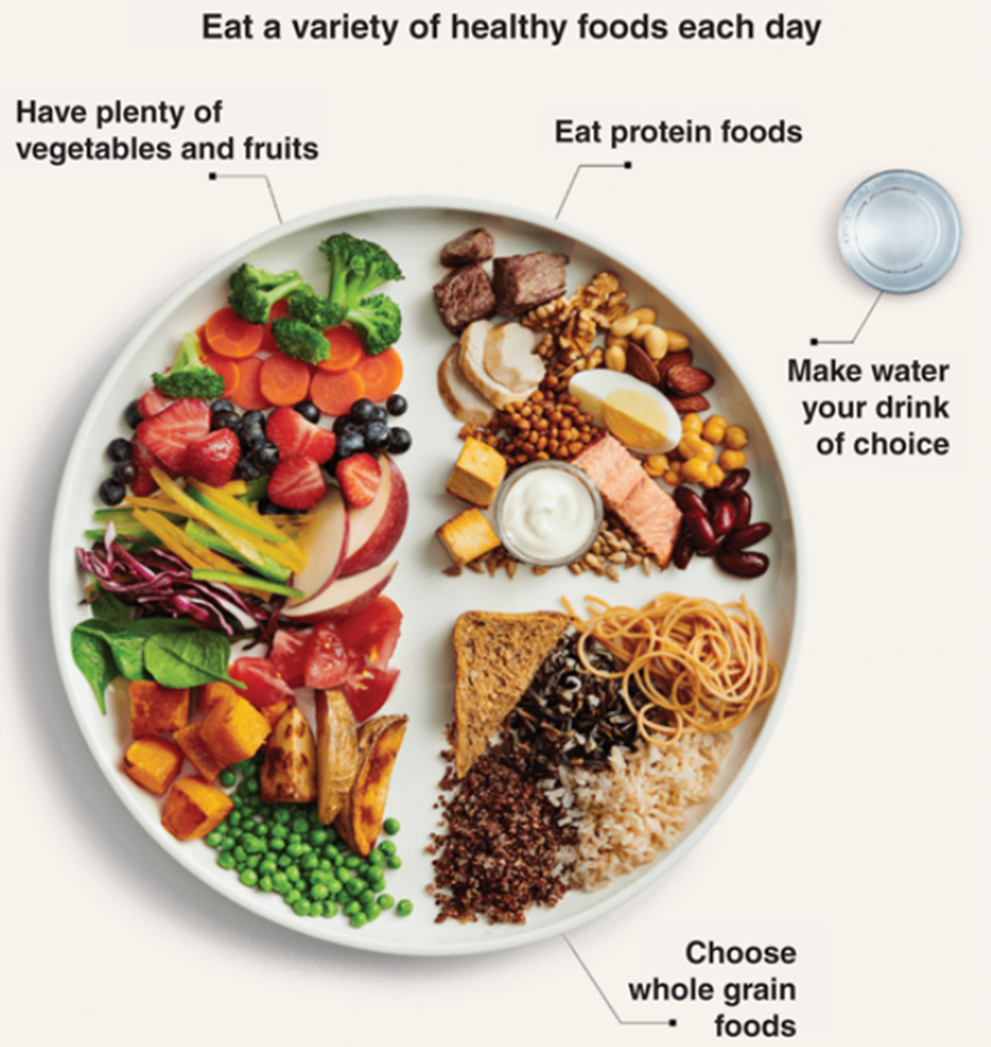
List 4 dietary recommendations from the new guideline
Choose protein-rich foods (~25% of diet)
Make water your drink of choice
Choose whole grain foods (~25% of diet)
Eat plenty of fruits and vegetables (~50% of diet)
List the 4 healthy eating recommendations from the new guideline
be mindful of your eating habits
cook more often
enjoy your food
eat meals with others
List 3 cautions from the new food guideline
use food labels
limit foods high in sodium, sugar, or saturated fat
be aware of food marketing
What does being mindful of your eating habits mean
being aware of how you eat, why you eat, what you eat, when you eat, where you eat, and how much you eat.
Those that are more aware of what they are eating are more likely to eat better
How to be mindful of your eating habits (3)
Create a healthy eating environment (e.g., make it easy to make healthy choices)
Use your senses to be mindful of the foods that you are consuming (aroma, texture, flavours, taste) and more conscious of the food you are eating
Consider your eating habits.
Can you recall the details of the last time you ate?
If so, then you were likely being mindful of your eating habits.
First step in picking the healthier food item over the other
Choose the one with LESS sugar, sodium, and saturated fats.
Some nutrients you may want MORE of include iron, fibre, calcium, and potassium.
Processed foods
have been specially treated or altered from their natural state, often by industrial food processes.
Often high in Na, sugars, sat fat
Unprocessed or minimally processed foods
GREEN (best)
foods do not undergo processing or minimal processing (i.e. grinding, pasteurization)
legumes, vegetables, fruits, eggs, chicken, milk
Processed culinary ingredients
YELLOW (good)
from minimally processed foods to season, cook
salt, sugar, oils, butter, other fats
Processed foods
ORANGE (worse)
unprocessed or minimally processed foods which have been added processed culinary ingredients. Industrialized
Bottled meat, veggies, bread, cheese, paste
Ultra-processed foods
Derived from foods being added cosmetic food additives not used in culinary
breast milk substitutes, junk foods, sugary drinks, hamburgers
High sodium can
lead to higher BP and heart disease
Increased sugar consumption leads to
increased risk of obesity and T2D
Sugary drinks increase risk of cavities in kids
Replacing foods that have mostly saturated fat with foods that have healthy fats can
help lower risk of heart disease
Excess consumption of processed meats is linked to
increased risk of colorectal cancer
Processing makes foods less ________ and more _________
nutrient dense, energy dense
Energy vs nutrient dense foods
Energy dense foods have many Calories, but relatively few micronutrients per gram (“empty calories”), tend to be highly processed
Nutrient dense foods have many micronutrients (e.g., vitamins, minerals) per gram and often fewer Calories, tend to be minimally processed, whole foods
What is another reason people choose to eat processed foods
may be more shelf stable or cheaper
What is the exception to processing makes foods less nutrient dense and more energy dense
Fortified and enriched foods
What are enriched and fortified foods in general
gain (some) nutrients through processing, often to meet a need in the population (e.g., iodized salt)
Fortified vs enriched foods
Fortified have NEW nutrients added that are normally absent (e.g., vitamin D in dairy milk)
Enriched have nutrients RETURNED that are removed during processing (e.g., enriched flour)
Any nutrient added to a food must be
listed on the nutrition label as well as the ingredient list
Example of food marketing
packaging
Why is food packaging a form of marketing
Food is often packaged so that it is VERY EASY to eat more than one serving at a time.
You don’t know what you’re eating because serving size is different from the amount you’ll eat (i.e. serving size half a muffin)
This makes the food you’re buying seem healthier than it is
Serving VS portion
Portion amount of food that you choose to eat for a single meal or snack. (DIFFER FROM PERSON TO PERSON)
Serving specific, measured amount of food or drink that is indicated on the label (ALWAYS THE SAME FOR EVERYONE)