Parasites Identification + Life cycles - PRACTICAL
 Call Kai
 Learn
 Practice Test
 Spaced Repetition
 Match
 Flashcards
 Knowt Play
1/46

There's no tags or description
Looks like no tags are added yet.
47 Terms
What are the key 2 most common flea speciea, their hosts , features , vetinary important, activity and contorl..
Ctenocephalides felis
Ctenocephalides Canis
Key species: Ctenocephalides felis, Ctenocephalides canis
Hosts: Dogs, cats, sometimes ruminants
Features: Laterally compressed body, powerful hind legs, wingless, and Combs
Veterinary importance: Flea allergy dermatitis (FAD), intermediate host of Dipylidium caninum, anaemia in puppies/kittens
Activity: View fleas under microscope + associated 2 tasks
•
Control: Topical insecticides, environmental control, treating all pets
Flea Life cycle
adult will attatch onto host, suck blood lay eggs
eggs fall off into enviroment hatch into larvae
larvar migrate away from light + eat FLEA DIRT ( very sensitive too light, the ENVIROMENT will become ridden with fleas, therefore making flea dirt available too eat..)
Larvae —→ Pupae
Pupae will only hatch out from movement/ warth nearby encourages them too break out + will then attatch to their adult hosts..

What are the Key lice species of veterinary importance ( lice scientific name = phthiraptera)
Key species: Biting/chewing (Mallophaga): e.g., Trichodectes canis
Sucking (Anoplura): e.g., Haematopinus spp.
Hosts: Species-specific (dogs, cattle, pigs, horses)
Features: Dorsoventrally flattened, wingless, and claws for grasping
Veterinary importance: Irritation, anaemia, secondary infections
Activity: View lice under microscope + associated 2 tasks
•
Control: Insecticides, improve hygiene, treat all animals
What are the flies of veterinary importance…
Stomoxys calcitrans (stable fly), Musca domestica (housefly), Hypoderma, Gasterophilus (myiasis-causing), Culicoides, and Tabanus
What are the mites of veterinary importance/ significance… (remember 2 x subcatagories)
Key species: Burrowing: Sarcoptes, Demodex;
Surface: Psoroptes, Chorioptes, Otodectes
Hosts: Species-specific but zoonotic potential in some
Features: Microscopic, 4 pairs of legs (larvae have 3 pairs)
Veterinary importance: Mange, otitis externa, alopecia, pruritus
Activity: View under microscope + associated 4 tasks
Control: Acaricides, deep cleaning, isolate infected animal
What is the 4 stages of the mite life cycle
1) Adult female mites
2) Female mites lay eggs
2) Larvae hatch out (have 6 legs)
3) Larvae MOULT to become 8 legged nymphs (Protonymph, deutonymph, tritonnymph….——> (back to adult)

What genus of mite is only parasitic at stage 3 of the lifecycle…
Chigger
(laravae of the tombiculidae…)
Psoroptes Ovis

Chorioptic MAnge

Sarcoptic Mange caused by,,,

Notoedric Mange
Notoedres Cati

Mange?
Mite Infestation
Ear Canal Mite?
Otodectes

What is the test for burrowing mites?
Deep Skin scrape

What is the genus of this mite?
Psoroptes

Whar are the key species of Tick, hosts, features, veterinary importance activity and control…

Scientific Name for HArd ticks?
Ixodidae
Scientific name for soft ticks?
Argasidae

Label the structures on this tick
SPiricles (breathing)
Hypostome (mouth association)
Palps ( elongated apendages like whicskers associated with touch + taste)
Anus
Anal groove
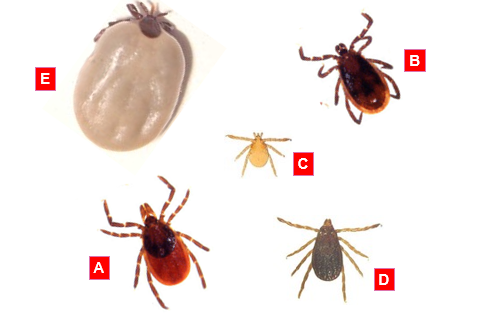
Label Each Stage of the stick life cycle
A - Semi - engorged female (multiple thier body size)
B- Male
C - Larva
D - Nymph
E- Full engourged female
What is the full life cycle of the Ixodidae…

What does a soft tick look lick?
Flat + squished..

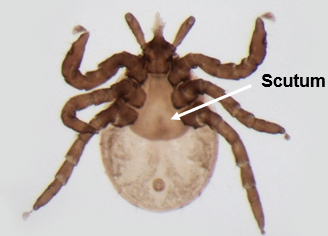
What feature can be used to identify a hard tick
scutum is present even though it only partially covers the dorsum of the larva.
By What process do hard ticks find their hosts…
QUESTING —> Ticks crwling grass/ on stems + extend front legs ready to latch on to any passing organisms…
What does the anal groove look like of the Ixodes tick species…
IT is U shaped

What are teh main clinical symptoms for baesia (tick bourne infection)
§Fever, pale mucous membranes and gums, coloured urine, enlarged spleen, swollen lymph nodes.

What are the symptoms of the louping - ill virus…
Muscular tremors, nervous nibbling, ataxia (especially hindlimbs), weakness, and collapse.
Colloquil name for Borreliosis
Lyme disease
HOw do you remove a tick form an animal?
•Use fine-tipped tweezers to grasp the tick as close to the skin's surface as possible.
•Pull upward with steady, even pressure. ...
After removing the tick, thoroughly clean the bite area and your hands with rubbing alcohol, an iodine scrub, or soap and water
what are the Identifying features of Insects whcich definces them
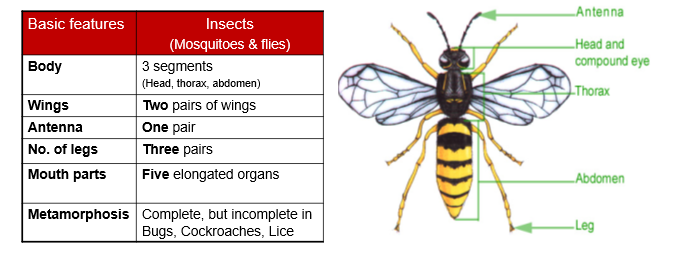
2 types of insect development…

Key Identification of Insect mouth parts..
can protude + it is calle dArista..

True flies. 2 common types
have typical fly features + retractable mouth part..

What are 6 examples of true flies of veterinary importance which cause direct skin damage, or act as vectors + transmit infections to the affected animals..
horn fly
Muscid
tabanus
hippobosca
sand fly
simulium

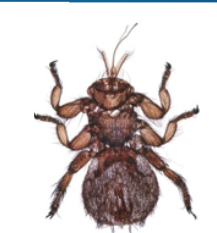
Identify this Image..
This is a sheep Ked.. (Melophagus ovinus)
It is a fly!

What issues can sheep keds cause
Suck blood from host, irritation and loss and damage too the wool
wool damage, irritation amenai can cuase weight loss and stunted growth in lambs…
What is significant about a bot fly…
It is the LARVAL STAGE which causes infestation and damage - Adult flys = HARMLESS
What are the different types of Bot fly — see if you can name all 4…
Hypoderma bovis — Cattle grubs/ warbles
Gastrophilus Spp — Horse stomach bots
Oestrus obis — Sheep nasal fly
Cuterebra — Rodent bot fly

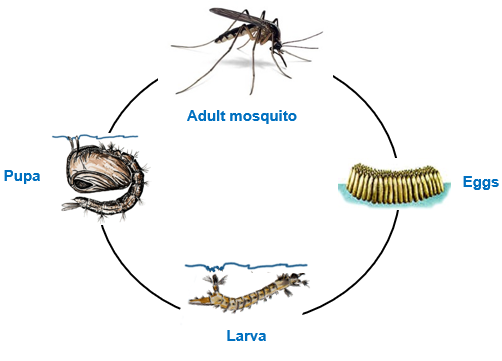
What is the 4 stage life cycle of the mosquito…
Vector for many species… malaria + dirofiliaria immitis (heart worm)
lay eggs on surface - Larva and pupa = under the water…
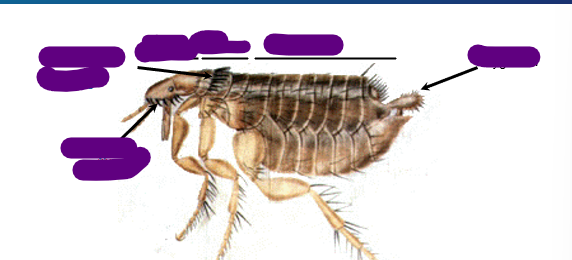
label the flea key parts… (low priority)

What are some common flea species (referance only)
Cat flea (Ctenocephalides felis),
Dog flea (Ctenocephalides canis)
Human flea (Pulex irritans)
Northern rat flea (Nosopsyllus fasciatus)
Oriental rat flea (Xenopsylla cheopis)
Sand flea (Tunga penetrans)

How can you tell between the bird flea and human flea
bird flea has a pronotal comb ( nb bird fllea infestations CAN occour although very rare, in this instance need specifiic bird flea treatments..

HOw to differentiate between ctenocephalides canis and Ctenocephalides felis

What is anoplura vs mallophaga lice…
Anoplura = sucking lice
Mallophaga = chewing lice
lice = obligate ecto parasites
host specific
dorsoventrally flattened
wingless
strong legs + claws


Morphological difference in sucking and chewing lice in terms of… Mouth, size, head, thorax, abdominal segments, secual differentiation…

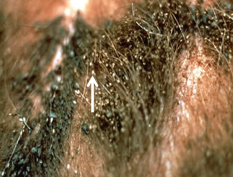
What are these small pale ovals (opposite image) stuck on the animal’s hairs likely to be
Small oval, pale louse eggs firmly attached to hairs.

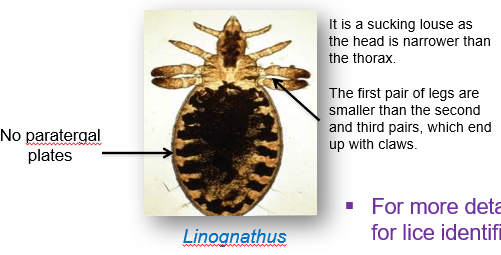
§What genus does this ectoparasite (bottom image) belong to?
Linognathus… - No paratergal plates - sucking louse
N.B lice feed on BLOOD!