Lecture 9: Signalling via Protein Modification (specific examples)

0.0(0)
Studied by 0 people
call kaiCall Kai
learnLearn
examPractice Test
spaced repetitionSpaced Repetition
heart puzzleMatch
flashcardsFlashcards
GameKnowt Play
Card Sorting

1/22

encourage image

There's no tags or description

Looks like no tags are added yet.

23 Terms

1
New cards

Two mechanisms of signaling via enzyme-coupled receptors

  1. Phosphorylation: signal perception triggers activation of receptor kinases or receptor-associated kinases

  • a) Receptor tyrosine kinases

  • b) Tyrosine kinase associated receptors

  • c) Receptor serine/threonine kinases

  1. Proteolysis: signal perception triggers protein cleavage or degradation

    1. Also used for signalling (not just cell death)


2
New cards

Receptor tyrosine kinases (RTKs) are essential in mammals

  • they mediate diverse functions

  • Don’t have to memorize the table

    • E,g, EGF activates EGF receptors and is part of the RTK family


<ul><li><p>they mediate diverse functions</p></li><li><p>Don’t have to memorize the table</p><ul><li><p>E,g, EGF activates EGF receptors and is part of the RTK family</p></li></ul></li></ul><p></p>
3
New cards

RTKs share a common structure

  • Different extracellular domains bind different ligands

  • •Transmembrane domain

  • •Intracellular tyrosine kinase domain phosphorylates different targets at tyrosine residues

    • Some have extra amino acids (tyrosines) but it still works


<ul><li><p>Different <strong>extracellular domains </strong>bind different ligands</p></li><li><p>•Transmembrane domain</p></li><li><p>•<strong>Intracellular tyrosine kinase domain</strong> phosphorylates different targets at tyrosine residues</p><ul><li><p>Some have extra amino acids (tyrosines) but it still works</p></li></ul></li></ul><p></p>
4
New cards

RTKs are activated by ligand binding & transautophosphorylation

  • trans = on different RTK molecules

  • •auto = RTKs can act on RTKs


  • They phosphorylate each other on specific tyrosines on the tyrosines kinase domain


  • Trans phosphorylation: they cross and phosphorylation at the same time (but be exactly at the same time; if one doesn’t work, neither will work)

  • Then phosphorylate other thyroxine’s outside of its domain

  • Always true and always happens, but not always shown


<ul><li><p><strong>trans</strong> = on different RTK molecules</p></li><li><p>•<strong>auto</strong> = RTKs can act on RTKs</p></li></ul><p></p><p></p><ul><li><p>They phosphorylate each other on specific tyrosines on the tyrosines kinase domain</p></li></ul><p></p><ul><li><p>Trans phosphorylation: they cross and phosphorylation at the same time (but be exactly at the same time; if one doesn’t work, neither will work)</p></li><li><p>Then phosphorylate other thyroxine’s outside of its domain</p></li><li><p>Always true and always happens, but not always shown</p></li></ul><p></p>
5
New cards

RTK transautophosphorylation can recruit other signaling molecules

The activated RTK can act as a scaffold protein

<p>The activated RTK can act as a <strong>scaffold protein</strong></p>
6
New cards

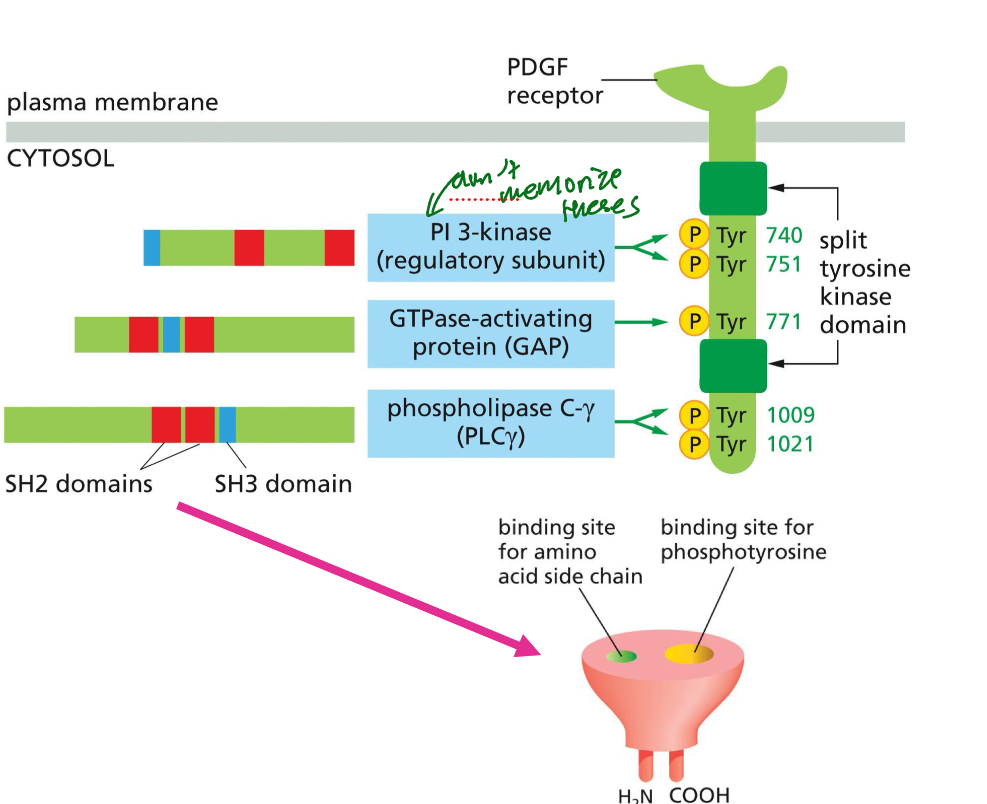
Signaling proteins can bind to RTKs via SH2 or PTB domains

  • Each SH2 domain has 2 two binding sites:

    • 1. Recognizes the phosphorylated tyrosine

    • 2. Recognizes nearby amino acids

  • •These ensure that SH2 domains bind specific phosphorylated proteins

<ul><li><p>Each SH2 domain has 2 two binding sites:</p><ul><li><p>1. Recognizes the phosphorylated tyrosine</p></li><li><p>2. Recognizes nearby amino acids</p></li></ul></li><li><p>•These ensure that SH2 domains bind specific phosphorylated proteins</p></li></ul><p></p>
7
New cards

Activated RTKs can recruit other signaling molecules

knowt flashcard image
8
New cards

RTK activation often activates Ras-GEFs

  • Ras-GEF

  • Ras protein activated by the switching from GDP to GTP


<ul><li><p>Ras-GEF</p></li><li><p>Ras protein activated by the switching from GDP to GTP</p></li></ul><p></p>
9
New cards

Ras family proteins are related to other monomeric GTPases

knowt flashcard image
10
New cards

Many RTKs signal to activate Ras monomeric GTPases

Ras

Rho

<p>Ras</p><p>Rho</p>
11
New cards

Activated Ras can activate MAP kinase cascades

  • mitogen: substance that cause mitosis (name is only hisotorical; doesn’t always do mitosis have many other functions

  • MAP kinase = mitogen-activated protein kinase

  • •MAP kinases can convert a short- term RTK activation at the cell surface to a stable/long-term change in gene expression

  • •MAP kinases also provide negative feedback

  • •Humans have ~ 7 MAPKKKs, 7 MAPKKs, and 12 MAPKs

    • MAPKKK is not phosphorylate

    • Erm, men, and raf are names for human versions

  • ** they all interact with different specifities


<ul><li><p>mitogen: substance that cause mitosis (name is only hisotorical; doesn’t always do mitosis have many other functions</p></li><li><p>MAP kinase = mitogen-activated protein kinase</p></li><li><p>•MAP kinases can convert a short- term RTK activation at the cell surface to a stable/long-term change in gene expression</p></li><li><p>•MAP kinases also provide <strong>negative feedback</strong></p></li><li><p>•Humans have ~ 7 MAPKKKs, 7 MAPKKs, and 12 MAPKs</p><ul><li><p>MAPKKK is not phosphorylate</p></li><li><p>Erm, men, and raf are names for human versions</p></li></ul></li><li><p>** they all interact with different specifities</p></li></ul><p></p>
12
New cards

Scaffold proteins can provide specificity to MAP kinase cascades

  • mating factor activates receptors

  • Activates MAP KKK (both)

  • High osmolarity activates kinase A


However, there is two different pathways, separately

  • for mating factor: mating response

  • For high osmolarity: glycerol synthesis


<ul><li><p>mating factor activates receptors</p></li><li><p>Activates MAP KKK (both)</p></li><li><p>High osmolarity activates kinase A</p></li></ul><p></p><p>However, there is two different pathways, separately</p><ul><li><p>for mating factor: mating response</p></li><li><p>For high osmolarity: glycerol synthesis</p></li></ul><p></p>
13
New cards

Drosophila Sevenless signaling as an example of RTK signaling

  • Drosophila compound eyes are made of ommatidia

  • •Each ommatidia has 8 photoreceptor cells (R1-R8)

  • •The R7 cells is required to detect UV light

  • •To understand the developmental signaling pathway, scientists screened for Drosophila mutants that cannot sense UV light and characterized these components.


  • r8 differentiates first

    • In charge

    • Tells the neighbouring cells to change to R5, R2

    • Continues

    • Until finally changes to R7 cells


<ul><li><p>Drosophila compound eyes are made of ommatidia</p></li><li><p>•Each ommatidia has 8 photoreceptor cells (R1-R8)</p></li><li><p>•The R7 cells is required to detect UV light</p></li><li><p>•To understand the developmental signaling pathway, scientists screened for Drosophila mutants that cannot sense UV light and characterized these components.</p></li></ul><p></p><p></p><ul><li><p>r8 differentiates first</p><ul><li><p>In charge</p></li><li><p>Tells the neighbouring cells to change to R5, R2</p></li><li><p>Continues </p></li><li><p>Until finally changes to R7 cells</p></li></ul></li></ul><p></p>
14
New cards

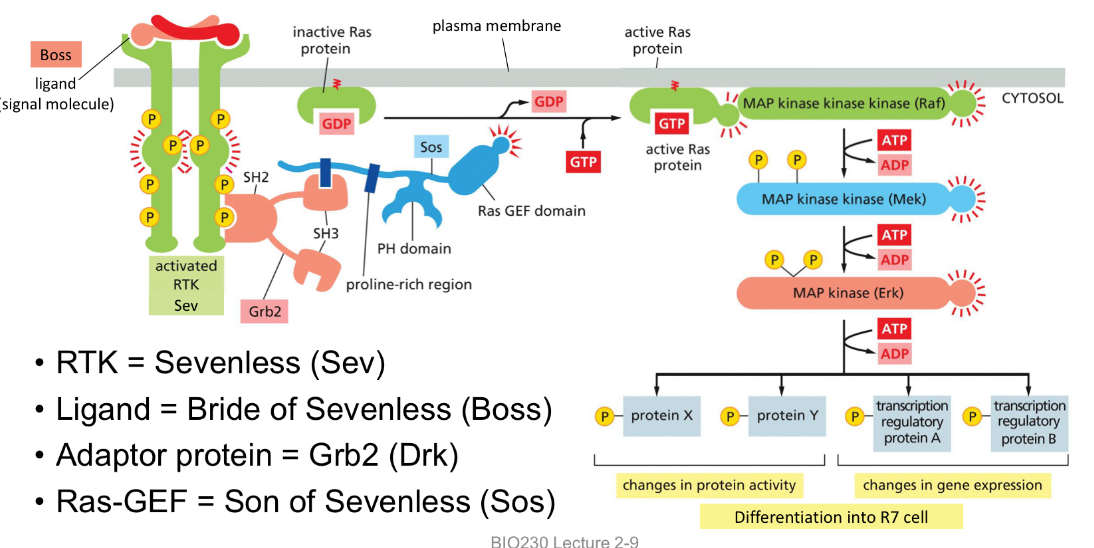
Sevenless signaling involves RTKs, Ras, and a MAP kinase cascade

  • RTK = Sevenless (Sev)

  • •Ligand = Bride of Sevenless (Boss)

  • •Adaptor protein = Grb2 (Drk)

  • •Ras-GEF = Son of Sevenless (Sos)


  • r8 signals boss (the protein), activating seven less, which signals the adaptor protein grb2 downstream of receptor kinase to activate Ras-GEF son of seven less (Sos)

  • To activate MAP KKK, KK, and K, and corresponding effector proteins

  • Results in the cell changing to r7


<ul><li><p>RTK = Sevenless (Sev)</p></li><li><p>•Ligand = Bride of Sevenless (Boss)</p></li><li><p>•Adaptor protein = Grb2 (Drk)</p></li><li><p>•Ras-GEF = Son of Sevenless (Sos)</p></li></ul><p></p><ul><li><p>r8 signals boss (the protein), activating seven less, which signals the adaptor protein grb2 downstream of receptor kinase to activate Ras-GEF son of seven less (Sos)</p></li><li><p>To activate MAP KKK, KK, and K, and corresponding effector proteins</p></li><li><p>Results in the cell changing to r7</p></li></ul><p></p>
15
New cards

RTKs can also signal through phosphoinositides (PIPs)

  1. RTK activated by a survival factor

  2. RTK activates PI 3-kinase

  3. PI 3-kinase converts PI(4,5)P2 to PI(3,4,5)P3

  4. PDK1 & Akt bind PI(3,4,5)P3

  5. PDK & mTORC2 phosphorylate Akt

  6. Akt phosphorylates Bad to release Bcl2 to inhibit apoptosis (cell death) (lecture 11)


<ol><li><p>RTK activated by a survival factor</p></li><li><p>RTK activates PI 3-kinase</p></li><li><p>PI 3-kinase converts PI(4,5)P2 to PI(3,4,5)P3</p></li><li><p>PDK1 &amp; Akt bind PI(3,4,5)P3</p></li><li><p>PDK &amp; mTORC2 phosphorylate Akt </p></li><li><p>Akt phosphorylates Bad to release Bcl2 to inhibit apoptosis (cell death) (lecture 11)</p></li></ol><p></p>
16
New cards

Some pathways signal via tyrosine-kinase-associated receptors

  • Some receptors have no kinase activity (e.g. cytokine receptors)

  • •These associate with cytoplasmic tyrosine kinases to signal

  • •The mechanisms of transautophosphorylation and protein binding to the phosphorylated receptor remain similar


<ul><li><p>Some receptors have no kinase activity (e.g. cytokine receptors)</p></li><li><p>•These associate with cytoplasmic tyrosine kinases to signal</p></li><li><p>•The mechanisms of transautophosphorylation and protein binding to the phosphorylated receptor remain similar</p></li></ul><p></p>
17
New cards

Receptor serine/threonine kinases can also transmit signals

Similar to RTKs:

•Extracellular ligand binding domain

•Transmembrane domain

•Intracellular kinase domain

•Multiple receptors associate in response to signals

•But: kinase domains phosphorylate serine and/or threonine residues in targets

<p>Similar to RTKs:</p><p>•Extracellular ligand binding domain</p><p>•Transmembrane domain</p><p>•Intracellular kinase domain</p><p>•Multiple receptors associate in response to signals</p><p>•But: kinase domains phosphorylate serine and/or threonine residues in targets</p>
18
New cards

Delta-Notch is an example of contact-dependent signaling

Notch signaling involves:

•Signaling via endocytosis

•Signaling via proteolysis

<p>Notch signaling involves:</p><p>•Signaling via endocytosis</p><p>•Signaling via proteolysis</p>
19
New cards

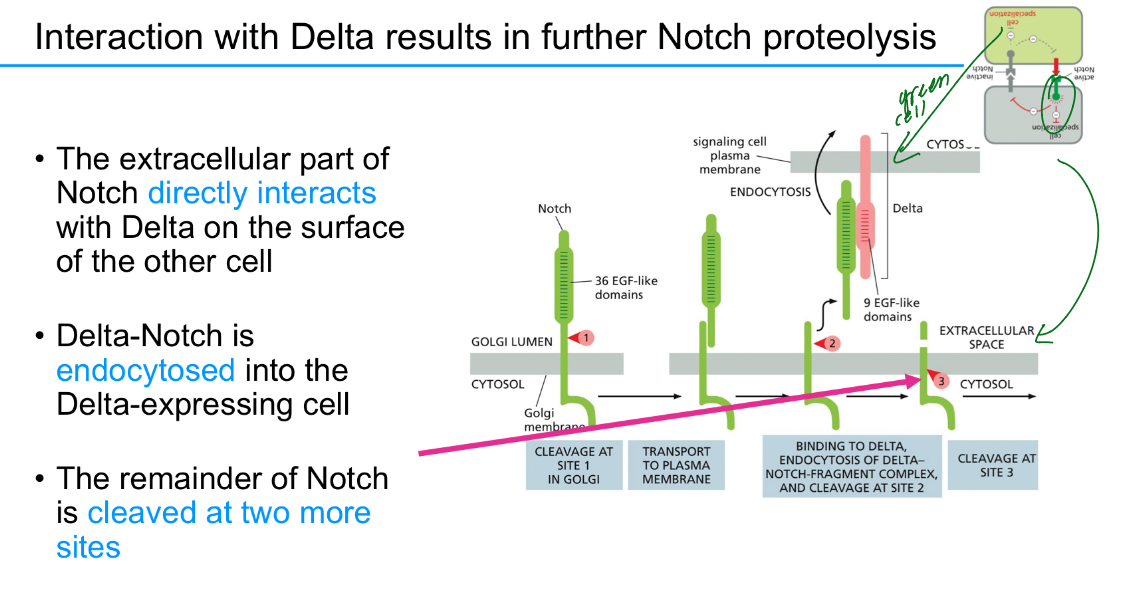
Active Notch is one protein that is cleaved into two pieces

  • Notch protein is made in the ER

  • •Notch is cleaved into two pieces in the Golgi

  • •The two pieces stay together and move to the plasma membrane

<ul><li><p>Notch protein is made in the ER</p></li><li><p>•Notch is cleaved into two pieces in the Golgi</p></li><li><p>•The two pieces stay together and move to the plasma membrane</p></li></ul><p></p>
20
New cards

Notch proteolysis activates Notch target gene expression

  • The cytosolic ā€tailā€ of Notch moves to the nucleus

  • •The Notch tail promotes transcription of Notch target genes

  • •Delta is repressed in this cell

  • •The cell with active Notch target genes does not differentiate


<ul><li><p>The cytosolic ā€tailā€ of Notch moves to the nucleus</p></li><li><p>•The Notch tail promotes transcription of Notch target genes</p></li><li><p>•Delta is repressed in this cell</p></li><li><p>•The cell with active Notch target genes does not differentiate</p></li></ul><p></p>
21
New cards

Hedgehog signaling combines several mechanisms

  • asked to review

  • Review these previous lectures from section 2


<ul><li><p>asked to review</p></li><li><p>Review these previous lectures from section 2</p></li></ul><p></p>
22
New cards

When there is no hedgehog signal…

  1. Patched is active in the cilium

  2. Active Patched inhibits Smoothened and keeps Smoothened out of the primary cilium

  3. SuFu binds and inhibits Gli2 & Gli3

  4. GPCR (Gpr161) is active

  5. Active Gpr161 promotes cAMP synthesis

  6. cAMP activates PKA

  7. PKA phosphorylates Gli3

  8. Gli3 phosphorylation causes Gli3 proteolytic processing

  9. The remaining fragment of Gli3 moves to the nucleus to repress expression of hedgehog target genes


<ol><li><p> Patched is active in the cilium</p></li><li><p>Active Patched inhibits Smoothened and keeps Smoothened out of the primary cilium</p></li><li><p>SuFu binds and inhibits Gli2 &amp; Gli3</p></li><li><p>GPCR (Gpr161) is active</p></li><li><p>Active Gpr161 promotes cAMP synthesis</p></li><li><p>cAMP activates PKA</p></li><li><p>PKA phosphorylates Gli3</p></li><li><p>Gli3 phosphorylation causes Gli3 proteolytic processing</p></li><li><p>The remaining fragment of Gli3 moves to the nucleus to repress expression of hedgehog target genes</p></li></ol><p></p>
23
New cards

When hedgehog signal is present…

  1. Hedgehog binds and inactivates Patched

  2. Smoothened is active and moves to the tip of the primary cilium

  3. Gpr161 and PKA are inactive (not shown)

  4. Gil3 is not proteolytically processed so it does not inhibit hedgehog target genes

  5. SuFu and Gli2 move along microtubules to the tip of the primary cilium

  6. Smoothened releases Gli2 from SuFu

  7. Gli2 moves along microtubules from primary cilium to nucleus

  8. Gli2 activates hedgehog target genes


<ol><li><p>Hedgehog binds and inactivates Patched</p></li><li><p>Smoothened is active and moves to the tip of the primary cilium</p></li><li><p>Gpr161 and PKA are inactive (not shown)</p></li><li><p>Gil3 is not proteolytically processed so it does not inhibit hedgehog target genes</p></li><li><p>SuFu and Gli2 move along microtubules to the tip of the primary cilium</p></li><li><p>Smoothened releases Gli2 from SuFu</p></li><li><p>Gli2 moves along microtubules from primary cilium to nucleus</p></li><li><p>Gli2 activates hedgehog target genes</p></li></ol><p></p>