5.2.2 Manages the aftercare of patients wearing rigid gas permeable contact lenses.
 Call Kai
 Learn
 Practice Test
 Spaced Repetition
 Match
 Flashcards
 Knowt Play
1/22

There's no tags or description
Looks like no tags are added yet.
23 Terms
HISTORY AND SYMPTOMS
RGP A/C
General symptoms
Discomfort, dryness, or irritation while wearing the lenses?
Notice any redness, itching, burning or watering?
Experienced blurred vision, ghosting, glare, halos?
Do the lenses meet your needs?
How is the comfort, rated out of 10?
HISTORY AND SYMPTOMS
RGP A/C
Care and compliance
Hygiene?
Insertion and removal routine?
Case cleaning compliance?
Tap water contact?
HISTORY AND SYMPTOMS
RGP A/C
Wearing habits
Average wear time? Maximum wear time? Wear time today?
How many days per week do you wear them?
How often are you replacing your lenses? (Reusable)
Record lens details:
RGP A/C
Name of brand
Name of lens
Modality (monthly/daily)
Base curve
Diameter
Prescription
Assessing an RGP fit
Centration
Movement on blink
Movement on eye motion
Fluorescein pattern
Comfort
Assessing an RGP fit
Centration
Is the lens centred on the cornea?
(Or is it decentered superiorly/inferiorly/temporally)
Upper lid position relative to lens edge
Lens riding with upper lid or sitting between lids?
(Lid-attachment vs intrapalpebral fit)
Assessing an RGP fit
Movement on blink
Should have smooth repositioning, no excessive lag
Assessing an RGP fit
Movement on eye motion
Stability and return to the centre
No limbal crossing
Assessing an RGP fit
Fluorescein Pattern
Central fit
Mid-peripheral fit
Edge lift
Fluorescein must be applied to superior conjunctiva whilst patient looks down
Maximises length of time stain stays in eye
Assessing an RGP fit
Comfort
0-10 scale
Early vs late wear comfort
Awareness of lies edge under lids?
RGP A/C
Lid attachment fit
The lens is designed to ride under the upper lid, so the lid helps hold it in place.
Lens sits slightly superior
Minimal vertical movement
N.B. not possible if upper lids sits above limbus
RGP A/C
Intrapalpebral fit
Lens is designed to fit within the palpebral aperture, without significant lid interaction.
Lens centres on cornea, not held by lid
Freely moves 1-2mm with blink
RGP A/C
Optimal fit
Slight central clearance
Mid-peripheral alignment
Appropriate edge clearance


Toric cornea, spherical RGP


Fill in the table:

RGP A/C
OVER-REFRACTION
Trial frame
(Wider field of view; allow you to observe more realistic binocular interactions)
Occlude left eye
Perform spherical refinement
Present plus / minus
Find maximum plus that gives best comfortable acuity
Binocular balance
Remove occluder and check with both eyes open if the lenses added before make a difference to VA
RGP A/C
Common aftercare complications
Mechanical
Hypoxia-related
Inflammatory complications
Infection
Common aftercare complications
RGP A/C
Mechanical
Corneal abrasion / epithelial staining
Usually from lens edge trauma or trapped debris under the lens
3 and 9 o’clock staining
Due to poor blink, poor edge clearance, or excessive dry eye at the horizontal meridian
Superior arcuate staining
From a steep upper lens edge or tight superior fit
Corneal warpage
Steep lens or lens worn excessively can temporarily distort corneal curvature
Common aftercare complications
RGP A/C
Hypoxia-related
Corneal oedema
Stromal haze, striae, microcysts cause blur and discomfort
Endothelial changes
Common aftercare complications
RGP A/C
Inflammatory complications
CLPC (Contact Lens Papillary Conjunctivitis )
From mechanical irritation of the upper lid
More common with dirty lenses or deposits
Limbal redness
Often from poor edge alignment or excessive movement
Peripheral corneal infiltrates
Typically sterile, but must be monitored
Common aftercare complications
RGP A/C
Infection
Microbial keratitis
Rare in RGP wearers
Usually due to poor hygiene, overnight wear or contaminated cases
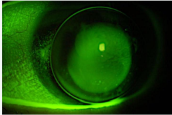
Name this :
RGP A/C complication
3 and 9 staining
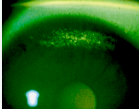
Name this :
RGP A/C complication
Superior arcuate staining