MATH0520 - LE1-4, EV1, EV2
 Call Kai
 Learn
 Practice Test
 Spaced Repetition
 Match
 Flashcards
 Knowt Play
1/35

There's no tags or description
Looks like no tags are added yet.
36 Terms
matrix
an 𝑚 ×𝑛 array of real numbers with 𝑚 rows and 𝑛 columns
column vectors

set notation for matrices
</span> mathematical notation used to represent a matrix's structure, typically involving brackets and commas to separate elements within rows and columns </span>

Euclidean vector
an ordered list of real numbers

component
each number in the list/euclidean vector
linear equation
equation of the variables 𝑥𝑖 of the form

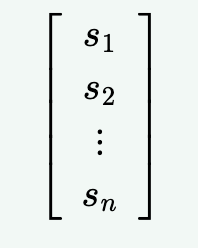
solution
linear equation is a Euclidean vector that satisfies
𝑎1𝑠1+𝑎2𝑠2+⋯+𝑎𝑛𝑠𝑛=𝑏 (that is, a Euclidean vector whose components can be plugged into the equation).
system of linear equations or a linear system
is a collection of one or more linear equations

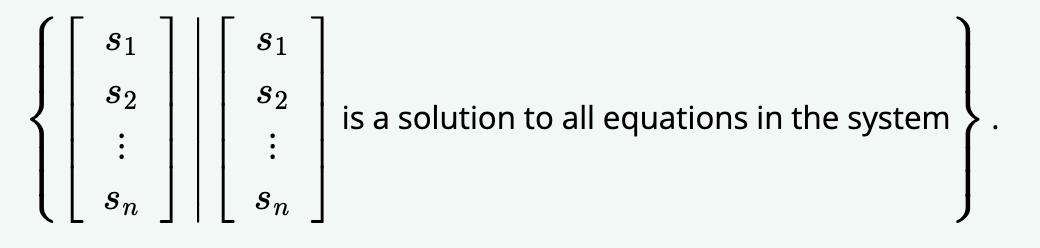
solution set
is a solution to all equations in the system
consistent
if its solution set is non-empty (that is, there exists a solution for the system
inconsistent
if its solution set is empty (that is, there is no solution for the system)
consistent with one solution
solution set for linear system that is contains a single vector (one unique solution)

consistent with infinite solution
solution set for linear system that contains infinitely many vectors (infinite solution)

inconsistent
solution set for linear system that is empty set, denoted by either {} or ∅, no solution

augmented matrix
the 𝑚 ×𝑛 matrix of its coefficients augmented with the 𝑚 constant values as a final column

coefficient matrix
𝑚 ×𝑛 array consisting of the coefficients of the linear system (and ignore its constant terms)

Vector equation
an equation written as a linear combination of column vectors with unknown scalar variables set equal to a target result vector

equivalent
Two systems of linear equations are that have the same solution set (denote with ∼)
three row operations produce equivalent augmented matrices
Swap two rows, for example, 𝑅1 ↔𝑅2
Multiply a row by a nonzero constant, for example, 2𝑅1 →𝑅1
Add a constant multiple of one row to another row, for example, 𝑅2 −4𝑅1 →𝑅2

reduced row echelon form (RREF)
The leftmost nonzero term of each row is 1. We call these terms pivots.
Each pivot is to the right of every higher pivot.
Each term that is either above or below a pivot is 0.
All zero rows (rows whose terms are all 0) are at the bottom of the matrix
Gauss-Jordan elimination algorithm
Ignoring any rows that already have marked pivots, identify the leftmost column with a nonzero entry.
Use row operations to obtain a pivot of value 1 in the topmost row that does not already have a marked pivot.
Mark this pivot, then use row operations to change all values above and below the marked pivot to 0.
Repeat these steps until the matrix is in RREF.
inconsistent linear system (RREF)
If the linear system given by RREF(𝐴) includes the contradiction
0=1, that is, the RREF matrix includes the row [0⋯01]

consistent linear system with one solution (RREF)
If the linear system given by RREF(𝐴) sets every variable of the system to a specific value; that is we have:
𝑥1=𝑠1
𝑥2=𝑠2⋮
𝑥𝑛=𝑠𝑛
(with some possible extra 0 = 0 equations), then

consistent with infinitely-many different solutions (RREF)
not include a 0 =1 contradiction while at least one variable is not required to equal a specific value.

bound variables
pivot columns in an augmented matrix
free variables
a variable that does not correspond to a pivot column in row-echelon form, meaning it can take any real number value
scalar
The real number that is used to multiply a vector
vector spaces
a collection of objects called vectors that can be added together and scaled by numbers called scalar (e.g. polynomials, matrices)
linear combination
a set of vectors {v1,v2,…,vn} is given by c1v1 +c2v2 +… +𝑐𝑛𝑣𝑛 for any choice of scalar multiples 𝑐1,𝑐2,…,𝑐𝑛.

span of a set of vectors
is the collection of all linear combinations of that set

span in R^m
𝑚 vectors are required to span ℝ^𝑚
{v1,…,vn} spans all of ℝ^m
is consistent for every vector meaning the vector is in R^m (RREF of the vector equation’s coefficient matrix has all pivot rows)
{v1,…,vn} fails to span all of ℝ^𝑚
when the vector equation
𝑥1⃗𝑣1+⋯+𝑥𝑛⃗𝑣𝑛=⃗𝑤
is inconsistent for some vector ⃗𝑤 ∈ ℝ^𝑚 (RREF of the vector equation’s coefficient matrix has at least one non-pivot row (a row of zeroes)
rank-nullity theorem
The dimension of the domain of 𝑇 equals dim(ker𝑇) +dim(Im𝑇).
rank of 𝑇 (or 𝐴)
The dimension of the image
nullity
the dimension of the kernel