Genetics - Exam 1
 Call Kai
 Learn
Learn Practice Test
 Spaced Repetition
 Match
Match Flashcards
 Knowt Play
1/127

There's no tags or description
Looks like no tags are added yet.
Name | Mastery | Learn | Test | Matching | Spaced | Call with Kai | Chat |
|---|
No analytics yet
Send a link to your students to track their progress
128 Terms
SARS (Symptoms, Inheritance, Molecular, Fun Fact)
Flu Like, No inheritance (viral), no molecular, DNA vaccines are under test
Griffiths Experiment (Purpose, What did he do & work with, Results, Conclusion)
Purpose: Showed transformation occurs
Worked with Streptococcus pneumoniae and mice
He injected 2 strains into mice (R strain (non virulent) & S strain (virulent))
Results:
Live S → mouse dies
Live R → mouse lives
Heat-killed S → mouse lives
Heat-killed S + live R → mouse dies, and live S bacteria are recovered
Conclusion:
- Something from the dead S bacteria transformed the harmless live R bacteria into deadly S bacteria. Griffith called it the “transforming principle,” but he did not identify it as DNA.
Avery, MacLeod, & McCarty (Purpose, What did he do & work with, Results, Conclusion)
Purpose: Showed DNA was the transforming factor
What they did: Oswald Avery, Colin MacLeod, and Maclyn McCarty used a cell-free extract from heat-killed virulent S bacteria and tested whether it could transform live nonvirulent R bacteria into virulent S bacteria.
What did they work with: They treated the transforming extract with substances that destroy specific molecules
Results & Conclusion:
Only destroying DNA stopped transformation. Therefore, the “transforming principle” was DNA, not protein, RNA, lipid, or carbohydrates
Was not widely accepted because DNA was thought to be not complex enough
Hershey and Chase Experiments (Purpose, What did he do & work with, Results, Conclusion)
Purpose: Determining if DNA or proteins are the hereditary material
What they did:
They used bacteriophage T2 infecting E. coli in side-by-side experiments, labeling either the protein capsid or the DNA core.
Radioactive labels:
Radioactive sulfur (³⁵S) → labels protein (because proteins contain sulfur)
Radioactive phosphorus (³²P) → labels DNA (because DNA contains phosphorus)
Procedure:
Let labeled phages infect bacterial cells.
Use a blender to shake off phage capsids from the bacterial surface.
Use a centrifuge to spin down the heavier bacterial cells into a pellet, leaving lighter capsids in the supernatant.
Results:
³⁵S (protein): Radioactivity was mostly found in supernatant (capsids outside cells). Means proteins did not enter bacteria
³²P (DNA): Mostly in cell pellet meaning DNA entered bacteria.
Conclusion:
The component that entered the bacterial cells and transmitted the infective/genetic information was DNA, not protein. Therefore, DNA is the genetic material.
Rosalind Franklin (Purpose, What did they do & work with, Results, Conclusion)
Purpose: Determine the structural properties of DNA including its width, the distance of one helical turn, and the number of “steps” per turn.
What did she work with: Did this using X-ray crystallography (DNA crystals, x-ray machine, photographic plates)
Results
DNA is helical — X-ray pattern showed an X shape
Width of DNA: about 2 nm (20 Å)
Distance of one complete turn: about 3.4 nm (34 Å)
Number of steps (base pairs) per turn: about 10
Distance between each step/base pair: about 0.34 nm (3.4 Å)
Famous evidence:
- Her Photo 51 was a critical X-ray diffraction image that helped reveal DNA’s helical structure. Watson and Crick used her data to help build their DNA model.
Watson & Crick (Purpose, What did they do & work with, Results, Conclusion)
For their purposes they used both Franklins photograph and chargraffs information about base pairing rules.
Proposed that DNA is a double helix made of two antiparallel strands (left 5’-3’ and right 3’ to 5’)
The sugar and phosphates form the side rails and the bases form the rungs of the ladder.
Adenine (A) pairs with Thymine (T)
Guanine (G) pairs with Cytosine (C)
How did they do that
By using physical model building they determined:
The distance between A–T is the same as G–C (a purine + a pyrimidine fits the uniform width).
Hydrogen bonds between complementary bases hold the two strands together.
The two strands run in opposite directions (antiparallel).
Key structural points:
Two polynucleotide chains
Strands are antiparallel — one runs 5′→3′, the other 3′→5′
Bases are on the interior
Sugar-phosphate backbone is on the exterior
A–T and G–C base pairing
Right-handed double helix
Watson/Crick and Rosalind Franklin published independently but in the same journal the articles which proposed the double helix or spiral staircase structure of the DNA molecule in ________
1953
Until 1944, which cellular component was thought to carry genetic information?
Proteins, amino acids
Why do you think nucleic acids were originally not considered to be carriers of genetic information?
They were thought to not be complicated enough since DNA only has 4 bases but a single cell can contain hundreds or thousands of proteins.
The experiments of Avery and his coworkers led to the conclusion that
DNA is the transforming agent and genetic material
In the experiments of Avery, MacLeod, and McCarty, what was the purpose of treating the transforming extract with enzymes?
To isolate the different factors to find which the transforming agent was. If transformation still occurred after treatment, then that molecule was not genetic material.
Read the following experiment and interpret the results to form your conclusion. Experimental data: S bacteria were heat killed and cell extracts were isolated. The extracts contained cellular components, including lipids, proteins, DNA, and RNA. The extracts were mixed with live R bacteria and then injected together into mice along with various enzymes (proteases, RNAses, and DNAses). Proteases degrade proteins, RNAses degrade RNA, and DNAses degrade DNA.
S extract + Live R cells | Mouse dies |
S extract + Live R cells + protease | Mouse dies |
S extract + Live R cells + RNAase | Mousie dies |
S extract + Live R cells + DNAase | Mouse lives |
Transformation stops when the dna is degraded meaning it is the transforming factor
Recently, scientists discovered that a rare disorder called polkadotism is caused by a bacterial strain, polkadotiae. Mice injected with this strain (P) develop polka dots on their skin. Heat-killed P bacteria and live D bacteria, a nonvirulent strain, do not produce polka dots when injected separately into mice. However, when a mixture of heat-killed P cells and live D cells were injected together, the mice developed polka dots. What process explains this result? Describe what is happening in the mouse to cause this outcome.
When the heat-killed P bacteria are mixed with live D bacteria, the killed P cells release their DNA into the mouse. Some live D bacteria take up fragments of this P DNA and incorporate it into their own genome. The acquired P DNA contains the genes that allow the bacteria to cause polkadotism—the polka-dot skin lesions.
As a result, the previously harmless D bacteria become transformed into virulent, P-like bacteria. These transformed bacteria then multiply in the mouse and produce the disease, causing the mice to develop polka dots.
So, the process is transformation, and the outcome occurs because live D bacteria acquire genetic material from heat-killed P bacteria, making them capable of causing polkadotism.
List the pyrimidine bases, the purine bases, and the base-pairing rules for DNA.
T/C are pyrimidines
A/G are purines
A & T (2 hydrogen bonds)
G & C (3 hydrogen bonds)
In analyzing the base composition of a DNA sample, a student loses the information on pyrimidine content. The purine content is A= 27% and G= 23% . Using Chargaff’s rule, reconstruct the missing data and list the base composition of the DNA sample.
A= 27% & T=27%
G= 23% & C= 23%
The basic building blocks of nucleic acids are:
Nucleotides (A phosphate group, 5 carbon sugar, and nitrogenous base)
Adenine is a
Purine & Base
Polynucleotide chains have a 5’ and a 3’ end. Which groups are found at each of these ends?
5’ phosphate
3’ OH
DNA contains many hydrogen bonds. Are hydrogen bonds stronger or weaker than covalent bonds? What are the consequences of this difference in strength?
Hydrogen bonds in DNA are much weaker than covalent bonds. This allows the two DNA strands to separate easily during replication, transcription, and PCR, while the many hydrogen bonds together still keep the double helix stable. The stronger covalent bonds in the sugar-phosphate backbone hold each strand together, preventing it from falling apart.
Watson and Crick received the Nobel Prize for:
Solving the structure of DNA
State the properties of the Watson–Crick model of DNA in the following categories:
Number of polynucleotide chains
Polarity (running in same direction or opposite directions):
Bases on interior or exterior of molecule:
Sugar/phosphate on interior or exterior of molecule:
Which bases pair with which:
Right- or left-handed helix:
Number of polynucleotide chains: Two
Polarity (running in same direction or opposite directions): Opposite Directions
Bases on interior or exterior of molecule: Interior
Sugar/phosphate on interior or exterior of molecule: Exterior
Which bases pair with which: A-T & G-C
Right- or left-handed helix: Right-handed double helix
Chemical analysis shows that a nucleic acid sample contains A, U, C, and G. Is this DNA or RNA? Why?
It is RNA. It has uracil
How does DNA differ from RNA with respect to the following characteristics?
number of chains
bases used
sugar used
RNA: 1 chain & DNA: 2chain
RNA: AUGC & DNA: ATGC
RNA: Ribose Sugar & DNA: Deoxyribose
RNA is ribonucleic acid, and DNA is deoxyribonucleic acid. What exactly is deoxygenated about DNA?
DNA is missing a single oxygen on its 2’ carbon of the 5 carbon sugar ring
What is the function of DNA polymerase?
It adds DNA nucleotides to a replicating strand.
COME BACK TO CH 8 Q. 22
How does DNA replication occur in a precise manner to ensure that identical genetic information is put into the new chromatid?
DNA replication is precise because it is template-directed and semiconservative:
The DNA double helix uncoils, and each old strand serves as a template.
New nucleotides are added by complementary base pairing:
A–T and G–C.DNA polymerase links the new nucleotides, but it can only synthesize in the 5′ → 3′ direction.
One new strand is made continuously (leading strand).
The other is made in short Okazaki fragments (lagging strand), later joined by DNA ligase.
Each resulting DNA molecule has one old strand and one new strand = semiconservative replication.
DNA polymerase proofreads mistakes, and repair enzymes fix mismatches.
So, during S phase, each chromosome is replicated into two sister chromatids. Because each new strand is built by complementary base pairing against the old template, the new chromatids contain the same genetic information as the original DNA.
Nucleosomes are complexes of:
RNA and DNA
RNA and histone
histones and DNA
DNA, RNA, and protein
amino acids and DNA
Histones & DNA
What are the 2 functions of DNA
to carry genetic info and replicate itself
What type of replication does DNA exhibit
semiconservative
DNA polymerase reads _____ and polymerizes _____
3’ - 5’ and 5’ - 3’
Since DNA is antiparallel, one strand is assembled ______. The other is assembled in many pieces, called _______.
Continuously, Okazaki fragments
Function of DNA ligase
seal gaps
What is chromatin?
DNA and protein components of chromosomes
What are histones?
DNA-binding proteins that help compact the DNA
What is a nucleosome?
A beadlike structure composed of histones wrapped with DNA
What is a centromere?
Region of a chromosome where sister chromatids attach. It is also where spindle fibers attach during cell division
What is a telomere?
Short repeated DNA sequences located at the end of Chromosomes
During DNA replication, the ends of the chromosome are ______, so chromosomes ____ every division.
not copied, shorten
Gamete forming cells have an enzyme, _____, which adds nucleotides in the _____ and thus prevents chromosome shortening
telomerase, telomers
During interface, each chromosome occupies a distinct region called ________. This organization is closely linked to gene function. The position of gene territories is dynamic according to ________.
chromosome territory, gene regulation
How many autosomes are present in a body cell of a human being? In a gamete?
There are 44 autosomes in a body (somatic) cell and 22 autosomes in a gamete
Define chromosome
The threadlike structures in the nucleus that carry genetic information.
Define chromatin
The DNA and protein components of chromosomes, visible as clumps or threads in nuclei.
Human haploid gametes (sperm and eggs) contain how many chromosomes and chromatids
23 chromosomes, 23 chromatids
What are sister chromatids?
Two identical copies of a single replicated chromosome joined together at a centromere
Draw the cell cycle. What is meant by the term cycle in the cell cycle? What is happening at the S phase and the M phase?
Cells undergo a series of events involving growth, DNA replication, and division that are repeated by the daughter cells, forming a cycle, called the cell cycle. During S phase, DNA synthesis occurs. During M phase, mitosis and cytokinesis take place.
In the cell cycle, at which stages do two chromatids make up one chromosome?
The beginning of mitosis and G2
Does the cell cycle refer to mitosis as well as meiosis?
No
Identify the stages of mitosis, and describe the important events that occur during each stage.
Prophase - Chromosomes condense into visible X-shaped structures, the nuclear membrane breaks down, and the mitotic spindle starts to form.
Metaphase - Chromosomes line up along the middle of the cell (the metaphase plate) and attach to the spindle fibers.
Anaphase - Sister chromatids are pulled apart toward opposite poles of the cell by the spindle fibers.
Telophase - Two new nuclear membranes form around each of the two separated sets of chromosomes, creating two distinct nuclei
Cytokinesis - divides the cytoplasm and cell membrane, officially splitting the parent cell into two identical daughter cells
Why is cell furrowing important in cell division? If cytokinesis did not occur, what would be the end result?
Importance of Cell Furrowing
It splits the fluid and organelles evenly between the new cells.
It ensures each daughter cell gets a single, complete nucleus.
If cytokinesis did not occur…
The cell ends up with one large cell containing two or more nuclei (called a syncytium or multinucleate cell).
The cell becomes tetraploid (4n) because it doubled its chromosomes during mitosis but never split its contents.
Uncontrolled cytokinesis failure can lead to abnormal cell growth, genetic instability, and cancer.
During which phases of the mitotic cycle would the terms chromosome and chromatid refer to identical structures?
Anaphase and Telophase
Describe the critical events of mitosis that are responsible for ensuring that each daughter cell receives a full set of chromosomes from the parent cell.
The attachment of spindle fibers (prophase),sister chromatids are separated (metaphase), nuclear envelope forming around each of the separated chromosomes and cytoplasm splitting (telophase/cytokinesis)
Mitosis occurs daily in a human being. What type of cells do humans need to produce in large quantities on a daily basis?
Somatic cells specifically blood and skin cells
Speculate on how the Hayflick limit may lead to genetic disorders such as progeria and Werner syndrome. How is this related to cell division?
The Hayflick limit may lead to genetic disorders when the limit is prematurely reached or is erased. For progeria a defect in the LMNA gene (producing mutant lamin A called progerin), cells experience severe genomic instability, nuclear malformation, and exceptionally rapid telomere shortening. Somatic cells exhaust their finite Hayflick limit allotment decades ahead of schedule. Werner syndrome is caused by mutations in the WRN gene, which codes for a DNA helicase enzyme vital for DNA replication and repair. A faulty WRN helicase causes DNA replication to stall and increases genomic instability. This heightened level of DNA damage forces cells to activate a premature stress response, tricking the cell into reaching its Hayflick limit much earlier than normal . Because these genetic defects compromise DNA maintenance, cells hit their maximum division ceiling prematurely. The massive accumulation of these senescent, non-dividing cells disrupts tissue homeostasis, mirrors physiological aging, and results in early-onset degenerative symptom
How can errors in the cell cycle lead to cancer in humans?
If any errors/ mutations occur to the genes that control how cells grow or divide cancer can occur. Failure of checkpoints can allow incorrect amounts of DNA or strands with incorrect sequences to pass spreading the mutations into daughter cells. Uncontrolled cell growth can lead to tumors.
Number of daughter cells produced: Mitosis ________ Meiosis _____
Number of Chromosomes per daughter cell: Mitosis ________ Meiosis _____
Do chromosomes pair: Mitosis ________ Meiosis _____
Does crossing over occur: Mitosis ________ Meiosis _____
Can the daughter cells divide again: Mitosis ________ Meiosis _____
Do chromosomes replicate before division: Mitosis ________ Meiosis _____
Type of Cell produced: Mitosis ________ Meiosis _____
Mitosis: 2 Meiosis: 4
Mitosis: 2n Meiosis: n
Mitosis: No Meiosis: Yes
Mitosis: No Meiosis: Yes
Mitosis: Yes Meiosis: No
Mitosis: Yes Meiosis: Yes
Mitosis: Somatic Meiosis: Gamete
Which of the following statements is not true in comparing mitosis and meiosis?
a) Twice the number of cells are produced in meiosis as in mitosis.
b) Meiosis is involved in the production of gametes, unlike mitosis.
c) Crossing over occurs in meiosis I but not in meiosis II or mitosis.
d) Meiosis and mitosis both produce cells that are genetically identical.
e) In both mitosis and meiosis, the parental cell is diploid.
D) Meiosis and mitosis both produce cells that are genetically identical

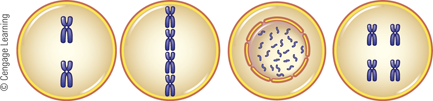
Match the phase of cell division with the following diagrams. In these cells 2n=4
a) anaphase of meiosis I
b) interphase of mitosis
c) metaphase of mitosis
d) metaphase of meiosis I
e) metaphase of meiosis II
Picture 1: Metaphase of meiosis II
Picture 2: metaphase of mitosis
Picture 3: interphase of mitosis
Picture 4: Metaphase of meiosis I
What is physically exchanged during crossing over?
Segments of dna
Provide two reasons why meiosis leads to genetic variation in diploid organisms.
Crossing over, independent assortment (during Metaphase I of meiosis, pairs of chromosomes line up randomly at the center of the cell. How one pair lines up does not affect any other pair, meaning maternal and paternal chromosomes are mixed randomly into the resulting gametes)
What happens in each phase of the cell cycle: Interphase (G1, S, and G2), mitosis and cytogenesis
G1 - The cell grows physically larger, copies its organelles, and accumulates the molecular building blocks and energy reserves required for later divisions
S - Cell replicates DNA and centrosomes
G2 - The cell undergoes its final stage of growth & produces proteins and enzymes necessary for mitosis
Mitosis - Prophase, metaphase, anaphase, telophase
Cytogenesis - the splitting of the cells cytoplasm into 2 new daughter cells
What happens in each stage of mitosis
Prophase - Nuclear envelope dissolves, chromosomes condense, spindle fibers start to form
Metaphase - Chromosomes line up at the metaphase plate at the center of the cell & spindle fibers attach to the centromeres
Anaphase - Sister chromatids are pulled apart to opposite poles of the cell
Telophase - Chromosomes begin to decondense back into chromatin and a new nuclear membrane begins to form around each set of dna
What happens during each phase of meiosis
Prophase (meiosis 1) - Chromosomes condense. Homologous pairs find each other and form a tetrad. Crossing over occurs, where segments of DNA are exchanged to create genetic diversity.
Metaphase (meiosis 1) - Homologous pairs line up at the metaphase plate and spindles attach
Anaphase (meiosis 1)- Homologous pairs are separated and pulled to opposite poles
Telophase (meiosis 1) - New nuclear membranes form around the chromosomes, and the cell divides into two new haploid cells. Each cell has half the starting number of chromosomes, but each chromosome still has two sister chromatids
Prophase II - Chromosomes condense and spindle fibers form
Metaphase II - Chromosomes line up at the metaphase plate and spindle fibers attach to the centrosomes
Anaphase II - Sister chromatids are pulled apart to opposite poles
Telophase II - Nuclear membranes reform around the four new sets of chromosomes, and the cells divide
The genetic material has to store information and be able to express it. What is the relationship among DNA, RNA, proteins, and phenotype?
Dna is transcribed into RNA and RNA is translated into proteins and the expression of proteins controls phenotype
The genetic material has to store information and be able to express it. What is the relationship among DNA, RNA, proteins, and phenotype?
Replication is the process of making DNA from a DNA template, transcription makes RNA from a DNA template, and translation makes an amino acid chain (a polypeptide) from an mRNA template. Replication and transcription happen in the nucleus, and translation occurs in the cytoplasm.
If the genetic code used 4 bases at a time, how many amino acids could be encoded?
There would be 4^4 which means 256 possible
If the genetic code uses triplets, how many different amino acids can be coded by a repeating RNA polymer composed of UA and UC (UAUCUAUCUAUC …)?
a) 1
b) 2
c) 3
d) 4
four
What is the start codon? What are the stop codons? Do any of them code for amino acids?
They indicate where the cell should start producing a protein and when it should stop
Start (AUG) - Met
Stop (UAA, UAG, UGA) - No amino acids
Is an entire chromosome made into an mRNA during transcription?
No, transcription only copies specific segments of dna, genes, and only specific genes are transcribed based on the proteins needed by the cell. Additionally there are large regions of DNA in chromosomes that dont code for proteins so they are left untrascribed
The promoter and terminator regions of genes are important in:
a) coding of amino acids
b) gene regulation
c) structural support for the gene
d) intron removal
e) anticodon recognition
gene regulation

The following segment of DNA codes for a protein. The uppercase letters represent exons. The lowercase letters represent introns. The lower strand is the template strand. Draw the primary transcript and the mRNA resulting from this DNA.
Primary transcript (pre-mRNA):
5′-GCUAAAUGGCAAAAUUGCCGGAUGACGCACAUUGACUCGGAAUCGAGGUCAGAUC-3′
Mature mRNA (spliced):
5′-GCUAAAUGGCAGCACAUUGACUCGGGGUCAGAUC-3′

What are the three modifications made to pre-mRNA molecules before they become mature mRNAs, are transported from the nucleus to the cytoplasm, and become ready to be used in protein synthesis? What is the function of each modification?
Removal of introns, 5’ cap (ribosome binding), 3’ poly-A tail (mrna stability)
The pre-mRNA transcript and protein made by several mutant genes were examined. The results are given below. Determine where in the gene a likely mutation lies: the promoter region, exon, intron, cap on mRNA, or ribosome binding site.
a) normal-length transcript, normal-length nonfunctional protein
b) normal-length transcript, no protein made
c) normal-length transcript, normal-length mRNA, short nonfunctional protein
d) normal-length transcript, longer mRNA, shorter nonfunctional protein
e) transcript never made
a) exon (missense mutation: full length protein is created but one amino acid is changed making it non-functional)
b) cap on mrna (the transcript is made but without the proper 5’ cap translation cannot initiate so no protein is made)
c) ribosomal binding site (the mutation allows the ribosome to skip the normal start codon and start downstream at another AUG creating a shorter non-functional protein)
d) intron (intron is retained so the mrna transcript is longer but the retained intron introduces a premature stop making a shorter and nonfunctional protein)
e) promoter region (mutation prevents transcription initiation so no transcript is made)
Describe the function of each in protein synthesis: rRNA, tRNA, mRNA
rRNA
Function: Forms the structural and catalytic core of cellular ribosomes.
Details: Organizes the interaction between mRNA and tRNA. It acts as an enzyme to catalyze peptide bonds, linking amino acids into a growing chain
tRNA
Function: Transports specific amino acids to the ribosome during protein assembly.
Details: Features an anticodon loop that matches complementary codons on the mRNA strand. This ensures each new amino acid matches the genetic code
mRNA
Carries genetic instructions from DNA in the cell nucleus to the ribosomes in the cytoplasm.
Details: Acts as a temporary template. Its sequence of three-nucleotide units (codons) determines the precise order of amino acids in the final protein
What is the difference between codons and anticodons?
Codons are triplets of bases on an mRNA molecule. Anticodons are triplets of bases on a tRNA molecule and are complementary in sequence to the nucleotides in codons.
Given the following tRNA anticodon sequence, derive the mRNA and the DNA template strand. Also, write out the amino acid sequence of the protein encoded by this message:
trna: UAC UCU CGA GGC
mrna:
protein:
How many hydrogen bonds would be present in the DNA segment
mrna: AUG-AGA-GCU-CCG
protein: Met-Arg-Ala-Pro
31 hydrogen bonds
Given the following mRNA, write the double-stranded DNA segment that served as the template. Indicate both the 5’ and 3’ ends of both DNA strands. Also write out the tRNA anticodons and the amino acid sequence of the protein encoded by the mRNA message.
DNA:
mRNA: 5’ — CCGCAUGUUCAGUGGGCGUAAACACUGA — 3’
protein:
tRNA:
DNA: 3′-GGCGTACAAGTCACCCGCATTTGTGACT-5′
protein: Met – Phe – Ser – Gly – Arg – Lys – His – Stop
tRNA: 3′-UAC-5′ · 3′-AAG-5′ · 3′-UCA-5′ · 3′-CCC-5′ · 3′-GCA-5′ · 3′-UUU-5′ · 3′-GUG-5′
The following is a portion of a protein:
met-trp-tyr-arg-gly-pro-thr-
Various mutant forms of this protein have been recovered. Using the normal and mutant sequences, determine the DNA and mRNA sequences that code for this portion of the protein, and explain each of the mutations.
a) met-trp-
b) met-cys-ile-val-val-leu-gln-
c) met-trp-tyr-arg-ser-pro-thr-
d) met-trp-tyr-arg-gly-ala-val-ile-ser-pro-thr-
a. met–trp–
This is a nonsense mutation. The third codon, UAU (Tyr), is changed to a stop codon UAA (UAU → UAA). Translation stops after Trp.
b. met–cys–ile–val–val–leu–gln–
This is a frameshift mutation. One nucleotide is deleted in the Trp codon UGG. For example, deleting the second G gives UGU (Cys), shifting the reading frame. The new sequence after Met becomes Cys–Ile–Val–Val–Leu–Gln… instead of Trp–Tyr–Arg–Gly–Pro–Thr…
c. met–trp–tyr–arg–ser–pro–thr–
This is a missense mutation. The Gly codon GGU is changed to AGU (Ser) by a single base substitution G → A at the first position. So Gly is replaced by Ser.
d. met–trp–tyr–arg–gly–ala–val–ile–ser–pro–thr–
This is an in-frame insertion mutation. Twelve nucleotides are inserted between the Gly codon (GGU) and the Pro codon (CCU). For example, the inserted mRNA sequence could be:
GCU GUA AUC UCC = Ala–Val–Ile–Ser
So the mutant mRNA would be:
5′-AUG UGG UAU CGU GGU GCU GUA AUC UCC CCU ACA-3′
Indicate in which category, transcription or translation, each of the following functions belongs: RNA polymerase, ribosomes, nucleotides, tRNA, pre-mRNA, DNA, anticodon, amino acids.
RNA polymerase | Transcription |
Ribosomes | Translation |
Nucleotides | Transcription |
tRNA | Translation |
pre-mRNA | Transcription |
DNA | Transcription |
Anticodon | Translation |
Amino acids | Translation |
In the most common form of cystic fibrosis, one amino acid is missing in the CF protein. Explain why none of the mutant protein product ends up in the cell’s plasma membrane.
In the most common form of cystic fibrosis, the mutation is ΔF508—a deletion of the amino acid phenylalanine (F) at position 508 of the CFTR protein.
Because even one missing amino acid can disrupt the protein’s normal 3D folding, the mutant CFTR is misfolded. The endoplasmic reticulum (ER) quality-control system recognizes it as abnormal and retains it in the ER instead of allowing it to move to the Golgi apparatus and then to the plasma membrane. The misfolded protein is eventually ubiquitinated and degraded by the proteasome(ER-associated degradation, or ERAD).
So the mutant CFTR never reaches the cell surface, meaning no functional chloride channel is present in the plasma membrane.
Polypeptide folding is often mediated by other proteins called chaperones. Describe how a mutant chaperone protein might be responsible for a genetic disorder involving an enzyme.
A mutant chaperone protein can cause a genetic disorder involving an enzyme even if the enzyme’s own gene is completely normal. Chaperones help newly made polypeptides fold into their correct three-dimensional shape, prevent abnormal aggregation, and sometimes help assemble multi-subunit enzymes or transport them to the right cellular location.
If a chaperone is mutated so that it can no longer bind, stabilize, or properly release its target enzyme, the enzyme may:
fail to fold into its active conformation,
be recognized as misfolded and degraded by quality-control systems such as ER-associated degradation (ERAD) or the proteasome,
aggregate inside the cell,
be mislocalized so it never reaches the compartment where it normally functions,
or assemble incorrectly if it is a multi-subunit enzyme.
As a result, the enzyme’s catalytic activity is reduced or absent, a metabolic pathway is blocked, and substrates may accumulate or products may be deficient—leading to a genetic disorder. The disease is inherited through the mutant chaperone gene, not necessarily through the enzyme gene itself. In some cases, a mutant chaperone can also act dominantly by interfering with normal chaperone complexes, causing widespread protein-folding problems.
Do mutations in DNA alter proteins all the time?
No. DNA mutations occur continually, but most do not alter proteins.
Why not:
Most DNA is noncoding — introns, intergenic regions, repetitive DNA, etc. Mutations there usually don’t change protein sequence, though some may affect regulation.
The genetic code is redundant — many mutations in protein-coding regions are silent/synonymous and don’t change the amino acid.
Many mutations are neutral — even if an amino acid changes, the protein may still function normally.
DNA repair systems correct many mutations before they become permanent.
Not all genes are expressed in every cell — a mutation in an unexpressed gene may have no protein effect.
Some mutations affect RNA processing or regulation rather than the protein’s amino acid sequence.
When mutations do alter proteins, they can be:
Missense — one amino acid changed
Nonsense — premature stop codon
Frameshift — insertions/deletions shift the reading frame
In-frame insertions/deletions — extra or missing amino acids
Splice-site mutations — abnormal mRNA processing
So: DNA mutations are common, but protein-altering mutations are a minority. Even among those, many have little or no functional effect.
Prions are neither virus nor bacteria. They are misfolded proteins. When one ingests these misfolded proteins, they can induce other proteins to also misfold. Despite their non-traditional nature, they can spread in a way similar to infectious diseases due to their ability to propagate within the body and cause disease. Once introduced into a host, prions can induce normal proteins in the host's brain to misfold, leading to a cascade of misfolding that progressively damages brain tissue. This misfolding process is what causes the neurodegenerative diseases associated with prions, such as Creutzfeldt-Jakob disease, and bovine spongiform encephalopathy (mad cow disease)
Important Note
What is a codon ?
Triplet of nucleotides in mRNA encoding information for one amino acid
In eukaryotes, information is first copied into a _____ in the ____. Then, ___ are removed by ____, a modified guanine is added to the ___ prime end called the cap, and a poly A tail is added to the ___ end. After processing, it exits to the cytoplasm as ___
pre-messenger RNA in the nucleus
introns, are removed by the splicesosome
5’ and 3’
mrna
What are the three stages of transcription
Initiation (RNA polymerase and transcription factors bind to the promoter)
Elongation
Termination
Alternative splicing of _____ allows for one gene to encode information for different types of proteins. This is quite prevalent and over 90% of human genes have alternative splicing. There are more _____ than ____
introns
proteins than genes
During _______, amino acids are linked by a peptide bond formed between the ______ and the _______ groups.
translation
amino and the carboxyl
Give an concise explanation of translation and the involvement of ribosomes, transfer RNA, start codon, and stop codon
Translation is the process in which a ribosome reads an mRNA and builds a polypeptide.
Ribosome: binds mRNA and catalyzes peptide bond formation between amino acids.
tRNA: carries a specific amino acid and has an anticodon that base-pairs with the mRNA codon.
Start codon: AUG begins translation, sets the reading frame, and usually adds methionine.
Stop codon: UAA, UAG, or UGA ends translation; no tRNA pairs with it, so the polypeptide is released.
In short: ribosome + mRNA + tRNAs → amino acids joined in codon-specified order, starting at AUG and stopping at a stop codon
What are primary, secondary, tertiary, and quaternary protein structure
Primary structure: The linear sequence of amino acids in a polypeptide, linked by peptide bonds.
Secondary structure: Local folding patterns such as α-helices and β-pleated sheets, stabilized mainly by hydrogen bonds between backbone atoms.
Tertiary structure: The overall 3D shape of a single polypeptide, stabilized by interactions between R groups (hydrophobic interactions, hydrogen bonds, ionic bonds, disulfide bridges).
Quaternary structure: The arrangement of multiple polypeptide subunits into a functional protein complex (e.g., hemoglobin). Not all proteins have this level.
The promoter in a DNA tightly bound to ______ is not accessible to the ____ polymerase. _________ is one of the main gene regulation systems in humans
histones, RNA polymerase
Chromatin Remodeling
Micro-RNA and RNA interference (RNAi) can destroy ____ or block ____, allowing for post-transcriptional gene regulation
MRNA or block translation
Creutzfeldt- Jacob disease (symptoms, inheritance, molecular, fun fact)
Human form of mad cow disease and leads to memory loss and death, No inheritance since prions is acquired by eating infected meat, prions are abnormally folded proteins
Alkaptonuria (symptoms, inheritance, molecular, fun fact)
Urine black due to accumulation of “alkapton”, no inheritance, The gene responsible for the enzyme breaking down alkapton is mutated, Helped establish the link between genes and proteins
Cystic Fibrosis (symptoms, inheritance, molecular, fun fact)
molecular: Deletion of single amino acid. Makes chloride ion membrane channel fold wrongly.
Epigenetic changes involve ______ alteration of the genome
reversible
Epigenetics study chemical modifications to ____ or ______ that change the expression of
genes, without modifying the _____ sequence of the DNA
DNA or histones
nucleotide
Methylation of ____ and _____ determine access to the promoter and close or open
chromatin, which regulate genes. Methylation is reversible.
CpG and histones
Genetic imprinting is
the selective expression of either the maternal or paternal copy of a gene