Math 321: Applied Mathematical Analysis 1: Vectors and Complex Calculus
 Call Kai
 Learn
Learn Practice Test
 Spaced Repetition
 Match
Match Flashcards
 Knowt Play
1/75

Earn XP
Description and Tags
We used Fabian Waleffe's Textbook. I took this class in Fall 2026.
Name | Mastery | Learn | Test | Matching | Spaced | Call with Kai | Chat |
|---|
No analytics yet
Send a link to your students to track their progress
76 Terms
How can vectors be written in terms of there magnitude and unit vector
(Lecture 1, Covered September 3)

What is the magnitude of a unit vector
1 (Lecture 1, Covered September 3)
What is the vector equation through a line
(Lecture 1, Covered September 3)

If phi = atan2(y,x), what is the range of phi
(Lecture 1, Covered September 3)
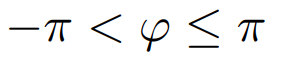
Fully describe, what is atan2(y,x)
atan2(y,x) is the arctangent function but it’s range is -pi < phi <= +pi. The regular arctangent function only has range -pi/2 < phi < +pi/2 (Lecture 1, Covered September 3)
What is atan2(y,x) in terms of arctan
(Lecture 1, Covered September 3)

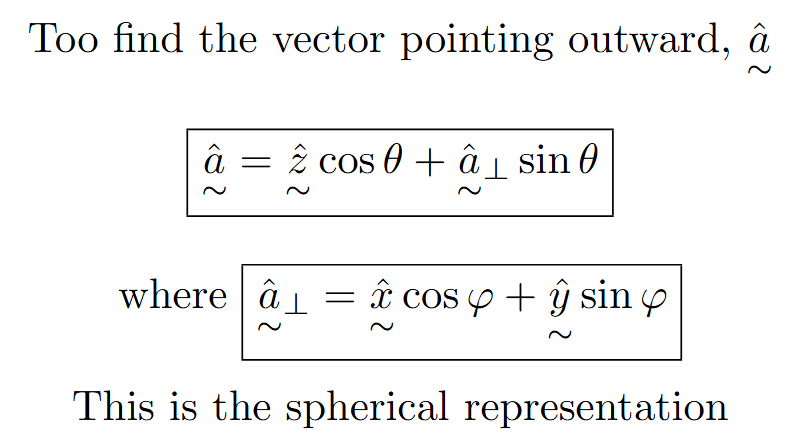
For a 3D telescope, phi is the azimuth angle, and theta is the inclination angle. What formula(s) can you use too find a vector pointing outward from the origin in spherical coordinates
(Lecture 2, Covered September 8)
For a parallelogram formed by two vectors, what are the diagonals of that parallelogram in terms of the vectors
(Lecture 2, Covered September 8)

What is the triangle inequality
(Lecture 2, Covered September 8)

What is the definition of linear independence in 2D space. What does this mean geometrically?
(Lecture 2, Covered September 8)
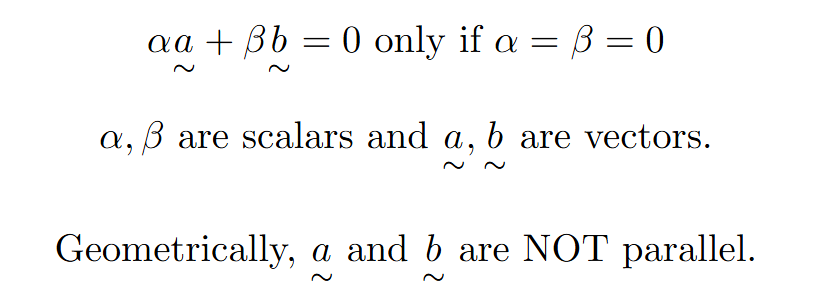
What is the definition of linear independence in 3D space. What does this mean geometrically?
(Lecture 2, Covered September 8)

What is the geometric definition of the dot product
(Lecture 2, Covered September 8)

What is the projection of a onto b
(Lecture 2, Covered September 8)
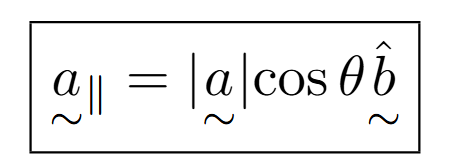
What is the decomposition formula in terms of parallel and perpendicular vectors
(Lecture 2, Covered September 8)

What is the angle between the parallel and perpendicular vector
90 degrees (Lecture 2, Covered September 8)

What is the name of the property for the image
Commutative Property, they Commute (Lecture 2, Covered September 8)

What is the image equal too
(Lecture 2, Covered September 8)


What is the image less than or equal too. What is the name of this property
Cauchy-Schwarz Inequality (Lecture 2, Covered September 8)


What is the image equal too. What is the name of this property
Distributive Property (Lecture 2, Covered September 8)

What is the Cartesian Basis Formula for the dot product
(Lecture 2, Covered September 8)

What is the geometric definition of the cross product
(Lecture 2, Covered September 8)


For a parallelogram made by two vectors, what is the image equal too
(Lecture 2, Covered September 8)


What is the image equal too. What is the name of this property
Distributive Property for Cross Products (Lecture 2, Covered September 8)

What is the cartesian basis formula for cross products
(Lecture 2, Covered September 8)

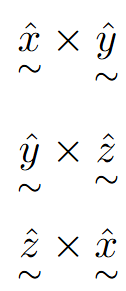
What is each line in the image equal too
(Lecture 2, Covered September 8)

What is the cartesian representation of a vector
(Lecture 2, Covered September 8)
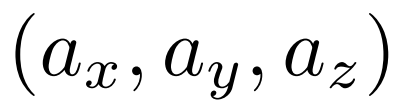
For the cartesian component, a_z, how do you calculate it?
(Lecture 2, Covered September 8)

What is the spherical representation of a vector
(Lecture 2, Covered September 8)

What is the cylindrical representation of a vector
(Lecture 2, Covered September 8)

How do you find the value of a_perp
(Lecture 2, Covered September 8)
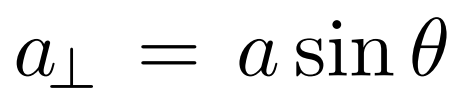

What is the image equal too
(Lecture 3, Covered September 10)

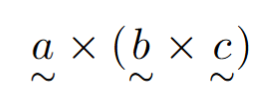
What is the image equal too
(Lecture 3, Covered September 10)

What is the Kronecker delta function
(Lecture 3, Covered September 10)

What is the Levi-Civita function
(Lecture 3, Covered September 10)

What is the equation that relates the Levi-Civita symbol and and Kronecker Delta symbol
For these, you want to get it of the form epsilon_{ijk}epsilon_{ijm}. You can ignore the i’s so you have (j,k) and (l,m) then j goes to l and k goes to m and then you do the remaining pair for the minus sign. (Lecture 4, Covered September 15)


What is the image equal too in cartesian index notation
(Lecture 4, Covered September 15)

What is the mixed product. What does it tell you geometrically
It tells you the volume of a parallelepiped. One way to think of this is that you “distribute” c into b, and get (b x c) •a. Moreover, you can do the same and get (c x a) • b. (Lecture 4, Covered September 15)

What is the mixed product in cartesian index notation
(Lecture 4, Covered September 15)

How does the mixed product relate to determinants
(Lecture 4, Covered September 15)

What is the radius vector (also known as the position vector) mathematically
(Lecture 4, Covered September 15)

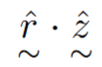
For the radius vector (position vector) what is the image equal too
(Lecture 4, Covered September 15)


For the radius vector (position vector) what is the image equal too
(See LaTeX notes for the other formulas for Points, Planes, and Lines (Lecture 4, Covered September 15)


What is the image equal too
(Built on in Discussion 3, Covered September 16)
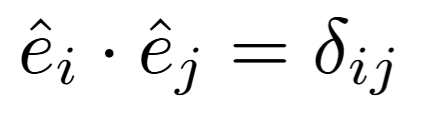

What is the image equal too. Why?
It equals 6 because for every i = j = k, the epsilons multiply too give 0. Additionally, there are 3 pairs of epsilons that equal -1 and 3 pairs that equal 1. so 1 + 1 + 1 + (-1)(-1)(3) = 6 (Chapter 5)
What are the parametric representations of lines
(Lecture 5, Covered September 17)
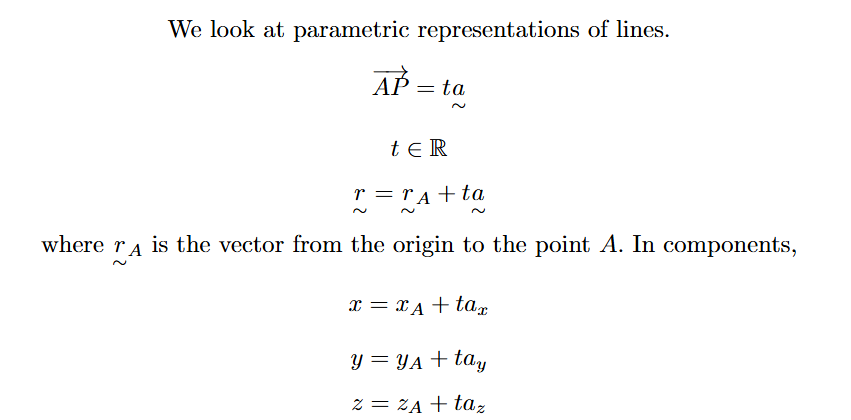
What is the implicit representation of a line
(Lecture 5, Covered September 17)
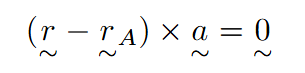
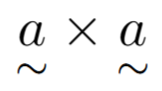
What is a vector crossed with itself equal too
(Lecture 5, Covered September 17)

What is the parametric representation of a plane
(Lecture 5, Covered September 17)
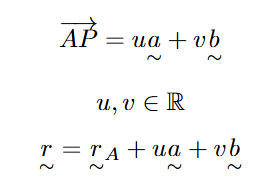
What is the Implicit representation of a plane
(Lecture 5, Covered September 17)

If we look at the parametric representation of a line and implicit representation of a plane, what is the scalar t equal too
(Lecture 5, Covered September 17)

What is the implicit representation of a sphere
(Lecture 5, Covered September 17)

What is the component form of a sphere
(Lecture 5, Covered September 17)

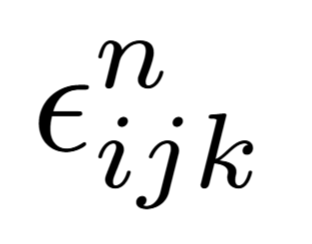
What is the image equal too (Epsilon is obviously the Levi-Chivita symbol)
(Not a lecture. I figured this out myself)

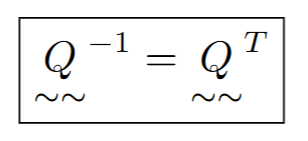
If a matrix is orthogonal, what does that mean
It means the Matrices inverse is equal to it’s transpose (Lecture 6, Covered September 22)
What is the volume of a parallelepiped spanned by vectors a, b, c
(Discussion 4, Covered September 23)

What is the derivative of the magnitude of a vector a
(Lecture 8, Covered September 29)

What is the dot product, a dot b, in index notation
(Preparing For Midterm 1)

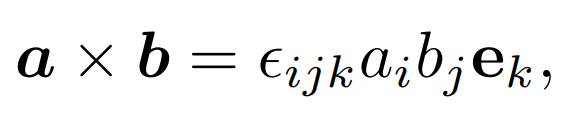
What is the cross product, a x b, in index notation
(Preparing For Midterm 1)

What is the image equal too where A and B are matrices and T denotes the Transpose
You simply invert the order of the matrices and apply the transpose (Preparing For Midterm 1)


What is the image equal too where A and B are matrices and T denotes the Transpose
The sum of the individual transposes (Preparing For Midterm 1)


What is the image equal too
(Preparing For Midterm 1)


What is the image equal too where A and B are matrices
(Preparing For Midterm 1)


What is the image equal too
Kronecker Delta n times is just Kronecker delta (Preparing For Midterm 1)

How do I know if a basis is orthonormal
The vectors must be perpendicular to each other and they must be unit vectors (Preparing For Midterm 1)

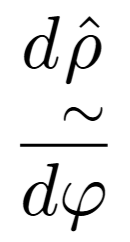
What is the image equal too
(Lecture 9, Covered October 1)
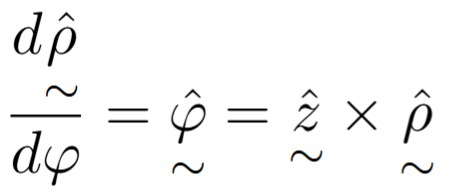

What is the image equal too
(Lecture 9, Covered October 1)

What is angular velocity in terms of phi and \hat{z}
(Lecture 9, Covered October 1)

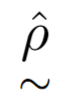
What is the image equal too in Cartesian directions
(Lecture 9, Covered October 1)


What is the image equal too
You simply take the derivative of rho hat with respect to varphi (previous flashcard) (Lecture 9, Covered October 1)


What is the image equal too
(Lecture 9, Covered October 1)


What is the image equal too
(Lecture 9, Covered October 1)


What is the image equal too
(Lecture 9, Covered October 1)


What are the things in the image equal too
(Lecture 9, Covered October 1)


What is Position in the cartesian, in spherical, cylindrical and cartesian coordinates respectively
(Lecture 9, Covered October 1)
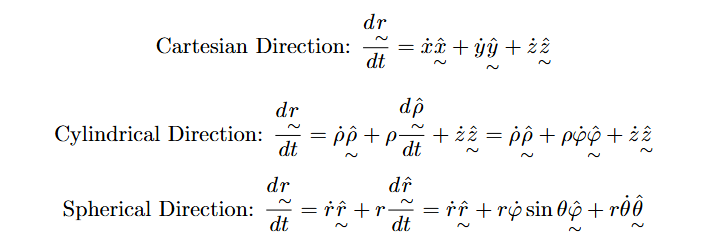
What is Velocity in the cartesian, in spherical, cylindrical and cartesian coordinates respectively
(Lecture 9, Covered October 1)

What is the image equal too in terms of 3 Kronecker deltas being multiplied (formula 5.25 in the book)
The first line (with addition) corresponds to even permutations of (i,j,k) and (l,m,n). You start with (l,m,n) and do odd and even permutations of it and correspond that to (i,j,k) (Preparing For Midterm 1)
