ECE361 Midterm 1: b. Computer Network Architectures
 Call Kai
 Learn
 Practice Test
 Spaced Repetition
 Match
 Flashcards
 Knowt Play
1/40

There's no tags or description
Looks like no tags are added yet.
41 Terms
What are the 6 questions we should ask when defining a computer network architecture?
what services are provided by the network
what services are provided by entities attached to the network
how are resources shared to disseminate (spread) info
how are major hardware components of the system organized and connected
how is software organized
how can user processes running in remote computer communicate using a network infrastructure
what is a connection oriented network service?
one that establishes and path before sending and all data flows along the same path (FIFO)
what are the 3 aspects are needed for a connection oriented service
reliable data transfer: in order delivery, no duplicates or missing data
flow control: do not congest the receiver
congestion control: do not congest the networks
what is a connectionless network service
one that transmits packets independent of path and may follow different routes
what delivery and protocol method do connectionless services use?
no delivery guarantees
end-to-end protocol: each edge requests from the source and its only in charge of itself
routers don’t need to handle flow control, only hosts
what is switching?
how info flow uses multiple nodes and links (routing data)
what is multiplexing?
how multiple info flows into the same link, sharing channel
what are switching methods used for?
allocation of shared network resources and the transport of user data
how does circuit switching work
circuit establishment: a dedicated circuit between intermediary switching centers
data transfer: data can be transferred between the source and destination once the circuit has been established
circuit disconnection: when one of the users initiates the disconnect

what are some of the limitations with circuit switching?
set up phase delay when establishing connections
signaling overhead when ending connections
= introduces a time delay and network traffic
what is multiplexing in circuit switching
sharing a given communication channel among multiple connections
what are the 2 types of multiplexing in circuit switching
frequency division multiplexing (FDM)
time division multiplexing (TDM)
how does frequency division multiplexing in the circuit switching work?
the frequency spectrum of a link (the medium) is partitioned into multiple bands. each connection get its own frequency band. some frequency bands have no connections

how does time division multiplexing in the circuit switching work?
time is divided into frames of fixed duration. frames are divided into fixed number of time slots. connections are assigned to a time slot. connections occupy the same time slot for multiple frames
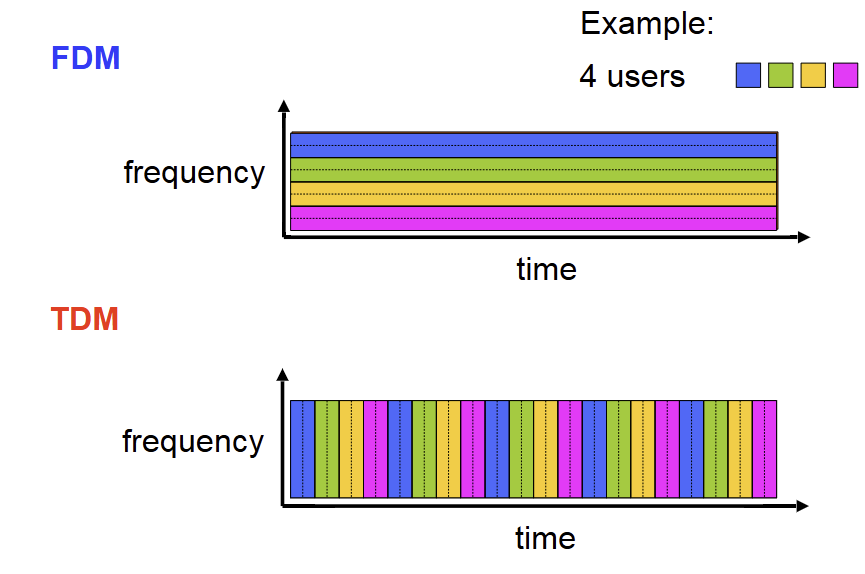
what is the limitation of frequency division multiplexing (FDM) and time division multiplexing (TDM)
users can have silent periods of time, wasting resources
what is message switching
a message is sent as a single unit from one node to another without a dedicated path between the sender and receiver
how does message switching work
message: has a header with information, used for forwarding a message to destination
store and forward: each relay node must store the entire message before forwarding. transmission occurs only if the next link and node are available, otherwise, the message waits in storage until resources are free
resources are shared among different calls (transmissions)

what is statistical multiplexing?
sharing the same communication channel/bandwidth among multiple connections without fixed allocations of the resource to those connections

what is the limitation to statistical multiplexing?
the entire message must be received at a switch before it can be forwarded
what is packet switching
message from the sender is broken into packets: each packet consists of a header and a payload
store and forward: a packet switch stores each packet it receives and determines how to forward it based on the header info
(resources are shared among connections)
what is the benefit of packet switching
packets that are from the same connection can be processed concurrently, saves time
what are datagrams
an approach to packet switching that avoid connection setup delay
how do datagrams work
packet has header with destination, no preestablished path
switch reads packet destination
switch checks routing table
tells packet next hop based on destination
packet is forwarded, routed independently
multiple routes: can also be rerouted if there is an error
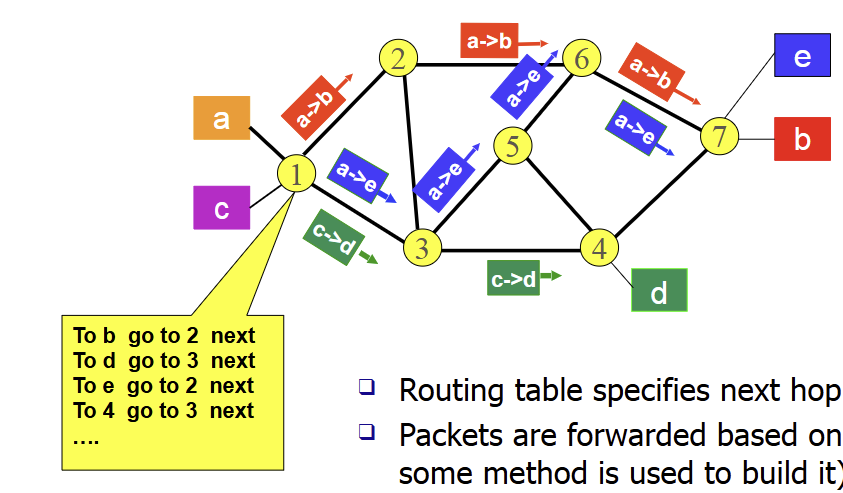
what is the limitation with datagrams
packets can be received at different sequences
what are virtual circuits
approach to packet switching with a preestablished path
how do virtual circuits work
the routing table at each switch is based on the preestablished path, like statistical multiplexing
the packet header specifies which virtual circuit to use
(relative or global names can be used, relative VC names need label switching)

what is ARPANET
first packet switching protocol, uses IMP (interface message processor), or the ARPANET router
what did the beginnings of protocol layering look like?
end nodes didn’t know what was happening in the network (routing)
only considered passive info transfer, not applications (active instructions)
few destinations

how does the layering model work?
partition services and functions into layers
each layer of service is provided by peer protocol entities (nodes following the layers protocol)
identifiers within protocols = identifiers across layers
what is the OSI architecture for protocol stacks?
breaks down flow of info
application: end user services, user interaction
presentation: formatting, encryption, compression of data
session: setup and management of end-to-end dialogue and connection
transport: end-to-end delivery of messages to processes, arrival in right order, reassmbles, retransmits
network: end-to-end transmissions (of packets) in net, routing, assigns IP address
link: makes sure data moves smoothly between devices of the same network (MAC and LLC)
physical: transmission of bits over physical media
what is payload
data
how does encapsulation work at each layer
each layer needs this to process the payload from the previous layer
application: high level control information for request
transport: utilize datagrams, read control info
network: add source and destination for routing, go through routers, forward info from client → router → server
link: take network layer payload, deal with packets (IP addresses) → frames (MAC addresses)
physical: info bits are sent with a waveform receiver, decodes

what is the internetworking architecture?
application layer: http, email, etc.
transport services: routing, …
transport layer: UDP, TCP
network layer: IP, …
link layer: ethernet, wifi, optical fiber, …
what defines networking interconnection? (5)
heterogeneous transmission media
heterogeneous hardware & OS
common address space used to identify where a host/router is connected to the internetwork
common protocol for all gateways (hardware/software program that acts as an entry and exit point between different networks) and hosts
common protocol used for data transfer and signalling
how was the internet a big ARPANET?
destinations are attached to routers
routers speak for destinations, one router per destination — assumes a destination has a single instance
host to IMP → IP
IMP to IMP → TCP
host to host → UDP
router: “i want popcorn“
other router: “i am the only one whos has popcorn“
how does the ip internet work today?
networks are organized into autonomous systems (different networks can run different protocols)
routers run IP to forward data packets
multiple routers for a source/destination network
router: “i want popcorn“
other router: “they have popcorn“ → points to network
ex. of internet use, how do you get a page from the web?
computer (client) and attached router are configured
host and router communicate through a LAN (local area network) or point to point link
data is broken into packets, router over links, computer for routing, and networks
host obtains IP address of remote server
client starts end to end reliable connection with remote server and starts exchanging messages
Must the Internet Protocol (IP) be used at the network of any computer network layer as packets flow across networks from their origins to their destination?
No, it is currently the norm as no translations are needed and it uses one network layer protocol
What advantage do you think is attained by using IP at the network layer of the networks that constitute the Internet?
Uses only IP for packet switching instead of multiple protocols
What is the importance of having a transport layer with respect to application developers
Application developers do not have to redesign the services provided by the transport layer for each new application
Why do you think routing tables today [for datagram-based packet switching] state simply the next hop towards an intended destination address?
memory was expensive