3) Decision Neuroscience
 Call Kai
 Learn
 Practice Test
 Spaced Repetition
 Match
 Flashcards
 Knowt Play
1/35

There's no tags or description
Looks like no tags are added yet.
36 Terms
what are the two observation of the modern field of decision neuroscience (2)
patients with vmPFC lesions show poor judgement and risky decision making in the real world
behavioural neuroscience studies show that during pavlovian conditioning, dopamine neurons fire to unexpected rewards and conditioned stimuli that predict reward
Damasio’s patient EVR (2)
formerly a pillar of society, a store manager/ accountant, husband and father
had a frontal lobe tumour that was detected early and had surgery to remove it
Damasio’s patient EVR post operative recovery (7)
above average IQ, memory, perception
no psychiatric symptoms
performed well on neuropsychological assessment, including traditional tests of frontal lobe damage
but he made many poor real life decisions
unreliable employee, fired from jobs
questionable business ventures that led to bankruptcy
erratic personal life, got a divorce and moved back with parents
what is brain damage to the vmPFC linked to (4)
real life decision making deficits
where choices offer immediate gratification but with long term negative consequences
patients failed to learn from their mistakes
myopia for the future, shortsighted in their choices
Iowa gambling task (4)
given 100 choices from 4 decks of cards
decks A and B are risky outcomes, they have high immediate reward but very high long term punishment, have a net loss (e.g. win $100 or pay $250)
decks C and D are safe outcomes, they have low immediate reward but minimal long term punishment, have a net profit (e.g. win $50 or pay $50)
net score = safe choice (C/D) - risky choices (A/B)
results of the Iowa gambling tasks on normal vs brain damaged patients vs EVR and EVR patient type (2)
normal and brain damaged patients do well and choose the safe choice options
at the start, they are drawn to the higher rewards but after a few trials, they realise that the penalties are not worth and chooses the safe deck
EVR and EVR patient type, the target subjects at the end, they are still choosing the risky desks
ecological validity of the Iowa gambling task (3)
it lacks a wager as nothing it put forward
it lacks a real incentive
there is no pure chance as it is a learning task
arousal and risky decision making in Iowa gambling task (4)
tested using skin conductance, sweating from fingertips to measure the somatic markers
healthy ppts show skin conductance responses to winning and losing outcomes and develop anticipatory responses before card choices esp to the risky desks
patients with vmPFC damage show outcome responses to wins and losses but do not develop anticipatory responses before their choices
patients with amygdala damage struggle to mount any psychophysiological responses to outcomes or choices
brain structure in people with gambling problems
structural MRI in people with gambling disorder shows differences in morphology, sulcus and gyrus folds in the orbitofrontal cortex
developmental changes in preferences for risk (2)
adolescents are widely assumed to be high risk takers where there is a non linear effect, driven by a neurobiological imbalance, where there is a mature system and immature frontal control system
but research actually indicates a gradual decline and improvement in risk taking as they get older

what are the 2 dopamine pathways
nigro striatal pathway
meso limbic pathway
nigro striatal pathway (2)
starts at the substancia nigra and to the striatum
the pathway that degenerates in Parkinson’s disease, affecting movement

meso limbic pathway
starts at the ventral tegmental area (VTA) to nucleus accumbens, that is part of ventral striatum that processes reward
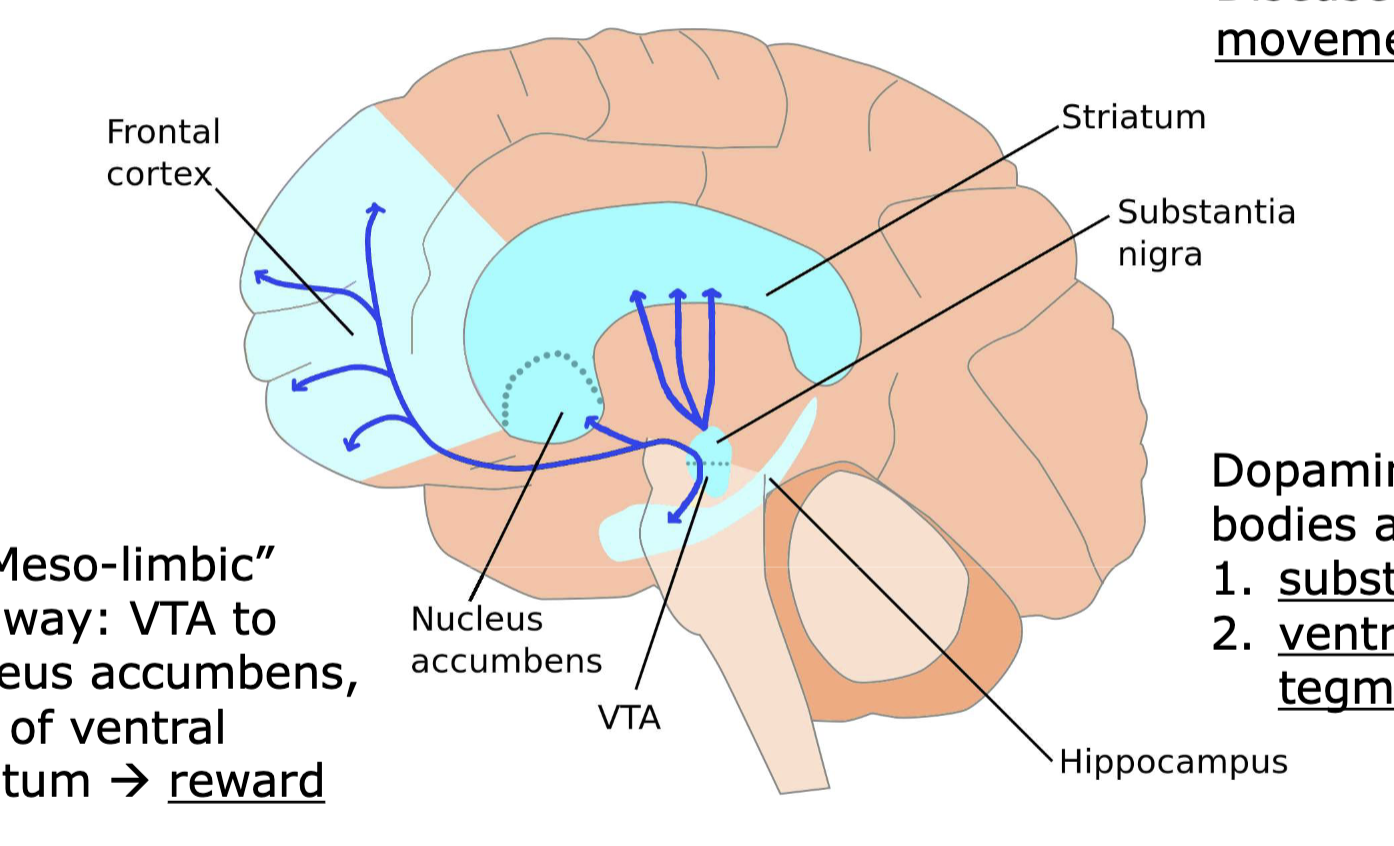
where are dopamine cell bodies located in the brain (2)
substancia nigra
ventral tegmental area
Schultz’s study on dopamine and reward learning (4)
during appetitive pavlovian conditioning, midbrain dopamine neurons signal prediction errors
early in the task, phasic responses follow the juice
with learning, the phasic responses shift to the conditioned stimulus, picture that predicts reward
from this point, the dopamine cells no longer fires to the reward itself
what is the modern view on dopamine
changed from pleasure to motivation, information, prediction, learning and driving behaviour
how do we record individual cell in brain and measure dopamine in humans
using functional MRI
functional MRI (3)
not measuring dopamine directly but through blood flow response
relies on oxygenated and de oxygenated blood having different magnetic properties
has good temporal resolution as blood flow changes every 2- 7s
conclusion of fMRI research on reward system
in each research, see ventral striatum responding to different kinds of rewards
reward system in social media use (4)
social media is a complex platforms where ppl can post, receive feedback, observe, provide feedback or compare
interested in which part of the brain responds to positive description of yourself vs other three condition
sees correlation with brain areas that responds to pairing of positive words with yourself and real world weekly facebook use
people who used facebook more show stronger response to positive reputation words and photos of themselves
study on instagram likes and brain areas
found that ventral striatum activity increases with number of likes on posted photos supplied by the participants compared to neutral and risky images
regulatory pressure on social media (4)
concerns dating back to 2019 regarding infinite scroll, auto play and personalised recommendations
some platforms offer de- metricating options, removing numbers and metrics
EU digital services act require risk assessment to be submitted for any design changes to large online platforms
recent major us lawsuit against meta
gambling in parkinson’s disease (4)
ppl with parkinson’s disease have dopamine neurons that are degenerated
dopamine agonist medications can trigger excessive gambling as a side effect
most linked to 2 drugs, pramipexole and ropinirole that bind to dopamine D3 receptors
other side effects include impulse control and reward problems
Winstanely - rat gambling task (3)
rat is in a skinner box with several holes where the rat can poke their nose to make a choice where a light will light up when choice is made
to translate IOWA to rats, switched money to food pellets, rats got 1-4 pellets depending on the hole, probability also exists with the holes (e.g. hole with 1 food pellet has a higher probability of reward and hole with 4 food pellets has a lower probability of reward)
penalties is time out where the box goes dark and nothing works in the box, length depends on the choice of hole
Barrus and Winstanley - extension of rat gambling task (5)
made changes to the tasks by adding bells and whistle
cued condition: when it wins food pellets, there are flashing bulbs and chimes, intensity differs with number food pellets
uncued condition: original version of rat gambling task
found that adding audiovisual feedback reduced preference for the best “deck”, it was harder to determine the best option but in uncued condition they selected the best option
injecting dopamine D3 agonist had a dose dependent effect of reducing choice of option 2 and increasing choice of option 3, the risky choice
value function - win $10 vs pay $10 (2)
the function is steeper in the loss domain compared to the gain domain
so losses dominate over gains
why is there a bias for losses dominating gains in our decision making
as species who are foraging in environments with scare resources, there is a drive to protect what we have and gain if there is an opportunity
endowment effect (3)
a cognitive bias where people assign a higher value to objects simply because they own them
asked students to choose how much money to sell mug after receiving it during the summer vs just asking how much they are willing to pay
value of willingness to sell is greater than value of willingness to pay
loss aversion
a cognitive bias where the psychological pain of a loss feels roughly twice as intense as the pleasure of an equivalent gain
Shiv et al - investment task (4)
asked 20 times if they want to invest $1 on coin flip, heads lose investments vs tails win $2.50
EV is positive and would make a profit if they say yes
but healthy participants say no to alot of gamble as they are loss averse and don’t want to lose the $1
target patients, vmPFC/ amygdala/ insula damage make higher profits and accept the investment because they lack emotional response to loss aversion
De Martino - loss aversion in amygdala (5)
looked at the effect of the amygdala on loss aversion
looked at 2 rare patients with urbach wiethe disease which is a rare genetic disorder where calcium deposits cause selective amygdala atrophy
does a whole series of loss aversion exercise
both would accept gamble even when there is a lower EV value whereas control would only accept gamble when there is a high positive EV value
amygdala damage show abolished loss aversion therefore showing its importance of amgydala in this effects
two theories of vmPFC function
Damasio/ Bechara - somatic marker hypothesis
Kable and Glimcher - valuation perspective
somatic marker hypothesis (2)
vmPFC retrieves emotional memories from similar decisions made in the past to guide decisions making
emphasises physiological signals in the body
valuation perspective (2)
vmPFC contains information about subjective values, utilities of objects or actions
emphasises brain signals, no view on the body
Plassmann et al - willingness to pay study (5)
auction tasks, bidding for food they like
free bid trial where they can bid whatever
control condition where they are told what to bid
looked at brain activity while deciding what to bid and how much you actually bid
vmPFC correlates with economic willingness to pay
meta analysis of fMRI studies of subjective value (3)
fMRI signals in vmPFC scales with subjective value as well as expected and delayed value
vmPFC converts outcomes into a common neural currency that allows us to make our decisions
vmPFC is also more interested in choices than outcomes