BIOL 207 Lecture 6 - Foundations in Classic Genetics (Questions)
 Call Kai
 Learn
 Practice Test
 Spaced Repetition
 Match
 Flashcards
 Knowt Play
1/14

There's no tags or description
Looks like no tags are added yet.
15 Terms
What are the two cases of hemizygotes?
Deletion, where the gene locus on one homologous chromosome is deleted
Naturally occurring in males (XY), where gene loci/alleles for X-linked traits are only present in one copy on the X
Explain how dominant and recessive are relative terms.
Used always in relation to another allele (matter of perspective)
Ex. codominance or incomplete dominance: an allele may be expressed dominantly compared to a null allele, but compared to a different mutant allele it may not have complete dominance anymore
What types of dominance/alleles are needed for haplosufficiency? Haploinsufficiency?
Haplosuffiency: complete dominance. Only one allele when paired with any other mutant or null allele will result in the wt phenotype
Haploinsufficiency: codominance/incomplete dominance. Only one allele when paired with an equally dominant mutant allele will not result in the wt phenotype, must be two copies of the allele for wt phenotype
What is the phenotype of hemoglobin in regular blood cells? What is the phenotype of sickled blood cells?
HbA/HbA = normal
HbA/HbS = some blood cells sickled under low oxygen conditions
HbS/HbS = fatal sickle cell anemia
Compare the phenotype HbA to HbS. What causes HbS to sickle?
S mutation is identical to A version, except for a point mutation that changes the glutamate on A to be encoded as a valine instead. Polarity changes, valine’s nonpolar nature causes sickling + chains of Hb to be formed
Explain the dominance pattern of HbA and HbS on the cellular level, organism level, and the protein level.
Organism: heterozygotes of HbS do not show the sickle phenotype → complete dominance
Protein: both S and A forms of hemoglobin are produced in equal, distinct types and amounts regardless of whether there is anemia → codominance
Cellular: blood is made up of slightly sickled cells and normal-looking cells (is a blended phenotype of the two) → incomplete dominance
Wild type alleles are more often (dominant/recessive) over mutated alleles.
Dominant
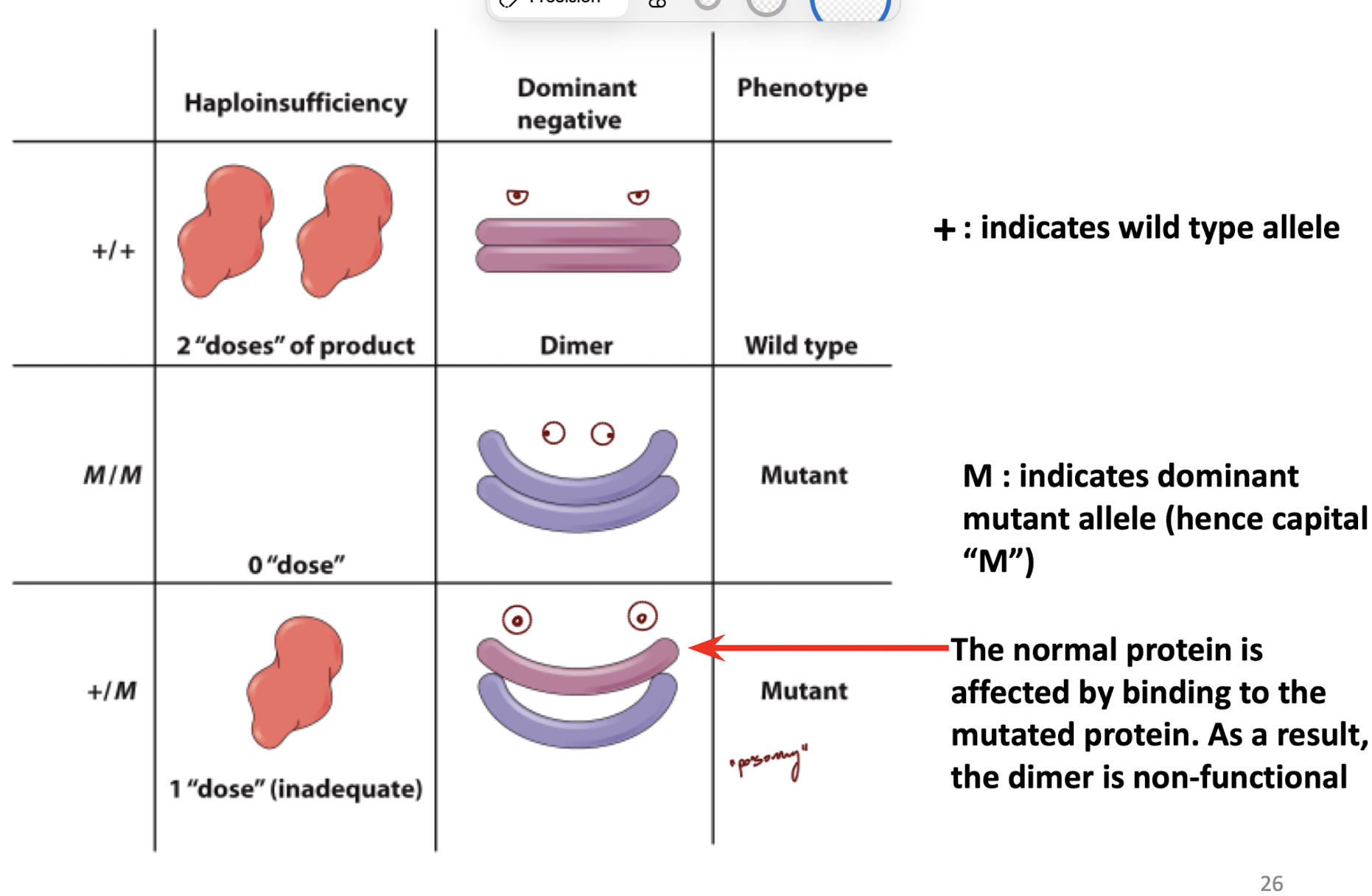
In what cases will a mutated allele be dominant over or change the dominance of the wild type allele?
Haploinsufficiency of the wt allele
Dominant negative effect: mutant creates gene product that prevents gene product of wt from correctly functioning
Gain-of function effect (not shown)
What is the cause of each form of allele defect?
Amorph: any mutation that removes the function of a gene (entire gene deletion, missense/nonsense mutations that change its function)
Hypomorph: mutations in regulatory elements (changes how much the gene is expressed), small point mutations that inhibit gene product formation slightly
Hypermorph: mutations in regulatory elements (changes how much the gene is expressed), small point mutations in coding regions that cause hyperactivity
Neomorph: mutations affecting structure (enzyme affinity sites), regulatory region mutations activating genes in the wrong tissues or at the wrong times, translocations that create hybrid genes
Antimorph: formed protein may cause non-functional dimers with the wild type protein
Do porphyria patients have completely amorphic heme production? Explain.
No, no heme production would be fatal. At least one allele must have some activity
Heterozygous amorphic/hypomorphic or heteroallelic
The most common myostatin mutations in sheep are point mutations in noncoding DNA, while in cattle they are nonsense mutations in coding DNA. Classify the myostatin allele mutations by animal and their subsequent effects.
Sheep: protein formation is suppressed but still formed → hypomorph. More muscular breed of sheep
Cattle: protein formation is stopped completely → amorph. Severe double muscling in cattle
Compare neomorphs and hypermorphs.
Both “gain of function” mutations
Hypermorph: gene product did not gain any new property, is just produced at a higher level than normal due or is more active when produced. Must be produced in a cell where they normally occur. Gain of function = gained the ability to repress gene production more
Neomorph: acquired function or changed function from the wild type, gaining new properties. Can be produced where it does not normally occur. Gain of function = gain of different properties (structure, production, etc.)

Describe the complementation test conclusions on the following test for a wild type phenotype offspring as well as a mutant phenotype offspring.
Mutant: must mean that the two studied genes are found on the same gene loci and are the same mutation. The offspring has no copies of the wt allele and thus the phenotype is not expressed → the offspring fail to complement
Wt: must mean the two studied (heteroallelic) genes are found on different gene loci and are not the same mutation. The offspring must still have a copy of the wt allele in order for it to be expressed, which would not be possible if both copies of the mutant gene are the same → the offspring complement

What would the phenotype of the F1 generation be if a parent with Solomon Island blond hair was crossed with Swedish blond hair?
F1 should not be black hair
Swedish and Solomon Island blond is found on different genes, each represents a loss of function mutation on a different gene. Would complement one another

Describe the difference in regular gene functioning for Solomon Island blond and Swedish blond.
Solomon island: TYRP1 disrupts the MC1R pathway so that eumelanin production is inhibited → blonde comes from pheomelanin
Swedish: KITLG expression does not rely on arrival of a melanocyte, there is no production of eumelanin or pheomelanin