Research Tax - Chapter 2: Tax Research Methodology
 Call Kai
 Learn
 Practice Test
 Spaced Repetition
 Match
 Flashcards
 Knowt Play
1/15

There's no tags or description
Looks like no tags are added yet.
16 Terms
Steps to Research
Establish the Facts
Identify the Issues
Locate Authority
Evaluate Authority
Develop Conclusions and Recommendations
Communicate Recommendations
The Citation System
Step 1: Establish the Facts
Compile and evaluate significant facts surrounding the issue.
• Client’s tax entity
• Client’s personal (family) situation
• Client’s past, present, and projected marginal tax rates
• Client’s legal domicile and citizenship
• Motivation for the transaction
• Related party involvement
• Client’s special tax status
• Whether transaction is proposed or completed
Step 2: Identify the Issues
Research issues can be divided into two major categories
− Fact issues—information with objective reality
Dates and amounts and reasonableness, intent, or purpose
− Law issues—unclear how tax law applies
Possible conflict between IRC sections or no provision found that addresses the client’s specific issue
Collateral estoppel bars relitigation on the same facts or the same issues; therefore, it is critical to identify all issues surrounding the original case.
Step 3: Locate Authority
• Primary authority—original pronouncement that comes from statutory, administrative, or judicial sources.
Statutory—the U.S. Constitution, tax treaties, and tax laws passed by Congress
Administrative—various rulings of the Treasury Department and the IRS, which are issued in the form of regulations, revenue rulings, and other pronouncements
Judicial—collected rulings of the various courts on federal tax matters
• Secondary authority—interpretations of primary authority; useful when there is conflicting primary authority or there appears to be no extant primary authority, or clarification is needed.
Tax services, journals, textbooks, treatises, newsletters
Step 4: Evaluate Authority
• Different authorities may suggest different treatments.
Court decisions may often need to be evaluated in comparison to IRS pronouncements.
Different authorities have different precedential values.
• Evaluation of authority can lead to identification of new issues.
The researcher may be required to gather additional facts, find additional pertinent authority, and evaluate the new issues
Step 5: Develop Conclusions and Recommendations
• May have no single “best” alternative.
Alternatives must be considered.
The client’s preferences must be considered.
The “ideal” solution may be impractical.
• Recommendations should include alternatives.
If open-fact situation (client has opportunity to change actions), practitioner might detail several alternative courses of future action
Step 6: Communicate Recommendations
• Memo to client file and letter to client (memo to client file usually contains more detail)
Restatement of pertinent facts
Any assumptions researcher made
The issues addressed
The applicable authority
The practitioner’s recommendation
Step 7: The Citation System
• Citations are a shorthand system of documentation that helps the researcher pinpoint the specific location of the relevant text in the specified authority.
In citing an IRC section, the researcher must provide not only the section number but also the subsection, paragraph, subparagraph, and clause if applicable.
The typical citation for a case includes the names of the parties in the case, the volume number and abbreviation of the reporter, a page number showing where the case begins, and the year in which the opinion was issued.
• Documents preparer’s research
• Signals to reader the level of authority relied upon
Conducting Tax Research Using Online Services
• Primary benefit of online tax service is ability to query vast amount of data.
• Skill is in narrowing search terms and sources searched to thoroughly and efficiently produce valuable research.
• Commercial services may allow researcher to link to decision or ruling immediately upon release.
• When choosing among online commercial services, include availability of editorial materials, focus on specific topics, and customer support and training.
Using Commercial Online Tax Service to Conduct Research (for Step 3)
Step 1: State the Issue as a Question
Step 2: Identify the Keywords
Step 3: Construct a Research Query
Some services have “natural language” search feature (using normal sentence structure).
Queries allow wildcard “*”.
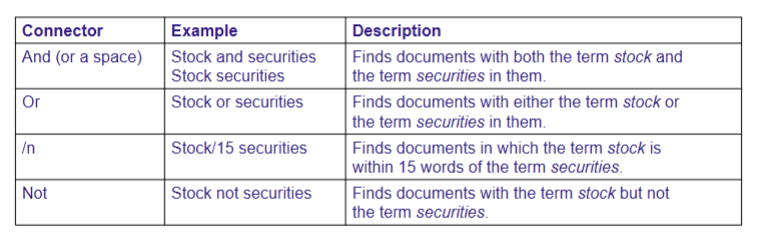
Search connectors such as “and,” “or,” “not” are critical.
Step 4: Select Sources and Execute Search
Step 5: Interpret and Refine Search
Selected Checkpoint Search Connectors
Tax Research Practical Considerations
• Engagement Time Cost
Research is an expensive service for client
Must determine if research brings value to client
• Potential Tax Liability Involved
Important to assess cost–benefit of research projects in light of the potential tax liability exposure
• Accuracy Threshold
Need for definitive, completely accurate answer weighed also with cost–benefit analysis
• Ethics
Need for overriding consideration of ethical standards required to support tax return positions
Research and Tax on the CPA Exam
(1) financial accounting and reporting (FAR), (2) auditing and attestation (AUD), and (3) taxation and regulation (REG)
Taxation and Regulation (REG)
(1) Ethics, Professional Responsibilities and Federal Tax Procedures,
(2) Federal Taxation of Property Transactions,
(3) Federal Taxation of Individuals
(4) Federal Taxation of Entities
Ethics, Professional Responsibilities, and Federal Tax Procedures area of the REG
• Ethics and Responsibilities in Tax Practice—Requirements based on Treasury Department Circular 230 and the rules and regulations for tax return preparers
• Licensing and Disciplinary Systems—Requirements of state boards of accountancy to obtain and maintain the CPA license
• Federal Tax Procedures—Understanding federal tax processes and procedures, including audits and appeals, appropriate disclosures, substantiation, penalties, and authoritative hierarchy
• Legal Duties and Responsibilities—Understanding legal issues that affect CPAs and their practices
Tax Compliance and Planning (TCP)
− Tax Compliance and Planning for Individuals and Personal Financial Planning,
− Entity Tax Compliance
− Entity Tax Planning
− Property Transactions (disposition of assets)