3.4.6 Biodiversity within a community
 Call Kai
 Learn
 Practice Test
 Spaced Repetition
 Match
 Flashcards
 Knowt Play
1/6

There's no tags or description
Looks like no tags are added yet.
7 Terms
Biodiversity
-This refers to the variety of organisms in an area
-Habitat - The place where a species lives within an ecosystem.
-Community - The living organisms of all species found in a particular ecosystem at a particular time.
-Ecosystem - A relatively self-contained, interacting community of organisms and their environment.
-Levels of biodiversity:
Ecosystem diversity (habitat diversity) - The number of habitats.
Species diversity - The number of species and the number of individuals in each species.
Genetic diversity - The variation in alleles within a population of a species.
Interspecific and intraspecific variation:
-Variation refers to differences between individuals.
-Interspecific variation:
This is variation between different species.
It is due to different genes causing differences in physical traits, adaptations, habitats, etc. and environmental factors like climate, diet, lifestyle, etc.
-Intraspecific:
This is variation between individuals within a species.
It is due to different alleles (gene variants) and environmental factors.
Species richness and species evenness: measures of biodiversity:
Species richness:
The total number of different species in a habitat.
It is quantified by taking random samples and counting the species present.
A higher species richness indicates greater diversity.
Species evenness:
A comparison of the numbers of individuals of each species in a community.
It is measured by taking samples and counting individuals of each species.
More even abundances mean higher species evenness and diversity.
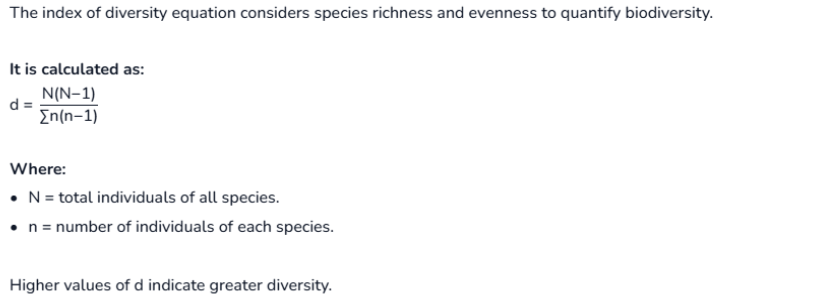
Index of diversity
a mathematical measure of species diversity in a community that incorporates both species richness (the total number of different species) and species evenness or abundance (the relative population size of each species)
impacts of growing human population on biodiversity
Deforestation for development destroys habitats and reduces ecosystem diversity.
Overuse of resources causes certain species to decline or go extinct, reducing genetic and species diversity.
Urban sprawl isolates wildlife populations, limiting breeding and decreasing genetic diversity.
Pollution kills species directly and harms habitats long term.
Agricultural practices reducing biodiversity:
Monocultures - This involves growing single crops over large areas, typically without crop rotation, directly decreasing the diversity of plants and of species that depend on them for food or a habitat. Monocultures also deplete the nutrients from soil.
Converting woodland and hedgerows into fields - This decreases numbers of trees and other species, and destroys habitats relied on by many species.
Filling in ponds, draining marshes, over-grazing of land - This directly destroys habitats and reduces species diversity.
Removing weeds with herbicides - This may harm other species or those that depend on target species.
Using pesticides to kill crop pests - This may harm other species or those that depend on target species.
Using inorganic fertilisers - These may runoff into water courses, causing issues for aquatic species.
Effects of climate change on biodiversity:
Different regions experience changes in temperature and rainfall, and most species are adapted to specific climates.
Changed conditions will make certain areas more or less habitable in general.
Suitable habitats for some species will expand or contract e.g. melting polar ice caps removes a habitat for all polar animals.
Changing climate conditions may influence species distribution and migration.
Slow-moving species may become extinct if change is too rapid or severe.
If conditions in general become warmer, tropical diseases will be more likely to spread.
Rising sea levels may lead to more frequent flooding of terrestrial habitats in low-lying land.