Hematology I Introduction into Heme
 Call Kai
 Learn
 Practice Test
 Spaced Repetition
 Match
 Flashcards
 Knowt Play
1/45

Earn XP
Description and Tags
CLS 356 Unit 1 - 8/26/2026
46 Terms
What are the 4 humors?
Black bile, blood, phlegm, and yellow bile
How much blood does a normal adult have?
6 liters or about 7-8% of body weight
What percentage of the blood is plasma?
~55%
What is the liquid component of blood?
Plasma
What are the cellular component of blood?
RBCs, WBCs, and PLTs
What is the difference between serum and plasma?
Plasma has clotting factors and serum does not
What is the composition of plasma?
Water, ion, and proteins
What is the function of plasma?
Acts as a transport medium for cell nutrients and metabolites
What is the function of WBCs?
Defense against foreign antigens such as bacteria and viruses
What is the function of RBCs?
Contains hemoglobin which transports O2 and CO2
What is the function of PLTs?
Necessary for hemostasis
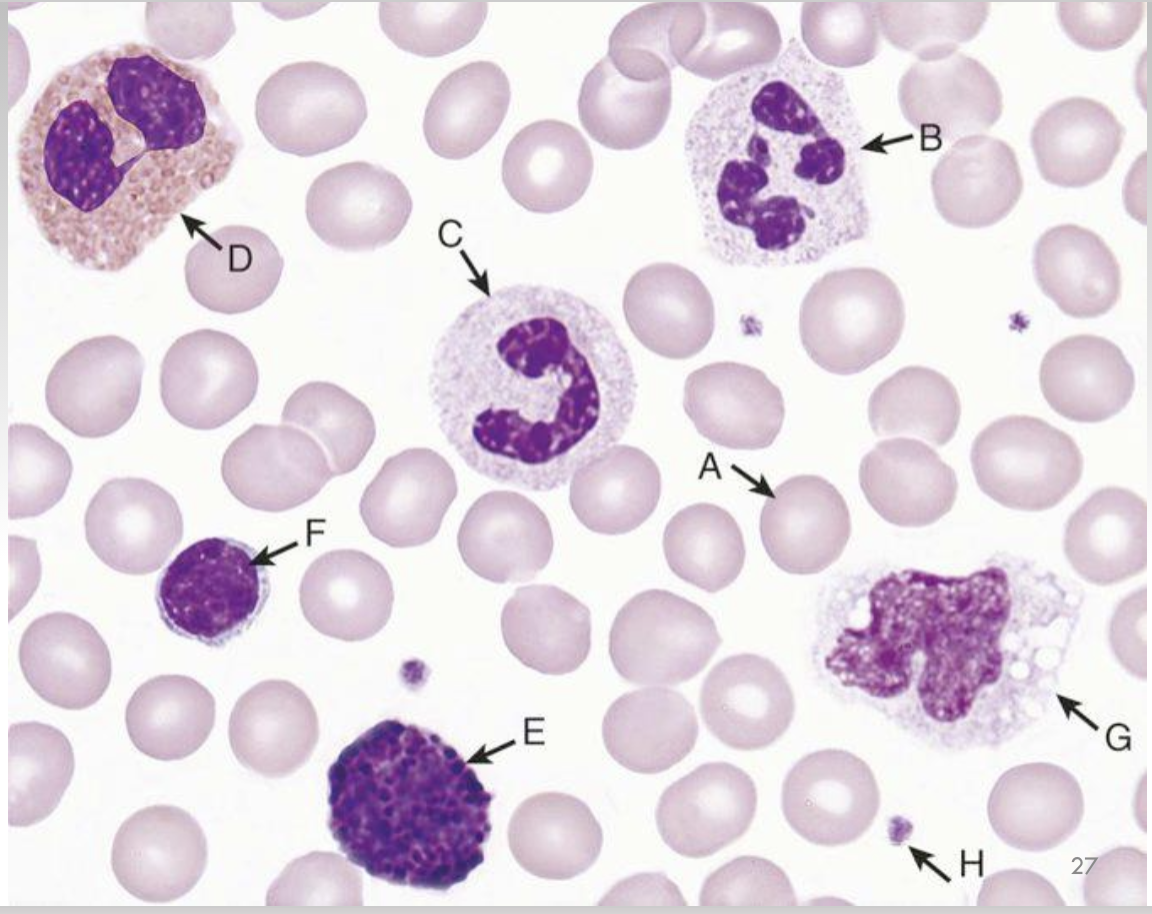
What are these cells?
A is an RBC, B is a segmented neutrophil, C is a band neutrophil, D is an eosinophil, E is a basophil, F is a lymphocyte, G is a monocyte, and H is a PLT
What does a CBC quantify?
WBCs, RBCs, Hgb, HCT, PLTs, RBC indices, and WBC diff
When do pathological changes occur?
As a result of injury or disease
What is reflex testing?
Follow-up testing due to the results of screening tests
Why is reflex testing important to a lab?
The laboratory must design reflex testing protocols for common diseases (AKA algorithms)
What is a decrease in RBCs?
Anemia
What is a increase in RBCs?
Polycythemia
What reagent is used for Hgb assay?
Drabkins reagent
What does Drabkin’s reagent do, and what wavelength is it run on?
Converts Hgb to cyanmethemoglobin, which is read at 540 nm
What is a HCT?
Ratio of the volume of RBCs to the volume of whole blood
What is the mean corpuscular volume (MCV)?
Reflects RBC diameter
What is the mean corpuscular hemoglobin (MCH)?
Reflects hemoglobin mass
What is the mean corpuscular hemoglobin concentration (MCHC)?
Reflects RBC pallor
What are reticulocytes?
Young RBCs that contain RNA
What range do retics make up of the RBC population?
1 - 2%
What is the appearance of the reticulocyte?
Slightly larger in diameter that stain slightly blue-gray

What cell is this?
Reticulocyte
How are cell counts perfromed?
Visually with a microscope and hemocytometer or using an automated profiling instrument
What are the 5 types of WBCs?
Neutrophils, eosinophils, basophils, lymphocytes, and monocytes
What is a decrease in PLTs?
Thrombocytopenia
What is a increase in PLTs?
Thrombocytosis
What is hemostasis?
Process of forming blood clots to stop blood loss
What are the stages of hemostasis?
Primary, secondary, and fibrinolysis
What is required for homeostasis?
PLTs, blood vessels, and proteins
What is thrombosis?
Bleeding or abnormal clotting
What are homeostasis screening tests?
PLT count, prothrombin time (PT), and activated partial thromboplastin time (APTT)
What is the common tube type for hematology?
EDTA purple tube
What is in the purple tube and what does it do?
EDTA (ethylenediaminetetraacetic acid) that binds calcium
Is a green top tube commonly seen in hematology?
No
What is in the green tube and what does it do?
Sodium Heparin which stops/slows the action of thrombin
What is hematology quality assurance?
All of the processes that are done to ensure an accurate result
What is hematology quality control?
A part of quality assurance that is used for assay validity and accuracy
What is the pre-analytical component of lab testing?
All aspects of testing that occur prior to the testing
What is the analytical component of lab testing?
All factors that affect test procedures
What is the post-analytical component of lab testing?
All factors taht affect testing after completion of the test