Cell Bio: Chapter 29- Transcription
 Call Kai
 Learn
 Practice Test
 Spaced Repetition
 Match
 Flashcards
 Knowt Play
1/20

There's no tags or description
Looks like no tags are added yet.
21 Terms
Which way is DNA read in transcription?
3’ to 5’
Which way is RNA synthesized in transcription?
5’ to 3’
Template v Coding Strand
Template: strand that is used as template for RNA polymerase to make mRNA
Coding: strand is that almost identical as mRNA but doesn’t contain U’s
What are the four steps of transcription?
RNA Polymerase binds to DNA
Initiation
Elongation
Termination
What are the different parts of RNA polymerase?
Holoenzyme: contains all 5 subunits: 2 alpha, beta, beta prime, and sigma factor
Core enzyme: contains 2 alpha, beta, beta prime
What does the sigma factor do?
Helps RNA Pol bind to specific start sites of DNA
What are rNTPs?
Building blocks for RNA (ribonucleoside triphosphates)
If core enzyme, DNA and rNTPS added in vitro, whats happens? How does also adding the sigma factor change it?
In vitro: makes random RNA sequences that don’t match RNA seen in vivo
Adding sigma factor makes correct RNA
Promoter
Conserved sequences upstream of start site (+1)
-35 sequence: TTGACA
-10 sequence (Pribnow box): TATAAT
Sigma factor binds to promoter sequences which positions RNA polymerase at start site properly
In some genes alpha subunit can bind to upstream element

What are the steps of initiation (prok)?
RNA Pol unwinds small section of DNA to expose template
rNTPs diffuse randomly into active site on RNA Pol.
When first rNTPs H-bond to bases on template, RNA Pol. catalyzes phosphodiester bond between them
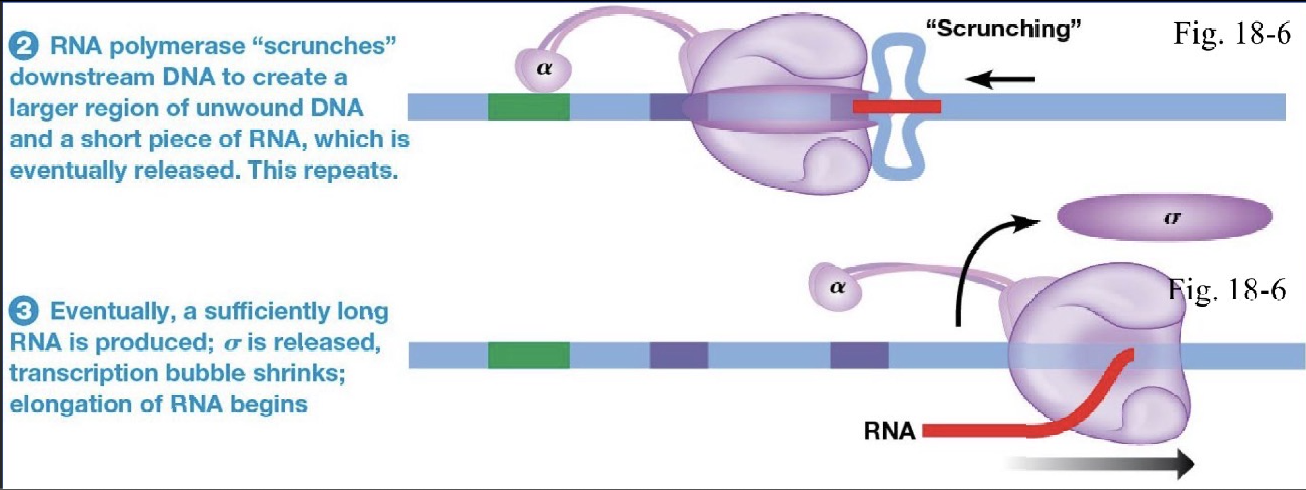
Beta and Beta’ subunits pull DNA toward polymerase, unwinding 20-25 bp, which is called scrunching and the polymerase waits for another rNTP to H-bond to the next base
RNA Pol. makes short RNA fragments (8-9 nucleotides) and release them, which is called abortive synthesis; repeats many times
When a fragment of 10 nucleotides is produced- polymerase detaches from promoter and releases sigma factor and begins to move along DNA
Elongation
rNTPs diffuse quickly and there is a 25% chance that the correct rNTP has diffused and will bind to correct base
A short DNA/RNA hybrid (8-9 nucleotides) forms and stays
RNA Pol. has weak proofreading ability but can still remove incorrect nucleotides
What are thet wo types of prokaryotic termination signals?
GC rich Poly A (guanine cytosine rich poly adenine)
Dependent on rho factor
GC rich Poly A
*GC has a 50% stronger bond than AU because GC has three bonds but AU has 2 bonds
RNA Pol transcribes self complementary sequences (fold in on itself) on DNA which forms a GC rich hairpin loop
Hairpin causes RNA Pol to pause as it transcribing A region on DNA that makes weak A-U region
Hairpin causes tension on AU region and that promotes detachment of RNA from template
Hairpin has a long trail of U’s

Rho factor
Rho factor is a protein that follows RNA Pol. as it moves down DNA
Recognizes termination signal in RNA and causes dissociation between RNA Pol and DNA
What do eukaryotic RNA polymerases synthesize?
RNA Pol 1: synthesizes rRNA fragments
RNA Pol 2: synthesizes pre-mRNA, snRNA, and microRNA
RNA Pol 3: synthesizes tRNA, and small RNA
What is RNA Pol 2 made out of and what does it bind to?
Made of 10 polypeptides
Binds to general transcription factors
Binds to core promoter
What are the different parts of the TATA Driven Core Promoter?
BRE: TF2B recognition element
TATA Box
Inr: Initiation Sequence
(all consensus sequences)
What are the different parts of a DPE Driven Core Promoter?
Inr: initiation sequence
DPE: downstream promoter sequence
What is the pre-initiation complex and how is it formed?
It is the group of general transcription factors that need to bind to the DNA to start transcription
First TF2D binds
Contains TBP (TATA-binding protein) and binds to the TATA box in TATA-driven promoters
TBP binding causes DNA to bend 80 degrees
Also binds to DPE in DPE-driven promoters but doesn’t use TBP for that
Next TF2A and TF2B bind next
Then TF2F and Rna Pol. 2 bind
Last TF2E and TF2H bind
TF2H: Contains helicase activity to unwind DNA and kinase activity to phosphorylate and activate RNA Pol. 2
C-Terminal Domain (CTD)
In RNA Pol 2
Contains heptapeptide sequence w/ tyrosine, serine, threonine and proline
Serine and Threonine are targets for phosphorylation
Proline prevents stable folding of CTD, which gives kinases easy access for phosphorylation
Phosphorylation of CTD by TF2H activates polymerase and begins elongation
Termination
Termination sequence: AAUAAA
Transcript is cleaves 10-35 nucleotides downstream of sequence and released
RNA Pol 2 can continue transcription after but RNA ends up being degraded