SLHS 566 Exam 2
 Call Kai
 Learn
 Practice Test
 Spaced Repetition
 Match
 Flashcards
 Knowt Play
1/110

There's no tags or description
Looks like no tags are added yet.
111 Terms
What occurs during pressed voice?
during pressed voice there is very strong tension of VFs (especially medial compression)
this results in excessive approximation of the vocal folds
Adduction period is longer
Abduction is narrower
What occurs during breathy voice?
Larger glottis aka abduction is wider
VFs vibrate the same as they do in modal (normal) voice
since vibration is the same, they have to be adjusted somehow to increase airflow coming out
Adduction is basically non-existent — never fully close
weak medial compression
posterior gap never fully closes because the IA is not fully active
smaller degree of voicing effort
Glottal area will not reach ‘0’
always present to a degree
What is the difference between breathy voice and a whisper?
A whisper is produced by maintaining the posterior glottal gap open but compressing the anterior portion of the vocal folds medially. This is unlike breathy voice where the entire glottis generally remains more open because of weaker medial compression. During a whisper, air is only able to come through the posterior glottal gap which requires more voicing effort. The vocal folds are also not vibrating during a whisper, however they do vibrate in breathy voice.
Although perceptually, there is no clear boundary between a whisper and breathy voice.
What are two types of sound that can be produced without vocal fold vibration?
glottal stop
glottal fricative
How is a glottal stop produced?
a glottal stop is produced through a complete obstruction of airflow which causes tracheal air pressure build up (pressurization phase)
this airflow is then let out by VF abduction— this instant release of that tracheal air pressure and airflow results in a noise burst (release phase)
for a glottal stop to be produced the glottis has to be completely obstructed
cannot build pressure if there is a gap
How is a glottal fricative produced?
unlike a glottal stop, to produce a glottal fricative, the glottis will not be completely adducted
a very tiny glottal gap will remain where the air will need to get through
Airflow will travel through a constructed airway (glottis) which results in turbulence noise
This narrow opening turns smooth airflow into turbulent airflow (chaotic, irregular air particle movement), which creates a continuous hissing or buzzing noise known as frication
What theory explains why vocal folds vibrate?
myoelastic-aerodynamic theory
What is the myoelastic-aerodynamic theory?
The myoelastic-aerodynamic theory of phonation (MEAD) states thatvoice production results from an interaction between muscle action, tissue elasticity, and lung airflow
Different components:
Myoelastic (Muscle & Elasticity): Laryngeal muscles bring the vocal folds together (adduction) and set their tension and mass. The elastic properties of the tissue allow the folds to snap back to the midline after being forced apart.
Aerodynamic (Airflow & Pressure): Air pressure from the lungs (subglottal pressure) builds up beneath the closed folds until it blows them apart. As air rushes through the opening (the glottis), aerodynamic forces and tissue recoil assist in closing the folds
the bernoulli effect is part of the aerodynamic component of vocal fold vibration
What is the bernoulli effect? How is it unfortunately involved in phontion? :(
Generally, the bernoulli effect states:
The faster the air molecules move, the lower the air pressure
The slower the air molecules move, the higher the air pressure
How it is involved in phonation:
Air Pressure Build-Up: Laryngeal muscles bring the vocal folds together at the midline (adduction). Air pressure from the lungs (subglottal pressure) builds up beneath them until it forces the vocal folds apart.
Acceleration and Pressure Drop: As air rushes through the narrow opening between the folds (the glottis), the velocity of the airflow increases. According to Bernoulli's principle, an increase in fluid velocity causes a localized drop in static (lateral) pressure against the vocal fold walls.
The Suction and Closure Phase: This drop in pressure creates a suction force that pulls the medial surfaces of the vocal folds back toward each other.
Self-Sustaining Vibration: Combined with the natural elasticity and recoil of the vocal fold tissue, this alternating cycle of pressure build-up and Bernoulli suction repeats hundreds of times per second, chopping the airflow into rapid acoustic pulses that create voiced sound.
Why wouldn’t out motor system be able to be soley responsible for phonation?
our vocal folds are moving hundreds of times per second. that requires intense and frequent neuronal firing. Our motor system is not equipped to support phonation on its own but it plays an important role in putting all our systems in place so that once PTP is reached the vocal folds become a self-sustaining system.
Describe the process of a vibratory cycle
tracheal air pressure builds up
vocal folds separate bottom up
glottis appears, pressure releases, vocal folds move laterally
full lateral excursion of vocal folds
vocal folds move toward midline
vocal folds approximate from bottom up
cycle complete and renews
Describe why the one mass model is not a true representation of vocal fold vibration?
only models translational movement and not rotational movement
the vocal folds do not function as one big mass which is what this model proposes

Describe why the two mass model is not a true representation of vocal fold vibration?
it fails to adequately represent the distinct anatomical layers of real human vocal tissue
the two masses represent upper and lower sections of the fold, but the arrangement acts primarily as a "cover" model. It does not allow for independent, coupled oscillation between a flexible outer mucosa ("cover") and a deeper muscle core ("body")

Describe why the three mass model is the best model of self-sustained VF vibration?
It uses two small upper/lower masses to represent the flexible mucosal cover (epithelium and lamina propria) and one large mass to represent the underlying thyroarytenoid (body) muscle, connected by springs and dampers
shows both rotation and translation

Where does the push come from that sets the vocal folds off into motion?
Intraglottal pressure P_g
pressure within the glottis
the air pressure exerted directly within the space between the vocal folds—is the primary driving forcethat initiates and sustains vocal fold vibration and voice production
Explain the vocal fold mechanics that cause our vocal folds to open and close. The response to this question is probably longer than my wedding vows will be ngl.
REMEMBER: OUR VF OPEN FROM BOTTOM TO TOP!
Intraglottal pressure (Pg) pushes VF outward (apart)
Since we open from bottom to top, the lower portion leads the upper one (a1>a2)
Glottis takes convergent shape
occurs when the inferior (bottom) margins of the vocal folds are farther apart than their superior (top) margins as air passes through them — occurs during open phase
in a convergent-shaped glottis, the average intraglottal pressure Pg closely correlates with and is nearly equal to the subglottal pressure Ps
Increase in restoring force due to vocal fold elasticity
the more you push vocal folds at the bottom apart the more the restoring force pushes against it
the restoring force is fighting against the air that deformed the VF
force of air on the VF vs force of the VF themselves
this restoring force is initially greater for the lower portion because the VF have been displaced more than the top portion has
Widening of the glottis decreases intraglottal pressure Pg
Increasing space decreases pressure — wider the glottis the lower the Pg will be
At the same time, restoring force continues to increase because VF are further from the midline
REMEMBER: OUR VF CLOSE BOTTOM TO TOP!
Change direction of motion
due to: decreasing Pg and increasing restoring force
Pg is typically enough to overcome restoring force but once the glottis gets too wide pressure decreases and restoring force becomes greater than Pg
RF > Pg = Closing of the lower portion
Lower portion becomes divergent
occurs when the superior (upper) margins of the vocal folds are wider apart than the inferior (lower) margins — occurs during closing phase of vibration
lower portion is very close to closing during this phase
the intraglottal pressure (Pg) and supraglottal pressure (Pi) become very close
All of the above occur with the top portion too, leading to top closure and then rinse repeat!
What is the Phonation threshold pressure?
the minimum subglottal pressure at which VFs sustain vibration
aka the least amount of air beneath the VF to set it all in motion so it can vibrate
For vocal efficiency, what level of PTP is desirable?
low PTP is desirable
easier, more efficient, no trauma
What kind of things affect PTP?
size of our vocal folds
big, thick = lots of mass to move
any lesions, swelling, etc..
increases mass
VF histology
as you get older elasticity decreases so PTP becomes higher
hydration
dry VF = sticky and require more PTP
Vocal fatigue
Pitch
high pitch causes PTP to be higher because things are much more stiff
Low pitch doesn’t require a high PTP because things are much looser
what is the f0?
the frequency we are speaking with
fundamental frequency of our voice
how often do our vocal folds vibrate (complete a full glottal cycle) per second
f=1/T
Measured in Hz
What is the perceptual correlate of f0?
pitch!
f0 is the acoustic measure
What does a change in f0 mean?
a change in the f0 means there is a change in how often our VF vibrate
If frequency/pitch increases that means our vocal folds are vibrating faster
glottal area closes more often and is closed for less time
If frequency/pitch decreases that means our vocal folds are vibrating slower
glottal are takes longer to close but is closed for more time
Why do we need to change our f0?
pitch change can provide meaning
questions
pragmatic purposes
some languages, such as tonal languages, rely on changes in pitch to convey meaning
What two factors determine the f0?
Driving forces of pitch!
Mass (m): Fixed —> regardless of f0 mass/weigh of VF stays the same barring any effects from a disorder
Stiffness (k): main driver, dynamic
How are stiffness and mass related to pitch?
direct relationship
increase in stiffness = higher pitch
decrease in stiffness = lower pitch
inverse relationship
higher in mass = lower pitch
lower in mass = higher pitch
Formula
k/m = fo
What controls the f0?
Key drivers of f0!
thyroaryetnoid
TA shortens VF
cricothyroid: contraction of CT causes thyroid and cricoid to rotate which causes the vocal folds to change in length
CT lengthens VFs
Stress (tension) in the vocal folds has a passive and an active component. What are they?
Passive component - we have no control over this
mucosa
ligament
strain is the only way to change these layers → we cannot directly affect these layers of the VF → BUT we can do it indirectly → contracting the TA muscle strains these layers
Active component — we have control over these things
muscle contraction
What happens if we have full activation of the CT?
VF length increases
high tension in cover and body (passive)
high f0
What happens if we have full activation of the TA?
VF length decreases → the TA is the VF so if it contracts it will shorten
low tension in cover → lThe cover contains no muscle fibers—it is purely mucosa, collagen, and elastin. It cannot contract on its own. Its stiffness is entirely dependent on how tightly it is stretched from end to end but since the VFs are shortened the cover is loose
high tension in body (muscle) → becomes very tense + stiff because it is contracting
f0 could be both high or low because of the high tension and the short/loose aspect
What are the possible f0 effects of other laryngeal muscles?
LCA: medial compression can lead to higher pitch
adducts
When it fully full force contracts, anterior medial compression is very high → they are absolutely squeezed together that they almost become one and cant vibrate → takes out mass which increases picth
PCA: bracing effect, affects stiffness, and increases picth
moves arytenoids posteriorly which pulls the VFs a bit and lengthens them
How can breathing impact f0?
increase in subglottal pressure will increase pitch
the greater the subglottal pressure you build up the faster the vibration will be (like a windmill)
What does CT and TA activation look like when the VF are short?
high TA activation
low CT activation
What does CT and TA activation look like when the VF are long?
low TA activation
high CT activation

Explain what the attached graph is showing.
This graph is showing the results of different activation levels
we can achieve the same pitch through different combinations of activation levels aka there is no one way to produce a particular pitch
it is a highly complicated interplay that requires precise coordination between the muscles to obtain a particular pitch but they can be coordinated in more than one way to obtain that pitch!
How do age differences and differences in laryngeal structure impact f0?
mass changes as we age!
After puberty mass is mainly fixed for the person so thats why it is not the main driving force (stiffness is)
BUT between populations mass differs
pitch decreases as we age
How does the infant oral cavity, pharynx, and larynx differ from that of an adult?
larynx and pharynx are located more superiorly and anteriorly in infants
larynx is not on a perpendicular axis — titled forward in infants
epiglottis is floppy in infants
larynx is very compressed so membranes are very small and not very visible
tiny VF in infant
huge arytenoids in infant
pharynx is small
the tongue is massive and occupies most of the oral cavity
no teeth
no space between velum + epiglottis
prevents choking while feeding
creates a seal/blockage in the back of the pharynx
At what age are VF finally fixed in mass and length?
At age 20
from puberty to 20 years old our length is still changing
males have longer VF, larger laryngeal cartilages, and greater VF thickness than women
infants VF vibrate faster bc of mass difference → lighter than adult VFs
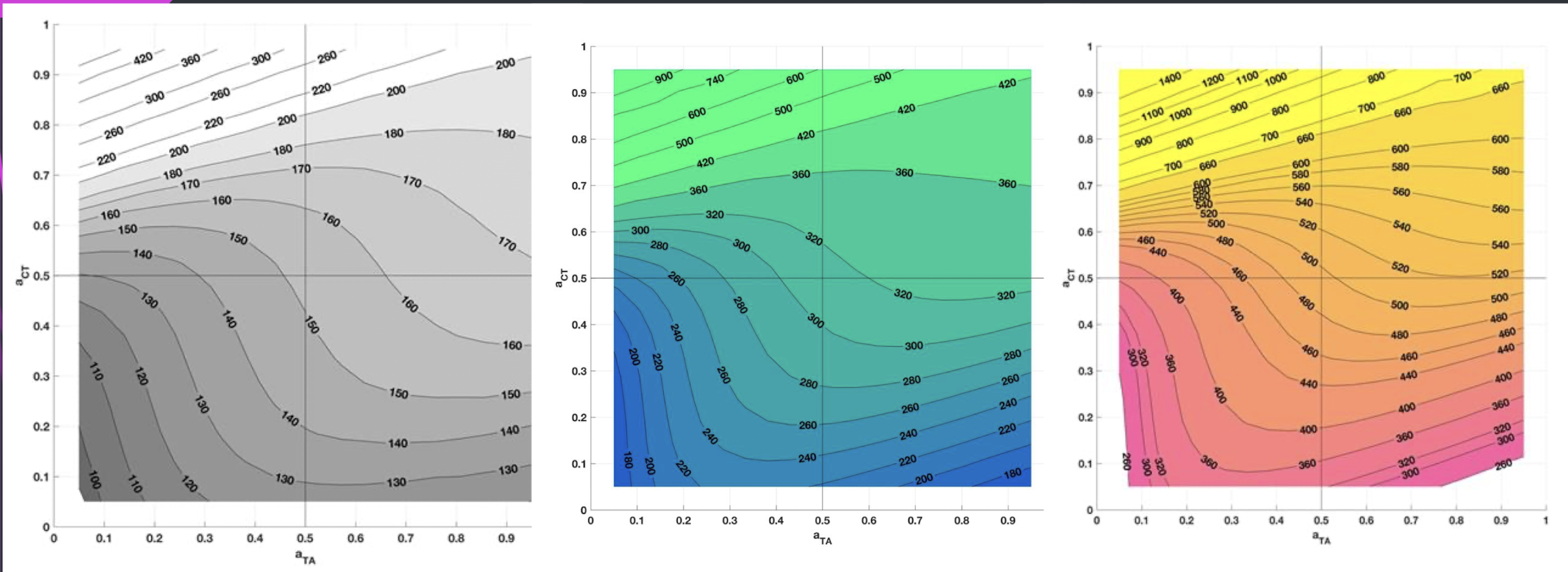
Label the following graphs with their corresponding population. Discuss what you see depicted across graphs.
G1: Male
G2: Female
G3: Child (4yo)
pitch numbers are different across all three graphs
BUT all curves are similar because it all functions in the same way throughout life
the anatomical differences in the larynx across population account for drastic pitch representations in these graphs
What are some age-related effects that impact f0 control?
Age related effects
degeneration of cartilage and soft tissue
ossification: our cartilages become more bone like, loose flexibility and become more stiff
calcification: cartilages become more brittle and start to flake and chip
Alters structure and vibratory characteristics of VFs
muscle atrophy: muscles may become weaker
nerve fiber loss: TA is less innervated
layers may become very thick and more collagenous and others may just degenerate
May relate more to physiologic age not chronological age
What kind of consequences do those age-related effects have on f0 and vocal quality?
incomplete glottal closure → affects vocal quality leading to a breathy aspect
alternations in mucosal wave → change in how VF vibrate because layers change in composition
scars or trauma may lead to a harsh and strained vocal quality
reduced vibration → getting into a particular f0 more difficult
more effortful vocal quality
possible tremor → shaky voice
breathier voices, greater f0 variability
How do we control intensity? Three steps!
increased lung pressure (respiratory drive) → adjusting our breathing apparatus
sounds are pressure fluctuations → more pressure fluctuations = increase in intensity
Higher subglottal pressure
greater amplitude of VF vibration/flow
VF open more than usual causing an increase in flow because more air can come out
highly adducted VFs
produce sharper cutoff of glottal flow
if we have half-assed VF closure air will escape and pressure won’t build as high as it can
it would also not provide much resistance to subglottal pressure
configuration of vocal tract
OPEN WIDE!

This image shows the voice range profile. What does the green represent?
speak as quiet as you can in the lowest pitch you can
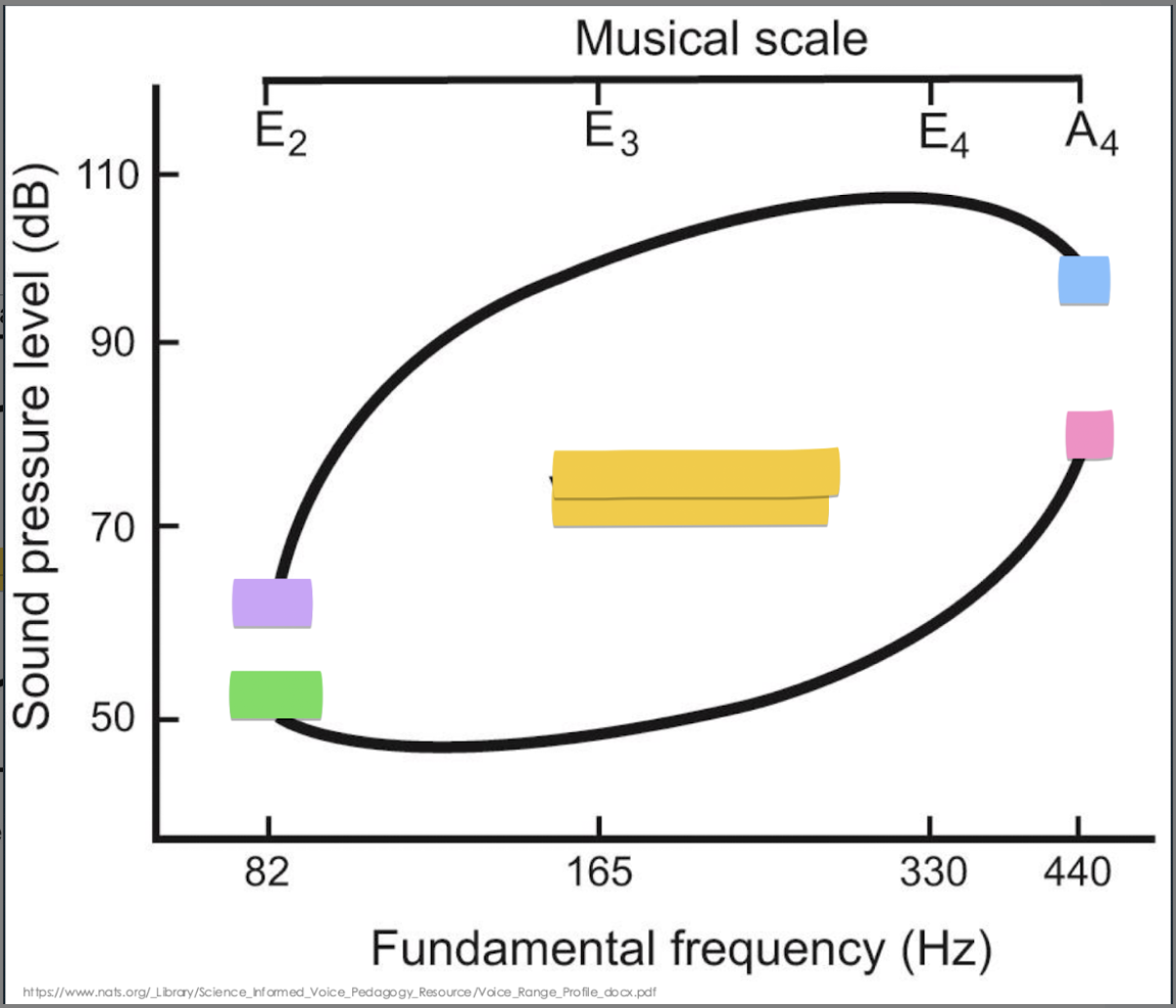
This image shows the voice range profile. What does the purple represent?
speak as loud as you can in the lowest picth you can

This image shows the voice range profile. What does the blue represent?
speak as loud as you can in the highest pitch you can

This image shows the voice range profile. What does the pink represent?
speak as quiet as you can at the highest pitch you can
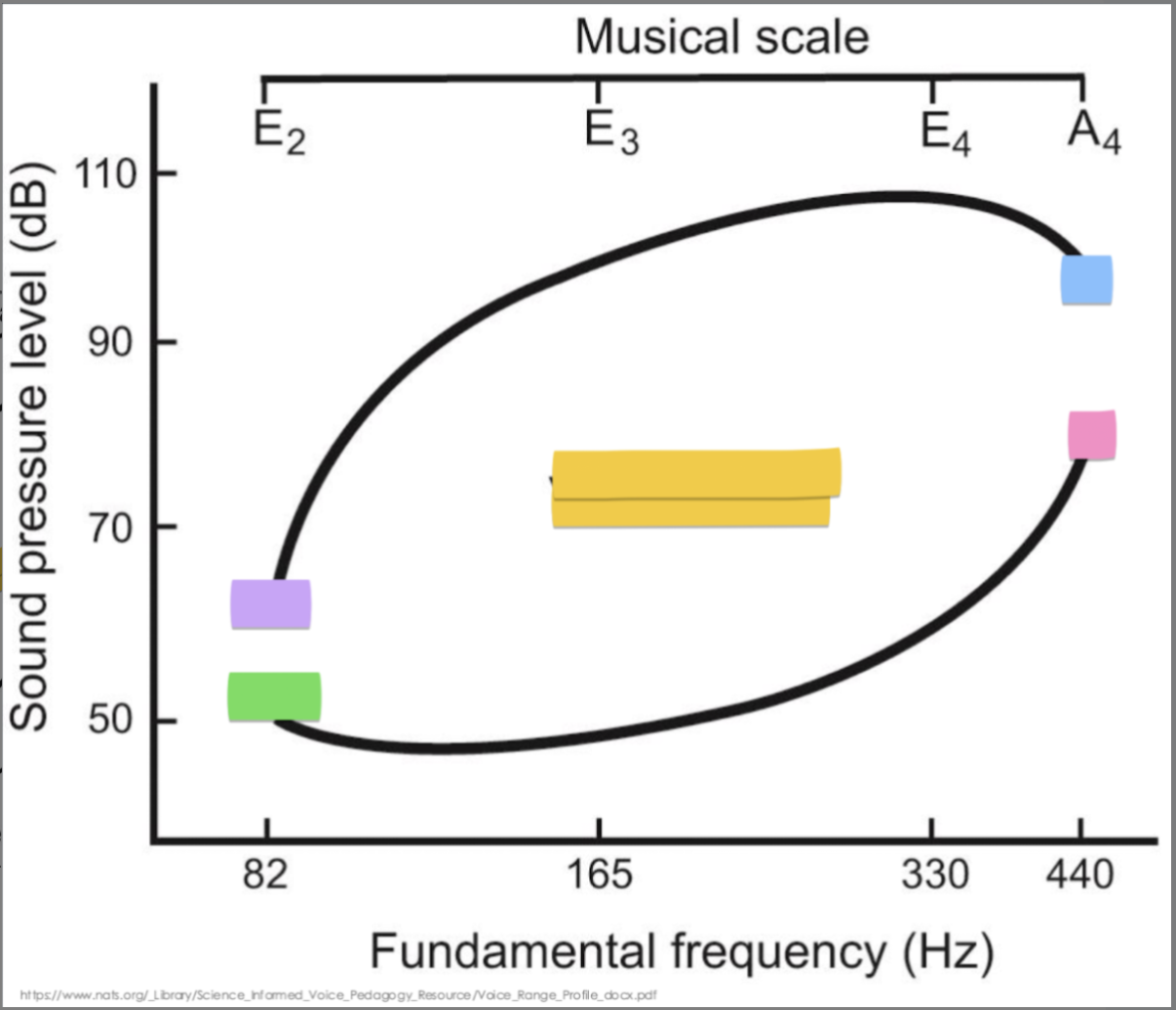
This image shows the voice range profile. What does the yellow represent?
voice area
the purple and blue provide the upper boundary of vocal range
the green and pink provide the lower boundary of vocal range
if in the low area, that represents low pitch → vocal folds will be short and loose
can’t be loud is you have wobbly and loose VF
why its hard to be loud at low frequencies
When is glottal flow at 0? When is glottal flow have a value?
when VF are closed glottal flow is at 0
when VF are open air is flowing through and there is a unit of glottal flow
What is the open quotient?
The open quotient is the ratio of then open phase of the glottal waveform to the total period. AKA relation of open phase of the glottis to the full glottal cycle.
open phase time/total time of glottal cycle = the % of the full glottal cycle in which the glottis os open
(T4-T2)/(T4-T1) = open quotient
The longer the VF are together → lower the open quotient (Q0) will be
The longer the VF are apart → the bigger the open quotient (Q0) will be → voice may start to sound breathy is really high
Range for the quotient: most extreme case: 1 (probs wont reach this tho bc of adduction) → minimum: 0 (prob won’t happen either)
What is the skewing quotient?
The skewing quotient applies only to the open phase of the glottal waveform and is the ratio of the “rise time” to the fall “fall time”
rise time (when flow is rising/increasing) / fall time (when flow is falling/decreasing) = skewing Quotient
(T3-T2)/(T4-T3)
When glottis is closing its still open but less and less air is coming through
if Qs id higher you speak louder → cutting off more quickly allows for greater subglottal pressure → rise time > fall time
if Qs is 1 this indicates rise time = fall time (symmetrical)
Where does air movement originate?
Air movement originates in the lungs/diaphragm
when lungs expand > air comes in
when lungs volume is reduced > air goes out
this is an autonomic response → medulla controls it
breathing is conditioned by chemoreceptors that detect CO2 in the body when it detects increased CO2 it moves to bring o2 back in
What is Boyle’s law?
volume of a gas is inversely proportional to its pressure (in a closed system)
volume (space air fills) of a gas is opposite to the pressure in a system where not much is happening
if volume increases, pressure decreases
if volume decreases, pressure increases
Pv=nRT
What is equalization of pressure?
air flows from high pressure areas to low pressure areas
Explain how air comes in and out of the system using boyle’s law and equalization of pressure.
Boyle's Law and the equalization of pressure help explain inhalation and exhalation. Boyle's law states that when volume is high, pressure is low or when volume is low, pressure is high. Equalization of pressure states that air likes to flow from high pressure areas to low pressure areas.
When we put these two principles together we can see that air from the environment is going to want to travel into our respiratory system when our lung volume is high (the diaphragm contracts). This describes inhalation. When our lung volume decreases (the diaphragm returns to its natural state) the pressure in our lungs will increase which is going to make the air want to rush out of our respiratory system and back out into the environment. This describes exhalation.
volume expands first via muscles
What are the three types of pressure associated with our respiratory system?
alveolar pressure
inside lungs (air pressure)
pleural pressure
inside thorax but outside lungs
abdominal pressure
inside abdominal cavity

What are the passive forces in respiration?
passive forces
inherent + always present
natural recoil
of ribs → ribs are elastic when we breathe in they are out of position and want to go back so their recoil
surface tension on the alveoli
alveoli are at the bottom of the lungs
if you blow in air these sacs also grow
gravity
pulls everything down
force on the diaphragm → goes down
affects breathing but we can’t do anything about it
What are the active forces in respiration?
willfully applied by skeletal muscle (esp. chest muscles)
depends on the amount of air inside the apparatus
What are alveoli?
tiny, hollow, cup-shaped air sacs at the very end of the respiratory tree in the lungs where the body exchanges oxygen and carbon dioxide.
300-500 million
What happens when the sternocleidomastoid contracts?
expands thoracic cavity by elevating the sternum + clavicles which elevates the ribs
inhalation
origin: sternum + clavicle
insertion: mastoid process

What happens when the pectoralis minor contracts?
it elevates the ribs
inhalation
origin: rib 2-5 (near their cartilage)
insertion: scapula (front surface)

What happens when the pectoralis major contracts?
allows us to expand our chest cavity outward by pulling ribs and sternum outside (upward)
origin: sternum + costal cartilage
insertion: humerus

What happens when the external intercostals contract?
inhalation
moves rib cage up as a unit → expands the thoracic cavity
stiffens space between the ribs → maintains form + shape which prevents collapse and immediate recoil
11 muscles filling outer space between ribs (= rib interspaced)
orientation: forward + down ward (how you put your hands in your pocket)

What happens when the internal intercostals contract?
exhalation
moves ribcage downward as a unit and stiffens space between ribs
11 muscles filling inner space between ribs (underneath the external ones)

What is the diaphragm? When happens when it contracts?
dome-shaped structure
unpaired muscle
has a central tendon + sheet of muscle tissue
tendon is stiff and inelastic
muscle fibers project upward into central tendon
contraction of this muscle causes it to flatten by pulling it down
It is the sole driver of increasing volume of lungs by lowering and allowing for lung expansion
List the abdominal muscles.
rectus abdominis
transverse abdominis
obliques
internal
external
What happens when the rectus abdominis contracts?
Rectus abdominis
compartmentalized muscle
a group of muscles, nerves, and blood vessels enclosed together in the body by a tough, inelastic layer of connective tissue
Contraction
muscle of expiration → squeezes air out
lowers ribs and sternum
forces front abdominal wall inward
Origin: front edge of coxal (hip) bones
Insertion: sternum and 5-7th costal cartilages

What happens when the transverse abdominis contracts?
Contraction:
muscle of expiration
brings the front and side of the abdominal wall inward
Origin: upper surface of coxal (hip) bones and costal cartilages (inner surface)
Insertion: abdominal aponeurosis

What is the abdominal aponeurosis?
An aponeurosis is a thin sheath of connective tissue that helps connect your muscles to your bones. Aponeuroses are similar to tendons.
The abdominal aponeurosis helps connect our abdominal muscles to bones.
broad, flat sheet of dense, fibrous connective tissue that covers, shapes, and connects the muscles of the abdominal wall.

What happens the obliques contract?
contraction:
both externals and internals pull the lower ribs downward and forces the front abdominal wall inward
What are the two divisions of the breathing apparatus?
Pulmonary apparatus
chest wall
What structure divides the two divisions of the breathing apparatus?
the diaphragm
What are the components involved in our pulmonary apparatus?
pulmonary airways
Upper airway: nasal cavity to larynx
Lower airway: trachea, bronchi, bronchioles, alveolar ducts, alveolar sacs, and alveoli
lungs (5 lobes)
What are the three functions of the pulmonary apparatus?
air containing
air conducting
gas exchanging
How many lobes does the right lung have? What about the left lung?
Right lung
3 lobes
Left lung
2 lobes
Alveoli surface area
An adult human has about 300-500 million alveoli across both lungs, creating a massive surface area of roughly 70 to 85 square meters (similar to a tennis court) for gas exchange
The greater the surface area the greater the gas exchange!
Alveoli gas exchange process
Inhalation: When you breathe in, air travels down your windpipe and into the alveoli, filling them like tiny balloons.
Gas Exchange: Oxygen passes through the ultra-thin alveolar walls into surrounding blood vessels (capillaries).
Exhalation: At the same time, carbon dioxide moves from the blood into the alveoli so you can breathe it out.
What four parts make up the chest wall?
rib cage wall → bones around thoracic cavity
diaphragm → dome shaped muscle that is the main muscle for breathing
abdominal wall → ab muscles that encircle our abdominal cavity
abdominal content → organs
Which of the four components of the chest wall are involved in breathing?
rib cage wall
diaphragm
abdominal wall
What are the two types of rib cage movement?
pump handle motion
bucket handle motion
Describe the pump handle motion of the ribs
Thepump-handle movement refers to the upward and forward rotation of the upper ribs and sternum during inhalation, which increases the front-to-back (anteroposterior) diameter of the chest cavity
During exhalation it moves the ribs downward and backward decreasing the diameter of the chest cavity
Describe the bucket handle motion of the ribs
The bucket-handle movement is a respiratory motion of the lower ribs that increases the side-to-side (transverse) diameter of the thoracic cavity during inhalation
during exhalation it moves the ribs downward and inward to decreasethe side-to-side (transverse) diameter of the thoracic cavity
How does the diaphragm change shape during inhalation vs exhalation?
inhalation
flattens
exhalation
becomes more domed
How does the abdominal wall move for breathing?
most movement occurs alond the anterior and posterior dimension → squeezes the cavity to expel air
How does body position, body type, age, and sex influence breathing?
Body position:
Moving from a seated or upright position to a supine or inclined position reduces tidal volume
In an upright or seated posture, the rib cage contributes more to chest wall motion. When lying supine, the percentage contribution of the abdomen to tidal volume increases significantly.
Body type
High body mass or increased abdominal fat places physical upward pressure on the diaphragm, decreasing functional residual capacity and total lung capacity.
Age
As people age, the chest wall and rib cage cartilage tend to stiffen, reducing the overall contribution of the rib cage to tidal volume
Sex
On average, biological females have smaller overall lung dimensions and smaller rib cage compartments compared to biological males, even when adjusted for height. This results in smaller absolute lung volumes and lower maximal expiratory flows in women.
What is tidal breathing?
relax breathing in which the time to breathe in is about the same time as the time to breathe out.
when breathing out you just relax and natural recoil of ribs goes back → don’t need much muscle involvement
What is the composition of inhalation / exhalation of speech breathing?
Inhalation: 10% → quick breath in
Exhalation: 90% → long exhalation during speech
allows us to speak for a long time
muscles help lungs deflate in a constant steady rate
What is the target of speech breathing?
maintain constant alveolar pressure
requires coordination of inspiratory and expiratory muscles
As you speak and exhale, your lung volume continuously shrinks. Naturally, the elastic recoil of the lungs drops as volume decreases. To keep alveolar pressure steady despite this drop in natural recoil, your respiratory muscles (such as the abdominal and internal intercostal muscles) must constantly adjust their muscular effort to "take over" and maintain the driving pressure
that is why speech breathing is much more effortful than tidal breathing
Why do we need alveolar to remain constant during speech breathing?
We need constant alveolar pressure during speech breathing to maintain a steady vocal intensity (loudness) and a stable pitch while speaking
How do lung volume, rib cage wall volume, and abdominal wall volume change during speech breathing? What about alveolar pressure?
lung volume, rib cage wall volume, abdominal wall volume all decrease as we breathe out and speak
alveolar pressure does not change during speech breathing. It remains constant!
What is lung volume?
amount of air in the lungs at a given time
What is lung capacity?
a combination of various lung volumes
What are the four types of lung volume?
tidal volume
inspiratory reserve volume
expiratory reserve volume
residual volume
What is tidal volume?
volume inhaled and exhaled during a cycle of respiration
~ ½ L of air
What is inspiratory reserve volume?
volume of air that can be inhaled above TV
can breathe in a lot more till your lungs are fully full → not a regular process
What is expiratory reserve volume?
volume of air that can be exhaled below TV
same as IRV but breathing out → squeeze out everything → abdominal muscles come in to squeeze the abdominal cavity which decreases thoracic cavity
What is residual volume?
volume of air remaining after max expiration; cannot be expelled voluntarily
we cannot squeeze everything out → if we did our lungs would collapse and stick together → takes a lot of energy to force breathing when lungs are in this state.
death breath
you breathe it out and its lights out
What are the four types of lung capacity?
vital capacity
functional residual capacity (FRC)
total lung capacity (TLC)
Inspiratory capacity (IC)
What is vital capacity?
volume of air that can be exhaled after max. inhalation
IRV + TV + ERV = VC
all of the air that is important and that we have access to
What is the functional residual capacity (FRC)?
volume remaining as end-expiratory level
aka all the air that is left after tidal breath
ERV + RV
What is total lung capacity (TLC)?
total amount of air your lungs can hold (TV + IRV + ERV + RV)
all volumes together
What is inspiratory capacity (IC)?
max. of air that can be inspired from end-expiratory level (TV + IRV)
the moment you stop breathing out you can start breathing in → the air that comes in after exhalation (biggest deep breath) is your IC
the max inhaled air the lungs can hold