E&M - Test 1
 Call Kai
 Learn
 Practice Test
 Spaced Repetition
 Match
 Flashcards
 Knowt Play
1/29

Earn XP
Description and Tags
electrostatics. opposites attract
30 Terms
ion def.
atom that has net charge (unequal proton/electron)
what is most of the atom’s volume taken up by?
electron
(SI) unit for quantifying the amount of electrical charge present in an object is
Coulomb (C)
Coloumb defintion
“the amount of charge (symbol: Q or q) transported by a constant current of one ampere over one second”
How can objects gain static charge?
friction, conduction, induction
how can friction make an object charged or uncharged?
rubbing two electrically neutral objects together can charge both objects; the two will have opposite charges
how can conduction make an object charged or uncharged?
Certain materials, called conductors, allow charges to move easily through them (like a copper wire). A conductor therefore can act like a bridge between a charged and uncharged object in an attempt to equalize the charge between the two objects
how can induction make an object charged or uncharged?
When a charged object comes near a conductor without touching, the charges in the conductor will reorganize.
Polarization versus Induction
If electrons were people in a room,
Induction sends all the negative charges to one side of the room (creating true charged zones).
Polarization just makes everyone in the room lean slightly to the left (the room stays perfectly blended).
does a conductor have a charge? y?
yes; electrons flow freely through
does an insulator have charge? y?
NO; no freely floating electrons
are metals typically conductors or insulators?
conductors
many other materials are insulators
what is inverse square law?
the intensity or strength of a physical quantity—such as light, gravity, or sound—is inversely proportional to the square of the distance from its source
(used in coloumbs law)
What does coloumbs law measure?
The force that one charged particle exerts on another
(equal and opposite)

k = ?
9 × 10^9 (N*m²)/(C²)
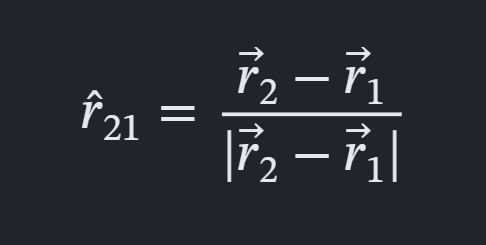
position unit vector for coulombs law
this is found by: (target charge vector - source charge vector)
Coulombs law accounting for theta

steps to solving a coulombs eq.

what is an electric field?
a vector field that is defined as the Force
experienced by a positive unit “test” charge (i.e. a charge of
one unit – either C or e +) in space due to the presence of other
electric charge(s)

What is a test charge
a single positive point charge
what is electric field
force created at location P due to a test charge

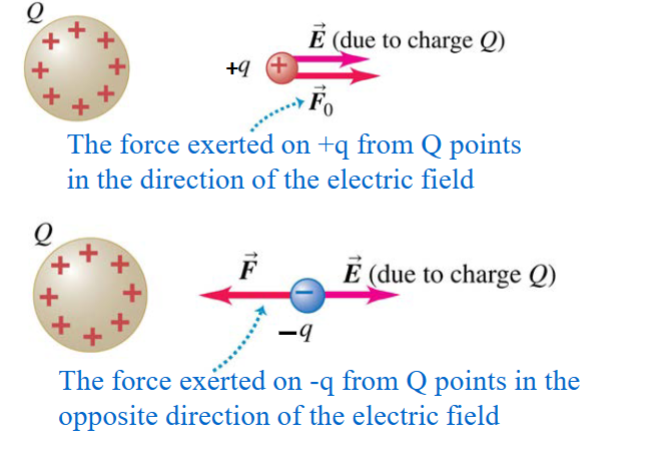
why is this true?
the sign of q changes the direction of F

Theory of superposition
The total electric field at a point in space is the vector sum of the fields due to all the charges present.

superposition visually

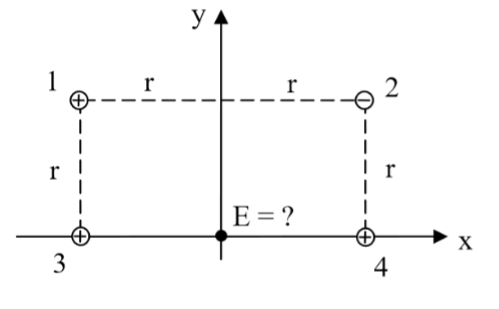
what is the direction of the E field at the origin?

Charge of electron & proton

coulombs law equation

Is electric potential higher or lower towards the + side
higher, lower at -
when is KE = 0?
velocity = 0
(at rest, changing direction)
when is potential energy = 0
when r is infinitely far away