CH 14 Intrapartum Fetal Surveillance
 Call Kai
 Learn
Learn Practice Test
 Spaced Repetition
 Match
Match Flashcards
 Knowt Play
1/34

There's no tags or description
Looks like no tags are added yet.
Name | Mastery | Learn | Test | Matching | Spaced | Call with Kai | Chat |
|---|
No analytics yet
Send a link to your students to track their progress
35 Terms
Fetal monitoring
Continuous recording of the fetal heart rate and maternal uterine contractions to assess fetal status and the progress of labor.
Intrapartum Fetal Assessment
- Primary goal of intrapartum fetal surveillance is to enable clinicians to assess adequacy of fetal oxygenation during labor.
- Fetal monitoring has transitioned from "low" technology to "high" technology.
- Approximately 89% of births in the United States are electronically monitored.
Intrapartum Fetal Assessment: Information gathered at the bedside about fetal assessments assists clinicians in?
- Evaluation in fetal oxygenation.
- Decision to implement corrective measures to improve fetal oxygenation.
- Provision of mechanism to optimize communication between clinicians and patients.
- Support of clinical decision making which promotes an environment of patient safety and quality care.
Fetal Oxygenation: five factors for adequate fetal oxygentation:
1. Sufficient maternal blood flow and volume to the placenta.
2. Normal maternal oxygen saturation.
3. Adequate exchange of oxygen and carbon dioxide.
4. An open circulatory path from placenta.
5. Normal fetal circulatory and oxygen-carrying functions.
What are the types of circulation?
- Uteroplacental circulation
- Fetal placenta circulation
- Fetal heart rate regulation
Fetal heart rate regulation
- Autonomic nervous system
- Baroreceptors and chemoreceptors
- Hormonal influences
Internal fetal monitoring
- Fetal scalp electrodes (FSE)
- Intrauterine pressure catheter (IUPC)
Fetal Scalp electrodes (FSE)
- Requires cervical dilation and ruptured membranes.
- Electrodes applied directly to fetal presenting part of head or buttocks.
Intrauterine pressure (IUPC)
- Sterile, flexible catheter inserted directly into the uterus transcervically.
- Measures actual uterine pressure in millimeters of mercury mm HG
Fetal Heart rate interpretation
- Baseline fetal heart rate (FHR)
- Baseline FHR variability
- Periodic and episodic
Baseline fetal heart rate (FHR)
- Normal 110 to 160 bpm.
- Bradycardia Less than 110 bpm.
- Tachycardia Greater than 160 bpm.
Baseline FHR variability
- Factors that decrease
- Classification of variability
- Either Absent, minimal, moderate, and marked.
Periodic and episodic FHR patterns
- Periodic: Associated with uterine contractions
- Episodic: Not associated with uterine contractions
• Accelerations: periodic or episodic
•Decelerations: depends on which type of decelerations
Types of Decelerations
- Early
- Later
- Variable
- Prolonged
Early
- Head compression
- Periodic
Late
- Uteroplacental insufficiency
- Periodic
Variable
- Cord compression
- Periodic or episodic
Prolonged
- Periodic or episodic
Variable EAL
CHOP
If there is variable in baby then -->
Cord compression
If there is Early deccelerations then there is?
Head compression
If there is Accelerations then there is?
Oxygentation
If there is late decelerations then there is?
Placental insufficiency
Early decelerations
- Greater than 30 seconds to reach Nadir.
- Mirror uterine contraction.

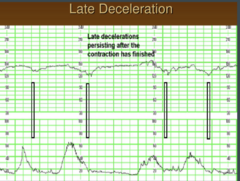
Late decelerations
- Greater 30 seconds to reach Nadir.
- Nadir after uterine contractions peak.
Variable Declarations
- Drops at least 15 beats per minute and for 15 seconds.
- Lasts for less than 2 minutes.
- Less than 30 seconds to reach Nadir.
Uterine activity
- Frequency
- Duration
- Intensity
- Resting tone

Categorization of Fetal Heart Rate Patterns
- Category 1: normal.
- Category 2: indeterminate, it is most common.
- Category 3: abnormal.
Category I: Normal
- Baseline rate: 110-160 bpm
- Variability: Moderate
- No decelerations, nor late, variable or prolonged.
Category III "Abnormal": Absent variability with recurrent variable decelerations.
- Absent variability with recurrent late decelerations.
- Absent variability with recurrent variable decelerations.
- Absent variability with bradycardia for at least 10 minutes.
- Sinusoidal pattern

Category III: Abnormal: Absent variability with recurrent late decelerations.
Can include also include: Absent variability with recurrent variable decelerations.
Absent variability with bradycardia for at least 10 min.
Sinusoidal pattern.

Category III "Abnormal":
Sinusoidal pattern

Standardized Intrapartum Interpretation and Management: Two guiding principles:
- Variable, late, or prolonged decelerations indicate interruption of oxygen transfer from the environment to the fetus at one or more points.
- Moderate variability and/or accelerations reliably exclude ongoing hypoxic injury at the time they are observed.
Commonly performed corrective measures
- Maternal repositioning.
- IV fluid boluses.
- Administering oxygen.
- Reducing uterine activity.
- Correcting maternal hypotension.
- Performing amnioinfusion.
- Modifying second stage pushing efforts.
Fetal monitoring education and competency
- Intrapartum fetal assessment requires skilled clinicians to be able to interpret FHR and UA patterns and to make clinical decisions based on these findings.
- Professional organizations have developed guidelines to promote education and standardization in fetal monitoring.
- Ongoing fetal monitoring education and clinical competency is important to maintain.