Anthropometry and Body Composition (research methodologies)
 Call Kai
 Learn
Learn Practice Test
 Spaced Repetition
 Match
Match Flashcards
 Knowt Play
1/45

There's no tags or description
Looks like no tags are added yet.
Name | Mastery | Learn | Test | Matching | Spaced | Call with Kai | Chat |
|---|
No analytics yet
Send a link to your students to track their progress
46 Terms
Define ‘Anthropometry’
literally meaning "measurement of humans“ → measuring sizes and dimensions of the human. we can use it in nutritional science, as a reflection of nutritional state.
It refers to body shape, size and circumferences.
How is anthropometry used in Nutritional Sciences?
To evaluate disease risk as well as assessing body composition changes
in health and medicine: used to track growth and nutritional status → we measure body weight, body height to check growth in children, for example → growth is a mirror for the condition in society.
→ The nutritional state/dietary quality is directly linked to growth.
For example the BMI

What is the Anthropometric toolkit used?
height, weight, skinfold, circumference (waist and hip), etc. Picture → all these are examples of anthropometric and body composition methods.
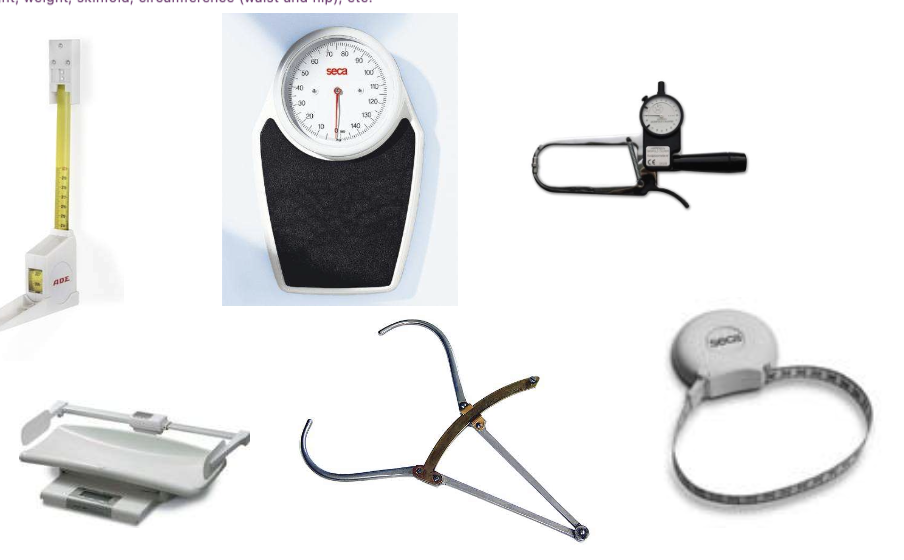
What is the best known measurement in anthropology?
BMI (weight/height in kwadraat) → see also picture for other frequent measures, like skin fold thickness, circumferences and weight or height (for age).
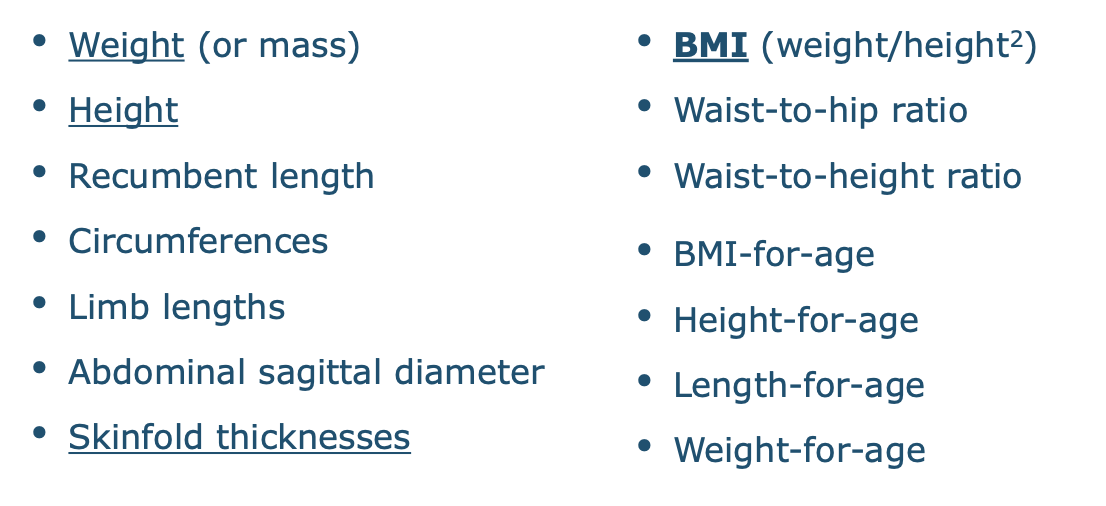
What are the advantages and disadvantages of anthropometric measurements?
Antropometric measurements are simple, cheap and easy to use in many settings. But they are not a direct measurement of body composition! Even though they are related.
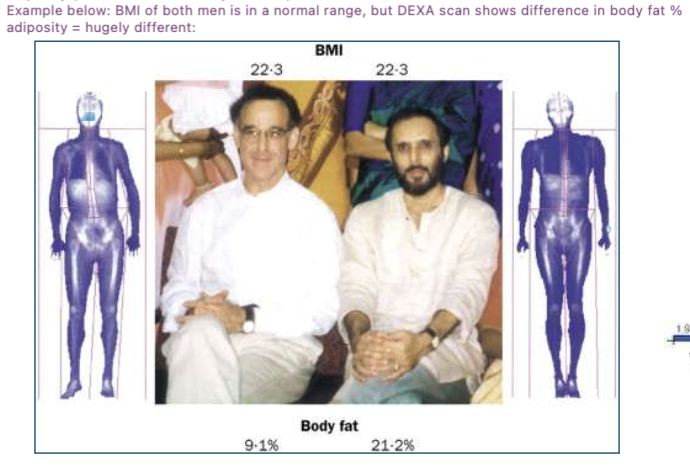
Is BMI a good measurement for measuring a healthy body composition?
BMI is a very common way to relate body weight to height. But it is not a good predictor of body adiposity.
At population level: BMI works well as an indicator of health and disease risk → on average, higher BMI means higher risk
But for individuals, BMI is not a good measure of body fat → doesn't reflect actual body composition: e.g. a bodybuilder with BMI 27.5.
How accurate is BMI in diagnosing obesity?
BMI (although known as a risk factor of cardiometabolic diseases), BMI is not a measure of body fatness!
Example: picture🙂 does not measure body fat directly
Define ‘Body Composition’ and what we are mainly interested in within this term
Body composition is about what your body is made of
In nutrition science, we are mainly interested in:
(1) fat mass,
(2) lean mass, and
(3) bone minerals.
Because these give us important information about nutritional status and health and disease risk.
“The estimation of body composition is an important component of health and fitness assessments in individuals and populations.In particular, the amount and distribution of fat and lean mass are important for health throughout the lifespan, but also bone mineral and fluid spaces – as well as its distribution”
Which abbreviations are used in body composition?
See picture

Into which two components can you break the body down?
(1) FAT mass → tissue (adipose tissue or AT). Molecule (lipid)
(2) Lean body mass = fat free mass → everything else in the body besides fat (→ bone, blood, muscle)
- (skeletal) Muscle Mass→ an important component of lean body mass or fat free mass,but it is not exclusively lean or fat free mass. lean mass is everything else in the body besides fat (bone, blood and also muscle. So, it's a major component but it doesn't equal each other)

What is fat free mass?
All mass that is not adipose tissue/part of body that does not contain lipids (tissue level vs molecular level → they don't agree on this in the research field).
75-85% of the body contains fat free mass: a combination of water, protein, minerals, carbohydrates. you can break it down more precisely/
15-25% is fat mass
At which 5 levels can we look at body composition?
(1) the atomic level → the body is made mostly of 6 elements (together these are about 99% of your body), oxygen is largest part by mass, mainly because of our body water content. Body weight = O + C + H + N + P + Ca ~ 98% of our body.
(2) molecular level: water is most abundant molecule: >50% of our total mass, followed by lipids, proteins, minerals and glycogen.* Most of the methods take the molecular approach. Most simple form: two-component model (1: fat mass and (2) fat-free mass → Body weight = lipid + water + protein + mineral + carbohydrate =FM + FFM
(3) cellular level: cells, extracellulair fluid (ICF), extracellulair solids(ECS)
(4) tissue level: two compartment model = fat or no-fat. muscle, adipose tissue, bone, organs → which we can see with MRI or CT
(5) Whole body level: which deals with size, shape and volume → the level that anthropometry also considers.
*fat contains almost no water, while lean tissue contains a lot, the correlation between body water and body composition is central to many methods →less body water relative to body weight means more body fat.
What is the ‘five-level body composition model’?
Breaking the body down into it’s core components (see picture)

What composition of reference body on molecular level?
we break down the body at the molecular level at 5 different compartments: lipid, water, protein, CHO (carbon, hydrogen and oxygen) and minerals. Breaking the body down in molecular level is most used.

At molecular level, you can have multiple components (break body down into two or more components). how many are there and what are the classes?
See picture, each extra component: another class is subdivided. If we combine information from multiple methods to assess body composition, we can describe the body at four, five or six components → gives you a much better estimation of the exact amount of body fat (the more precise)

What measurements/methods can we use to measure body composition?
Methods used to measure body composition rely on assumptions and relationships derived from these 5 different levels mentioned. Most frequently used methods:DEXAandBioelectric-Impedance Analysis (BIA)
Other methods:
(1) Densitometry (measuring body density),
(2) Hydrometry (measuring total body water),
(3) Multicomponent models → combine information from different methods to improve accuracy
(4) Imaging techniques → whole body fat(free)mass, distribution of body fat and muscle tissue. MRI-scan intracellular (organ)fat 3 deminsional, CT-scan: x-ray (3-dimensional) or DEXA (regional/intra-abdominal fat)
(5) Skinfold thickness measurements.

How do you know how to choose the right method?
Starts with understanding the principle: the accuracy, limitations, advantages and disadvantages of each method. It depends on what you want to know:
valid method → an exact measurement of body composition for an individual
BMI might be sufficient when working with large groups and only need general classification.
Some methods may not be vary accurate in terms of the absolute volume (e.g. fat mass), but they have a good precision (they provide reproducible results, making it a good method to measure changes over time.
next to quality of the method, size of the group, costs, availability of equipment are relevant factors to consider when choosing a method.
→ The larger the group → the cheaper and more practical a method should be → field studies often have limited acces to larger non-portable equipment.
The burden on participants may also an important factor for selecting a method
What is the difference between direct and (double) indirect methods?
the body is a 'black box' to us when measuring body composition. the only way to exactly measure body fat% is by breaking it down.
Direct methods: can accurately measure a component on atomic, molecular, cellular, tissue or whole body level
Indirect methods: Combine a direct measurement with an established steady-state relationship between the directly measurable and unknown components → this relationship is very strong/method is good. if the relationship is a bit weaker, the method is also weaker.
Some measurements don't have this established steady-state relationship, when method depends on calibration against another method → used for ‘prediction’.
What is the difference between accuracy and precision?
Accuracy = really measure what you should measure
Precision = if you measure it multiple times, it gets the same result
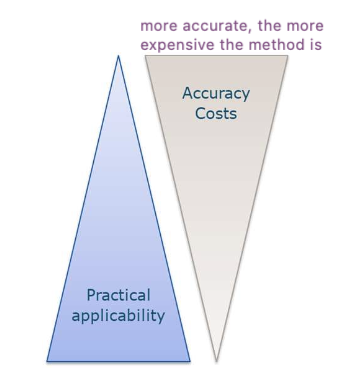
‘The more accurate a method is, the more expensive’.
low accuracy and high precision can be a desirable situation → not the right value but always the same.
What is the DEXA measurement? (mostly used method in research practice/studies)
DEXA = Dual Energy X-ray Absorptiometry
DEXA = 3 compartment model (bone mineral density, fat mass and lean soft tissue)
Allows measurement of bone mineral content, but also composition of soft tissue: fat mass and lean mass (indirect) → can estimate visceral fat
→ e.g. we can measure lean tissue in the legs; all soft tissue in the legs, is a good measure of skeletal measure in the legs.
Differential absorption of X-ray (‘attenuation’) -> algorithms
Regions of interest can be identified (e.g. abdomen; appendicular)
Very low radiation exposure
When is DEXA used in research settings?
Used in large-scale observational cohort studies.
Studies undertaking association analyses between exposure(s) and outcome(s).
Interventions and RCTs to examine intervention or treatment efficacy.
Validation studies as a reference method to evaluate simpler body composition measurements (e.g. skinfolds; BIA) when the criterion method is not applicable or available.
Bone mineral content by DEXA is also used to derive the 4-component model, the criterion method for assessment of body composition, together with other body composition methods
What are the strengths of DEXA?
Requiring little cooperation, relative quick (5-20 minutes), low radiation dose. possible to carry out DEXA measures in a mobile van.
It is highly precise
Able to estimate overall body fat as well as body fat patterning and distribution
What are the limitations of Dexa?
DEXA estimates of fat mass are influenced by ‘trunk thickness’ → (iemand die wat meer trunk heeft/ iets dikker: measurement minder precies)
Divice itself is pretty big, not very easy to transport (though can be put in van driven around)
Marked differences in the hydration of lean tissue may affect the measurement → google: changes or abnormalities in your body's water levels can cause the machine to miscalculate how much muscle you have
Differences between commercial systems (Hologic, GE and Norland) and due to Software updates can cause significant changes to soft tissue values and BMD.
DEXA vs BIA
BIA: easy-to-use field method for large and diverse populations (double-indirect method), Portable equipment and measurements are quick and cheap. because fat-free mass contains water (and conducts electricity better than fat mass), you can measure all body impedance that reflects total body water → you can measure body composition. Impedance value is then used in regression equations to estimate body composition.
Bia(and skinfolds) have larger error than DEXA.
DEXA: laboratory-based method, much more accurate than BIA (DEXA = indirect method). With DEXA you can measure bone mineral density, fat mass and lean soft tissue.
less easy to use: ±15-20 minutes for one measurement, the participants need to lie very still.
The device is not easy to transport (big)
What is Bio-electrical impedance?
Bio-impedance (indirect estimate of body composition (2CM) = resistance of a body when a non perceivable alternating current is applied.Measures FFM, FM, TBW (ECW/ICW).
Based on differences in electrical conductivity (impedance) of body compartments (related to water content) → travels from feet to the hands
Bio-electrical is more used in practice (by dietician), whereas DEXA is more used in research.
Depends on height: electrical current easily foes into tissue with more water (these tissues have a high conductivity) so how much of this tissue that you have between legs and arms determines the speed of this small current used to measure body composition

What are the strengths of Bio-electrical impedance?
this method is smaller (portable), quicker than DEXA
less cooperation for the participant (but less accurate and precise)
Easy to use
Cheaper
Multi-frequency has advantage
What are the limitations of Bio-electrical impedance?
it’s a 2-component model (DEXA = 3CM)
less accurate and precise than DEXA
BIA is only as good as the equation used.
influenced by body size, gender, age, disease state, race or ethnicity; affected by hydration status. Vigorous exercise, excessive caffeine and alcohol use
tendency to overestimate body fat in very lean individuals, underestimate in obese individuals
How do you go from impedance to body composition?
Impedance (Z) has two components: Resistance (R) and Reactance (Xc)*
Uses regression models to estimate (predict) body composition
The impedance index (Ht2/R), reactance (Ω), age (years), and body weight (kg) are the independent variables used in those predictions
*google: resistance—>Water and dissolved electrolytes (like sodium and potassium) are great conductors of electricity. Tissues with high water content (muscle and blood) have low resistance. Conversely, tissues with low water content (fat or bone) act as poor conductors and show high resistance.What it measures: It is used primarily to estimate total body water (TBW) and fat-free mass (FFM)
Reactance → The opposition to the current caused by the capacitance (the ability to briefly store and release electrical energy) of living cell membranes. In the human body, every cell membrane acts like a tiny electrical capacitor or condenser because its lipid (fatty) core separates the inner fluid (cytoplasm) from the outer fluid (extracellular fluid). When the alternating current hits these membranes, the signal temporarily delays or stores a charge. It serves as an indirect measure of body cell mass (BCM) and overall cellular health or membrane integrity. Healthy cells with intact membranes produce higher reactance values.
Measurement of TBW (Deuterium Dilution Technique-DDT)
Deuterium (D2O) dilution method = a field method → Water dose containing known amounts of stable isotope (‘C1xV1’): 2H2O (most often) [H2 18O very expensive].
first a sample of body water is taken to measure the pre-test abundance of D2O in the body water, using saliva, blood or urine.
Then participants need to drink the known amount of substance that is added to an unknown volume of water
and they need to wait 3-4 hours for the D2O to be evenly distributed through the total body water before D2O is measured again.
A representative sample of the total body water is taken (post-dose) → need at least 3 samples that you need to store.
The added ‘concentration’ (post-dose enrichment-background) of D2O is measured.
Unknown volume can be calculated
-have to transport these samples. But we can do it in the field, it’s a field method (can easily do it everywhere), you can take saliva samples (cooperation), can take it and put it even on room temperature.We have portable devices with saliva (can do it on location).
How can you calculate the unknown volume (TBW)?
Dilution principle: M (C1 x V1) = C2 x V2
V2 (TBW)=M/C2 (C=concentration, M=mass), in our case
Dilution space (kg) = D2O (mg)/Δ enrichment (ppm)
→ TBW (kg) = Dilution space (kg) /1.041
How to measure fat (free) mass from TBW (indirect)?
Assuming a two component model on a molecular level
BM = FM + FFM
Hydration of FFM = 73% (assumption -> in children age/sex specific)
FFM = TBW/0.73
FM = BM-(TBW/0.73)
What other Dilution technique can we use?
D3-creatine!
all body creatine is inside muscle mass. large muscle mass = al lot of creatine → to know your muscle mass. (accurate, but expensive method)
Extra cellular water (KBr)
How accurate is BMI in diagnosing obesity?
Not that accurate. Better interpretation of BMI and body weight → when body frame size, body composition, and somatotype is taken into account!
How can you measure body fatness?
→ by sum of 8 skinfolds
What is Densitometry?
A (direct) measurement of body volume. Measurement of FM and FFM from body volume:
under water weighing
Air displacement plethysmography (BodPod)
Density = BM/volume
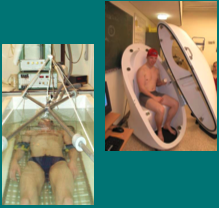
How can you measure F(F)M (fat mass & fat free mass) from body volume (indirect)?
Assuming a two component model on a molecular level:
BM = FM + FFM; BV = VFM + VFFM
V=M/D BM/DB = x/DFM + (BM-x)/DFFM
Body Density is derived from body weight and body volume
Density FM = 0.900 g/cm3
Density FFM = 1.100 g/cm3
Unknown FM (fraction x) can be calculated (e.g. Siri’s formula)
What is Siri formula? (+ example)
Siri = % body fat = (495/body density*) - 450
*body density = bwt/body volume = kg/liter for example
Example: In a female person the following quantities have been measured: Bwt = 65 kg and body volume (by BodPod) = 61 dm3
a) Calculate FM (kg) and FFM (kg) and %BF
1 dm3 = 1 liter. So, we are working with a body volume of 61 liters
body density = bwt/body volume = 65/61 = 1.0656 kg per liter -> using Siri’s equation: 495/1.0656 – 450 = 14.527 = 14.5%
Body fat % = 14.5%
The FM (kg) -> 65 (bwt) x (14.5/100) = 9.425 kg -> 9.4 kg
The FFM = bwt – FM -> 65 – 9.425 = 55.575 -> 55.6 kg
Why do we do skin fold measurements?
To get an estimation of body fat → the thickness of skin folds. The number is a direct measurement. but we take this as a reflection of your subcontaneous adipose tissue → so we take samples at different places of the body.
How is the validity of Skinfold DW?
Not very accurate. a huge variation (underestimated on average). If you’re trained, you can do it more precise.
What are multicomponent models?
most of the methods look at fat mass vs fat-free mass (the body having 2 components), but in practice its more complicated. you take assumptions, like that the hydration factor is 73%.
→the method becomes more accurate if you add components

What is the ‘two-component model’ and what are the limitations?
Molecular → two-component (fat mass and fat free mass)
Limitations → not valid in young children, pregnant women, elderly, categories of diseased, categories of sportsmen.
Consequences → make less assumptions by using a multi component model
Which multi-component models (molecular) are most practical and which one is the golden standard?
Three component (most practical) → Fat, water and fat-free dry tissue. FM = 2.057 x BV - 0.786 x TBW - 1.286 x BM
Four component (golden standard) → Fat, water, protein and mineral → also put minerals in equation → FM = 2,513 x BV – 0,739 x TBW + 0,947 x Mo – 1,79 x BM
Difference direct and (double) indirect methods?
Direct methods: can accurately measure a component on atomic, molecular, cellular, tissue or whole body level
Indirect methods: Combine a direct measurement with an established steady-state relationship between the directly measurable and unknown components and/or rely on calibration against criterion (reference) methods: ‘prediction’
Name the 3 imaging techniques places at tissue level
for measurement of:
Whole body fat(free)mass
Body fat distribution: (intra)abdominal AT and ‘ectopic fat’
Muscle tissue
Which techniques do we use for imaging?
Ultrasound → send sound waves tells depth of the reflecting surface
DEXA →regional fat, intra abdominal fat
Computer tomography (CT-scans): X-rays “high” dose (3-dimensional)
Magnetic Resonance Imaging / Spectroscopy (MRI/S):
● magnetic field (3-dimensional)
● MRS: intracellular (organ) fat
Where does the choice of the method for specific research question depend on?
depends on study aim, study population & size, study setting, study budget, portability of the instrument and body components that you’re interested in
