Lecture 2: What is the Self?
 Call Kai
 Learn
Learn Practice Test
 Spaced Repetition
 Match
Match Flashcards
 Knowt Play
1/46

There's no tags or description
Looks like no tags are added yet.
Name | Mastery | Learn | Test | Matching | Spaced | Call with Kai | Chat |
|---|
No analytics yet
Send a link to your students to track their progress
47 Terms
What is the Self?
The self is inherently social
Distinct entity, separate from other things or other people
Contains multiple sets of beliefs
Organizes knowledge & information that we have about ourselves
Everything we take in through lens of the self
Influences how we think, feel & behave
Very deep illusion that we are separate entities entirely
Body & mind ecosystem of different things connecting
Interweb of connections
Social psych pushes against notion of a clear bounded self, the self is very social, interconnected, constructed by relationships with others
What is a Self- Concept?
The self is a concept : a set of beliefs & perceptions you have about yourself
Gives rise to a self-schema: a cognitive structure that represents the self, derived from past experiences
Represents a person’s beliefs & feelings about the self (in both general & specific situations)
Used interchangeably
Self concept, a schema is a way of representing the self
Collection of beliefs about the self
Where does our self-concept & self schemas come from?
Others!!!
The self is, in large part, a social construct
Not something you created or individually came up with but reflection of society, how society views you
Frame of Reference Podcast
The Self is Inherently a Social Construct
Self is derived, in part from others or our relationship to others
Learn who we are from peers, parents, sibling
Draw info about self from how others see us, am i funny? Do other people laugh when i say things? Social perspective.
Reflected self appraisals: a belief about what others think of us
we experience overt or subtle reactions & appraisals from those around us
e.g., parents may praise accomplishments, romantic partner makes light of your fears. We internalize how we think others perceive us not necessarily how they do
What is the Relational Self?
Aspects of the self that are associated with one’s relationship with significant others
Who you are as:
daughter/son
boyfriend/girlfriend
friend
What is Social Identity?
Aspects of the self that are derived from one’s group membership
Who you are as:
You are liberal
You are a Raptors fan
You are Canadian
Socially constructed, self tied to membership of that group
The Self is Inherently a Social Construct
Self is derived, in part from others or our relationship to others
The self is influenced by context (power of the situation)
Social context can change
The self shifts depending on the context
What is a Working Self-Concept?
Self-concept is fluid
Changes, moving around with whatever context you’re in
For example: we see in movies teenage characters shifting who they are to conform with people around them. Around studious classmates may be more into homework versus more nonchalant around school athletes.
Subset of self-knowledge that is brought to mind in a particular context
Since context changes, can be put in forefront, background, dynamic fluidity to it
More fluid than people realize
May see yourself as more relaxed when with close friends but more shy and inhibited around new people
Context social
What is the Distinctiveness Hypothesis?
In this study young kids 6th graders, asked to write 12 statements about themselves
Idea what are they going to write about
More likely to list something if makes them distinct or unique from others- born in place most people weren’t born in, more likely to be something mention when asked to describe yourself
Or women in class of mainly men
Whats salient to person in given moment is what makes them unique-thats whats at the forefront of the mind
Self-concept is fluid and changes depending on context
We tend to highlight what makes us unique or distinctive in any given situation
Children defined themselves with respect to how they differed from their classmates

Where’s the continuity in a fluid self-concept?
(1) Some core beliefs are stable (not fluid)
Might have normal values stable and been with you for while, that wouldn't change based on the context
For example: although as you may see yourself shy around strangers compared to close friends, you see yourself as a good listener no matter what.
(2) There is stability underneath, though different dimensions can be salient
Fair you maybe at special event, interacting with people, fun but recognize generally you are a homebody
Out social, but homebody, hold those two things at same time
Can be introverted but extroverted, stable introvert that doesn't love going out
(3) The Impact of context is predictable
Self more understandable and stable
More talkative in one context, shy in one context
Talkative in small groups, shy in large groups
Some continuity there
(3) There are some enduring social influences on the self-concept that add stability
For example take a person who sees themselves as confident around friends but insecure about critical mother. Although this person’s sense of self shifts according to the context, when she is around friends she is confident versus when around mother.
It is malleable, shifting from one context to another but it also has core elements that persist across contexts
What are some enduring social influences on the self?

What are Individualistic Cultures? What sort of self does it give rise to?
Individualistic Cultures
Canada, US, Europe, Australia
Prioritize individual a little more, the self is an autonomous entity that is distinct & seperate from others
Gives rise to independent self
What are Collectivist Cultures? What Self does it give rise to?
More interdependant self
What is the Independent Self?
(1) Autonomous & distinct (outgoing)
See self as distinct & seperate from others
(2) Defined by traits & personal preferences (smart)
Internal, more specific to you
(3) More stable across context (funny)
Individualistic Cultures
In these cultures, the self is an autonomous & distinct entity separate from others
Depicted as non-overlapping circles for the self & others
important for people in these cultures to assert their uniqueness & independence
More of an inward focus on the self

What is the Interdependent Self?
(1) Connected to others (sister)
Sense of self connected to others more
(2) Defined by social duties & shared traits/preferences (students)
Define who are by social duties, shared traits/preferences
(3) Qualified by Context (funny at work)
Self as more qualified by context
self will change
Women more interdependent than men
Differences in different countries
The self fundamentally connected to other people
Overlap between the circles representing the self & others
Imperative to find a place within the community & to fulfill appropriate roles
Close attention to social context and recognition of the shifting demands of situations on behaviours
More of an outward focus of the self
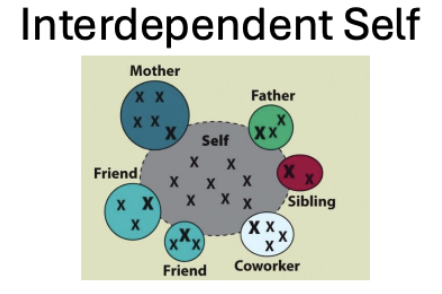
Independent Self vs. Interdependent Self
Who am I?
Independant self more likely to say “I’m friendly, “I’m hardworking”, “I like dancing”
Verus interdependent self “I am Sherman’s friend, I am serious at work”.
less likely to mention personal characteristics
Example Study
Northern Italy (independent)
More individualist, independent self
You are incredibly ugly
I wish you a cancer
Swine
Pile of shit
Person and qualities
Self of self separate
Southern Italy (interdependent)
More collectivist culture, interdependent
#@% you and 36 of your relatives
Your mother is a whore
Your mother is a breeding sow
Go to your @#!in’ dead relatives
Sense of self bound to others
Kinds of insults given to others
Participants filled out survey of swears
How do we perceive & evaluate ourselves?
What is Self-Esteem?
The positive or negative overall evaluation that each person has of themselves
High self esteem, better health outcomes
High self esteem good for a person
Where do you place your self worth?
Self esteem shifts by situation, relatively stable
Where you place self worth?
School, grades
How others view me
Generally people have a few
What are Contingencies of Self-Worth?
Self-esteem is contingent on successes and failures in domains on which a person has based his or her self-worth
self esteem goes up when you do well in areas that matter to you
Self esteem goes down when you stumble in areas that matter to you
Self esteem doesn't impact areas don’t care about
If being good friend important to you and do poorly, affect self esteem
If only have 1 place put self worth, if have failure in that domain, self-esteem tank because self worth out in one place
If have a few, feel worse failing in domain care about but can shift self esteem worth to other areas
Don't put all eggs in one basket
Place self worth in different areas, if dail in one domain take temporary hit but move self worth to other places
What is the Sociometer Hypothesis?
Sociometer Hypothesis states that self-esteem is an internal, subjective index or marker of the extent to which a person is included or looked on favorably by others
You decide your self esteem, comes from your successes and failures
Very social, alternate hypothesis
Self socially constructed, self important to humans, deep need to belong & connect to others
Self esteem quite social
Because need others to survive, self esteem asks as thermometer of how well doing in social group
How well things going in groups
High self esteem striving in social group
Low self esteem at risk of failure, ostracized by group
Self esteem as gage of how well going in group context
Hard to measure
Ideas put forward about what self-esteem is, how well doing in social group
Culture & Self-Esteem- How does it differ?
Members of individualistic cultures tend to report higher levels of self-esteem than members of collectivistic cultures
Idea feeling self is valued more important in individualistic cultures that focus on self more
Other cultures more focus on self improvement than how good or bad i am, contribute to group. Less emphasis on feeling good and contributions to group. More motivated towards self-improvement & commitment to group goals

What is Social Comparison Theory?
We evaluate ourselves through comparisons to others
How other people are doing
What matters is how you make these social comparison theory
What are Downward Social Comparisons?
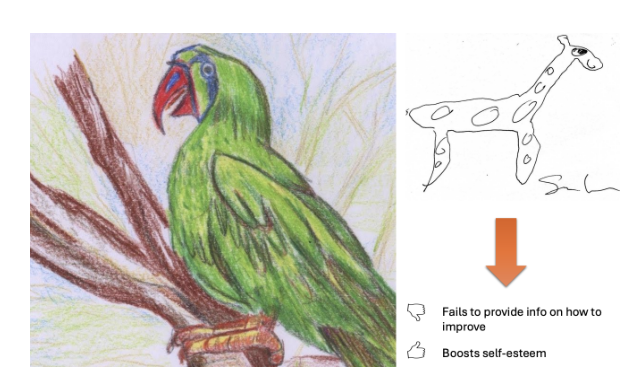
Invoke downward social comparison, looking down to person
Feel good about yourself
Fais to provide info on how to improve
Boosts self esteem
Good qualities & bad qualities
Example: told to draw a picture, you draw the one on the left. Other person draws the one on the right
Fails to provide information on how to improve
Boosts self-esteem
“Compared with people who are slightly worse at tennis than I am, I’m pretty good”
These sorts of downward social comparisons help us define ourselves favourably & boost our self esteem
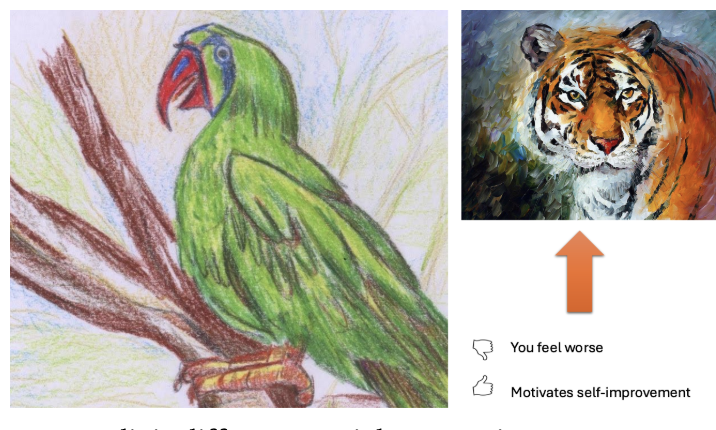
What are Upward Social Comparisons?
You feel worse
Motivates self-improvement
Upward social comparison, someone did something better then you
Feel worse about yourself
Motivate self-improvement, incorporate texture
Make social comparison all the time
Some tend to make more upwards, some more downward
Jonathan Haidt- Has Social Media Destroyed a Generation? Podcast
Social media, self-esteem & social comparisons
Survey Study: People who used Facebook most often had poorer self-esteem
Explained by greater exposure to upward social comparisons on social media.
Experiment: People saw fake profiles to elicit upward or downward and felt lower self-esteem in the upward comparison condition.
What is Self-Enhancement (Bias)?
Self-Enhancement is the desire to maintain, increase or protect one’s positive self views
Prominent in individualistic contexts
Do things to see selves positively
For example remember positive info about selves receives, versus bad
Failure to external factors, successes to internal
Creates Illusions about the self
Is self-enhancement good or bad?
Good: protects self esteem, confidence, strengths adhering to those
Bad: not changing/grow
Enduring trait or bias we have
What is the Better-than-average effect?
Better than average effect: the finding that most people think they are above around on various domains (such as personality trait & ability)
How would you rate your driving compared to other drivers?
A: I am an above-average driver
B: I am a below-average driver
C: I don’t know how to drive
Most people think above average at something
We cannot all be above average
Are some people better than average not
Protective to think better than average, can be bad in certain cases, protective against that
What is Self-Verification?
We strive to get others to confirm or verify our pre-existing beliefs about ourselves
For example if you see yourself as extraverted, self-verification theory predicts that you will try to get others to see you as extraverted as well
Generally get people to verify positive ways see yourself
Comforting to feel others see you the way you see yourself.
Want others to see you like you see yourself
Attend more heavily to info that confirms self, verus info we dont believe
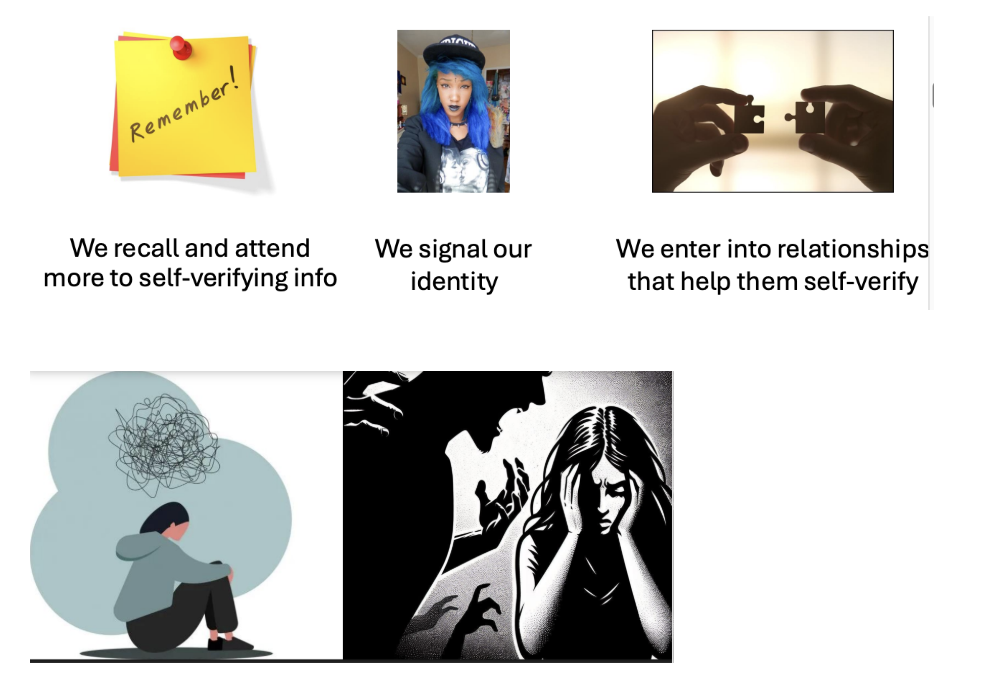
(1) We attend to and recall more self-verifying information (consistent with beliefs)
people with negative self views, spend more time studying negative rather than positive feedback about themselves, remember negative feedback better & interact with others who provide negative feedback
(2) We signal our identity
(3) We enter into relationships that help us self-verify
Most people wanna see self positively
More people have more negative views of self
Depressed people: remember negative feedback more than positive
Verifies how see self
People with low self esteem seek & stay with partners more abusive, coherence, think bad, someone treating them bad and makes the world make sense.
What is Self-Enhancement vs. Self-Verification? How do they differ?
Self-enhancement: most relevant to emotional responses to feedback about self
What info getting from others, feedback, drives emotional responses to feedback
Self-Verification: determines more cognitive assessment of validity of feedback
Tells accuracy of that
To test this, researchers gave participants with negative or positive self-beliefs negative or positive feedback
Study- What does Self-Verification Show?
Recruited people with positive views or negative views
Got + and - feedback
4 quadrants: positive few how received positive feedback, neg
Neg + feedback, neg and neg
People with negative fews found the negative feedback more accurate
Participants with positive views found positive feedback more accurate
Self-verification

Study- What does Self Enhancement Show?
All participants however felt good about positive feedback, and disliked the negative feedback.
Self enhancement differently
Feels bad to get negative feedback
Both felt bad about getting negative feedback
Both felt good to get positive feedback
Accuracy reflecting their + or - views
Negative feedback feels bad, positive feedback feels good
Two theories integrated
Know IV, DV, methods generally & outcomes & what that tells you

What is Self Regulation?
The process by which people initiate, alter, and control their behavior in pursuit of a goal to resist short-term rewards that thwart long-term goals.
Gives rise to idea called self discrepancy theory
What is the Self-Discrepancy Theory?
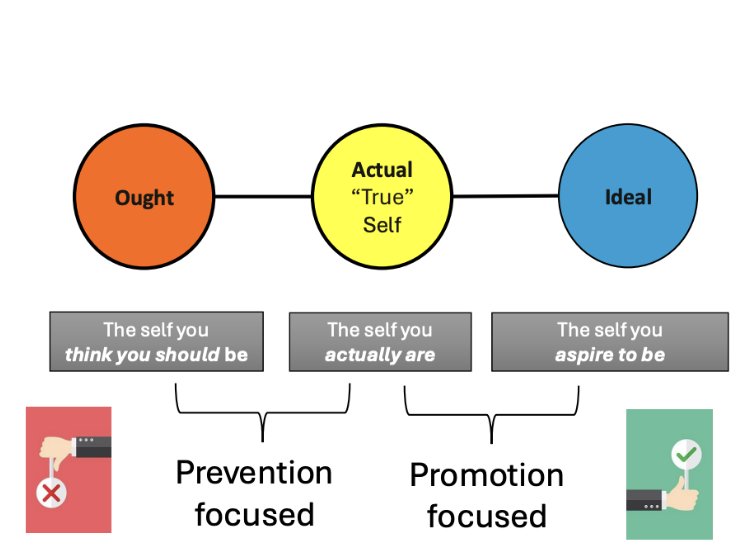
Self-discrepancy theory is a theory that behaviour is motivated by standards reflecting ideal and ought selves, falling short of these standards elicits specific emotions & may lead to efforts to get closer to them
Ought Self
The self you think you should be
(concerned with the duties, obligations & external demands people feel they are compelled to honour)
Actual Self “True Self”
The self you actually are
Ideal Self
The self you aspire to be
(embodies people’s wishes & aspirations)
According to this theory, ideal & ought selves serve as self-guides, motivating people to regulate their behaviours in order to close to gap between their actual self and their ideal and ought standards
When people pursuing goals to become ideal self, research shows focused on Promotion
Seeking out and obtaining certain goals
approach/promotion focused
Obtain positive outcomes to obtain ideal self
Promotion focus: self regulation of behaviour with respect to ideal self-standards, a focus on attaining positive outcomes through approach related behaviours
People from individualistic more likely to have promotion focus, attaining personal goals
Ought self
prevention/avoidant
Avoid negative outcome
If i think i ought to keep you here for 3 hours, avoid letting you leave early, extra lecture
Get in way of ought self, type of prof i should be
When people regulate their behaviour with respect to ought self standards they have a prevention focus: a focus on avoiding negative outcomes (such as being a bad grand-daughter)
People from interdependent cultures more likely to exhibit prevention focus: concerned with the possible negative consequences of their actions & how that might affect relations with others
Ideal self promotion
Prevention focused, vigilant for ought self
Sometimes have discerptancy between 3 selves
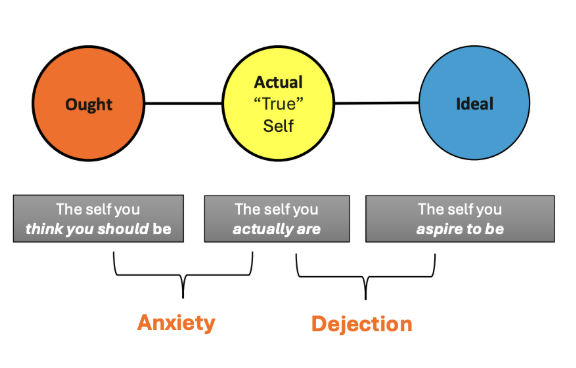
Discrepancies between our actual & ideal or ought self leads to negative emotions
If people feel discrepancy between who they should be (ought self) and actual, anxiety, anxious, worried not doing what they feel they ought to do.
If there is a discrepancy between the actual self and ideal self, feel dejected, disappointed in abilities
What are some Self-Regulation Strategies?
(1) Focus away from hotter, more tempting qualities of short term reward
Marshmallow Experiment
Kids focus more on marshmallow touched it, tended to be more likely to ring bell
Longer hold out shows other tradeoffs: go out vs. study
Going out to party (focus on spending money, losing out on sleep)
(2) Focus on high-level construals
See forest rather than trees, more long term thinking
High level LT goals, what trying to accomplish
(3) Action-implementation
If then statement
Smoking want to quit, dont make plan, just say going to quit
If i get urge to smoke, ill chew gum
Make these ahead of times help you in hot time, craving
How do we manage how others see us?
What is Self-Presentation?
Presenting the person that we would like others to believe we are
Doesn’t always correspond to type of person we are
1. Impression management
2. Self Monitoring
What is Impression Management?
Managing outward appearance to other (how dress, who associate with, what reveal about self or others)
We present, put best face forward, doesn't always correspond to who we are, discrepancy
What is Self-Monitoring?
Tendency to monitor one’s behaviour to fit the current situation
Tendency to monitor what we say and scrutinize behaviour in front of others to fit current situation
Do this with other people
People vary on this
High self monitors carefully scrutinize situations, according to the people or situation at hand
Low self monitors behave according to their own traits and preferences, regardless of social context
Self Monitoring Activity
What is your favorite and least favorite food? Why?
One person dont say “dont”, other “very”
What are the dangers of Self-Monitoring?
The self-monitoring group showed a reduction in:
Intellectual acuity on test taken after
Taking up bandwidth
Interpersonal restraint
Not look as comfortable, engage as much
Physical stamina
reduced
Executive function
Reduced
Don’t Ask, Don’t Tell Phenomena
Don't ask people about sexual orientation in military and don't offer information
In theory not infringe on people
Make everything smoother
Negative
Have element, partner, part of self now told cant share with people
Element of self told not supposed to share, not supposed to ask about
Self-monitoring
Not good
Negative consequence of self monitoring
What is Self-Handicapping?
Tendency to engage in self-defeating behaviour to prevent others from assuming that poor performance is due to lack of ability
Tendency to engage in sef-defeating behaviour in order to have an excuse ready should one fail or do poorly
Idea you take test and not sure going to do well, go out night before instead of studying, if fail test, because its because i was out partying all night
self-sabotage/handicap, create context fail
Procrastination can be
Self protective strategy