(A&P 2) Urinary System
 Call Kai
 Learn
 Practice Test
 Spaced Repetition
 Match
 Flashcards
 Knowt Play
1/136

There's no tags or description
Looks like no tags are added yet.
137 Terms
2 kidneys, 2 ureters, 1 bladder, 1 urethra
what 6 organs compose the urinary system?
filtration of blood
main function of urinary system
nitrogenous
urinary system excretes ________ waste
volume and pressure
urinary system helps regulate blood ______ and blood _____
solute concentration
the urinary system regulates the ___________ of blood
pH
urinary system regulates the ____ of extracellular fluid
erythropoietin
the kidneys produce __________
Vitamin D
urinary system aids in __________ synthesis
calcitrol
hormone made by the kidneys, needed for absorption of calcium phosphate, active form of vitamin D
blood calcium levels
the kidneys produce calcitrol which indirectly helps regulate _____________
uric acid
Nitrogenous waste formed when proteins are used in cells. It is excreted by the kidneys in urine.
ammonia
A small, very toxic molecule made up of three hydrogen atoms and one nitrogen atom; produced by nitrogen fixation and as a metabolic waste product of protein and nucleic acid metabolism.
creatinine
waste product of muscle metabolism, filtered out of the blood by the kidneys and excreted in urine
internal urinary sphincter
sphincter of the muscle system made of smooth muscle
external urinary sphincter
sphincter of the muscle system made of skeletal muscle
internal urinary sphincter
which sphincter keeps male semen out of the bladder?
external urinary sphincter
which sphincter is located at the pelvic floor?
internal urinary sphincter
which sphincter holds urine in the bladder?
ureter
#1

opening of ureter
#2

rugae
#3

prostate gland
#4

external urinary sphincter
#5
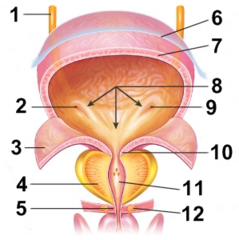
peritoneum
#6

smooth muscle
#7
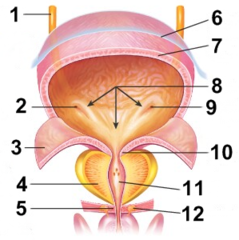
trigone
#8

internal urinary sphincter
#10

prostatic urethra
#11

bulbourethal gland
#12

bilateral retroperitoneal
location of kidneys
hilum
notch in kidneys where arteries, veins, and nerves enter
renal cortex
the cortex of the kidney containing the glomeruli and the convoluted tubules
renal medulla
Inner tissue layer of the kidney. Contains loops of Henle and collecting tubules. Contains pyramids.
renal sinus
central area of the kidney that includes the calyces, renal pelvis, renal vessels, fat, nerves, and lymphatics
calyces
system of ducts carrying urine from the nephrons to the renal pelvis
renal pelvis
a structure shaped like a funnel in the outlet of the kidney into which urine is discharged before passing into the ureter
nephron
microscopic functional units of the kidney, comprised of kidney cells and capillaries, each capable of forming urine
collecting ducts
receives urine from many nephrons and runs downward through the medullary pyramids, giving them their striped appearance. they give the striped appearance. as they approach the renal pelvis, they fuse to form larger papillary ducts, which empty the final urinary product into the clayces and pelvis of the kidney
interlobular arteries
#1

renal column
#2

renal sinus
#3

hilum
#4

renal pelvis
#5

papilla of pyramid
#6

ureter
#7

medulla
#8

renal capsule
#9

cortex
#10

minor calyces
#11
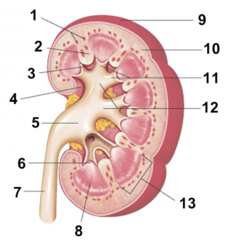
major calyces
#12

medullary pyramid
#13

renal corpuscle
the capsule that contains Bowman's capsule and a glomerulus at the expanded end of a nephron
glomerulus
small network of capillaries encased in the upper end of a nephron; where the filtration of blood takes place
bowman's capsule
cup-shaped strucutre of the nephron of a kidney which encloses the glomerulus and which filtration takes place.
renal tubules
microscopic tubes in the kidney where urine is formed after filtration
proximal convoluted tubule
part of the renal tubule where 75% of the salts, water, glucose and amino acids are reabsorbed
distal convoluted tubule
Between the loop of Henle and the collecting duct; Selective reabsorption and secretion occur here, most notably to regulate reabsorption of water and sodium
loop of henle
The loop of the nephron that dips downward into the renal medulla. The loop of Henle sets up a concentration gradient in the kidney such that from the cortex to the renal pelvis osmolarity increases. The descending limb of the loop of Henle is permeable to water, but not to sodium whereas the ascending limb is permeable to sodium, but not to water (and in fact, actively transports sodium out of the filtrate).
interlobular
#1
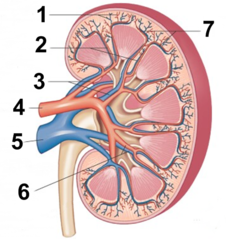
interlobar
#2

segmental
#3

renal artery
#4

renal vein
#5

lobar
#6
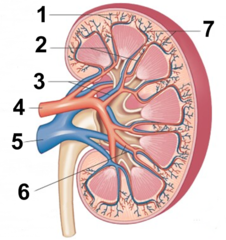
arcuate
#7

proximal convoluted tubule
#1

glomerulus
#2

distal convoluted tubule
#3

collecting tubule
#4

vasa recta
#5
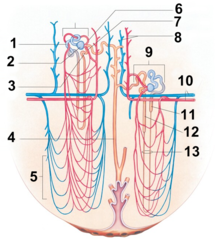
efferent arteriole
#6

afferent arteriole
#7

interlobular
#8

juxtamedullary nephron
#9
arcuate
#10
descending limb
#11
ascending limb
#12
henle's loop
#13
cortical
85 percent of nephrons are _______
juxtamedullary
15 percent of nephrons are _______
micturition
Process of emptying the bladder; urination; voiding
2-3 years
when does voluntary inhibition of micturition reflex develop?
200 ml
how much urine initiates the micturition reflex?
1000 ml
maximum amount of urine the bladder can hold
afferent arteriole
The small artery that carries blood toward the capillaries of the glomerulus.
efferent arteriole
The small artery that carries blood away from the capillaries of the glomerulus.
peritubular capillaries
The network of tiny blood vessels that surrounds the proximal and distal tubules in the kidney
renal corpuscle
where does filtration occur?
renal tubules
where does reabsorption and secretion occur?
filtrate
fluid that passes from the blood through the capillary walls of the glomeruli of the kidney
hydrostatic pressure
what force drives filtration?
plasma proteins
what does not get filtered from the blood?
proximal tubule
where does 65 percent of reabsorption occur?
loop of henle
where does 15 percent of reabsorption occur?
proximal tubule
where are all nutrients reabsorbed?
sodium
what is transported through active transport in the proximal tubule?
facilitated diffusion
how are the nutrients other than sodium transported back into the blood in the proximal tubule?
descending limb
where is the filtrate concentrated?
sodium, potassium, water
what gets reabsorbed in the descending loop of henle?
ascending limb
where does the dilution of urine begin?