Brain & Cognition sem 1 part 1
 Call Kai
 Learn
 Practice Test
 Spaced Repetition
 Match
 Flashcards
 Knowt Play
1/416

Earn XP
Description and Tags
Cognitive Neuroscience; the biology of the mind
417 Terms
Why were the ancient Greeks important to science?
Saw the natural world as an object that needed to be observed
Rejected supernatural expalantions of phenomena; every event had a natural cause
What is the anatomy of the spinal cord?
Butterfly shaped gray matter inside white matter with central canal
dorsal (sensory info in) and ventral (motor info out) root

What is the anatomy of the reflex arc?
Knee-jerk reflex; sensory neurons excite motor neurons directly in the spinal cord, before the brain know
Skinreceptor - dorsal root ganglion - afferent neuron - interneuron - efferent neuron - effector (muscle)

What historical evidence suggested that the brain’s activities produce the mind?
1) Broca’s patients; aphasia due to brain damage
2) Flouren’s animal experiments; removing hemipshere disrupted functions
3) Jackson’s seizure observations; order of movement linked to cortical body map
4) Fritsch/Hitzig stimulation experiments; stimulating area’s produced certain movements
Cortical paralymbic vs lymbic area’s
Paralymbic; links bodily/emotional states to cognition
Lymbic; central to emotion, arousal, motivation and memory
Monism vs Dualism
Monism; mind and body are intertwined (brain produces thoughts)
Dualism; mind (non-material) and body (material) are separate; interaction at pineal gland
Who was the founder of clinical neuroscience and how?
Thomas Willis;
observing patients throughout life
examining brain after death
linked brain damage to specific deficits

What is phrenology and who founded it?
Phrenology; personality is based on shape of skull
Gall and Spurzheim; if a personality trait is more frequent, it’s associated brain area will grow, causing a bump on the skull

Aggregate field theory
The whole brain influences behaviour (not certain parts)
What idea did Marie-Jean-Pierre Flourens support?
Aggregate field theory; behaviour depends on the whole brain working together

Which view did John Hughlings Jackson support?
Localizationist view; specific brain area’s are linked to specific functions, but behavior involves regions working together
What is cytoarchitectonics and who studied it?
Cytoarchitectonics; how braincells differ between regions
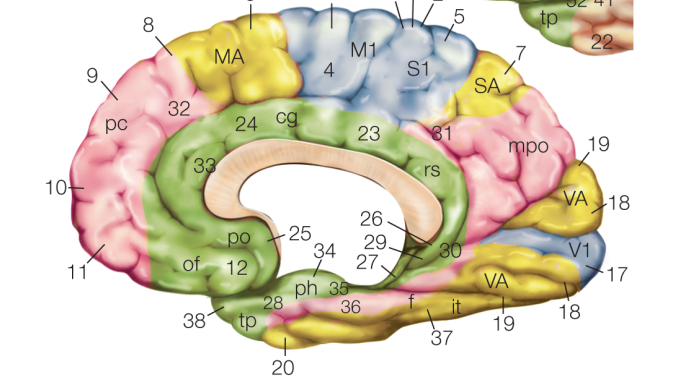
Brodmann, who stained the cortex and divided it into area’s

Unimodal vs multimodal association area’s
Unimodal (yellow); elaborate one sense
Multimodal (pink); combine the senses with memory, attention and emotion
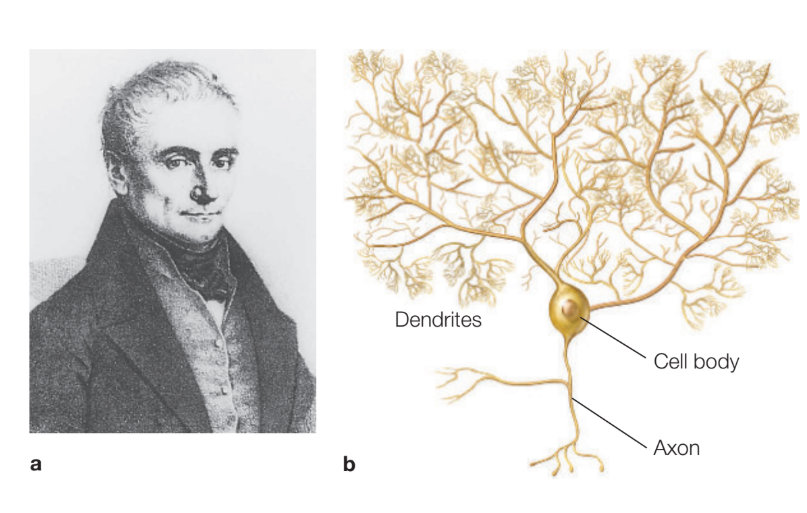
What technique did Camillo Golgi develop?
‘‘The black reaction’’; stain technique to make neurons visible

Neuron doctrine vs syncytium
Neuron doctrine; Cajal, the nervous sytem is made up of individual cells that do not fuse
Synctium; Golgi, the brain is one fused network
What did Ramon y Cajal discover about neurons?
The transmission of electrical information goes in only one direction, from the dendrites down to the axon

Rationalism vs Empiricism
Rationalism; knowledge is learned through reasoning (or innate)
Empiricism; knowledge is learned through (association of) sensory experiences (mind=blank slate)
What is associationism and who studied it?
Associationism; knowledge is learned though making associations (consequence of empiricism)
Ebbinghaus, Thorndike & Watson
Who is the founder of behaviorism?
Behaviorism; only study observable behavior (learned through conditioning)
Watson; ’’little Albert’’ experiment (white rat and loud noise)
What is the Montreal procedure and who invented it?
Montreal procedure; stimulating certain brain area’s and asking what patients experienced (damaging them stops epilepsy seizures)
Penfield
Who studied patient H.M and what did she find?
Brenda Milner
Hippocampal removal: no new long-term memories, but could still learn motor skills (evidence for multiple memory systems)
Circle of Willis
a ring at the bottom of the brain that connects major arteries

Jacksonian march
When people with epilepsy have a seizure there is a certain order of movements (supports later studies on the motor cortex)
What does the forgetting curve of Ebbinghaus entail?
Memory can be measured; how fast we forget a list of nonsense syllables
What does the law of effect of Thorndike entail?
Behavior with a positive outcome (reward) is more likely to be repeated
What were the causes of the cognitive revolution?
Cognitive revolution; the behaviorist view was rejected and focus was placed on mental processes
Computers/AI & criticism on behaviorism (Chomsky/Miller)
Deductive-nomological model
What was the problem with phrenology?
It was not falsifiable; there was no way to disprove it (confirmation bias was used)
Gall vs Flourens
Gall; localizationism (functions depend on specific brain regions)
Flourens; aggregate field theory (functions depend on the cerebral hemispheres working together)
Broca vs Wernicke’s area
Broca’s (B); non-fluent speech
Wernicke’s (A/Pc); no speech comprehension

How was the motor cortex discovered?
Fritsch and Hitzig used deep brain stimulation to activate regions, that produced different movements in dogs (localization).
Who was the first to describe a nerve cell?
Purkinje (czech!); largest neuron in the brain (=Purkinje cell)
Ch 2
Glial cells vs neurons
glial cells; glue (insulate/clean up)
neurons; signalling units
What are the two types of neuron signalling?
1) Electrical; within a neuron
2) Chemical; between neurons in the synapse (although electrical synapses also exist)

What are the 4 steps in synaptic transmission?
1) Action potential causes Ca+ ions to flow into presynaptic membrane
2) Vesicles bind to presynaptic membrane
3) Neutrotransmitters get released (exocytosis)
4) Neurotransmitters bind to postsynaptic receptors

What are the two components of the nervous system?
1) CNS; central nervous system (brain & spinal cord)
2) PNS; peripheral nervous system (rest of the body)

What are the two components of the autonomic nervous system?
1) Sympathetic; alerting (high heartrate, pupil dilation, adrenaline release)
2) Parasympathetic; calming (low heartrate,digestion)

What are the two components of the peripheral nervous system?
1) Autonomic; automatic functions (without conscious control)
2) Somatic; sensory input in, motor commands out (voluntary movements)
What are the structures of the brainstem?
What are the structures of the Diencephalon?
What are the structures of the Telencephalon?
What are the surface features of the cortex?
What is the cell architecture of the cortex?
What are the functions of the cortex?
What are the steps in the early development of the nervous system?
Do you get new neurons throughout your life?
What are the four types of glial cells in the brain?
1) astrocytes; form blood-brain barrier
2) oligodendrocytes/schwann cells; make myelin
3) microglial cells; remove damaged cells/debris
4) radial glia; structure for migrating neurons

Blood-brain barrier
Makes sure that nothing harmfull comes into contact with neurons in the brain
Axon collaterals
branches on an axon that connect with other cells

Permeability
the extent to which ions can cross a neuronal celmembrane
Electrical vs concentration gradient
electrical; assymetrical distribution of the voltage of ions in and out the cell (ions go toward the opposite charge)
concentration; distribution of the amount of ions in and out the cell (high to low)
Electrochemical equilibrium
the electrical and concentration gradient are even; the amount of a specific type of ions (e.g. K+) going in and out of the cell is the same
Excitatory postsynaptic potentials (EPSPs)
Depolarization due to neurotransmitter (glutamate) binding; postsynaptic action potential closer to threshold
Electrotonic vs saltatory conduction
electrotonic; no regeneration, in dendrites/cell body/between nodes
saltatory; electronic conduction between nodes plus regenaration of action potentials in nodes in axon
Spike-triggering zone in the axon hillock
Zone between axon and soma, if sum of membrane potentials reaches threshold it cause an action potential
What are the fases of electrical transmission in the axon?
resting potential (-70 mV, more K+ in cell)
depolarization (over -55 mV, Na+ in cell)
action potential (more Na+ in cell)
repolarization (K+ out cell, Na+ channels close)
hyperpolarization (more K+ out cell)
refractory period (K+ channels close)
Neural oscillations
Brain waves on EEG
What are the two types of ion channels?
non-gated; let everything through
gated; let specific ions through
Second messenger
Triggered by the G-protein of the postsynaptic receptor GPCR (influences mechanisms in cel)
What are the types of neurotransmitters?
1) Amino acids; GABA, glutamate etc.
2) Neuropeptides; strings of amino acids
3) Amines; dopamine, norepinephrine etc.
Conditional neurotransmitters
What are the two types of transmembrane proteins?
ion channels; move ions against their gradients, using ATP (active transport)
ion pumps; pores that let specific ions flow down their gradients (Na/K pump)
Ionic concentration vs electrical gradient
Equilibrium potential
Absolute vs relative refractory period
absolute; no action potentials possible
relative; higher depolarization needed for action potential (comes after absolute)
Neural oscillations
What are the two types of postsynaptic receptors?
1) Ligand-gated ion channels; fast signalling
2) GPCR’s; slow signalling
EPSP vs IPSP
EPSP; excitatory postsynaptic potentials (depolarizes closer to threshold)
IPSP; inhibitory postsynaptic potentials (hyperpolarizes further from threshold)

What does it mean when two neurons are isopotential?
In an electrical synapse; both neurons have the same electronic potential (electrical changes in one are reflected instantaneously in the other)
Microcircuit vs macrocircuit in the brain
Microcircuit; local connections between neurons (specific functions)
Macrocircuit; long axons connect microcircuits across brain regions

What are the three types of connections in the brain?
1) Microcircuits
2) Macrocircuits (neural networks)
3) Neural system (e.g. visual system)
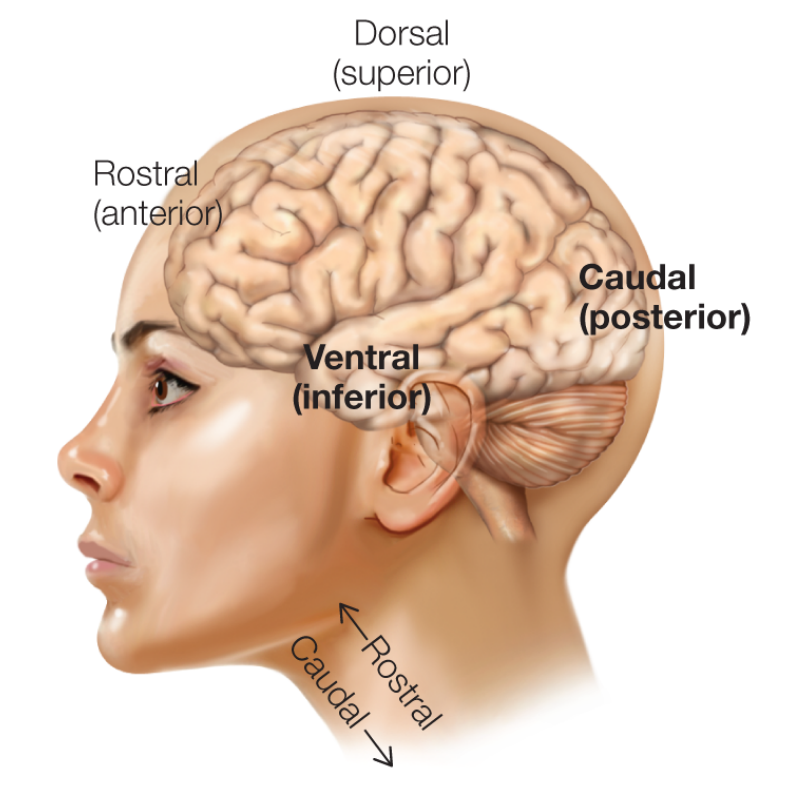
Rostral vs caudal
Rostral; anterior (front/upwards)
Caudal; posterior (back/downwards)
What are three protective membranes of the brain and spinal cord?
1) Dura matter
2) Arachnoid matter
3) Pia matter

What are the four ventricles?
1) Left lateral ventricle
2) Right lateral ventricle
3) 3rd ventricle
4) 4th ventricle

What is CSF and what is its relation to the arachnoid villi?
CSF= cerebral spinal fluid; flows through ventricles - subarachnoid space - spinal cord to protect brain
Arachnoid villi reabsorb CSF back into the brain
Grey vs white matter
Grey; soma’s, around white matter (nucleus/layers)
White; axons, in the middle (tracts)
(Opposite from spinal cord; grey in middle, white around)

What are tracts?
Tracts= white matter (axons) in CNS (similar to nerves (bundled axons) in PNS)
What are commissures and what is the largest one called?
Commissures; tracts that connect cerebral hemispheres
Corpus callosum is the largest commissure
What is the location and function of the medulla?
breathing and heart rate
motor fibres cross here; the left hemisphere controls the right body
under pons

What is the location and function of the pons?
under midbrain
relays between cortex and cerebellum + sleep

What is the location and function of the cerebellum?
Coordination; balance, posture and precise timing of movements
Gets cerebral info from pons

What are the three major parts of the midbrain?
1) tectum; superior colliculi (visual orientation) & inferior colliculi (sound orientation)
2) tegmentum; substantia nigra (dopamine) & red nucleus (coordination)
3) periaqueductal gray; pain modulation and defense

What is the location and function of the thalamus?
What is the location and function of hypothalamus?
under thalamus
(automatic) regulator of the body’s internal state; temperature, hunger, thirst, sleep-wake cycles & sexual behavior (hormones via pituitary gland)

What 4 regions are part of the cerebrum?
1) Lymbic system
2) Basal ganglia
3) Olfactory system
4) Cerebral cortex
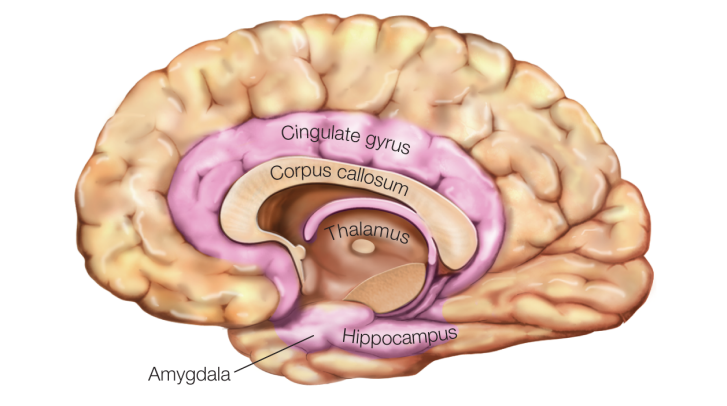
What 4 structures are part of the lymbic system?
Lymbic system; emotion
Hippocampus (memory)
Amygdala (emotion)
Cingulate gyrus (above corpus callosum)
Hypothalamus
What 4 structures are part of the basal ganglia?
Bsal ganglia; select and initiate actions & learn from reward
1) Striatum (caudate + putamen; Huntington’s)
2) Globus pallidus
3) Subthalamic nucleus
4) Substantia nigra (dopamine; Parkinson’s)

Sulci vs gyri
Sulci; infolding of the cortical sheet
Gyri; protruding, rounded surface

What is a fissure and what are its types?
Fissure; prominent sulcus
central (separates frontal/parietal)
sylvian (separates frontal/temporal)
interhemispheric (joined by corpus callosum)
calcarine (occipital)

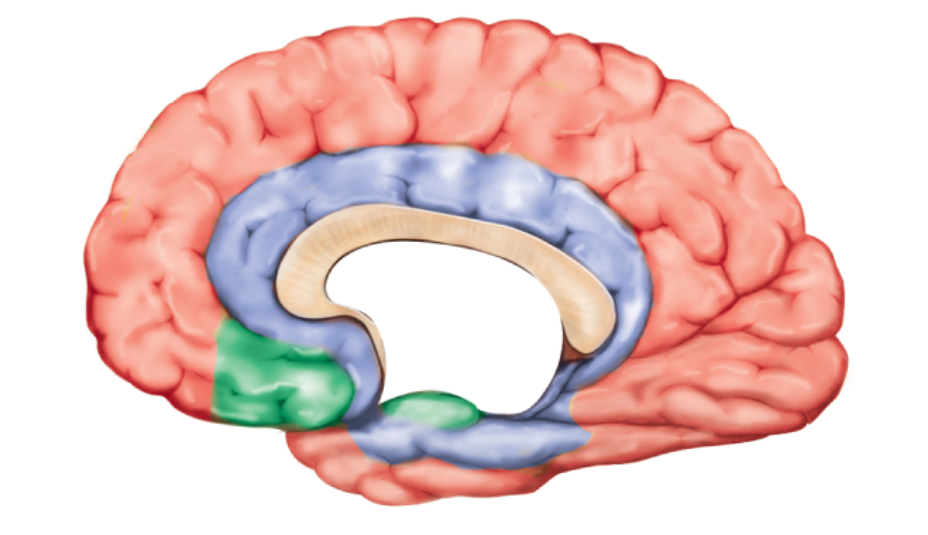
What are the 3 different types of cortex?
1) neocortex (red); most layers
2) mesocortex (blue); transition between neo and allo-cortex
3) allocortex (green); hippocampus/olfactory cortex
What are the two types of neural colums?
Neural columns act as basic processing units across cortical layers
1) Microcolumns
2) Cortical columns (bundles of microcolumns)

What are the three layers of the blastula?
blastula; clump of cells before fetus
1) ectoderm (outer); nervous system/skin
2) mesoderm (middle); skelet/muscles
3) endoderm (inner); organs
Neurulation
The early processes that go into forming the nervous system.
The three zones of neural proliferation
1) proliferative; neurons that form the brain
2) subventricular; cortical neurons
3) ventricular; neurons that form other parts of the brain
All the neurons arise from a layer of precursor cells.
Precursor cells
Undifferentiated cells from which all cortical cells (including neuronal subtypes and glial cells) arise through cell division and differentiation
Synaptogenesis
The formation of synapses