Theme 1 - Social behaviour in laying hens
 Call Kai
 Learn
 Practice Test
 Spaced Repetition
 Match
 Flashcards
 Knowt Play
1/45

There's no tags or description
Looks like no tags are added yet.
46 Terms
Chickens in the wild
Domestic chicken orginates from Jungle Fowl
Domestication started 8000 years ago: ornamental and fighting birds
Since 1000-2000 years kept for eggs and meat
Last 70-80 years intensive selection on productive traits, after WW@
Red Jungle Fowl (RJF)
Ancestor domestic chicken
Lives in the jungle
Trees
Shrubs
Open areas
Small groups: male with 6-7 hens and their offspring
Behaviour RJF
Mostly walking, pecking, looking and scratching
Behavioural synchronisation
Environmental and social pressures that favour group living
Protection from predators
Increased chance of resource discovery (food)
Induces synchrony
A shared threat: rest or hide together, escape
New food source: exploit before it runs out
Behavioural facilitation
Observe a conspecific performing a behaviour and replicate or follow the behaviour
Food pecking: pecking rate
Drinking: swallowing rate
Dust bathing: presence of (familiar) other birds
Maternal behaviour
Hens trained with two different foods
Palatable
Unpalatable
Hens observed chicks eating
Palatable
unpalatable: more ground pecking, scratching food pecking
Does it matter who’s in the group?
Evolutionary:
beneficial to help own kin (increased fitness)
Pair housing in cages: greater synchrony within pairs than between pairs
Feeding, head shaking, resting, sitting, standing, preening
Clustering: social or resource-driven
Small groups of familiar hens
Shared resource preference more important than social attraction
Social attraction complex: age, familiary, fearfulness, space allowance
Role of group size in social behaviour?
Groups of 15,30, 60 and 120 hens
Same stocking density
Behavioural synchrony
Spatial clustering
Synchrony decreases with group size
Clustering decreases with group size
Preening was the most synchronised behaviour
Feeding behaviour was the most clustered in space
Synchrony and clustering seems more relevant in small groups than in large groups
More important to consider resources in furnished cages than in non-cage systems
EU housing systems
Traditoinal battery cage banned in the EU from 2012
Only furnished cages and non-cage systems allowed
Furnished cages
Compared with traditional cages, laying hens in furnished cages have:
More space (750 cm2, vs 550 cm2)
A perch, a est and a scratching area
Larger groups (20-60 birds vs 4 birds)
Challenges
Limited space
Difficult to fit all functional ares (better in large FCs)
main challenge: litter supply
Limited height: resting birds block active birds
Non cage systems
Non-cage systems can be aviary systems or floor housing
More space than in cages, 1.111 cm2 vs 750/550 cm2)
perches, nests and a large scratching area
large group size (5000 - 30.000 birds)
Large gropu size: difficult to control social problems
feather pecking
panic reactions
piling/smothering
effect of group size on aggression
Comparison of furnished cage and non-cage housing

Social dominance
Domiannc hieracy/pecking order
common feature of social organisation
maintained by aggressive pecks to head
display of submissive behaviour
Social hierarchies in poultry are maintained through aggressive and submissive interactions. g
Group size and dominance
Small groups (0-30 birds(: individual recognition
stable dominance hierarchy
based on aggressive interactions
Large groups (>50 birds): no individual recognition
inefficient to invest in aggressive interactions
use simple signals to decide dominance
largest bird with largest comb is dominant
Problem large groups: pariah birds
Birds that are often wounded or have severe feather damage
Low in the hierarchy
Hide in the nests or on the perches
Feed/drink during night (low body weight)
Intermediate group size of 30-50 birds
Problematic
still able to recognize each other
Inefficient to invest in aggressive interactions
can lead to socially instable groups
Efffect of group size on body and egg weight
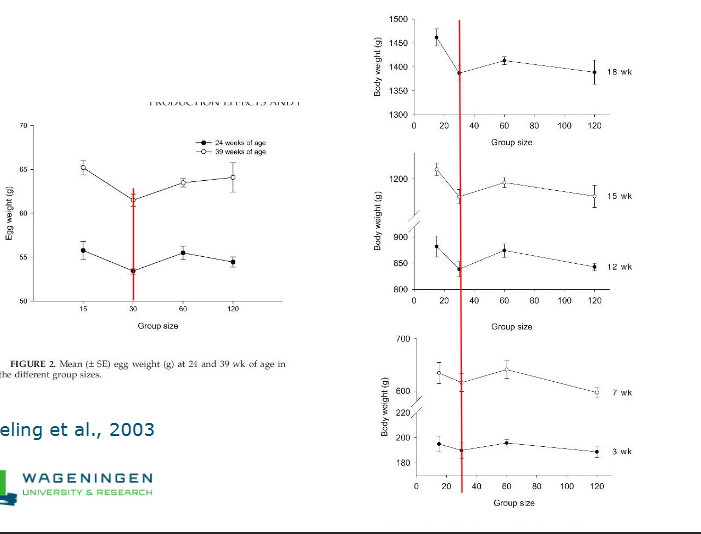
Social behaviour essential for survivial and fitness
behavioural synchornisation
behavioural facilitation
spatial clustering
less synchrony in larger groups
imlications for housing design
Aggression and group size
Small groups (0-30): stable dominance hierarchy
Intermediate group size (30-50) should be avoided
Large groups 9>50): simple rules to determine dominance
Behaviour RJF
Walking, pecking, looking, scratching most: social?

How has social behaviour changed?
Domestication
Intense selection for high egg production + efficiency
Large group sizes
High stocking densities
Space for natural behaviour?
Social behaviour compared
Jugnlyfowl shows a lot of wing signals compared to leghorn
Distance between birds
Leghorn is closer togheter than jungle fowl
Feeding and activity
Modern hen: less motivated for foraging
Less active
Less fearful
All in comparison with RJF
Effects of group size
First hour: group size modifies social behaviour
Large groups: less aggression
Feather pecking behaviour?
Effects of group size on feather pecking
Gentle and severe pecks really high in large group size

Effects of stocking density and group size
Maniupulation of stocking density by varying the group size in same size compartment
72, 168, 264 or 368 Isa brown birds
Worst plumage condition in the large groups
Stocking density 22 and 30 birds/m2
Effect may not be seen in very large groups
group sizes between 2450 and 4200
stocking densities between 7 and 12 birds/m2
most FP in smaller flock size
Stocking density and spatial needs

Freedom of movement
Larger in larger pens/cages
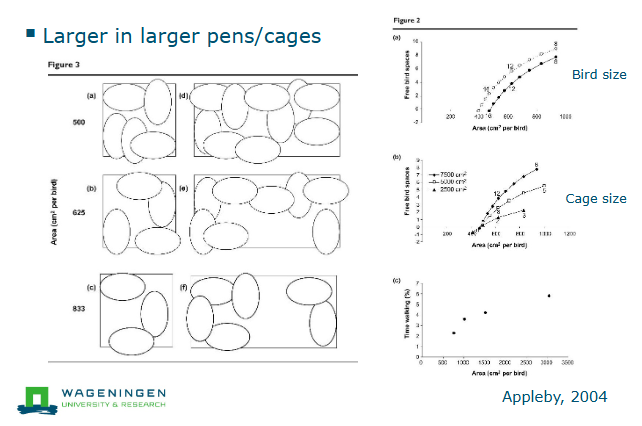
Limits to stocking density
Small gropus (2-30 birds), below 542-650 cm2 per hen
Higher mortality, lower egg production and body weight, poorer feed conversion
Behavioural restrictions wing stretching, leg stretching, tail wagging, locomotion, floor and object pecking and preening
EU: 750 cm2 furnished cages, 1.111 cm2 non-cage systems
Important tools in social signlaing
Physical appearance
body size
comb size and colour
Vocalisations
Alarm calls
Food calls
Postures
agonistic behaviours
Comb size and colour
Hens with higher dominance scores had larger combs than those with lower dominance scores
No associaiton between BW and dominance score
Relationsip between dominance score and comb colour
Hens with combs perceived by humans as more yellow-red than pure red were more successful competitors
Vocalisations
Extensive vocal repertoire
warning calls
contact calls
signlling threat or submission
food calls
territorial defence: long distance (crowing)
social domiance: quality plus rate
food calls
from mother to chicks
combined with ground pecking
combination with local enahncement
form males to females (honest?)Po
Postures
clearest: domiannce/submission
once dominance established: avoidance of dominant birds (advantage acess to resources)
Do modern laying hens form social networks
Individual variaiton in centrality
No clear preference for specific individuals
Modern hen compared with Red Jungle Fowl
Less fearful
Less active
Lower foraging motivation
Closer together
Group size affects feather pecking
Increased risk of feather pecking in large groups
Space allowance affects behaviour and welfare
More so in smaller pens: shared space
concern for furnished cages
Limited space affects
Freedom of movement, locomotion and body condition
hens use … to communicate social information
comb and body size, vocalisations, postures
We can measure social behaviour by …
tracking individual animals in groupsCo
Commercail application
Phenotyping for breeding
Scientific interest
Social network analysis, understanding socialbehaviuor, lik to personality traits