Lecture Exam #3 (Ch 11, 12, 14, 15 21-26)
 Call Kai
 Learn
 Practice Test
 Spaced Repetition
 Match
 Flashcards
 Knowt Play
1/84

There's no tags or description
Looks like no tags are added yet.
85 Terms
What illness in the US involves cercariae penetration?
cerarial dermatitis
Pregnant women should not contact feline feces because they could get:
toxoplasmosis from T. braadyzoites, causing fetal issues
Sporotrichosis is treated with a _____-cide
fungicide
What causes thrush and vaginitis?
candidiasis; overgrowth of C. albacins
What do E. histolytica eat?
bacteria, host tissues, food particles
If one ingests cysticerci, they may contract a:
taeniasis; tapeworm infection
What are the symptoms of vaginal candidiasis?
itchy, cheesy discharge
What is the etiological agent for LGV (Lymphogranuloma venereum)?
chlamydia tranchomatis
All protozoans make cysts (T/F).
false; only some do
What is the first test done to ID a bacterium?
gram stain
What are the characteristics of helminths?
parasitic, multicellular, eukaryotic, advanced reproductive systems
Compare transmission of Chlamydias and Rickettsias
chlamydias are transmitted via direct/sexual contact, rickettsias are G- coccobacilli transmitted through fecal waste of infected vectors (ticks, fleas, lice, mites)
Sac fungi are called:
ascomycota
What is the most highly developed system in helminths?
their reproductive systems
All fungi produce resting/diploid spores (T/F).
false
Helminth transmission is usually by what routes?
gastrointestinal (fecal-oral) or skin penetration
Tapeworms (cestodes) eat:
partially digested food
To avoid getting a tapeworm, you must:
avoid consuming undercooked meat that has been infected with larvae
Ringworm is caused by a:
fungal infection, not actually a worm
Give the correct terminology to describe the energy and carbon sources for Euglenozoa:
they’re photoautotrophs in light (light/sun for energy, CO2 for carbon) and facultative chemoheterotrophs in dark (organic compounds for energy and carbon)
When does one get a nosocomial infection?
In the hospital; hospital-contracted infection
Etiology was introduced by what scientist?
Koch
Septicemia is:
the multiplication of bacteria without toxin release
What do we call bacteria that are present for a short time?
transient
What are the major reservoirs of infection?
soil, water, hospital, people (sick and healthy), animals (sick and healthy)
What is a fomite?
inanimate object that can be contaminated with infectious organisms
What is a primary infection?
the initial contracted acute infection
What is a secondary infection?
infection/disease as a result of immunocompromised state due to primary infection(s)
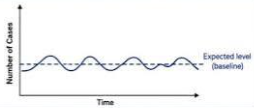
Endemic graph
consistently present, possibly with cyclic pattern
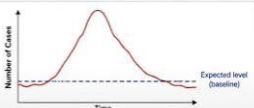
Epidemic graph
a fraction of population affected unexpectedly over a relatively short period
Sporatic graph
one or two occurrences in low numbers
An infection that develops after an operation can be due to:
aseptic technique, unsterilized equipment, opportunistic bacteria, etc.
An unprotected sneeze can be what form(s) of transmission?
droplet, airborne/vehicle
STDs are from what form of transmission?
direct contact transmission
Food poisoning is what form of transmission?
vehicle transmission through intoxication
Plague transmitted by a flea is what form of transmission?
vector transmission
Pneumonic plague (btwn humans) is what form of transmission?
droplet transmission
What is a zoonosis?
involves an animal vessel in some stage of illness
Why doesn’t C. albicans normally cause disease?
they’re in direct competition with lactobacilli, creating an antagonistic relationship
Describe synergistic relationships between bacteria.
one organism requiring the product(s) of another organism to survive; could be mutualistic
EIDs an be caused by what?
mutants, ignorance of disease spread, non-controlled animal populations, mass transportation, natural disasters, unsanitary conditions, overuse of antibiotics, climate change, geographic change (industrial and artificial waterways), reuse of needles, respiratory transmission (droplet and vehicle)
The most common portal of entry is the:
mucus membranes of respiratory then digestive system
Bacteria that can get through the skin when there is no abrasion or cut have probably gained access via:
sebaceous gland(s)
Define ID-50
infectious dose for 50% of lab organism test population
Define LD-50
lethal dose for fatality for 50% of sample population
Which form of anthrax is “easiest” to get?
cutaneous (skin reaction) ~ ID 50-100
What structures facilitate bacterial-invasiveness?
anything allowing organism to “stick”; capsules, fimbriae, pilli, ligands
Define leukocidins:
membrane-disrupting toxin released by microorganism to kill phagocytic leukocytes (WBCs)
Define hemolysins:
breaks down erythrocytes (RBCs) and/or phagocytes (WBCs)
Define coagulases:
coagulates blood
Define kinases:
dissolves blood clots
Define hyaluronidases:
breaks down hyaluronic acid
Exotoxins are destroyed by heat (T/F):
true
What competes with human iron-transferring proteins?
siderophores
Define parenteral route of entry:
introduced underneath skin from bites, punctures, trauma
How can one avoid botulism?
washing and cooking soil-based foods thoroughly
Septic shock due to G+ bacteria is caused by:
super-antigenic (resembles G- endotoxins)
How do G- bacteria cross the blood brain barrier (BBB)?
induces TNF (tumor necrosis factor) production
Injectable drugs are tested for endotoxins with the _______ test.
LAL (limulus amoebocyte lysate)
Via what scenario do antibiotics interfere with septic shock treatment?
if antibiotics destroys the cw with G- infection/intoxication, will decrease symptoms
What does TNF do to blood pressure?
decreases bp to increase BBB entry likelihood
What are the effects of lipid A release?
fever, vomiting, diarrhea (G-)
Are specific illnesses mechanically or biologically transmitted?
biologically
Effect of endo- and exotoxins
damages host cells/immune system
Effect of bacteriosins
competes with other bacteria, not damaging to human cells
What happens with the LAL test?
if there are endotoxins present, they will crystalize/precipitate
Disease incidence
indicates spread of disease (# cases over time)
Disease prevalence
length & severity of illness (# new vs old cases over time)
Stages of illness
incubation, prodromal, illness, decline, convalescence
Incubation stage of illness
time between initial infection/exposure and symptom presence (disease dependent)
Prodromal stage of illness
beginnings of symptoms
Illness stage of illness
peak of symptoms with most severe signs/symptoms
Decline stage of illness
decrease in etiological units
Convalescence stage of illness
restoration to normal health; disease-dependent
Antagonistic symbiotic relationship
2 competing organisms [ie C. albicans vs lactobacilli]
Cooperation symbiotic relationship
2 or more organisms with beneficial traits for others [ie teeth plaque]
Commensalism symbiotic relationship
1 organism benefiting while other organism has neutral effect
Mutualism symbiotic relationship
2 organisms both benefit [ie E. coli and humans]
Parasitism symbiotic relationship
1 benefits, other is negatively affected
Synergism symbiotic relationship
1 organism requires product of another organism (can also be mutualistic)
4 virulence factors
enzymes/proteins, external structures [allows for sticking/attachment], concentration of microorganisms, toxins [endo and exo]
A-B exotoxin
interferes with protein synthesis, A = active, B = binding
Membrane-disrupting exotoxin
causes leaky membranes of host cells through poked holes, destroys phospholipids
Superantigenic exotoxins
releases cytokines, similar to a G- intoxication, causes fever vomiting diarrhea
4-step sequence of endotoxin pyrogenic response
(1) macrophage ingests a G- bacterium (2) degraded bacterium in vacuole, releasing endotoxins inducing cytokine, IL-1, and TNF production (3) cytokines released into bloodstream by microphages travel to hypothalamus (4) cytokines induce hypothalamus production of prostaglandins