Chapter 2 - Chemistry Comes Alive
 Call Kai
 Learn
Learn Practice Test
 Spaced Repetition
 Match
Match Flashcards
 Knowt Play
1/75

There's no tags or description
Looks like no tags are added yet.
Name | Mastery | Learn | Test | Matching | Spaced | Call with Kai | Chat |
|---|
No analytics yet
Send a link to your students to track their progress
76 Terms
Inorganic Compounds
Do not contain carbon
Ex: Water, Salts, Many acids and bases
CO2 and CO are exceptions to the rule
Organic Compounds
Contains carbon
Ex: Carbohydrates, Lipids, Proteins, Nucleic acids
properties of water
High heat capacity (Absorb and release heat)
High heat of vaporization (Water evaporation releases heat like sweating)
Polar molecule > universal solvent (Transport medium & Lubricant)
Reactivity (Important reactant in chemical reactions)
Cushion (protection)
*Most abundant inorganic compound (Accounts for 60%–80% of the volume of living cells)
Hydrophilic substances
Polar molecules
Dissolve in water
Ex: Polar molecules, Ions, Small proteins
Hydrophobic substances
Nonpolar molecules
Don’t dissolve in water
Have to be transported via carrier proteins
Ex: Nonpolar molecules & Metals
Amphipathic molecules
Partially polar and nonpolar
> partially dissolves
Ex: Phospholipids & Glycolipids
monomer
Single building block
Form polymers via dehydration synthesis reactions

polymer
Chain of repeating monomers
Can be broken down into monomers via hydrolysis reactions

dehydration synthesis
monomers are joined by removal of OH from one monomer & removal of H from the other at the site of bond formation > anabolic

hydrolysis
monomers are released by the addition of a water molecule, adding OH to one monomer and H to the other

biological macromolecules always contain ?. may contain
always: C, H, O
may: N, P, S
elements of carbohydrates
Rings of carbons, where the number of C is equal to the number of O. (CH2O)n

Molecular formula of carbohydrates
(CH2O)n
function of carbohydrates
Fuel
Cell membrane structure (limited)
are carbohydrates hydrophilic or hydrophobic?
hydrophilic
types of carbohydrates
Monosaccharides
Disaccharides
Polysaccharides
monomer of carbohydrates
monosaccharides (simple sugar)
examples of carbohydrates
Glucose
Fructose
Galactose
Ribose
Deoxyribose
two monosaccharides = ?. formed through ?
disaccharides; dehydration synthesis
1. Most prominent carbohydrate
2. Main source of energy for most cells
3. Can be stored in the liver and skeletal muscle as glycogen.
glucose
Which monosaccharides combine to form sucrose
Glucose + Fructose
Which monosaccharides combine to form lactose
Glucose + Galactose
Which monosaccharides combine to form maltose
Glucose + Glucose
polysaccharides
largest carbohydrate (made of many monosaccharide molecules)
>Combined via dehydration synthesis reactions.
low solubility (due to their size and branching)
most prominent example in humans: glycogen
other ex: Starch and cellulose (plants)
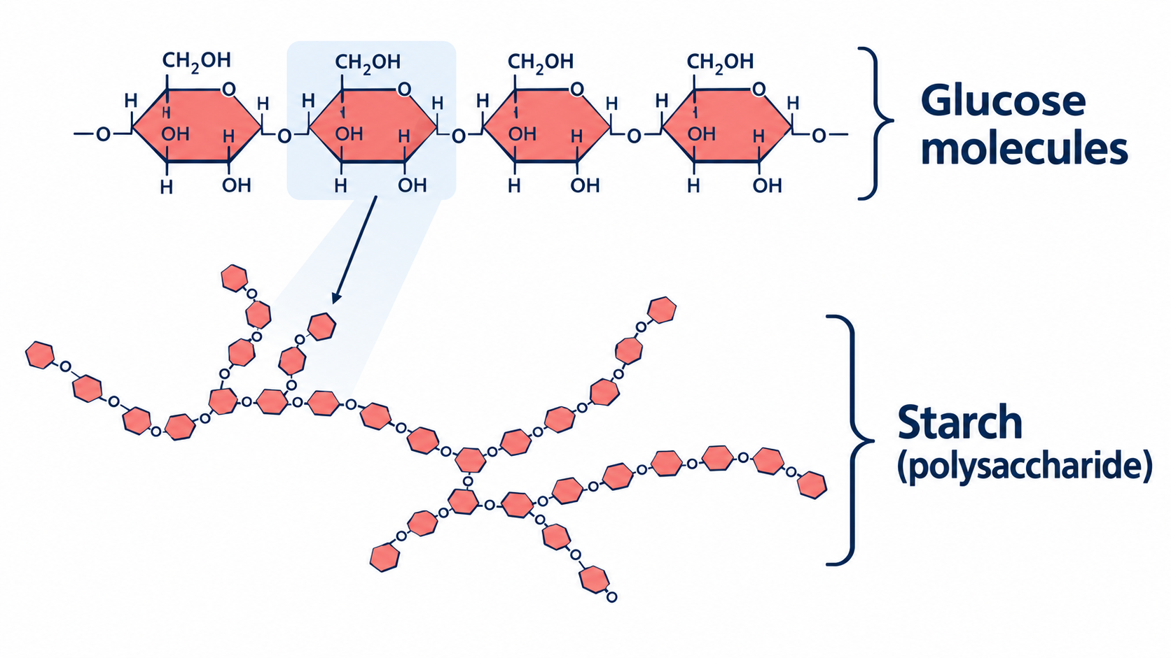
Glycogen can be broken down into ? when blood glucose is low.
This is an example of ? feedback.
Stored in the ? & ?
glucose; negative feedback; liver and skeletal muscles.
Glycogenesis
Storage of excess glucose in liver and skeletal muscle as glycogen
Glycogenolysis
Liver hydrolyzes glycogen into glucose when needed
Gluconeogenesis
Liver can make glucose from non-carbohydrate sources
does Glycogenesis increase or decrease blood glucose?
Decreases
does Glycogenolysis increase or decrease blood glucose?
Increases
does Gluconeogenesis increase or decrease blood glucose?
Increases
structure of lipids
C, H, O
function of lipids
Insulation
Fuel
Cell structure
are lipid molecules hydrophilic or hydrophobic?
hydrophobic
types of lipids
Fatty acids
Triglycerides
Phospholipids
Steroids
monomer of lipids
fatty acids
structure of fatty acids
type of lipid
Carboxyl (COOH)
Hydrocarbon chain
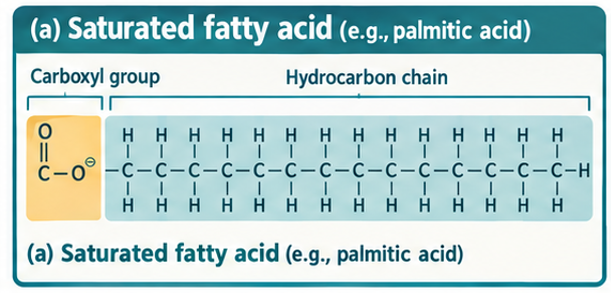
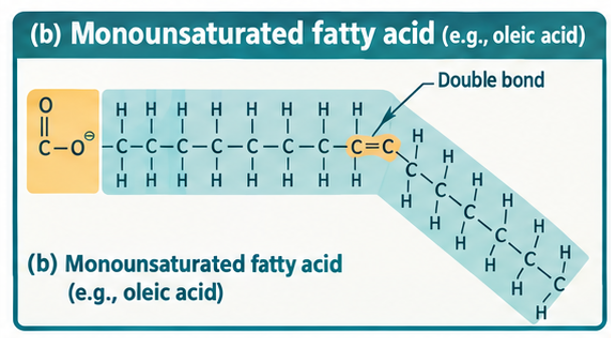
classes of fatty acids
Saturated fatty acids
Monounsaturated fatty acids
Polyunsaturated fatty acids
Saturated fatty acids
No double bonds
solid @ room temp

Monounsaturated fatty acids
1 double bond
liquid @ room temp
Polyunsaturated fatty acids
2 or more double bonds
liquid @ room temp

triglycerides structure
type of lipid
structure: 3 fatty acids + glycerol
Solids > fats
Liquid > oils

triglycerides function
Energy storage and fuel (Lipogenesis and lipolysis)
Insulation
Protection
lipogensis
3 fatty acids + glycerol → triglyceride + H₂O
Dehydration synthesis reaction
lipolysis
triglyceride + H₂O → 3fatty acids + glycerol
Hydrolysis reaction
phospholipids structure
type of lipid
modified triglyceride
Head (Polar)
>Phosphate-containing group
>Glycerol
Tail (Nonpolar)
>2 Fatty acids
amphipathic

phospohlipids function
Cell membrane structure
steroids structure
type of lipid
4 fused carbon rings
Composed of fatty acids

functions of steroids
Cell membrane structure
Hormone synthesis
Bile synthesis
Vitamin D
cholesterol
a. Component of cell membranes
b. Used to make bile salts (digestion), hormones (testosterone and estrogen), and vitamin D
proteins structure
Always: C, H, O, N
Sometimes: S and P
monomer of amino acids
Amino acids
Joined by peptide bonds
functions of proteins
Cell structure
Enzymes
Transport
Movement
Communication
Defense
function of structural support proteins
Proteins provide support and structure to cells and tissues.

function of enzymes/catalysts (proteins)
Proteins speed up chemical reactions in the body.

function of transportation proteins
Proteins transport substances throughout the body or across cell membranes.

function of movement proteins
Proteins allow cells and body parts to move.

function of communication proteins
Proteins help cells communicate with each other, often by acting as receptors or signaling molecules.
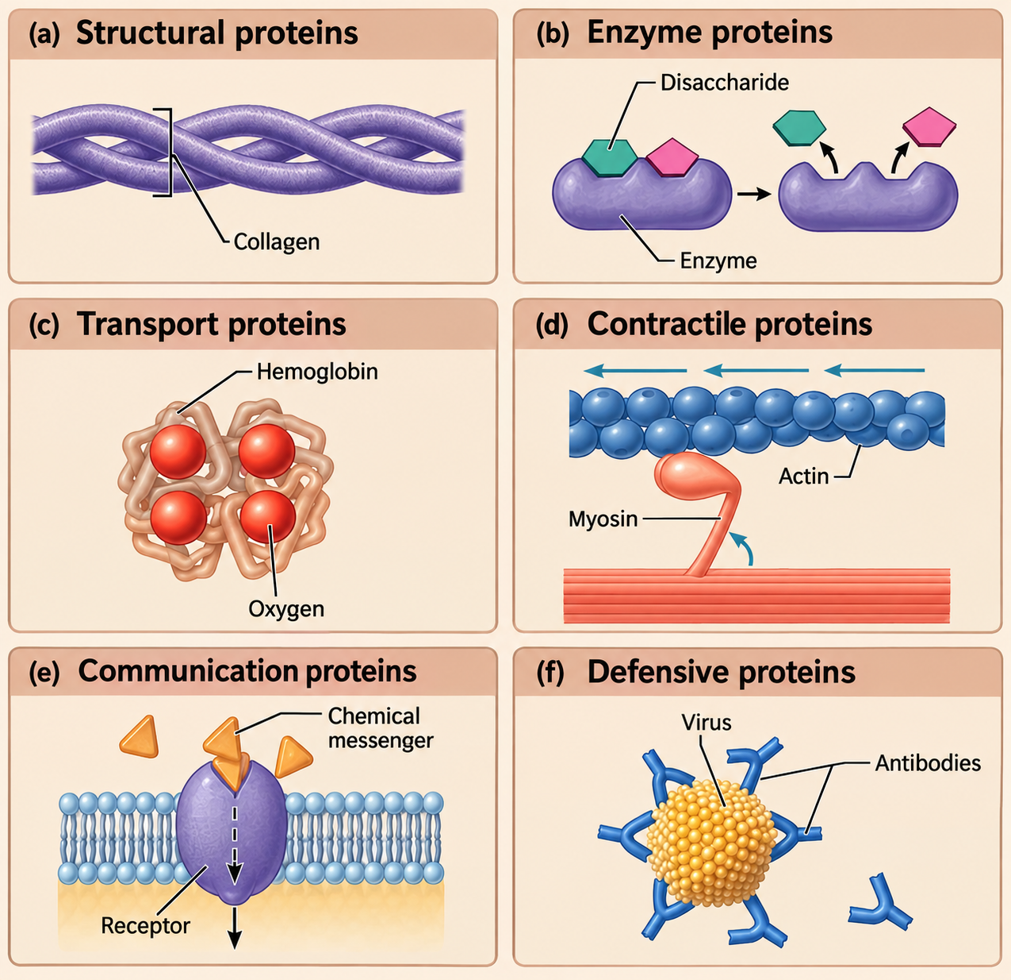
function of defense proteins
Proteins help protect the body from harmful substances/pathogens, such as antibodies.

monomer of proteins & how are they connected?
amino acid joined by peptide bonds via dehydration synthesis rxns

amino acid structure
Amine group (-NH2)
Acid group (-COOH)
H+
R group
Variable

enzymes lower ?
activation energy

primary protein structure
Continuous strand of amino acid bound together by peptide bonds.
ii. Linear
iii. Proteins do not exist as linear chains of amino acids > no function

Secondary structure of proteins
Patterns of hydrogen bonds that give either a twisty shape or a sheet shape.
1. Twisty shape = alpha helix
2. Sheet shape = beta-pleated sheet

protein tertiary structure
3D shape formed by two secondary structures
fibrous
globular

Fibrous Proteins
Strand-like
Hydrophobic
Stable
α-helices or β-sheets
Examples: Keratin, Elastin, Collagen
Globular Proteins
Spherical
Hydrophilic
Sensitive to environmental changes
both α-helices and β-sheets
Ex: Antibodies, Hormones, Enzymes
Proteins Quaternary Structure
How more than one polypeptide chain fits together to form a functional protein.
Not all proteins exhibit a quaternary structure only proteins made up of more than one polypeptide chain have quaternary structure.

protein denaturation
Loss of their 3D shape > & function
Caused by ↑ temperatures, ↓ pH (acidity), Chemicals
Reversible if normal conditions are restored
more common
Which type of protein (globular or fibrous) is more easily denatured?
Globular proteins because they fold into complex, compact shapes held together by weak, delicate bonds, shifts in temperature or pH easily disrupt their structure.
In contrast, fibrous proteins are highly resistant to denaturation because they form tough, tightly packed, rope-like structures stabilized by strong covalent cross-links.
structure of nucleic acid
C, H, O, N and P
monomer of nucleic acids
nucleotide
structure of nucleotide
Nitrogenous base
Phosphate group
Sugar (monosaccharide)
>Ribose or Deoxyribose

functions of nucleic acids
Store and transfer genetic information (DNA and RNA)
ATP
1. The main high energy compound in our bodies (though there are others).
2. Structure
a. Ribose
b. Adenine
c. 3 phosphate groups
the bonds between the phosphate groups store tons of energy. When those bonds are broken via hydrolysis reactions, the energy that is released can be used to do cellular functions
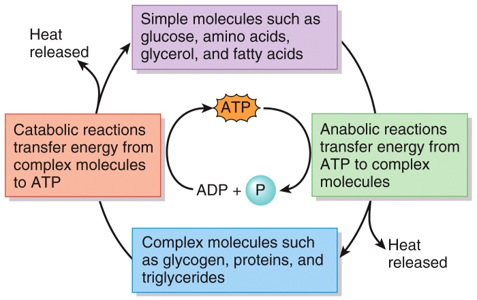
1. ATP is at the center of metabolism. It is the energy for our cells to carry out its functions

The ? of glucose via glycolysis (a type of hydrolysis reaction) is used to make ATP.
catabolism