Week 2 slides
 Call Kai
 Learn
Learn Practice Test
 Spaced Repetition
 Match
Match Flashcards
 Knowt Play
1/30

There's no tags or description
Looks like no tags are added yet.
Name | Mastery | Learn | Test | Matching | Spaced | Call with Kai | Chat |
|---|
No analytics yet
Send a link to your students to track their progress
31 Terms
DNA is build of
nucleotides (a, t, c, g)
A nucleotide consist of
A base, sugar and phosphate
Direction polymer of DNA
5’ to 3’
DNA replication
Chain is extended at its 3’ end. Synthesis occurs form 5’ to 3’ end. Template strand is read from 3’ to 5’ end.

In DNA replication
gets both template strands (parend DNA) a new second strand
Start of DNA replication position
The Origins of Replication Initiation (ORI), than in direction of replication forks (orginal strands are separated into two template strands)
Function of DNA polymerase
this catalyzes the linkage of nucleoside triphosphate to a growing strand
Proofreading
Activity by DNA polymerase, check if nucleotides added are corrected. The wrong are removed. One mistake every 10^7 nucleotides is not seen by proofreading
Discontinuous synthesis
DNA polymerase can only synthesize in 5 to 3 direction. The fork has a starting point and moves both sides. So that means that there are two places where the DNA synthesis can not be automatically done. So it is done by okazaki fragments, very small fregments which are later joined together.
RNA primer
start the Okazaki fragments
Enzymes involved by disontinuous synthesis
Primase: synthesizes new RNA primer
DNA polymerase: Adds necleotides in the direction of 3’end
Repair polymerase: the previous primer removed by nucleases and replaced with DNA by repair polymerase
DNA ligase: Two Okazaki fragments are sealed

Lagging strand incomplete replicated
Because the RNA primer starts the strand at a random positoin, it is impossible to the synthesize to the end
Solution incomplete synthesizing
Telomerase: a enzyme which makes the template strand longer, so the newly synthesized lagging strand can be extended to the same length as the template
DNA / RNA & differences
Deoxy-ribonucleic acid / ribonucleic acid: different sugar (ribose / deoxyribose) and different base (uracil / thymine)
Transcribtion
Template strand is a mold for RNA strand, with same nucleotide sequence. T in DNA = U in RNA
RNA polymerase
Enzyme which start RNA transcription
Start & end RNA polymerase
Start at promotor sites and stops at terminator sites
Promoter
Specific DNA sequences, for example tataa, or ttgaca
Eukaryotic mRNA is processed to mature mRNA
Before an Eukaryotic RNA transcript is ready to be translated into protein, 3 stepts have to be taken in the nucleus:
Removal of introns and the exons coupled to each other, addition of a cap at 5’end, addition of a poly tail (150 - 250 adenines) at 3’ end.
After it is exported to cytoplasm, for translation

Start codon in mRNA
Here starts protein syntheis, first AUG from 5’ end in Eukrayotic, here is a cap at 5’ end
In prokaryotic, there is first a purine rich part from -10 till +1 where AUG is. This is instead of a cap. This purine-rich part have base-pairs with ribosomal RNA.
Amino acid coupled to a unique tRNA molecule by
aminoacyl-tranferases, ATP is used.
tRNA-amino acid hybrids
read the correct mRNA codon, using its anticodon. At the 3 end, there is a specific amino acid coupled. The tRNA molecule is folded like a cloverleaf (klaverblad)
Migration of the Ribosome on the mRNA and coupling of amino acids
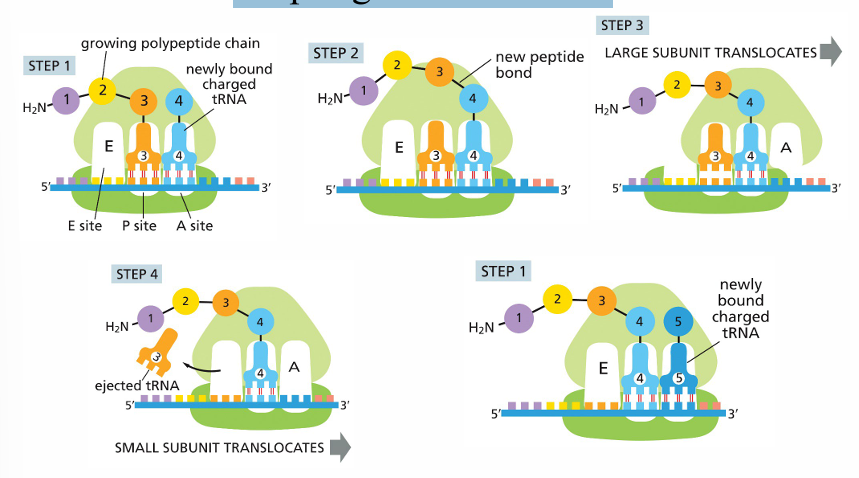
De verplaatsing van het ribosoom en het verlengen van de eiwitketen verloopt via een cyclus van 4 stappen:
Stap 1: Een nieuw geladen tRNA met aminozuur bindt aan de A-site van het ribosoom.
Stap 2: Er vormt zich een nieuwe peptideverbinding tussen de groeiende polypeptideketen (op de P-site) en het nieuwe aminozuur (op de A-site).
Stap 3: De grote ribosomale subunit transloceert (verschuift) ten opzichte van het mRNA.
Stap 4: De kleine ribosomale subunit transloceert, waarbij het lege tRNA via de E-site wordt uitgestoten en de A-site vrijkomt voor het volgende tRNA.
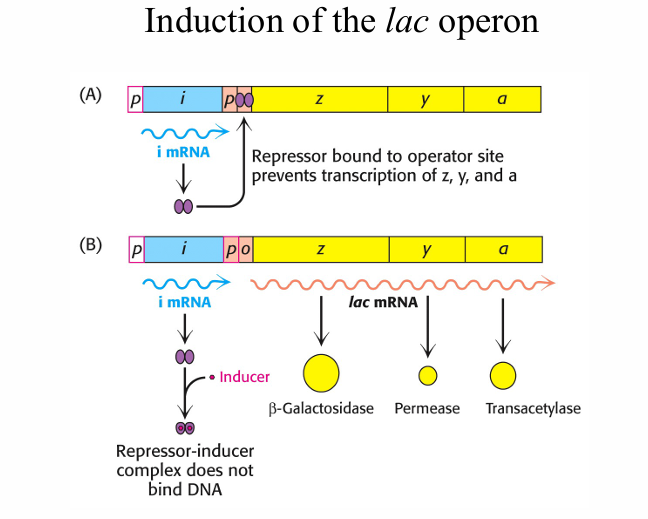
How is the induction of β-galactosidase regulated at molecular level
A regulator gene, has is own promotor and reacts on signals
Control sites in the DNA, promoter (here binds RNA-polymerase to start the making of mRNA) and operator (on-off button: when there is no inducer and so repressor binds to operator, the RNA polymerase is blocked. If there is inducer, the repressor binds to this)
Structural genes that encode proteins: ( β-galactosidase (z), permease (y) en transacetylase (a)
Reading frames in mRNA molecule
Reading frame consist of 3 nucleotides. There are 3 possible reading frames, it can start make groups of 3 from the first one, second or third nucleotide. So total in DNA (double strand) is 6
Terminate at stop codon in mRNA
If the stop codon is coupled to the A site, a release factor is bound to A site. A water molecule is added, then the ribosome dissociates
Regulation of gene expression in bacteria
E. coli needs beta-galactosidase enzyme to degrade lactose. When there is much lactose, more beta-galactosidase is made produced by E. coli.
Beta-galactosidase splits lactose
In glucose and galactose. Three proteins required for processing lactose are only synthesized in maximal amounts in absence of glucose and presence of lactose

The lac operon inducer
Allolactose, created from lactose next to glucose and galactose
How to prevent metabolism of lactose when glucose is present?
Catabolite Activator Protein (CAP) can stimulate transcription of the lac operon only when bound to cyclic AMP (cAMP) • When glucose levels are high, the cyclic AMP (cAMP) concentration is low. When glucose levels are low, cAMP levels are high (catabolite repression

How to find the protein-coding region of a gene?
Find the longest Open Reading Frame (ORF) in the DNA sequence
• An ORF starts with ATG (AUG encodes methionine) and ends with TAA, TAG or TGA (stop codons)
• In between are the triplets (codons), which allows you to derive the protein sequence (in prokaryotes)
• In eukaryotes, the presence of introns makes this direct inference impossible
