Trail: GAAAIT
 Call Kai
 Learn
 Practice Test
 Spaced Repetition
 Match
 Flashcards
 Knowt Play
1/55

There's no tags or description
Looks like no tags are added yet.
56 Terms
Heel Strike / Initial Contact
Dorsiflexor muscles place the ankle into dorsiflexion and prepares to lower the foot towards the ground

What muscles contract during heel strike / Initial Contact
Quads contract to place the knee in extension
Hamstrings contract to stabilize the knee and prevent hyperextension
Hip extensors and hip abductors contract to stabilize the trunk and pelvis over the leg
Foot Flat / Loading Response
Dorsiflexors act eccentrically to control lowering of the foot towards the ground

Throughout the loading response phase, what muscles contract concentrically to produce hip extension?
Hip extensors
Midstance
Plantar flexors continue to act eccentrically to control dorsiflexion as the body moves over the stance limb

During midstance, the _____ contract concentrically to continue producing ____-_____ knee extension
Quads
Closed-Chain
Heel off / Terminal Stance
The Plantar flexors begin to work concentrically to aid the foot in its propulsion of the body forward.

Toe Off / Pre-Swing
Plantar flexors are at their peak activity as the foot "toes off" from the ground

Acceleration / Initial Swing
Dorsiflexors contract concentrically to clear the foot from the ground, while the hamstrings assist with foot clearance by flexing the knee
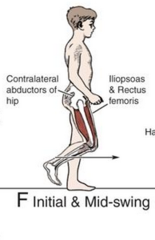
Midswing
Dorsiflexors continue to contract concentrically to maintain dorsiflexion, while knee and hip activity are minimal

Deceleration / Terminal Swing
Dorsiflexors continue to contract concentrically to maintain as well as ankle invertors to prepare foot for Initial Contact.
Hip extensors eccentrically slow the rate of hip flexion and prepare limb for initial contac

Which gait pattern is characterized by the legs crossing midline?
- Cerebellar
- Scissor
- Steppage
- Tabetic
Scissor
A scissor gait is most often associated with spastic cerebral palsy due to spastic paralysis of the hip adductor muscles.
The degree of toe out for an average adult is:
- 3 degrees
- 7 degrees
- 10 degrees
- 12 degrees
7 degrees
The degree of toe out refers to the angle formed by each foot's line of progression and a line intersecting the center of the heel and second toe.
Which of the following would not be considered a temporal variable of gait?
- Cadence
- Cycle time
- Step length
- Step duration
Step length
Commonly used temporal variables of gait include stance time, single limb and double limb support time, cadence, cycle time, step duration, and velocity.
A waddling gait pattern is often observed with bilateral weakness of the:
- Iliopsoas
- Gluteus maximus
- Gluteus medius
- Quadriceps femoris
Gluteus medius
A waddling gait is characterized by exaggerated lateral trunk movements and hip elevation. The abnormal gait is caused by gluteus medius weakness and is often seen with progressive muscular dystrophy.
A steppage gait pattern is often associated with weakness of the:
- Ankle dorsiflexors
- Ankle plantar flexors
- Quadriceps femoris
- Hamstrings
Ankle dorsiflexors
Weakness of the dorsiflexors will typically create a steppage gait pattern. The patient will present with foot slap at initial contact and compensate by lifting the knee higher than normal to clear the foot and avoid dragging the toe.
How much ankle dorsiflexion is required for normal gait on a level surface?
- 5 degrees
- 10 degrees
- 20 degrees
- 25 degrees
10 degrees
Normal dorsiflexion range of motion is 0-20 degrees, however, only 10 degrees is necessary for gait on a level surface.
How much knee flexion range of motion is required for adequate foot clearance during ambulation on a level surface?
- 50 degrees
- 60 degrees
- 70 degrees
- 80 degrees
60 degrees
Sixty degrees of knee flexion is required for adequate foot clearance during normal gait in the swing phase.
In which phase of gait are the ankle dorsiflexors contracting eccentrically?
- Heel strike
- Terminal stance
- Pre-swing
- Midswing
Heel strike
From heel strike throughout the loading response, the tibialis anterior works eccentrically to control the speed of the forefoot lowering to the ground.
According to standard gait terminology, the point in which the entire foot makes contact with the ground is known as:
- Heel strike
- Foot flat
- Midstance
- Loading response
Foot flat
Foot flat is the point in which the entire foot makes contact with the ground and occurs directly after heel strike. Foot flat is followed by midstance.
According to Rancho Los Amigos gait terminology, the point during stance phase that begins when the heel of the stance limb rises and ends when the other foot touches the ground is known as?
- Heel strike
- Loading response
- Midstance
- Terminal stance
Terminal stance
Terminal stance begins when the heel of the stance limb rises and ends when the other foot touches the ground. It is preceded by midstance and is followed by pre-swing.

The stance phase of gait is approximately what percentage of the total gait cycle for a typical adult male with a normal gait pattern?
- 60%
- 50%
- 40%
- 30%
60%
The stance phase of a normal gait pattern is approximately 60% of the gait cycle, leaving the remaining 40% occurring in the swing phase. The stance phase is comprised of single limb support and double limb support time, while the swing phase consists of the time when the foot is not in contact with the support surface.

How many steps per minute is considered the average cadence for an adult?
90-100
110-120
130-140
150-160
110-120
The average adult cadence is 110-120 steps per minute. Cadence is defined as the number of steps an individual takes within a given time.
What is the average stride length for an adult?
- 28 inches
- 36 inches
- 42 inches
- 56 inches
56 inches
The average stride length for an adult is 56 inches. Stride length is defined as the distance measured between right heel strike and the following right heel strike.
Which of the following is not a possible cause of knee hyperextension during the loading response phase of gait?
- Weak quadriceps
- Hamstring spasticity
- Compensation for a fixed ankle plantar flexion deformity
- Quadriceps spasticity
Hamstring spasticity
Weak quadriceps, quadriceps spasticity, and a fixed ankle plantar flexion deformity can all lead to the gait deviation of knee hyperextension during loading response. Hamstring spasticity would more likely result in excessive knee flexion during the loading response.
Which of the following terms describes an abnormal gait pattern characterized by forward trunk lean and a progressive increase in cadence?
- Festination
- Equinus
- Antalgic gait
- Ataxic gait
Festination
Festination, often associated with Parkinsonian gait, is characterized by a forward trunk lean and progressive increase in cadence as though the individual is unable to stop.

Early heel rise during gait may indicate which of the following?
- Increased tension of gastrocnemius-soleus complex
- Weakness of calf musculature
- Decreased tension in plantar flexors
- Weakness of hip abductors
Increased tension of gastrocnemius-soleus complex
Early heel rise can be associated with increased tension of gastrocnemius-soleus. Calf weakness is associated with late heel rise during gait, while hip abduction weakness manifests in a Trendelenburg gait pattern.
Which of the following muscles would be the most likely to contribute to pelvic obliquity during ambulation?
- Gluteus maximus
- Gluteus medius
- Gluteus minimus
- Tensor fasciae latae
Gluteus medius
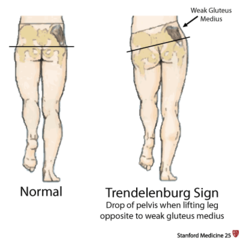
Weakness of the gluteus medius typically creates a contralateral dip of the pelvis during the stance phase of the weak side, also known as a Trendelenburg gait pattern. The observed contralateral dip of the pelvis results from the inability of the weak hip abductors to stabilize the pelvis during contralateral swing phase.
What movement dysfunction would be most likely to occur if the gluteus medius muscle is weak?
- Antalgic gait
- High steppage gait
- Trendelenburg gait
- Uncontrolled genu recurvatum during gait
Trendelenburg gait
A Trendelenburg gait pattern occurs when a weak gluteus medius is unable to support the body during single leg stance resulting in a contralateral hip drop.
What is the most likely rationale for a patient contacting the ground with the forefoot at initial contact instead of their heel?
- Shortened hip flexors of the stance limb
- Lengthened knee flexors of the swing limb
- Shortened knee extensors of the stance limb
- Shortened hip extensors of the stance limb
Shortened hip flexors of the stance limb
At initial contact the stance lower extremity is nearly fully extended, if a patient's hip flexors were shortened on the stance limb this would limit their ability to fully extend their stance leg, resulting in contact with the forefoot rather than the heel of the swing leg.

Which motion is most responsible for producing a rigid lever used in the toe off phase of gait?
- Pronation
- Supination
- Dorsiflexion
- Inversion
Supination
During supination, the calcaneus inverts, the head of the talus is pushed down and out, and relative to the calcaneus, the talus adducts and plantar flexes the subtalar joint. This motion provides a rigid lever used especially in the toe off phase of gait.
Which term is not used to describe the stance phase with Rancho Los Amigos gait terminology?
- Heel strike
- Loading response
- Midstance
- Pre-swing
Heel strike
The components of the stance phase according to Rancho Los Amigos gait terminology include initial contact, loading response, midstance, terminal stance, and pre-swing. Heel strike is a term used with standard gait terminology to describe the instant that the heel touches the ground to begin stance phase.
Which of the following is a component of the swing phase according to standard gait terminology?
- Acceleration
- Heel off
- Pre-swing
- Initial swing
Acceleration
Standard gait terminology used to describe the swing phase includes acceleration, midswing, and deceleration.
What gait term is defined as the linear distance between the point of heel strike of one extremity and the point of heel strike of the opposite extremity?
- Step time
- Step width
- Step length
- Cadence
Step length
Step length is defined as the linear distance between the point of heel strike of one extremity and the point of heel strike of the opposite extremity. Step length is approximately 28 inches in an adult.
Which of the following muscles would most likely contribute to hip hiking?
- Hamstrings
- Quadriceps
- Gluteus maximus
- Quadratus lumborum
Quadratus lumborum
The origin and insertion of the quadratus lumborum allow the muscle to hike the hip. The muscle originates on the iliolumbar ligament and the iliac crest. The muscle inserts on the inferior border of the last rib and the transverse processes of the upper four lumbar vertebrae. Hip hiking is a compensatory response for weak hip and knee flexors, or extensor spasticity commonly seen in the swing phase.

A patient who presents with a toe-in gait pattern would most likely exhibit:
- Excessive femoral retroversion
- Excessive femoral anteversion
- Excessive lateral tibial torsion
- Pes planus
Excessive femoral anteversion
Toe-in gait, or pigeon-toed gait, is typically caused by a structural malalignment as opposed to muscular asymmetry. The typical bony malalignment associated with an in-toeing gait pattern is femoral anteversion or medial tibial torsion.

Circumduction and hiking the hip would most likely result from:
- Weakness of the hip extensors
- Weakness of the ankle plantar flexors
- Weakness of the hip flexors
- Weakness of hip abductors
Weakness of the hip flexors
Weakness in the hip flexors can lead to decreased toe clearance during the swing phase of gait. The patient compensates for this by circumduction and hiking the hip.
A patient positioned in excessive plantar flexion ambulating without the heel touching the ground would be exhibiting what type of gait pattern?
- Equinus
- Trendelenburg
- Steppage
- Foot drop
Equinus
An equinus gait pattern occurs when the heel does not touch the ground. The gait pattern is characterized by high steps; usually involving excessive activity of the gastrocnemius. The abnormal gait pattern can be the result of spasticity or contracture of the plantar flexors.
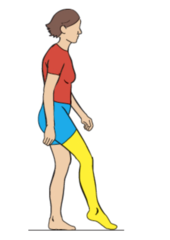
Which muscle group functions to decelerate the lower leg during late swing phase?
- Quadriceps
- Hamstrings
- Gluteals
- Iliopsoas
Hamstrings
Peak activity of the hamstrings during the gait cycle occurs during the late swing phase when the hamstrings decelerate the unsupported limb.
A pelvic drop during gait is commonly known as what type of gait deviation?
- Antalgic gait
- Foot drop gait
- Trendelenburg gait
- Scissoring gait
Trendelenburg gait
A Trendelenburg gait pattern describes the pelvis dropping on the contralateral side as a result of a weak gluteus medius muscle. This type of gait pattern results in excessive lateral trunk flexion and weight shifting over the stance leg.

When looking at a person walking with a normal gait, what percentage of the gait cycle is spent in the stance phase?
- 50%
- 60%
- 70%
- 80%
60%
The stance phase of gait accounts for 60% of the gait cycle with the swing phase accounting for the remaining 40%

Which phase of the gait cycle is characterized by single limb support?
- Loading response
- Midstance
- Heel off
- Pre-swing
Midstance
Midstance is the point during the stance phase when the entire body weight is directly over the stance limb.

A patient who demonstrates a backward lean of the trunk would most likely present with weakness in which muscle?
- Hamstrings
- Quadriceps
- Gluteus maximus
- Gastrocnemius
Gluteus maximus
Backward leaning of the trunk during gait indicates weakness in the gluteus maximus. This gait pattern is also known as a gluteus maximus gait.
What phase of the gait cycle would be most significantly impacted due to the presence of a knee flexion contracture?
- Initial swing
- Midswing
- Pre-swing
- Initial contact
Initial contact
Initial contact refers to the beginning of the stance phase that occurs when the foot touches the ground. Initial contact requires significantly more knee extension than any of the other listed options and therefore would be most significantly impacted by a knee flexion contracture
Which of the following gait deviations would most likely be observed in a patient with knee pain?
- Decreased stance phase on the involved extremity
- Trendelenburg gait
- Hip hiking
- Scissoring gait
Decreased stance phase on the involved extremity
A decrease in stance phase time is a common gait deviation for an antalgic gait since the individual attempts to limit the time spent on the involved extremity.
Which of the following is not a gait compensation used to achieve foot clearance during swing phase?
- Hip circumduction
- Excessive hip flexion
- Hip hiking
- Anterior pelvic tilt
Anterior pelvic tilt
Anterior pelvic tilt during gait may occur secondary to weak abdominals, a hip flexion contracture or forward trunk lean, however, it is not typically a compensation used for decreased foot clearance.
Which phase of gait requires the greatest amount of ankle dorsiflexion range of motion?
- Midstance
- Terminal stance
- Initial swing
- Initial contact
Terminal stance
Terminal stance requires the greatest amount of ankle dorsiflexion range of motion (10 degrees) during the gait cycle. During midstance, the ankle is dorsiflexed 5 degrees. During initial swing, the ankle is plantar flexed 5 degrees. During initial contact, the ankle is in neutral.

What is the normal hip position at initial contact during the gait phase?
- 10 degrees flexion
- 20 degrees flexion
- Neutral
- 5 degrees extension
20 degrees flexion
The normal hip position at initial contact is 20 degrees of flexion. During initial contact, the hip extensors are active in preparation for stabilization during the loading response.

During ambulation, which muscle exhibits peak activity during late swing phase?
- Tibialis anterior
- Gastrocnemius
- Quadriceps
- Hamstrings
Hamstrings
During late swing phase the hamstrings exhibit peak activity. The hamstrings are responsible for decelerating the unsupported limb.
Which muscle exhibits two periods of peak intensity during the gait cycle?
- Tibialis anterior
- Gastrocnemius
- Quadriceps
- Hamstrings
Quadriceps
The quadriceps exhibit two periods of peak activity during the gait cycle. They occur in periods of single support during early stance phase and just before toe off to initiate swing phase.
According to Rancho Los Amigos gait terminology, the point during swing phase that ends when the tibia is perpendicular to the ground is known as?
- Deceleration
- Initial swing
- Midswing
- Terminal swing
Midswing
Midswing begins with maximal knee flexion during swing and ends when the tibia is perpendicular with the ground. It is preceded by initial swing and is followed by terminal swing.

A foot slap observed during gait is often associated with:
- Weakness of the ankle dorsiflexors
- Weakness of the ankle plantar flexors
- Weakness of the quadriceps femoris
- Weakness of the hamstrings
Weakness of the ankle dorsiflexors
A patient may attempt to compensate for weakness of the ankle dorsiflexors by lifting the knee higher than normal to clear the foot and avoid dragging the toe.
According to Rancho Los Amigos gait terminology, the point during the stance phase between initial contact and the beginning of the swing phase for the other leg is known as?
- Heel strike
- Loading response
- Midstance
- Terminal stance
Loading response
Loading response corresponds to the amount of time between initial contact and the beginning of the swing phase for the other leg. It is preceded by initial contact and is followed by midstance.
What abnormal gait pattern is characterized by high stepping and slapping of the foot on the ground?
- Parkinsonian
- Tabetic
- Circumduction
- Vaulting
Tabetic
Patients who have sustained an injury to the dorsal columns may have decreased proprioceptive input. In order to feel the foot, the patient may lift their limb high in order to hit the ground hard
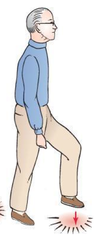
Which gait deviation would least likely be seen ipsilaterally with decreased ankle dorsiflexion range of motion?
- Increased stride length
- Hip circumduction in swing
- Excessive hip flexion in swing
- Increased knee flexion during stance
Increased knee flexion during stance
A decrease in ankle dorsiflexion range of motion can result in several different gait deviations that allow the foot to clear the floor during gait. Decreased ankle dorsiflexion would not result in increased knee flexion during stance, however, excessive dorsiflexion would be associated with this finding.
According to Rancho Los Amigos gait terminology, what phase of the gait cycle occurs between initial contact and midstance on the stance limb?
- Terminal stance
- Terminal swing
- Pre-swing
- Loading response
Loading response
The components of the stance phase according to the Rancho Los Amigos gait terminology include initial contact, loading response, midstance, terminal stance, and pre-swing. The loading response occurs between initial contact and midstance and corresponds to the amount of time between initial contact and the beginning of the swing phase for the other leg.