LING 400 Exam 2 Study Guide
 Call Kai
 Learn
 Practice Test
 Spaced Repetition
 Match
 Flashcards
 Knowt Play
1/47

There's no tags or description
Looks like no tags are added yet.
48 Terms
define morphology
the study of the shape of words, including the structure of words and their parts
syntactic category - noun (distribution, function, morphological)
person, place, or thing
distribution: between an article and a verb
function: typically occurs in phrases that function as subjects and objects
morphological: can usually take the pluralizing suffix -s (although some do not)
syntactic category - verb (distribution, function, morphological)
action, occurrence or state of being
distribution: after an auxiliary verb
function: typically occur in phrases that function as predicates
morphological: can usually take the progressive suffix -ing and the third-person subject-agreement suffix -s in the present tense
syntactic category - adjective (distribution, function, morphological)
modifier that expresses quality, quantity or extent
distribution: after an intensifier like “very”
function: typically occurs in phrases that modify nouns
morphological: usually have comparative or superlative forms (e.g., -er, -est)
syntactic category - adverb (distribution, function, morphological)
modifier that expresses manner, quality, place, time, degree, number, cause, opposition, affirmation, or denial
distribution: for manner, after a verb; for sentential, at the beginning of a sentence
function: typically occur in phrases that modify verbs
morphological: often have -ly suffixes
syntactic category - preposition (distribution)
modifier that indicates location or origin
distribution: between an intensifier and a location
syntactic category - determiners (distribution)
articles, such as a(n) and the; deictics, such as this/that
distribution: before the “adjective” other
syntactic category - complementizer (distribution)
that, which, for, etc
distribution: between a verb like “know” and a noun
syntactic category - conjunctions
and, but, or, nor, etc
syntactic category - quantifiers
each, every, some, three, etc
syntactic category - possessives
my, your, our, his, her, their, etc
syntactic category - auxiliaries and modal auxiliaries
express level of necessity or obligation
have, will, do, can/could, shall/should, will/would, must, may/might, dare
syntactic category - negators
no, not, -n’t
lexical morpheme - definition and examples
words that denote concepts
also referred to as “open class” because new words are easily added to a language in these categories
examples: nouns, verbs, adjectives
functional morpheme - definition and examples
serve grammatical functions but not much content
also referred to as “closed class” because new instances of these categories are rare
examples: prepositions, conjunctions, determiners, complementizers, auxiliaries, and negators
free morpheme - definition and examples
can be a stand-alone word
examples: fierce, desk, etc
bound morpheme - definition and examples
only occur attached to a free morpheme
examples: -s, -ed, pre-, etc
inflectional morpheme - definition and examples
adjust a word to fit its syntactic context, i.e., create a new form of the word (NOT A NEW WORD ALTOGETHER)
examples: -s, -ed, -ing
derivational morpheme - definition and example
create new words from existing ones; often change the syntactic category (if not, the change in meaning is still sufficient enough to be considered a new word)
example: -able, un-, etc
how to draw word structures
identify the root of the word
apply derivational affixes
apply inflectional affixes

how to combine affixes with their stems
add all derivational morphemes, then you add the inflectional ones
morphological processes for creating new words - affixation
adding prefixes, suffixes, infixes, and circumfixes
morphological processes for creating new words - compounding
combining two or more words to create a word
example: blackbird
morphological processes for creating new words - reduplication
doubling the whole or part of a morpheme
example: Bahasa Indonesia
[rumah] house; [rumahrumah] houses
morphological processes for creating new words - morpheme-internal changes (ablaut)
occurs in English irregular past tenses or plurals - vowel will change
example: ring rang rung
morphological processes for creating new words - suppletion
complete replacement of phonological material
example: I am - I was
morphological processes for creating new words - null/zero derivation (also called conversion)
no phonological marking, but the syntactic category has changed
example: run (verb) versus run (noun)
morphological processes for creating new words - null/zero inflection
no phonological marking, but can be used as singular and plural forms
example: sheep (singular) versus sheep (plural)
morphological processes for creating new words - coinage
words are invented
example: Kleenex
morphological processes for creating new words - acronyms
letters that stand for words are put together to create a new word
example: AIDS
morphological processes for creating new words - clipping (truncation)
part of an existing word is cut off, creating a new word that often has the same or similar meaning
example: gas for gasoline
morphological processes for creating new words - back-formation
starting with a longer word that seems to be inflected, and cutting off the “inflected” part to yield a different category
example: automate from automation
morphological processes for creating new words - blending
when two or more words are blended together
example: brunch from breakfast + lunch
how to segment words into individual morphemes and pair them with their meanings
Step 1: Choose one aspect of meaning that occurs in multiple words (by looking at English translations)
Step 2: Find all the words that have that part of the meaning and separate them from the rest
Step 3: Compare the actual words in that selection to each other (pay attention to every phoneme and other symbols), and see if there is any part of the word that repeats in all of the words in the selection
Step 4: Testing: If there is a part of the word that repeats in all of those words, then check if any words that are not in the selection have that part of the word
If not, check if there is any other part of meaning that also repeats in all those words.
If not, then you have just discovered what part, in each of the words in the selection, is used in that language to mark the part of the meaning that you were looking for
If some words that are not in the Selection also have that sequence of phonemes, then see if there is another sequence of sounds, found in all the words in the Selection, that only those words share
define tacit knowledge - examples using our knowledge of syntax
definition: we know a lot of things about language that we don’t know we know and that nobody has ever explicitly taught us (i.e., unconscious knowledge)
example: you know that some sentence orders are possible while others are not
acceptable: The baby mattered to us.
unacceptable: We were mattered to by the baby (but “We were chattered to by the baby” is acceptable)
define what a theory of syntax aims to capture (and what it does not)
aims to capture: should generate all of the grammatical sentences of a language and none of the ungrammatical ones
does not aim to capture: should not treat meaningful and non-meaningful sentences as the same
tests used to argue if a subunit of a sentence is a constituent
substitution - can the syntactic unit be replaced by an element, such as they, she, he, it, do so, etc?
[The children] will [stop at the corner]. —> They will do so.
movement - can the syntactic unit be moved as a single unit to a different position within the sentence?
They stopped [at the corner]. —> [At the corner], they stopped.
coordination - can the syntactic unit be joined to another group of words by a conjunction, such as and, or, or but?
The children will [stop at the corner] and [look both ways].
how to draw syntactic trees for basic phrases
general X’ schema:
all phrases have a head, X
all phrases have 3 levels: X, X’, XP (P=phrase)
if there is a complement(s), it attaches as a sister to the head, X
if there is a specifier preceding the head, it attaches as a sister to X’, forming an XP with it

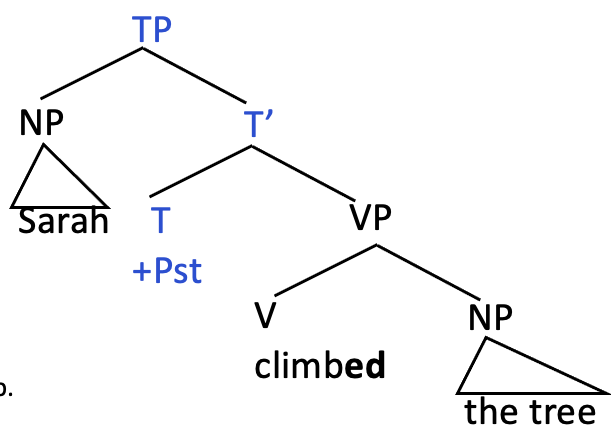
how to draw syntactic trees for simple declarative sentences
sentence = tense phrase (TP)
NP acts as the specifier and attaches to T’ (NP = subject)
T’ is made up of T and VP
V is made up of V and NP
for T:
can be an auxiliary verb, such as “can”
can be marked with a suffix on the verb, such as “-ed”
in that case, T = +Pst
how to draw syntactic trees for English yes-no questions
undergoes head movement:
before being transformed into questions, sentences are TPs with the head T —> auxiliaries are in the head T in declaratives (they mark tense by determining the form of the verb)
when transformed into a question, the auxiliary in position T is moved to position C
when the auxiliary is moved, it leaves a “trace”, denoted by t (in the head position) and draw an arrow showing where it moved to

how to draw syntactic trees for English Wh- questions
undergoes phrasal movement:
before being transformed into questions, sentences are TPs with the head T —> auxiliaries are in the head T in declaratives
however, these are phrases, so the NP that merged with the lexical verb in the VP must also be in the correct position
wh- phrase will then move:
auxiliary will move to the C of C’ (C’ = C + TP)
NP will move to the specifier of the CP (CP = NP + C’)
note: both the auxiliary and NP leave a “trace”, which is denoted with t

difference between head movement and phrasal movement
head movement - just the auxiliary verb
occurs for yes-no questions
phrasal movement - auxiliary and NP
occurs for wh- questions
reason why an auxiliary verb in English can occur at the beginning of a sentence, but a lexical verb cannot
Head-Movement Constraint - a moving head element cannot skip head positions (i.e., it can only move one head position up)
moving a lexical verb from V to C would not be movement to the next head position up, since there is an auxiliary in T
2 major tree relations between elements in a tree***
Head-Complement relation (or selection=subcategorization)
selection determines:
how many complements a head can take
what type of complement a head can take
what form the head of the complement can have
2 major reasons why the order of basic elements in a sentence may differ in 2 languages
Head Parameter:
setting 1: head precedes the complement, like in English
setting 2: head follows the complement, like in Japanese
Specifier Parameter:
setting 1: specifier precedes the head, like in English and Japanese
setting 2: specifier follows the head, like in Malagasy
word order of basic elements for Head and Specifier Parameters
if the head precedes the complement and the specifier precedes the head: S-V-O
if the head follows the complement and the specifier precedes the head: S-O-V
if the head precedes the complement and the specifier follows the head: V-O-S
if the head follows the complement and the specifier follows the head: O-V-S
major difference in word order between English and French declarative sentences
the main verb in French is not in V, but instead moves to a higher position, T

how to draw trees for French declaratives
D-structure: main verb is in V
S-structure: main verb moves to T