Bs1050- mitosis and meiosis
 Call Kai
 Learn
Learn Practice Test
 Spaced Repetition
 Match
Match Flashcards
 Knowt Play
1/19

There's no tags or description
Looks like no tags are added yet.
Name | Mastery | Learn | Test | Matching | Spaced | Call with Kai | Chat |
|---|
No analytics yet
Send a link to your students to track their progress
20 Terms
What does mitosis produce vs meiosis
2 Diploid, identical genetic information
Meiosis- haploid, variable genetic information
Mitosis stages (interphase)
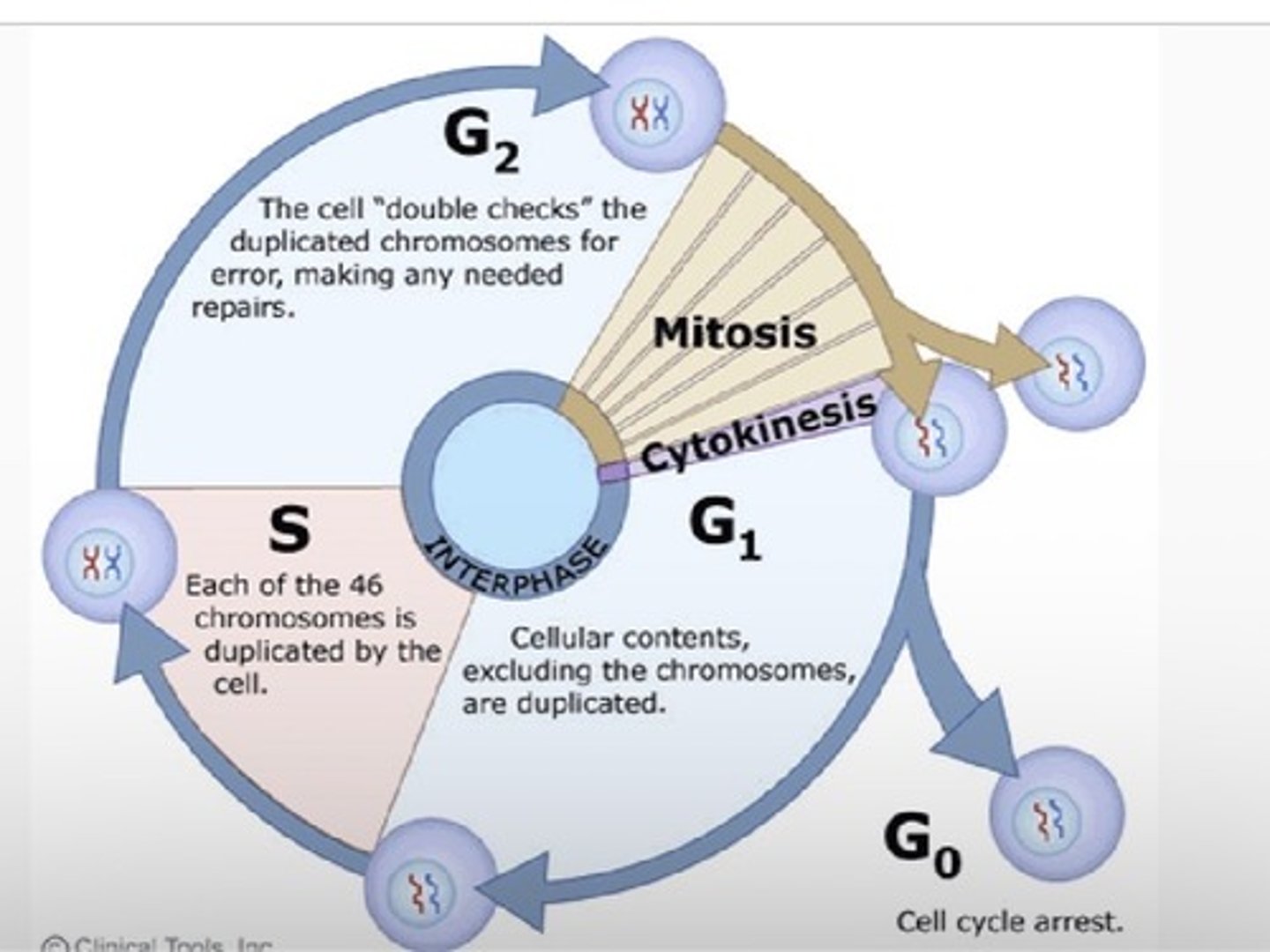
Mitosis steps
prophase, metaphase, anaphase, telophase
Prophase
Spindle fibers appear, chromosomes condense
Prometaphase
Spindle fibres attach to chromosomes
Chromosomes condense
Metaphase
Chromosomes align
Anaphase
Centromeres divide, sister chromatids move to opposite poles
Telophase
Nuclear membrane reforms, chromosomes decondense
Spindle fibres disappear
Meiosis I
Prophase 1- chromosomes begin to condense, homologous chromosomes pair, crossing over occurs, recombinant chromosomes
Metaphase I- spindle fibres attach to chromosomes, chromosomes line up in the centre of the cell
Anaphase 1- chromosomes start to move to opposite ends of a cell as spindle fibres shorten
Telophase 1- chromosomes reach opposite ends nuclear membrane forms
Meiosis II- males
Prophase II- chromosomes begin to condense nuclear membrane dissolves spindle fibres form
Metaphase II- spindle fibres attach to chromosomes chromosomes line up in the center of the cell Anaphase
Anaphase II- centromeres divide and sister chromatids move to opposite ends of cell as spindle fibres shorten Telophase
Telophase II- chromosomes reach opposite ends nuclear membrane forms
Cytokinesis- cell division occurs
Meiosis in females
At the end of meiosis I- telophase makes 1 polar body, 1 egg cell precursor
Meiosis 2- egg cell splits into 2 as well into a polar body and MATURE egg cell
Key features of meiosis
Replication precedes division
-Two sequential divisions
-Meiosis I (Reductional) (chromosome number is halved)
o Homologous chromosomes pair up
o Formation of chiasmata; these are essential for
chromosome segregation(points where Homochromo cross over)
o Homologous chromosomes separate ( 2n->n)
-Meiosis II (Equational) (chromosome number stays the same)(because sister chromatids separate)
o Division of centromeres and separation
of sister chromatids
-Events in Meiosis I and II differ; both differ from mitosis
Key feature s
Genetic diversity [production of new combinations of
genes different from those of each parent] through
recombination
by the random segregation of maternal and paternal chromosomes in Meiosis I
by the exchange of genetic material between homologous chromosomes during Meiosis I
Lecture 2
What was mendels approach
Model system based
Reductionist
Quantitative
Mendel first law
Allele segregation
-in a diploid the two copies of a gene segregate at meiosis
- 2 get 4 diff results you need to have 2 events (generations)
Genotypic ratio
R+R+, R+ r-, r- R+, r-r- = 1:2:1
Phenotypic
3 R+ and 1 fully r- so 3:1
Second law
Independant assortment- dihybrid cross
During gamete formation alleles of Independant genes assortment randomly
Members of different chromosome pairs assortment randomly at meiosis
Interpretaion of 9:3:3:1
From the first law we know that the fusion of two gametes (two
events) each carrying one of two possible alleles at one locus (two
outcomes) gives 4 possible results.
2^2 = 4
Therefore 16 possible results must derive from the two gametes (two events) carrying one of two alleles (two outcomes) at two loci
2^2 x 2^2 = 16