Internal Environment: Fluid Balance (3)
 Call Kai
 Learn
 Practice Test
 Spaced Repetition
 Match
 Flashcards
 Knowt Play
1/38

There's no tags or description
Looks like no tags are added yet.
39 Terms
Which of the following body fluid compartments contains the largest volume of water?
Intracellular (2x the size of extracellular, know ratios)
Extracellurar
Interstitial
Plasma
Transcellula
Describe the role of the ascending linb of the loop of Henle in producing a high renal interstitial fluid osmolarity. Beginning with the loop of Henle, contrast the tubular fluid and interstitial fluid osmolarity changes that either dilute or concentrated urine to be produced and excreted
kidneys alter water volume in the body
control of water volume in the body is through control intake & control of urine production
Contrast the relative contribution of neural and renal mechanisms in blood pressure and blood volume regulation
long-term with fluid balance
short-term with baroreceptor reflex
Inputs
Endocrine
Vasopressin (ADH)
don’t have ADH, will die within a day
alcohol (ethanol inhibits vasopressin)
urine output exceeds intake
dehydrated next morning bc they’ve lost water
CSF pressure goes down
Atrial Natriuretic Peptide
Na+ loss through kidneys
both hormones lead to temporary diabetes insipidus
Aldosterone
Cortisol
CNS
Sympathetic
B1- Stimulates renin release (brings pressure back up)
inc. HR & strength of contraction
inc. CO
both short-term
granular cells that release renin
renin release → long-term regulation to bring pressure back up
Parasympathetic (no effect on volume)
posterior pituitary → neurohormone
Body Fluid Compartments
Constituents
Extracellular fluid
Plasma
measure things in plasma, what we have access to
wtv. plasma conc. is, same that it is in interstitial fluid
not same as intracellular
Interstitial fluid
Intracellular fluid
phospholipid bilayer around cells
compounds easily cross

Distribution of water
60% of body weight is water (42 kg of water, a kg of water is a liter)
40% is intracellular
20% is extracellular (ECF)
20% of ECF is plasma
80% of ECF is interstitial
as you get older, get drier
men have a slightly higher %age of body water than women of the same age based on fat distribution
2 patients, you are an oncologist:
70 kg female that is 72 years old; 70 kg male that’s 22 years old
have same cancer, use same drug
don’t give them same dose, conc. higher in one than the other
she’s going to need less drug bc she’s got less water
give him her dose → not high enough to kill cancer
give her his dose → he’s got more water, may be too high in her

Indicator Dilution
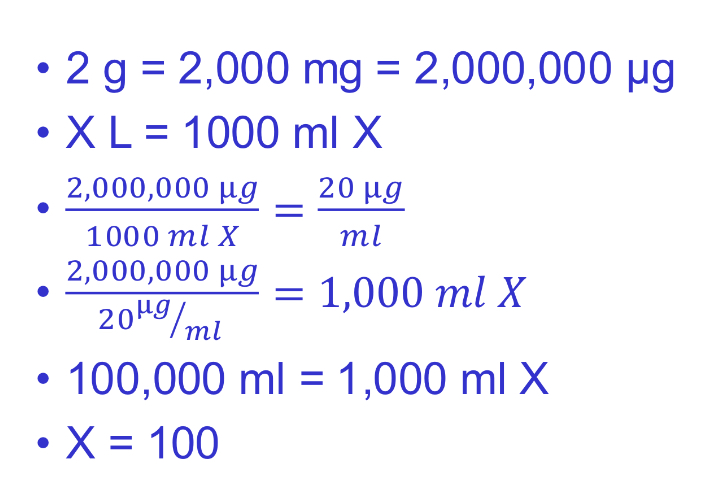
A known quantity of a substance in an unknown volume in liters yields a concentration (put a known mass in it)
M/V = C
Example: 2 g of a substance in an unknown volume yields a concentration of 20 ug/ml
M = 2 g
V = X L (always solving for volume, plasma volume, total body water)
C = 20 ug/ml
Indicator Dilution in Body Fluids
Total Body water = radio-labeled water (deuterium oxide, heavy water)
indicator is most important thing
how indicator behaves tells you your fluid compartment
volume
Extracellular Fluid = inulin
small, but polar… will not go into cells
stays in extracellular space
subtract from total body water to find intracellular volume
Plasma = albumen
big, does not come out of capillaries at all
plasma volume
interstitial fluid
what body compartment do my indicators measure?

Regulation of Body Fluids
Total Body Water
Water in = water out
Water in
consumption 2.25 L/day (both food & drink)
metabolic water- 0.35 L/day (body produces 350 mL/day)
Water out
Insensible loss (skin & lungs)- 0.9 L/day
Sweat- 0.1 L/day
Urine- 1.5 L/day (only one we control)
Feces- 0.1 L/day (weak control, dehydrated → dec. in fecal water loss)
Movement of water through the various compartments of the body

Constituents of Body Fluid
Extracellular (plasma)
Cations
Sodium
Potassium
Calcium
Anions
Chloride
Bicarbonate
Phosphate
ECF
Other
Glucose
Protein
Urine (has lipid solubility)
Constituents of Body Fluid 2
Intracellular fluid
Cations
Sodium
Potassium
Intracellular
Anions
Chloride
Bicarbonate
Phosphates
Other
Hexose monophosphate
Protein
ATP
Urea
Relative concentrations of cations and anions in the extracellular and intracellular body fluid compartments
Maintenance of Volume
Only partially dissociated from salt balance
Water loss
Insensible
Balance intake
Renal excretion
1.5 L/day
we can reabsorb water without reabsorbing Na+
can reabsorb Na+ without reabsorbing water (times we just need water → get back in balance, overhydrated → pull in Na+ without water)
need to be able to do these things separately
don’t always do them separately
dehydrated → high Na+ value
kidneys need to hold onto water
requirement for them to pull water & they also have to pull in Na+
Diagram of process of correction for hypertonicity and hypotension
vasopressin and osmoreceptors more important than heart
prioritize
what’s problem/situation that’s going to kill patient fastest?
#1 osmotic particle in body is Na+ (what’s role of Na+ in body → osmotic agent)
body doesn’t actually pay attention to Na+ itself, pays attention to conc. of particles
not really a Na+ detector in body
Ex: ramen noodles
lots of Na+
osmolarity goes up, from hypothalamus, going to trigger both thirst & vasopressin
osmolarity is most important stimulator of vasopressin release
just a slight change in osmolarity causes cells in posterior pituitary, if osmolarity goes up, the cells shrink a bit, vasopressin goes up

Maintenance of Volume (cont’d)
Increased volume is measured as an increase in blood pressure
body assumes that if BP is high there is too much volume
assumption not always correct
someone can have hypertension & high BP & not have too much volume
diuretic → inc. urine production
trying to get rid of water/volume
if we can get volume down, pressure will come down
Baroreceptor reflex (movement by moment control, vasopressin not tied in)
ADH release (less sensitive)
Increase parasympathetic tone (if pressure is high_
Decrease sympathetic tone
decrease arteriolar constriction
increase flow through the afferent arteriole of the nephron
increase GFR (glomerular filtration rate, inc. formation of urine, urine volume will go up to bring pressure down)
pressure is high, will constrict but GFR will still say somewhat elevated
filtration rate will still stay high bc we’re trying to lose that volume, get pressure down
Maintenance of Volume (cont’d 2)
Increased pressure
Fluid shift
From plasma to interstitial fluid
Short-term control
Based upon pressure changes and osmolarity changes
Decreased osmolarity (very tightly regulated)
Inhibition of ADH release
1% change alters ADH release (sensitive)
Maintenance of Volume (cont’d 3)
Decreased volume = decreased pressure
Renin-angiotensin-aldosterone system
Baroreceptor reflex
Increased sympathetic stimulation
increased arteriolar constriction (inc. resistance)
decreased GFR (dec. urine formation, short-term)
Ex: donate blood
pressures are low
baroreceptor reflex is going to compensate, will not be able to fix
The Renin-Angiotensin-Aldosterone

Maintenance of Osmolarity
Increased osmolarity (inc. ADH)
Osmoreceptor cells
Located near third ventricle
Outside the blood/brain barrier
Sensitive to minute changes in osmolarity
Direct stimulation of thirst
Direct ADH release
Decreased osmolarity (less vasopressin)
The relationship between osmolarity and vasopressin release

The relationship between blood pressure and vasopressin release

Combination of pressure and osmotic change

A nephron

Fig. 14-17, p. 524

Urine Formation
Isotonic (same tone as plasma), hypotonic (less salt/solute), and hypertonic (more)
Based upon need
Regulation of blood volume
Osmotic gradient
Established by the counter-current multiplier system
Maintained by countercurrent exchange with capillaries
Medulla
very hypertonic
isotonic: 300 milliosmoles/liter
need to know gradient exists & this is how we can move water without moving Na+ bc Na+ has already been moved, sitting in interstitial space concentrated & when water gets by it, water gets pulled out through aquaporins

Urine Formation (cont’d)
Vasopressin (ADH), variable release
Produced in hypothalamus
Acts at the level of the basolateral membrane in the distal and collecting tubules only
Open channels for water
Brings filtrate osmolarity to 1200 mOsm
Hypotonic urine produced without ADH
Isotonic urine produced with low levels of ADH
Action of Vasopressin on Principle Cells

Formation

Formation 2

Table 14-4: Handling of Sodium and Water by Various Tubular Segments of the Nephron
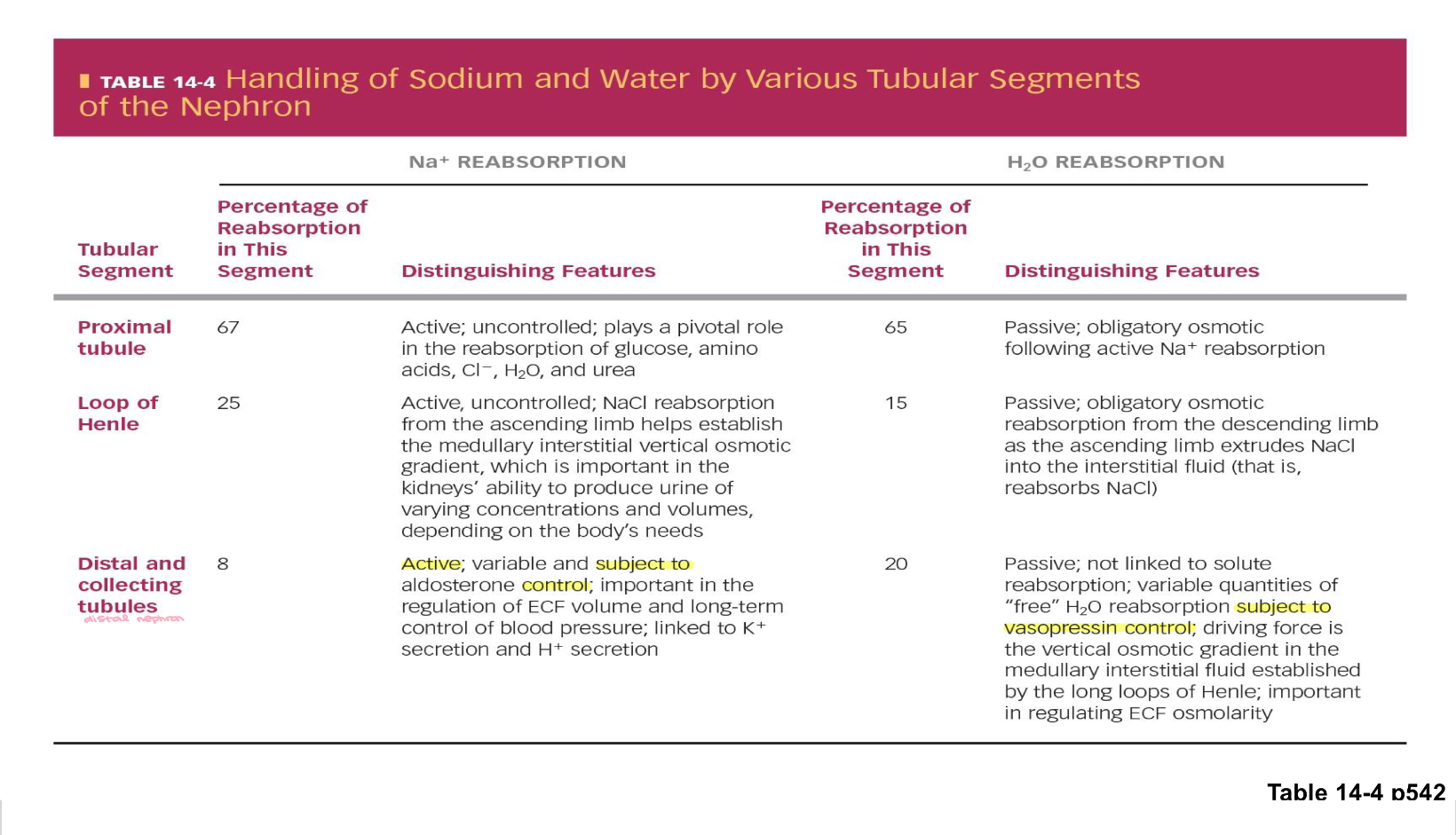
Fig. 10-34, p. 376

Which of the following is/are mechanisms to increase plasma volume?
Decrease vasopressin release (body would not conserve water as much & urine output would go up → BP is going down… not going to help us)
Shift fluid from the interstitial space into the plasma
Increase venous blood flow to the kidneys (more blood would be filtered, glomerular filtrate formation is going to go up & plasma volume is going to go down)
Inhibit renin release (no renin → no angiotensin II → no aldosterone → not going to retain Na+ → not going to get vasopressin release… everything is going to go down, low pressure triggered renin release → pressure goes back up)
All of these will increase plasma volume
ICQ
if the outward driving force of BP is lower, then less fluid is going to go into the interstitial space & more is going to stay into plasma
diagram that shows hemorrhage
vasopressin will not always be released if aldosterone is released
main thing that causes vasopressin release is change in osmolarity
if aldosterone is released & osmolarity goes too high, we would get vasopressin release
what if osmolarity is too low, they release aldosterone & they come back up to normal, then we’re not going to get vasopressin release
going back to set point, wtv is normal
once correction occurs, system shuts off
Control
Short-term
Baroreceptor reflex
Long-term
Osmoreceptors & Volume receptors
Hypothalamus, kidney, atria
Alters salt and water balance to alter volume

Fig. 10-40, p. 384
blue → consequences
pink → compensation
what does body do to bring things back up?
