MUSCULAR- EXAM#2
 Call Kai
 Learn
 Practice Test
 Spaced Repetition
 Match
 Flashcards
 Knowt Play
1/109

There's no tags or description
Looks like no tags are added yet.
Name | Mastery | Learn | Test | Matching | Spaced | Call with Kai | Chat |
|---|
No analytics yet
Send a link to your students to track their progress
110 Terms

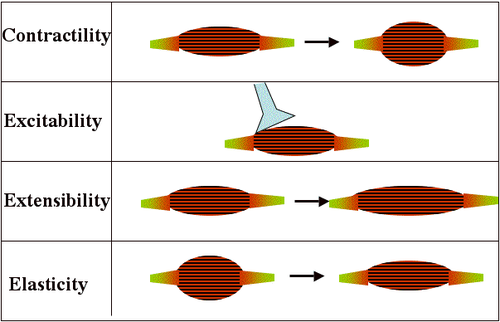
What are the four unique characteristics of muscle tissue?
Excitability, contractility, extensibility, and elasticity.
What is the definition of Excitability in muscle tissue?
Muscle cells are responsive to stimuli by producing an electrical signal

What is the definition of Contractility in muscle tissue?
Muscle fibers can contract and shorten when stimulated.

What is the definition of Elasticity in muscle tissue?
When tension is removed, muslce goes back to normal length

What is the definition of Extensibility in muscle tissue?
Ability of a muscle fiber to be stretched beyond its normal length
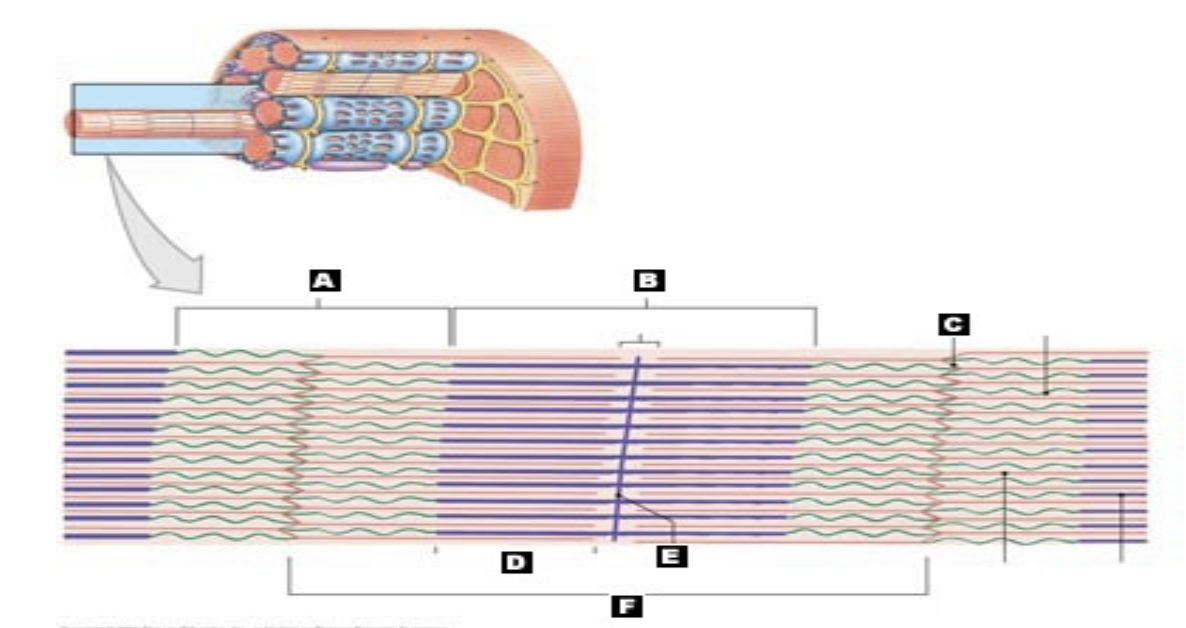
In this Microscopic anatomy of skeletal muscle, label letter A
I band (light band)
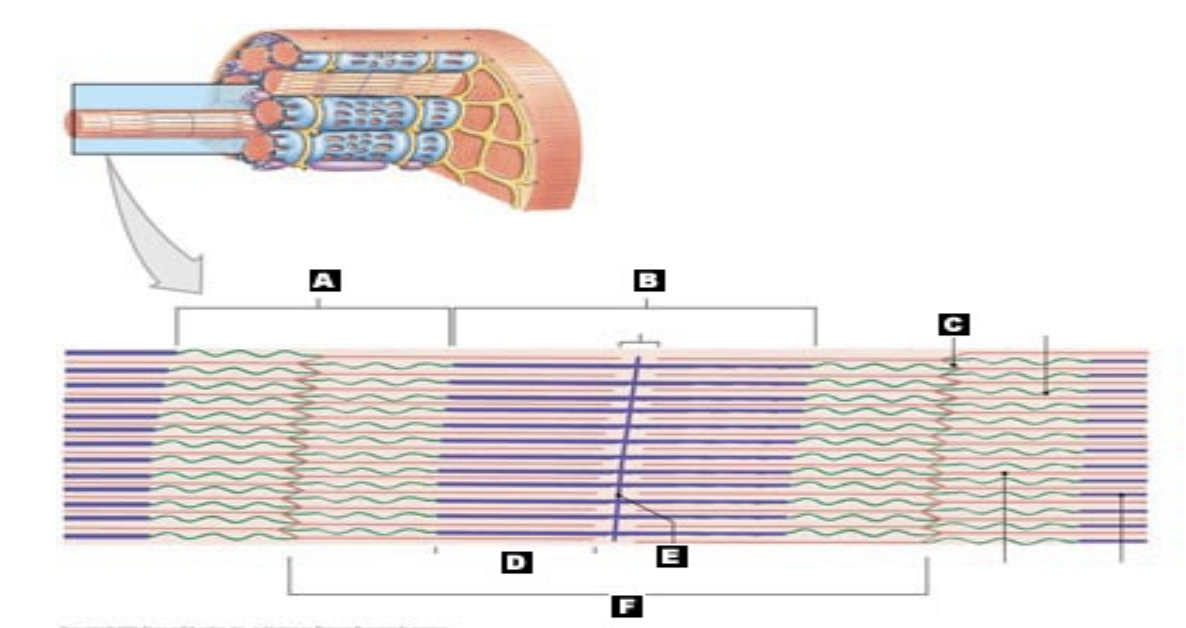
In this Microscopic anatomy of skeletal muscle, label letter B
H zone

In this Microscopic anatomy of skeletal muscle, label letter C
Z-Disc (Z line)

In this Microscopic anatomy of skeletal muscle, label letter E
M line-Center of A band where myosin filaments are anchored

What does M line do in the skeletal muscle?
Center of the A band where myosin filament are acnchored
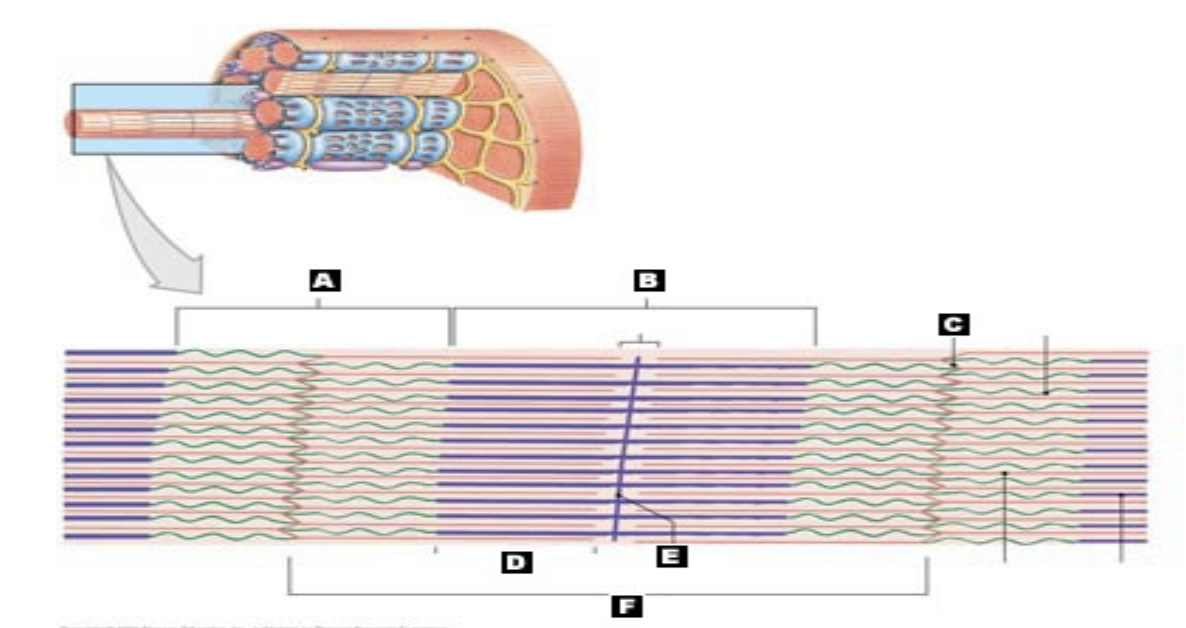
In this Microscopic anatomy of skeletal muscle, label letter F
Sarcomere
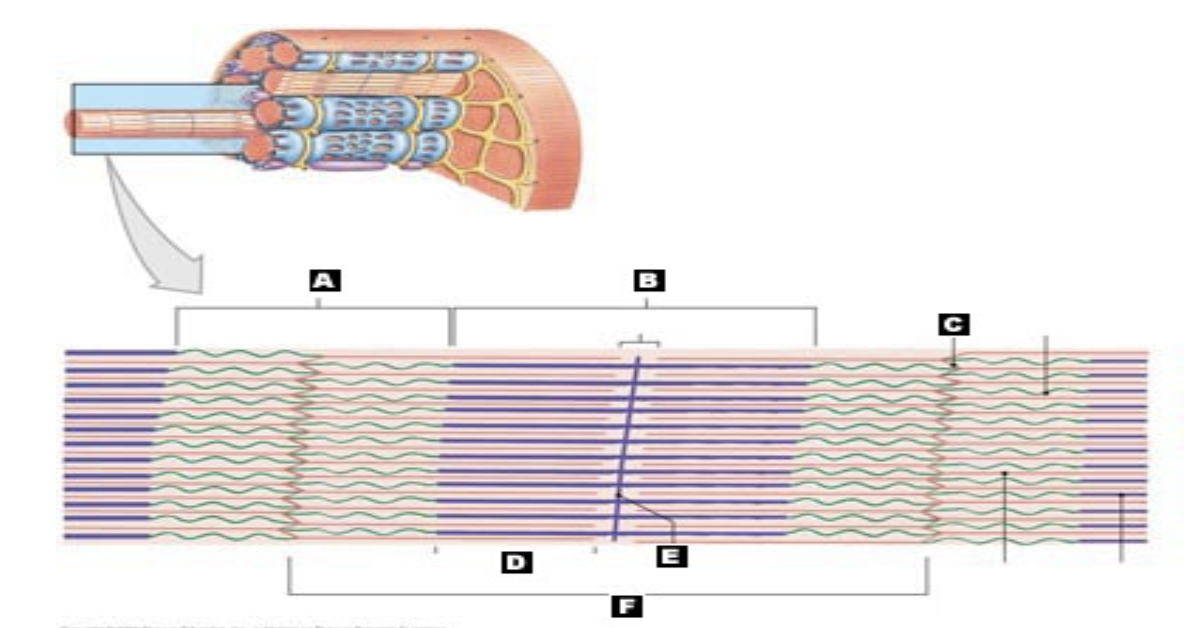
Which regions have only thick filaments ?
H zone (D on model)

Which regions have only thin filaments?
I band (labeled A)

Which regions have both thick and thin filaments?
A band (labeled C)

What is the name of the structure that runs from one Z-disc to the next Z-disc?
Sarcomere (labeled F)

Which of the above structures are seen as “dark”?
A band (labeled B)
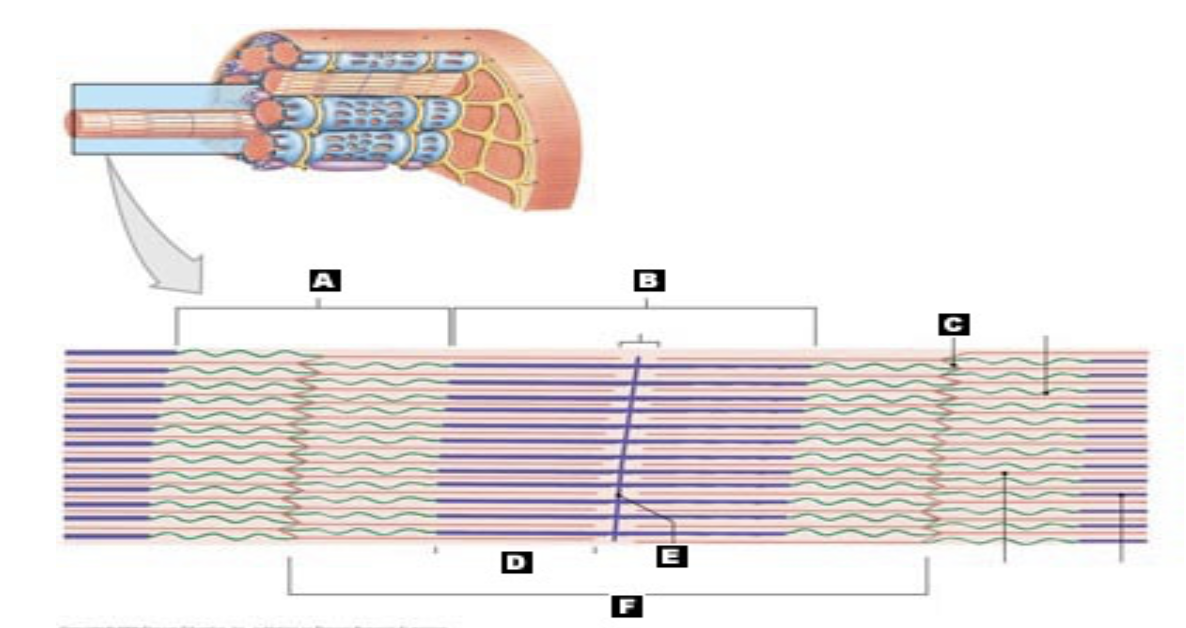
Which of the above structures are seen as “light”?
I band (labeled A)
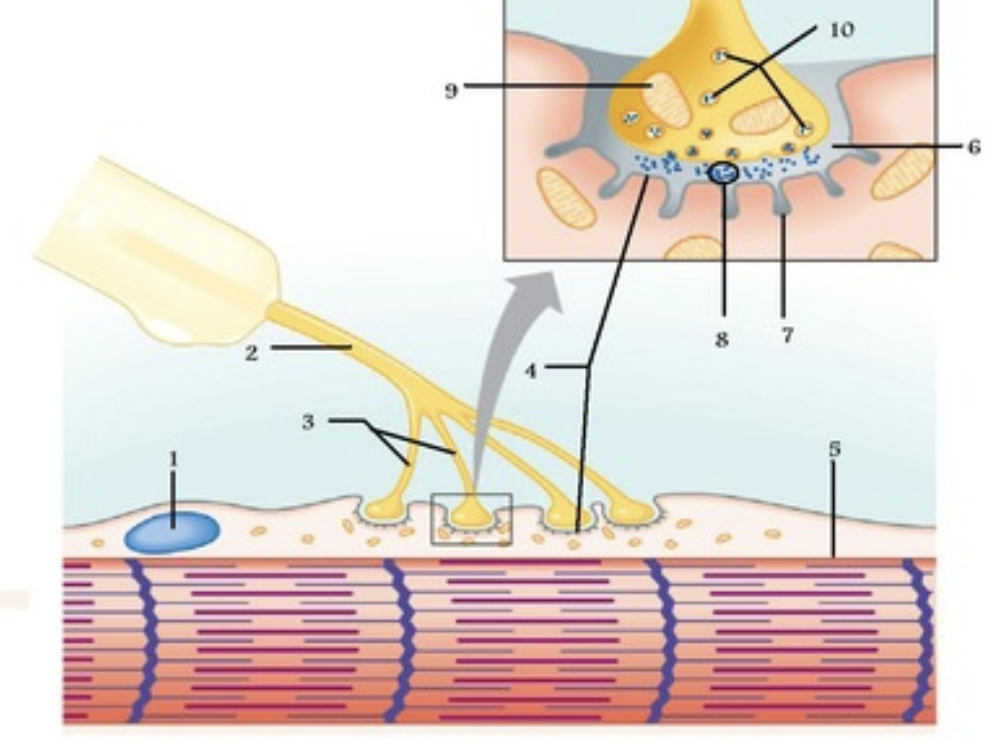
Label 1 on neuro-muscular junction model
Nucleus

Label 2 on neuro-muscular junction model
Motor neuron axon

Label 3 on neuro-muscular junction model
Axon terminals
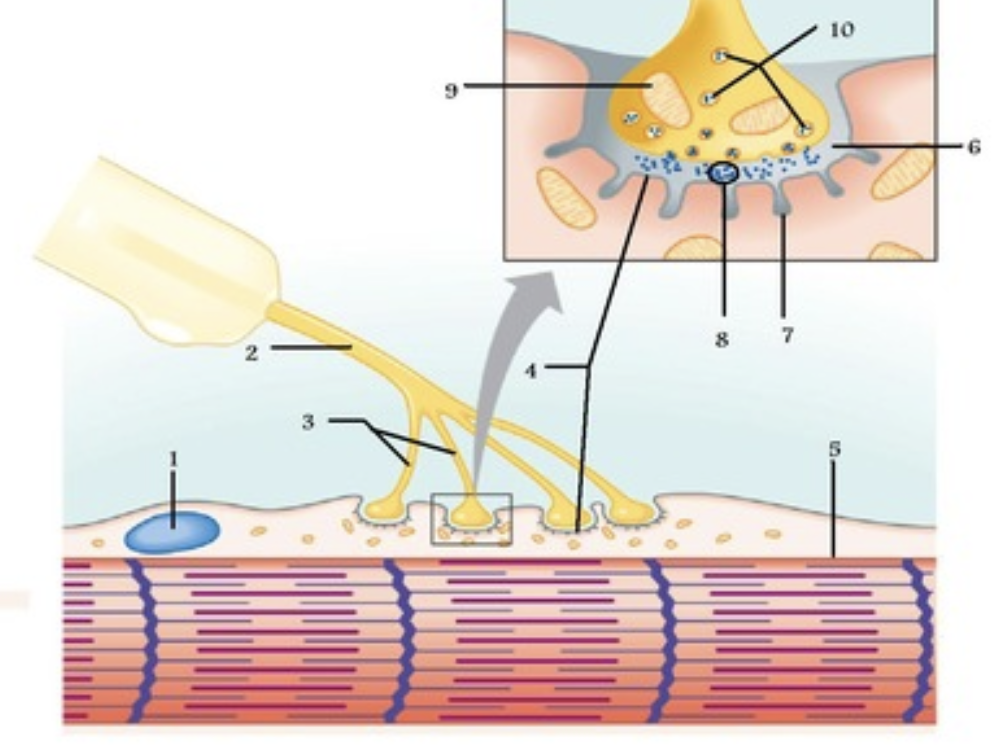
Label 4 on neuro-muscular junction model
Motor end plate

Label 5 on neuro-muscular junction model
Sarcolemma

Label 6 on neuro-muscular junction model
Synaptic cleft
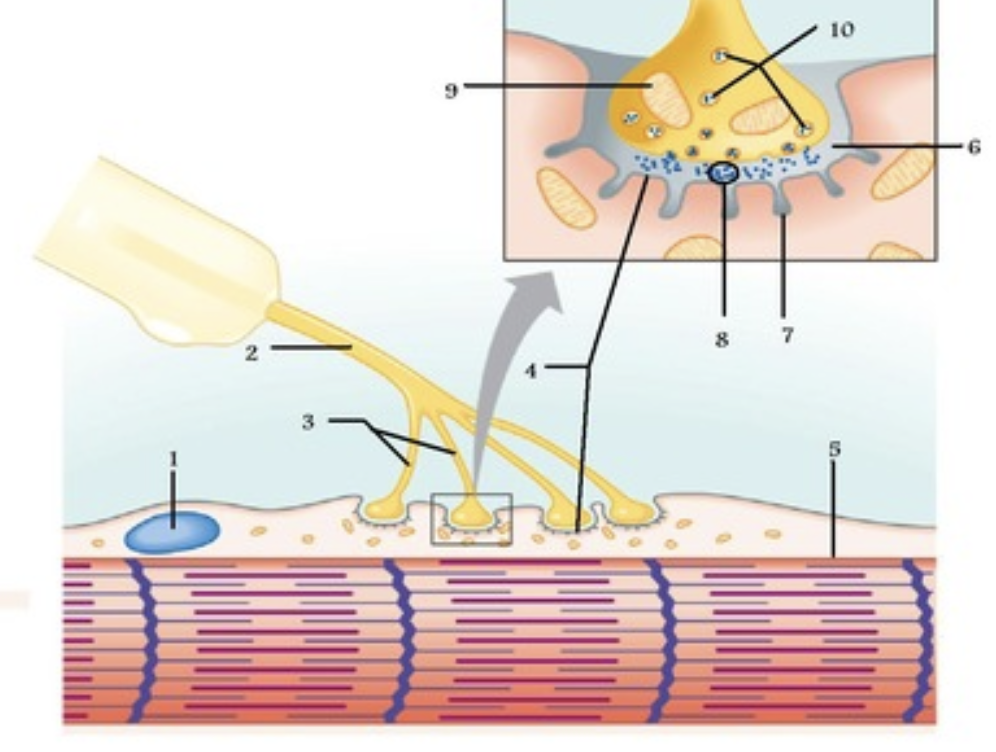
Label 7 on neuro-muscular junction model
Folded sarcolemma

Label 8 on neuro-muscular junction model
Acetylcholine

Label 9 on neuro-muscular junction model
Mitochondria

Label 10 on neuro-muscular junction model
Synaptic vesicles

What is stored in 10 in the neuro-muscular junction model?
Synaptic vesicles
What is the charge outside the muscle fiber at rest?
Positive
Which ion is in greater abundance outside the muscle fiber at rest?
Sodium (Na)
What is the charge inside the muscle fiber at rest?
Negative
Which ion is in greater abundance inside the muscle fiber at rest?
Potassium (K+)
What is the name given to the process of the muscle changing its initial charge?
Depolarization
Which ion must be allowed into the muscle cell to achieve Depolarization?
Sodium (Na)

What is Depolarization ?
Sodium enter the cell, making inside less neg. & temporarily pos.
What is the name given to the process of the action potential spreading down the sarcolemma?
Propagation
What is Propagation?
Depolarization signal spreading down the muscle fiber/sarcolemma
What is the name given to the process when the muscle cell is returning to its initial charge?
Repolarization
What ion must be allowed to leave the muscle cell to achieve Repolarization?
Potassium ion (K+)

How are the ions redistributed properly after this occurs? |
Sodium-potassium pump moves sodium out of cell and potassium back in to normal

Is Sodium-potassium pump active or passive transport?
Active transport - requiring ATP
The Na+/K+ pump moves how much Na+ and how many K+ per ATP?
3 Na+ out and 2 K+ in
What is the name of the neurotransmitter that must be released to allow Depolarization to even occur?
Acetylcholine
What is the sequence for a muscle contraction to occur?
ACh is released, ACh binds to motor end plate, sodium flows into cell, depolarization, propagation, contraction

What is the name of the region where the synaptic knob meets the muscle fiber to release this neurotransmitter?
Neuromuscular junction (NMJ)
What is the name of the thick filament? |
Myosin
What is name of the thin filament ?
Actin
Where is tropomyosin located? |
On the actin (thin) filament
What is the function of Tropomyosin?
It covers the myosin-binding sites on actin
Where is Troponin located?
on the thin filament (actin).
What is the function of Troponin?
Binds calcium →causes tropomyosin to moves exposing binding sites on actin
What ion does troponin bind with?
Calcium
What is the name of the structure that store the calcium within muscle fiber ?
Sarcoplasmic reticulum
What is the name of the structure that runs between the structures in the Sarcoplasmic reticulum? |
Transverse tubule (T-tubule)
What are the structures that make a “triad” in a muscle fiber?
One T-tubule and two terminal cisternae
What is used to help return the Calcium to the sarcoplasmic reticulum?
ATP is required to actively pump calcium back into the SR
What does the Calcium pump do?
Uses ATP to actively move calcium back into SR→ muscle relaxes
Is the Calcium pump active or passive transport?
Active transport
List 5 functions of muscle tissue
Movement, maintaining posture, stabilizing joints, generating heat, moving substances throughout the body.

Each muscle is composed of bundles of muscle fibers called
Fascicles
Myofibrils are made up of: |
Myofilaments; actin and myosin

List the three connective tissue layers to a skeletal muscle from superficial to deep.
Epimysium
Perimysium
Endomysium

The plasma membrane of a muscle cell is also known as the:
sarcolemma

What is the name of the structure that attaches muscle to bone?
Tendon
Is tendons well vascularized?
No, they have poor blood supply

What type of connective tissue is tendons made from?
Dense regular connective tissue

Give the definition of an isotonic contraction
Muscle changes length while moving a resistantance

Example of isotonic contraction?
Hold the dumbbell still with elbow bent (bicep is producing tension but muscle stays the same length)
List the two phases of an isotonic contraction.
Concentric
Eccentric

What does Concentric contraction mean?
Muscle shortens and gets shorter while moving the resistance.

Example of Concentric contraction?
Lifting a dumbbell during a bicep curl

What does Eccentric contraction means?
Muscle lengthens while producing tension
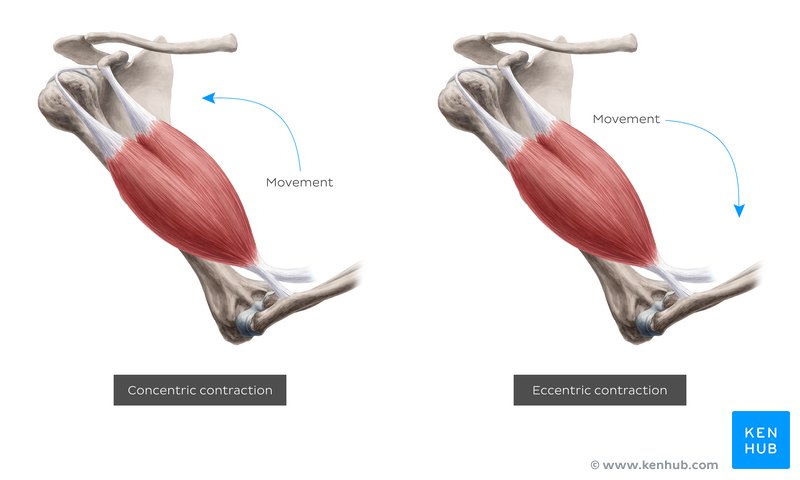
Example of Eccentric contraction?
Lowering dumbbell during a bicep curl


Give the definition of an isometric contraction.
muscle tension changes but muscle length remains constant.
Example of Isometric contraction?
Holding a dumbbell still with your elbow bent (no change in length)

What is a motor unit? |
One motor neuron
muscle fibers it controls
Which would have a larger amount of motor units, your hamstrings or the muscles of your hand? |
Hand muscle has more, smaller motor units for precise control

What is Agonist ?
The prime mover that produces a movement.

What is Antagonist?
A muscle that opposes the action of the agonist→ produces opposite movement

What is Synergist?
A muscle that helps the prime mover (agonist) perform a movement

What is a sarcomere? |
Basic functional unit of a muscle fiber, extending from one Z-disc to the next
During the sliding-filament theory, do the myofilaments actually shorten?
No. The actin and myosin filaments slide past each other; the filaments themselves do not shorten
What happens to the Z-discs during the sliding-filament theory?
move closer together as actin slides towards center
What happens to the H-zone during the sliding-filament theory?
becomes smaller/narrower and can disappear as actin moves toward the center.
List the 4 stages of the sliding-filament theory
Cross-bridge formation
Power stroke/working stroke
Detachment
Return/Reset/Recocking
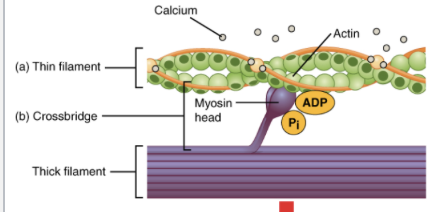
What does (1). Cross bridge formation do?
Calcium binds to Troponin→ causing Tropomyosin to exposes myosin heads→ myosin heads attach to actin
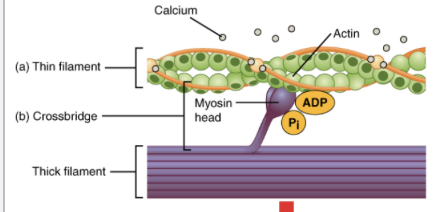

What does (2). Power stroke/Working stroke do?
ADP & Pi released, causing myosin heads to pull actin toward H- zone (the center of the sarcomere).

What does (3.) Detachment mean in the sliding-filament theory.
ATP binds to myosin heads, causing it to detach from the binding site on actin.

What does (4.) Return/Reset/Recocking mean in the sliding-filament theory.
ATP gets broken down to ADP+ Pi which gives energy to myosin heads to move back to ready position

What is #2 in the Skeletal muscle fiber model?
Transverse (T) tubule


What does the Terminal Cisternae do?
Stores and releases calcium to start muscle contraction.

What is #2 in the Skeletal muscle fiber model?
Transverse (T) tubule

What does Transverse (T) tubule do?
Carries the electrical signal (action potential) into the muscle fiber

What #1 in the Skeletal muscle fiber model?
Sarcoplasmic reticulum
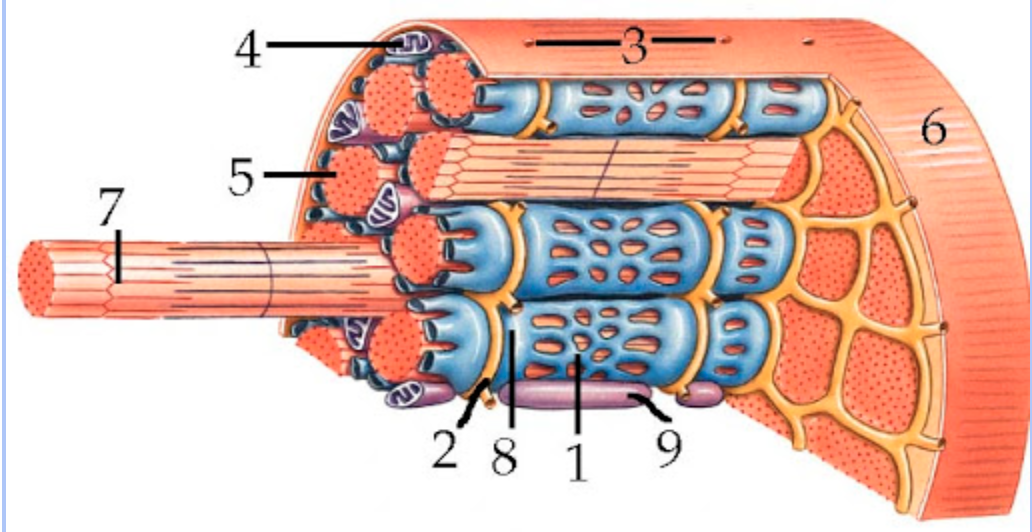

Function of Sarcoplasmic reticulum ?
Stores calcium for muscle contraction

What is #6 in the Skeletal muscle fiber model?
Sarcolemma

Function of Sarcolemma ?
A plasma membrane that protects the muscle fiber + helps transmit the electrical signal.

What is #7 in the Skeletal muscle fiber model?
Myofibril


What is a Triad in the Skeletal muscle fiber?
1 T-tubule surrounded by 2 terminal cisternae of the SR
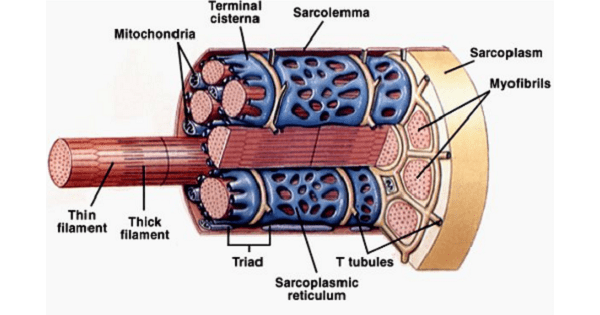
Function of the triad?
Helps transmit the electrical signal into muscle fiber
Triggers the release of calcium for muscle contraction