Enthalpy
 Call Kai
 Learn
Learn Practice Test
 Spaced Repetition
 Match
Match Flashcards
 Knowt Play
1/12

There's no tags or description
Looks like no tags are added yet.
Name | Mastery | Learn | Test | Matching | Spaced | Call with Kai | Chat |
|---|
No analytics yet
Send a link to your students to track their progress
13 Terms
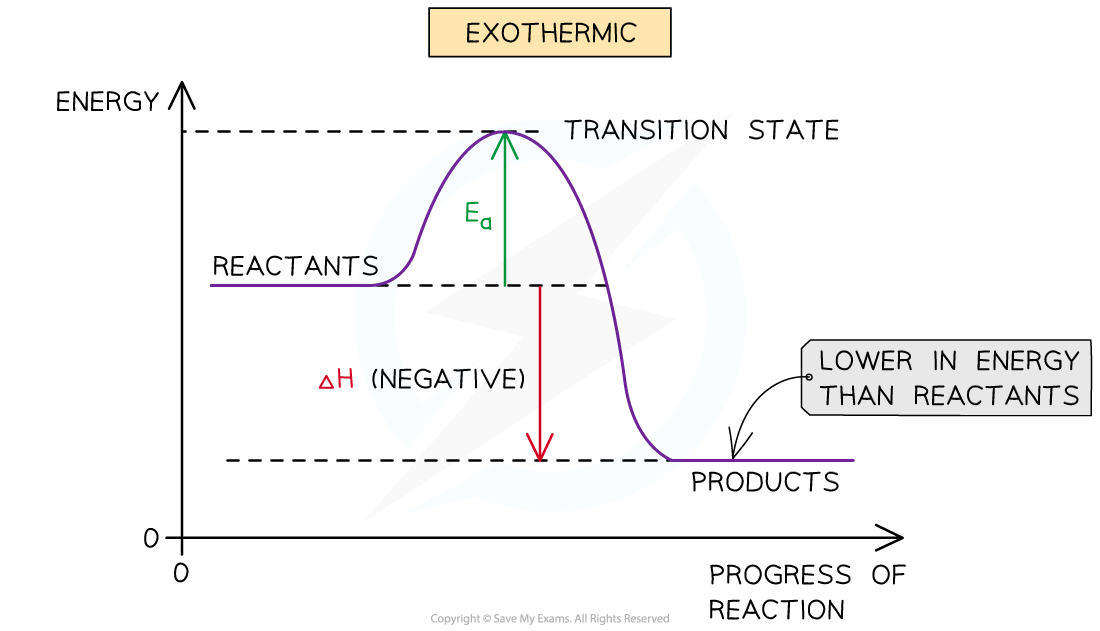
Draw an exothermic reaction profile and describe what this means in terms of bonds
The amount of energy given out is greater during bond making than the amount of energy absorbed when bonds are broken
Increase in temp of surroundings
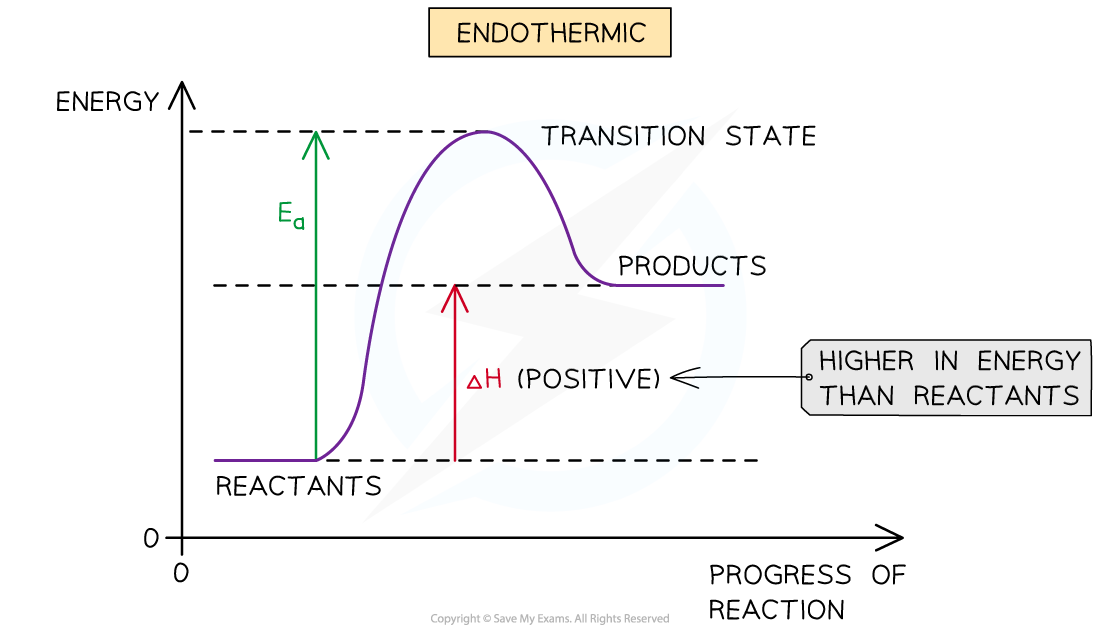
Draw an endothermic reaction profile and describe what this means in terms of bonds
The amount of energy absorbed is greater during bond breaking than the amount of energy released when bonds are made
Decrease in temp of surroundings
What are the standard conditions for enthalpy
100kPa
298K
this is recognised with: △Hθ
Define bond enthalpy
average amount of energy required to break 1 mole of a covalent bond measured in the gaseous state in kJmol-1
always a positive value: bond breaking requires energy, so energy is absorbed and is endothermic
What are rules of bond enthalpies
The higher the bond enthalpy, the stronger the covalent bond
Triple bonds: shortest but strongest
Single bonds: longest but weakest
Bond lengths increase down group 7
Bond strength decrease down group 7
What are the formulas used to calculate enthalpy change
q=mc△T
J → kJ= ÷1000
△H= q÷n
What is the definition for the enthalpy change of formation
Enthalpy change when 1 mole of a compound is formed from its elements in their standard states, under standard conditions
Define enthalpy change of combustion
Enthalpy change when 1 mole of a substance is completely burned in excess oxygen, under standard conditions to form CO2 + H2O
Definition of enthalpy change of neutralisation
Enthalpy change when an acid reacts with a base to form 1 mole of H2O under standard conditions
What does Hess’s law state
The enthalpy change for a chemical reaction is independent of the rate taken and depends only on the initial and final states
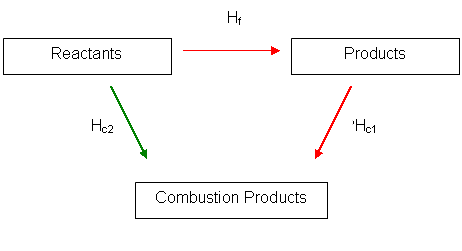
What does a combustion cycle look like
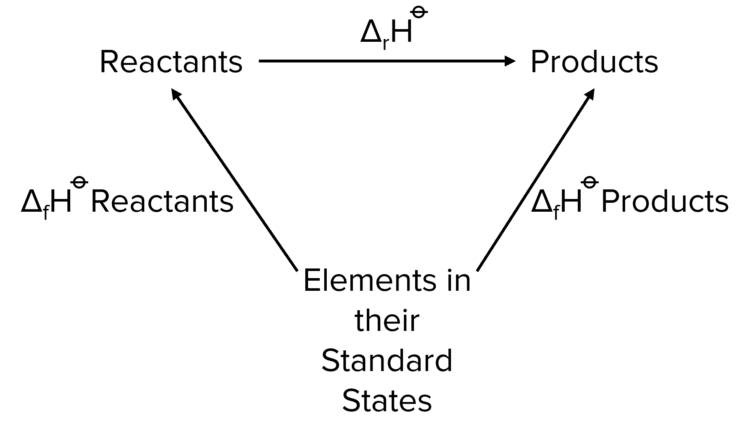
What does a formation cycle look like