3.1.1.12 Defining acids and bases
 Call Kai
 Learn
Learn Practice Test
 Spaced Repetition
 Match
Match Flashcards
 Knowt Play
1/79

There's no tags or description
Looks like no tags are added yet.
Name | Mastery | Learn | Test | Matching | Spaced | Call with Kai | Chat |
|---|
No analytics yet
Send a link to your students to track their progress
80 Terms
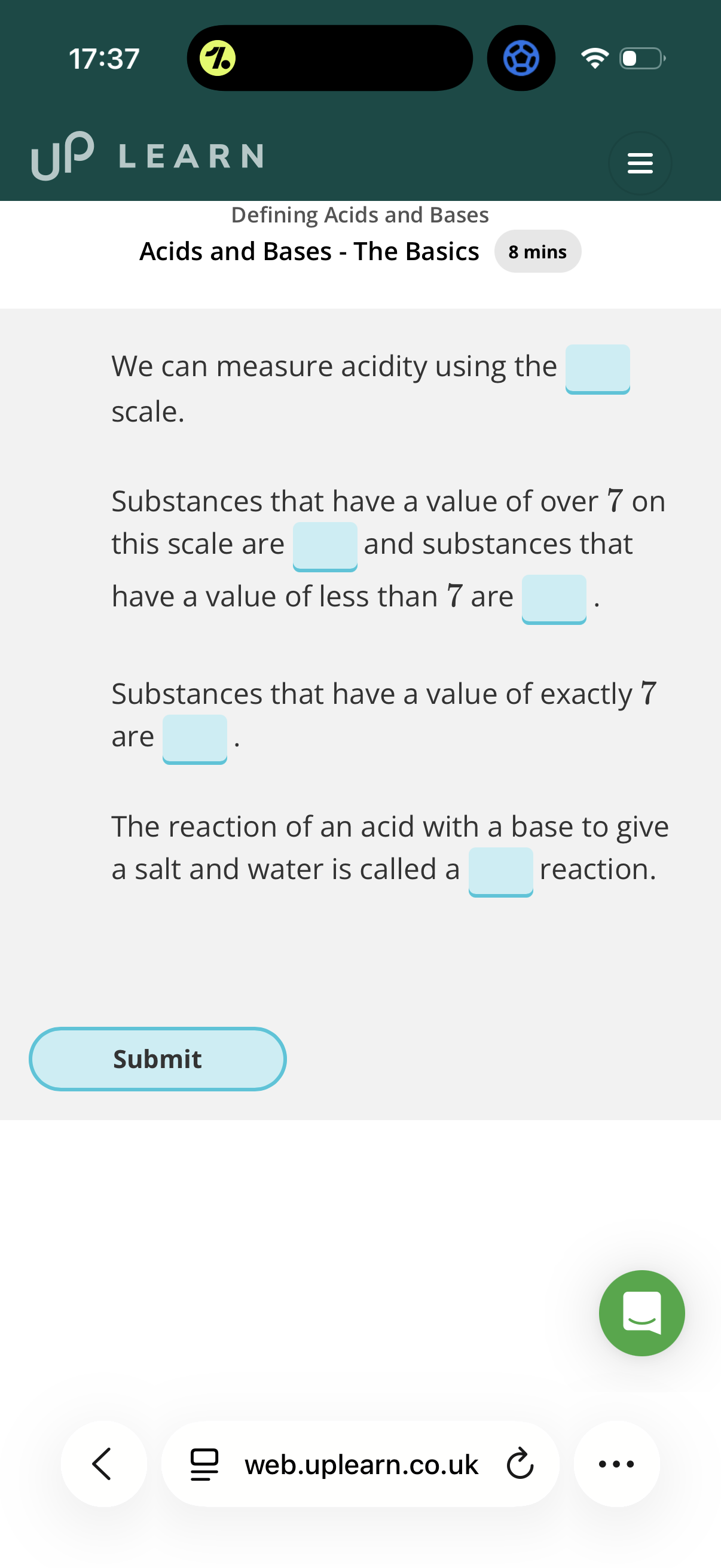
The pH scale measure…
•Alkali’s are soluble …2?
Info: pH7= …3?. Below pH7 is…4? And above 7 is …5?.
•An acid reacts with a base to form…6? (Acid + base → salt + water) → The products of the reaction are closer to pH 7 so we call it a …7? Reaction.
What experimental technique can we use to carry out neutralisation reactions to find the concentrations of acids and bases?
What are the 3 types of base?
What is the reaction between metal hydroxides and acids?
What is the reaction between Metal oxides and acids?
What is the reaction between metal carbonates and acids?
An acid reacts with a metal to form…
(acid + metal → salt + hydrogen)
How acidic or basic something is
Base
Neutral
Acidic
Basic
Salt + Water
Neutralisation
Titration
Metal oxide(e.g.K2O), metal hydroxide(NaOH) , metal carbonate(CaCO3)
Metal hydroxide(s) + acid(aq) → Salt(aq) + water(l)
Metal oxide(s) + acid(aq) → Salt(aq) + water(l)
Metal carbonate(s) + acid(aq) → Salt(aq) + water(l) + CO2(g)
Salt + hydrogen (g)


Bases and Alkali
Answer image question?
note: All alkalis are bases but not all bases are alkali.
Info: If we have a alkali in solution we call it an alkaline solution.
• An alkali is a base that is soluble in …2?
(Other side image contains info)
What is the correct formula for iron (III) hydroxide?
What is the correct formula for phosphoric acid?
A and B
Water
Fe(OH)3
H3PO4

The Arrhenius Model
Which two ions does hydrochloric acid dissociate into in water?
Hydrogen cations, or H+ ions, are also known as…
Sodium hydroxide, NaOH, dissociates into two different ions. The cation is...3?
and the anion is …4?
According to the Arrhenius model, why is a solution of sulphuric acid (H2SO4) acidic?
A: Sulphuric acid has a pH of less than 7.
B: When it dissolves, sulphuric acid releases H+ ions into water.
•Arrhenius discovered that when substances dissolve, they …6? into …7?. According to the Arrhenius model of acids and bases, acids add …8? to water, and bases add …9? to water.
H+ And Cl−
Protons
Na+
OH-
B(Arrhenius acids- any substance that adds H+ ions to water)
Dissociate
Ions
H+
OH-

The Bronsted-Lowry Model
HNO3+NaOH→NaNO3+H2O
In this reaction, the substance that is donating a proton is…
According to the Brønsted-Lowry model, an acid is a …2? and a base is a …3?
Consider the following reaction:
Ca(OH)2b(s) + 2HNO3 (aq) → Ca(NO3)2 (aq) + 2H2O (l)
Identify the acid and base according to the Brønsted-Lowry model.
5. Consider the following reaction:
HCl (aq)+LiOH (aq)→LiCl (aq)+H2O (l)
Identify the acid and base according to the Brønsted-Lowry model.Consider the following reaction:
HBr (g)+NH3(g)→NH4Br (s)
Identify the acid and base according to the Brønsted-Lowry model.Consider the following reaction:
HBr (aq)+H2O (l)→H3O+(aq) + Br−(aq)
Identify the acid and base according to the Brønsted-Lowry model.Consider the following reaction:
CO3 2−(aq) + H2O (l) →HCO3 *−(aq) + OH−(aq)
Identify the acid and base according to the Brønsted-Lowry model.Answer image question (note Arrhenius bases and acids are all soluble/dissolve in water→ if it isn’t in solution it isn’t an Arrhenius acid or base)
HNO3
Proton donor
Proton acceptor
Bron-low acid= nitric acid
Bron-low base=Calcium hydroxide
Bron-low acid= HCl
Bron-low base=Lithium hydroxide
Bron-low acid= hydroponic acid
Bron-low base=ammonia
(NH3 gained a proton and became NH4 so is a base, whereas HBr donated a proton and became Br so is an acid)
Bron-low acid= HBr
Bron-low base= water
Bron-low acid= water
Bron-low base= Carbonate ion
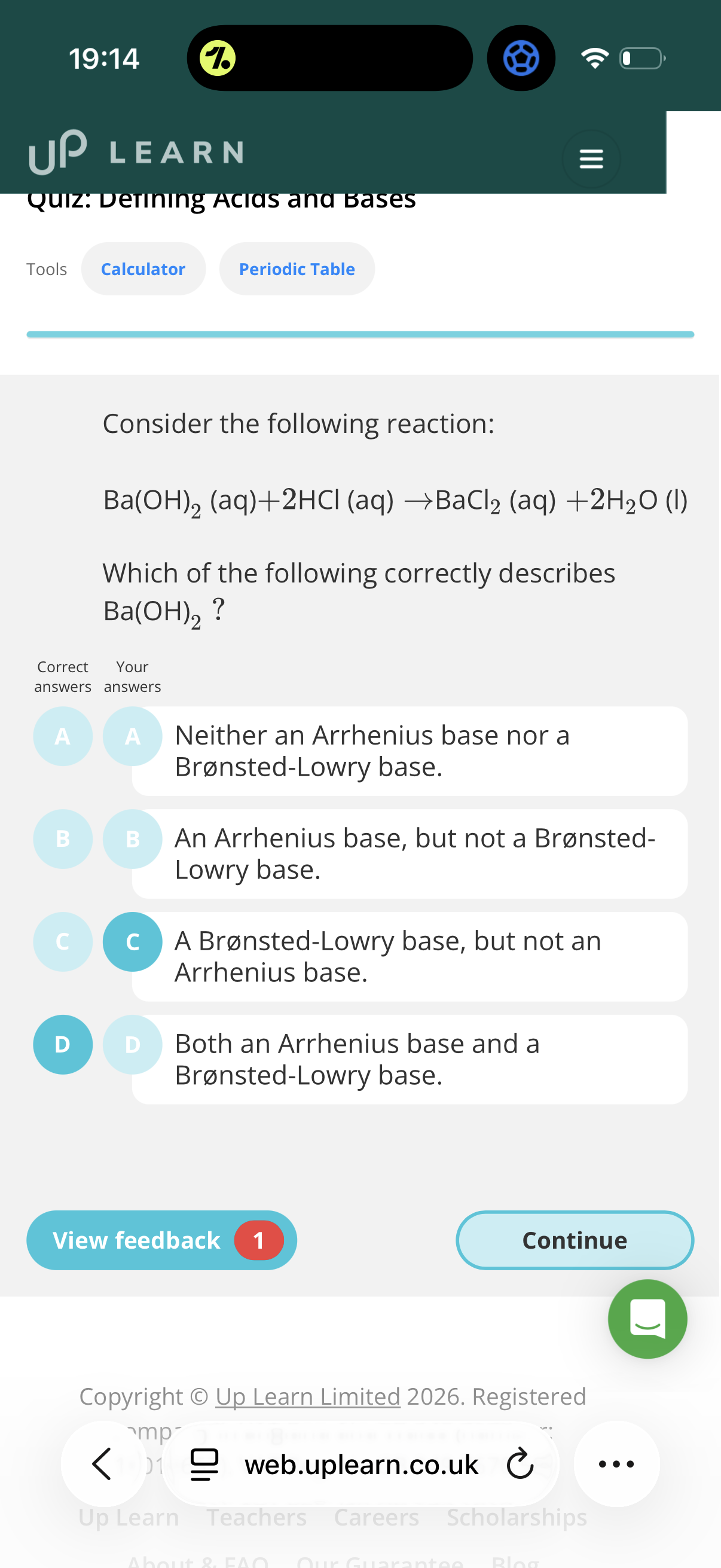

Differences Between the Models
Note: To tell if a substance is an Arrhenius acid or base we ask these questions
1)Is it soluble in water 2)Does it release H+ ions 3)If no for (q2) then does it release OH- ions. 4) If no then it’s neither an acid or base
If compound X dissolves in water and releases hydroxide ions, what must it be?
Note: To tell if a substance is a Bronsted-Lowry acid or base we ask these questions
1)Does it react with something → if no then it can’t be an acid or base
2) If yes(q1), we ask can it donate a proton
3) If no we ask does it accept a proton→ if no Then the substance is neither an acid or base
Answer image question
Base(according to the Arrhenius model)

![<p><strong>Strong and Weak Acids and Bases</strong></p><ol><li><p>The process where the ions in a compound separate when the compound dissolves in water is called…</p></li></ol><p>Note: HCl(hydrochloric acid), HNO3(nitric acid) and H2SO4(sulfuric acid) are strong acids</p><p></p><ol start="2"><li><p>When potassium hydroxide is added to water, it fully dissociates into ions. This tells us that potassium hydroxide is a…</p></li></ol><p>Note: NaOH[sodium hydroxide],Ba(OH)2 [barium hydroxide],Ca(OH)2 [Calcium hydroxide] are strong bases</p><p></p><ol start="3"><li><p>Answer image question?</p></li><li><p>When ammonia is added to water, it only slightly reacts with water to produce ions. This tells us that ammonia is a…</p></li><li><p>Water dissociates into H+ and OH- ions but we know that H+ ions don’t exist in their own and react. What ion is created when H+ ions react with water?</p><p>Info: Water also slightly dissociates into ions, forming an acid base equilibrium. (where a water molecule acts as an acid and another acts as a base)</p><p>H2O(l) +H2O (l) → H3O+(aq) + OH-(aq)</p></li><li><p><span style="line-height: var(--ck-content-line-height); font-size: var(--ck-content-font-size); color: var(--ck-content-font-color);">The first water molecule is acting as a Brønsted-Lowry base because it…</span></p></li><li><p>The second water molecule is acting as a Brønsted-Lowry acid because it…</p></li></ol><p>•<span style="line-height: var(--ck-content-line-height); font-size: var(--ck-content-font-size); color: var(--ck-content-font-color);">Weak acids …8? dissociate into ions In water. This forms an …9?. Strong acids and strong bases …10? dissociate into ions. Weak bases …11?with water to form an equilibrium.</span></p>](https://assets.knowt.com/user-attachments/2465f0b6-1adb-4e58-9ee9-2b8567b91c75.png)
Strong and Weak Acids and Bases
The process where the ions in a compound separate when the compound dissolves in water is called…
Note: HCl(hydrochloric acid), HNO3(nitric acid) and H2SO4(sulfuric acid) are strong acids
When potassium hydroxide is added to water, it fully dissociates into ions. This tells us that potassium hydroxide is a…
Note: NaOH[sodium hydroxide],Ba(OH)2 [barium hydroxide],Ca(OH)2 [Calcium hydroxide] are strong bases
Answer image question?
When ammonia is added to water, it only slightly reacts with water to produce ions. This tells us that ammonia is a…
Water dissociates into H+ and OH- ions but we know that H+ ions don’t exist in their own and react. What ion is created when H+ ions react with water?
Info: Water also slightly dissociates into ions, forming an acid base equilibrium. (where a water molecule acts as an acid and another acts as a base)
H2O(l) +H2O (l) → H3O+(aq) + OH-(aq)
The first water molecule is acting as a Brønsted-Lowry base because it…
The second water molecule is acting as a Brønsted-Lowry acid because it…
•Weak acids …8? dissociate into ions In water. This forms an …9?. Strong acids and strong bases …10? dissociate into ions. Weak bases …11?with water to form an equilibrium.
Dissociation
Strong base
4. Weak base
5. H3O+(hydronium ions)
Accepts a proton to become a hydronium ion
Donates a proton to become a hydroxide ion
Partially
Equilibrium
Fully
React

![<p><strong>Conjugate Acids and Conjugate Bases</strong></p><p class="sc-hKwBjT sc-cfJLes gPwEHt zSZxG">Full reaction: NH3(aq) + H2O(l) →←(RR) NH4+(aq) + OH- (aq)</p><p class="sc-hKwBjT sc-cfJLes gPwEHt zSZxG"><span style="line-height: var(--ck-content-line-height); font-size: var(--ck-content-font-size); color: var(--ck-content-font-color);">NH3 + H+→NH4+<br>In this reaction, ammonia is a Brønsted-Lowry …1? because it is a …2?.</span></p><p class="sc-hKwBjT sc-cfJLes gPwEHt zSZxG"><span style="line-height: var(--ck-content-line-height); font-size: var(--ck-content-font-size); color: var(--ck-content-font-color);">NH4+→NH3 + H+<br>In this reaction, the ammonium ion is a Brønsted-Lowry …3? because it is a …4?</span></p><p class="sc-hKwBjT sc-cfJLes gPwEHt zSZxG"><span style="line-height: var(--ck-content-line-height); font-size: var(--ck-content-font-size); color: var(--ck-content-font-color);">• Based from these examples, when ammonia acts as a bronsted-Lowry base, it form a bronsted-lowry acid, and we call the acid a …5?. So ammonium is the conjugate acid of ammonia.</span></p><p class="sc-hKwBjT sc-cfJLes gPwEHt zSZxG"><span style="line-height: var(--ck-content-line-height); font-size: var(--ck-content-font-size); color: var(--ck-content-font-color);">•So in general, when a substance reacts as a brosnted-Lowry base and accepts a proton, we call the product that forms a conjugate acid.</span></p><ol start="6"><li><p class="sc-hKwBjT sc-cfJLes gPwEHt zSZxG">What is the conjugate acid of hydroxide, OH−? (in the full reaction)</p></li></ol><p>info: in the full reaction, we would call the OH- and H2O the <strong>conjugate-acid base pair.</strong>→This is because we can covert between them by adding a removing a proton (OH-[base] + H+ →←H2O[conjugate acid])</p><p></p><ol start="7"><li><p>Whenever a substance reacts as a Brønsted-Lowry <strong>acid</strong> and loses a proton, we call the product that forms its conjugate base.<br><br>What is the conjugate base of hydrogen fluoride, HF?</p></li></ol><p>Note: Together, we would call the Fluoride and Hydrogen fluoride the conjugate acid base pair or conjugate-pair for short.</p><ol start="8"><li><p>Answer image question?</p></li><li><p>Whenever a substance acts as a Brønsted-Lowry base, we call the product it forms its…</p></li><li><p>Whenever a substance acts as a Brønsted-Lowry acid, we call the product it forms its…</p></li></ol><p></p>](https://assets.knowt.com/user-attachments/f467b93a-6d19-4bd6-a27e-9badbc566a61.png)
Conjugate Acids and Conjugate Bases
Full reaction: NH3(aq) + H2O(l) →←(RR) NH4+(aq) + OH- (aq)
NH3 + H+→NH4+
In this reaction, ammonia is a Brønsted-Lowry …1? because it is a …2?.
NH4+→NH3 + H+
In this reaction, the ammonium ion is a Brønsted-Lowry …3? because it is a …4?
• Based from these examples, when ammonia acts as a bronsted-Lowry base, it form a bronsted-lowry acid, and we call the acid a …5?. So ammonium is the conjugate acid of ammonia.
•So in general, when a substance reacts as a brosnted-Lowry base and accepts a proton, we call the product that forms a conjugate acid.
What is the conjugate acid of hydroxide, OH−? (in the full reaction)
info: in the full reaction, we would call the OH- and H2O the conjugate-acid base pair.→This is because we can covert between them by adding a removing a proton (OH-[base] + H+ →←H2O[conjugate acid])
Whenever a substance reacts as a Brønsted-Lowry acid and loses a proton, we call the product that forms its conjugate base.
What is the conjugate base of hydrogen fluoride, HF?
Note: Together, we would call the Fluoride and Hydrogen fluoride the conjugate acid base pair or conjugate-pair for short.
Answer image question?
Whenever a substance acts as a Brønsted-Lowry base, we call the product it forms its…
Whenever a substance acts as a Brønsted-Lowry acid, we call the product it forms its…
Base
Proton acceptor
Acid
Proton donor
Conjugate acid
H2O
F-
Conjugate acid(note that since these have gained protons[to form itself as the product], they can donate the protons to form the Brownsted-Lowry base again in a RR)
conjugate base(Note that since these have lost a proton, they can accept a proton to form the Bronsted-Lowry acid again in a RR)
![<ol><li><p>Base</p></li><li><p>Proton acceptor</p></li><li><p>Acid</p></li><li><p>Proton donor</p></li><li><p>Conjugate acid</p></li><li><p>H2O</p></li><li><p>F-</p><ol start="9"><li><p>Conjugate acid(note that since these have gained protons[to form itself as the product], they can donate the protons to form the Brownsted-Lowry base again in a RR)</p></li></ol></li></ol><ol start="10"><li><p>conjugate base(Note that since these have lost a proton, they can accept a proton to form the Bronsted-Lowry acid again in a RR)</p></li></ol><p></p>](https://assets.knowt.com/user-attachments/6590bb2d-2abd-4313-a3d4-a71221a82f3f.png)
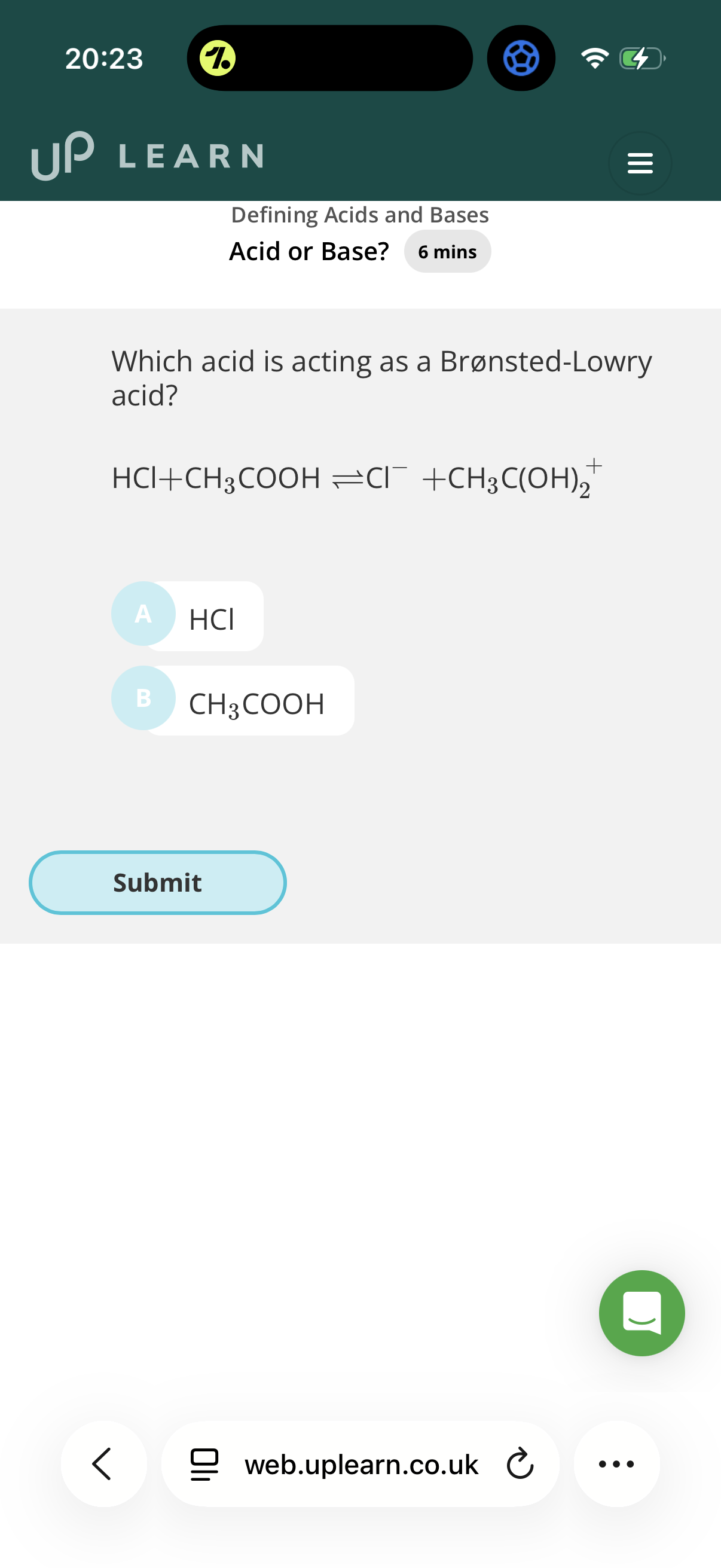
Acid or Base
Note: When two acids react, the strong acid always acts as the Bronsted-Lowry acid, and the weak acid acts as the Bronsted-Lowry base.
Answer image question?
H2O + HNO3→H3O+ + NO3−
In this reaction, water is acting as…H2O + NH3→ NH4+ + OH−
In this reaction, water is acting as…
A (this image shows that even though they are both acids, one can still act as bronsted-Lowry base→ they are both also Arrhenius acids since they dissociate in water)
Bronsted-Lowry base( it accepts a proton to become a hydronium ion which is the conjugate acid)
Bronsted-Lowry acid(it donates a proton to become OH- which is the conjugate base)


Image info: dissociation of water (note that not all water molecules dissociate into ions so this reversible reaction can occur)
Which of the following statements is true?
A: Whether a substance acts as an Arrhenius acid or an Arrhenius base depends on the reaction that is taking place.
B: Water can act as a Brønsted-Lowry acid or a Brønsted-Lowry base depending on what it is reacting with.
B

Answer image question
What does corrosive mean?
Can burn through living or non-living tissue


Answer image question
Define the term ‘Brønsted-Lowry base’.
Define the term ‘Arrhenius acid’
Water is capable of dissociation. Write an equation to show the dissociation of water molecules
According to the Brønsted-Lowry model, acid-base equilibria always contain two acid-base pairs, called …5? Each of these acid-base pairs is made up of a …6? and a …7?. The only difference between them is that the …8?has an extra proton.
a substance that accepts a proton in a reaction.
a substance that dissolves in water to produce H+ ions (or H3O+ ions).
or H2O + H2O⇌H3O+ + OH− or H2O ⇌ H+ + OH-
Conjugate pairs
Conjugate acid
Conjugate base
conjugate acid


Answer image question?
*Arrhenius discovered that the ions in a compound separate when the compound dissolves in water in a process called...2? →
…3? undergo this process almost fully to produce a solution of protons and anions. →
…4? undergo this process only partially to produce a solution of protons and anions.
Ammonium ions, NH4+, can be used as a weak acid in organic reactions. Write an equation for the dissociation of this acid. (Do not include state symbols)
info:When ammonium is used as a weak acid in organic synthesis, the reaction remains reversible because it exists in equilibrium with its conjugate base, ammonia.
Info: If a strong acid dissociates, the process is considered effectively irreversible because the acid completely donates its protons to the solvent, leaving virtually no original acid molecules behind to facilitate the reverse reaction.
Dissociation
Strong acids
Weak acids
NH4+⇌H+ + NH3


Answer image question

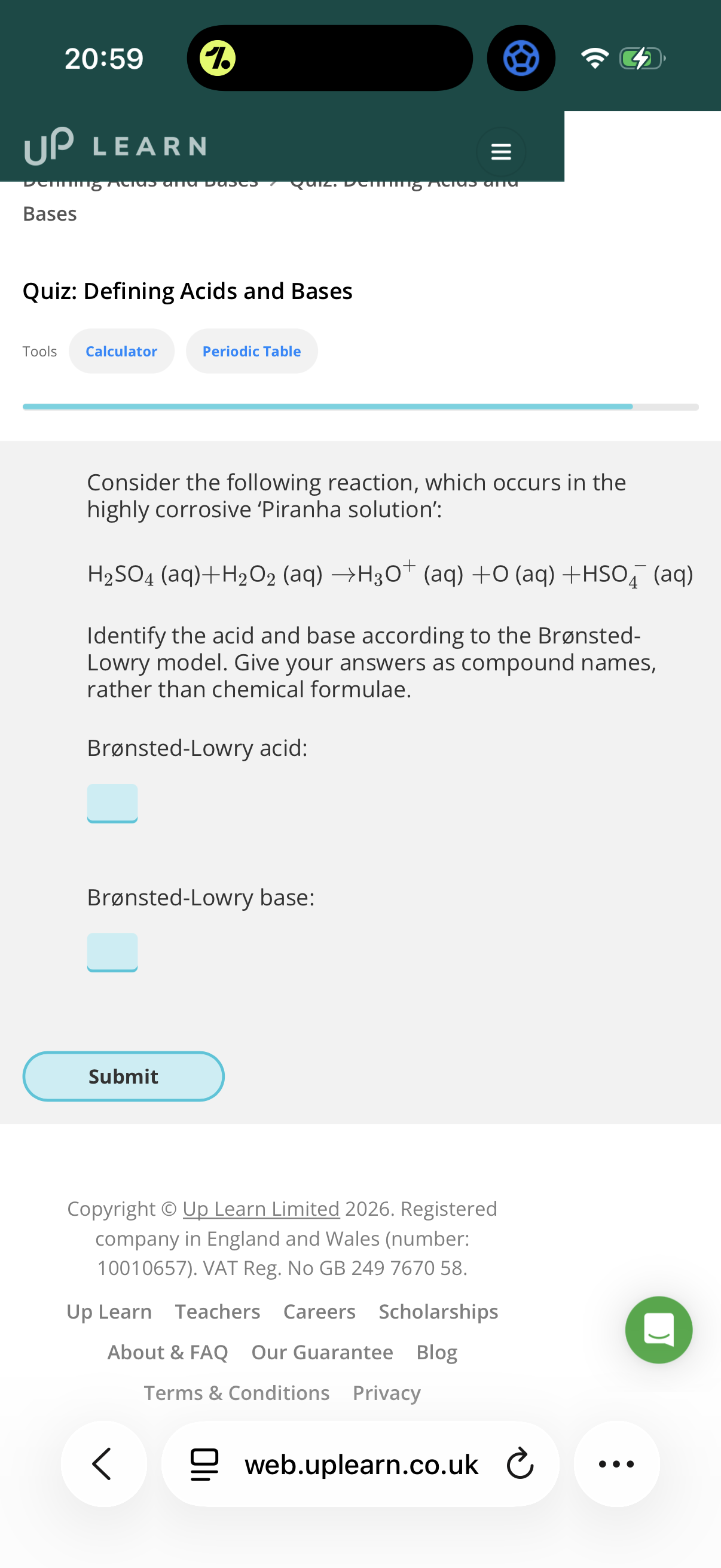
Answer image question
Acid and base reactions
• Acids can't just throw away their protons — they can only get rid of them if there's a …1? to accept them. In this reaction the acid, HA, transfers a proton to the base, B:
HA (aq) + B(aq) <=> BH+ (aq) + A- (aq)
Its equilibrium is far to the left for weak acids, and far to the right for strong acids.
-It's an equilibrium, so if you add more HA or B, the position of equilibrium moves to the right. But if you add more BH or A-, the equilibrium will move to the left, according to Le Chatelier's principle. When an acid is added to water, water acts as the ..:2? and accepts the proton:
HA (aq) + H2O(aq) <=>H3O+ (aq) + A- (aq)
Base
Base
![<p><strong>The ionic product of water</strong></p><p>Read image info:</p><ol><li><p>Why does the equilibrium of water dissociation lie to the left?</p></li><li><p>What is Kw?</p></li><li><p>What are the units of Kw always?</p><p>• The value of Kw changes as 4? Changes</p><p>5. what is the expression for Kw?(use this always when asked)</p><ol start="6"><li><p>When pure water dissociates,the concentration of [H+] and [OH-] is …, therefore [H+]=[OH-] so when dealing with water the expression for Kw can be written as …7?.</p></li></ol><ol start="8"><li><p>Answer the image questions?</p></li></ol></li></ol><p></p>](https://assets.knowt.com/user-attachments/2d3490d9-a9a5-43f0-8824-96c4bba67b6c.png)
The ionic product of water
Read image info:
Why does the equilibrium of water dissociation lie to the left?
What is Kw?
What are the units of Kw always?
• The value of Kw changes as 4? Changes
5. what is the expression for Kw?(use this always when asked)
When pure water dissociates,the concentration of [H+] and [OH-] is …, therefore [H+]=[OH-] so when dealing with water the expression for Kw can be written as …7?.
Answer the image questions?
Because water only dissociates a tiny amount so there is way more water molecules compared to H+ and Oh- ions.
The ionic product of water(basically the equilibrium or constant of water
Mol2 dm-6
Temperature
Kw= [H+][OH-]
The same/equal
Kw = [H+]*2 or even kw= [OH-]*2 •You must still write the expression in the original way
![<ol><li><p>Because water only dissociates a tiny amount so there is way more water molecules compared to H+ and Oh- ions.</p></li><li><p>The ionic product of water(basically the equilibrium or constant of water</p></li><li><p>Mol2 dm-6</p></li><li><p>Temperature</p></li><li><p>Kw= [H+][OH-]</p></li><li><p>The same/equal</p></li><li><p>Kw = [H+]*2 or even kw= [OH-]*2 •You must still write the expression in the original way</p></li></ol><p></p>](https://assets.knowt.com/user-attachments/bb493cf6-bc7a-482c-9dcd-4aae0676c393.heic)

pH calculations
Read image info
The pH scale is a measure of the …1? ion concentration in a solution.
The concentration of hydrogen ions in a solution can vary enormously, so those wise chemists of old decided to express the concentration on a logarithmic scale.
pH can be calculated using the following equation: …2?
If you've got the pH of a solution, and you want to know its hydrogen ion concentration, then you need the inverse of the pH formula which is ..,?
Answer image questions?
Hydrogen
pH= -log10 [H+]
[H+] = 10*-pH. (pH value in the indices)
![<ol><li><p>Hydrogen</p></li><li><p>pH= -log10 [H+]</p></li><li><p>[H+] = 10*-pH. (pH value in the indices)</p><p></p></li></ol><p></p>](https://assets.knowt.com/user-attachments/50ec767f-728a-454c-9bfb-e29f6441cdfa.heic)

pH change from dilution
Diluting an acid solution with water will do what to the pH? (Because it decreases the concentration of acid and so decreases the H+ ion concentration)
When Ezra added water to his acid solution, the number of H+ ions…
→ 3. In 0.3dm3 of HCl with a concentration of 0.8mol dm−3, how many moles of H+ions are there?
When Ezra added 0.9dm3 water to his acid solution, the volume of the solution…
Ezra’s acid solution contains 0.24mol H+ions when it has a volume of 0.3dm3. If the volume is increased to 1.2dm3, what is the new concentration of H+ ions?
What is the pH of the diluted acid if its concentration is 0.2mol dm−3? (2.dp)
If Ezra dilutes a 0.3dm3 solution of 0.8mol dm−3 acid with 0.3dm3 of water, what is the new concentration of the diluted acid? →The pH of a solution with 0.4mol dm−3 H+ ions is…8? (2.dp)
•To find the pH of a solution that has been diluted with water, we first find the new …9? of …10?. Then we can use our formula to calculate the new …11? of the diluted solution.
Answer image question
Increase the pH
Stays the same (water don’t react with the acid/H+ ions so it stays the same)
0.24 moles (C X V= moles)
Increased
0.2(C=Mol/V) (also note that the moles of H+ don’t change since the number of H+ are not removed or added)
0.70
0.4 mol dm-3
0.40
Concentration
H+
pH


pH Change from Reactions with Solid Bases
Ezra measures out 0.25dm3 of HCl with a concentration of 0.2mol dm−3. How many moles of HCl are in his sample?
Ezra’s acid solution contains 0.05moles of HCl. How many moles of H+ ions are there in the solution?
Ezra reacts the HCl with 0.04moles of NaOH Once the reaction has finished, the volume of the solution will have…
0.05moles of HCl reacts with 0.04moles of solid NaOH. How many moles of H+ions remain in the solution when the reaction has finished?(HCl is a strong monoprotic acid and fully dissociates into ions so the H+ ion concentration is equal to the acid concentration)
HCl (aq)+NaOH (s)→NaCl (aq)+H2O (l)If 0.01moles of H+ ions remain when the reaction has finished, and they are dissolved in 0.25dm3 of water, what is the concentration of H+ ions in the resulting solution?
Ezra’s acid solution has a concentration of 0.04mol dm−3. What is its pH?
•If we add a solid base to a solution of acid, the pH of the solution will…7? and the volume if the solution will …8?.
Note: The acid will donate protons/H+ ions to the base during the reaction which decreases the concentration of H+ ions in the products
A student has 50mL of a hydrobromic acid (HBr) solution with concentration of 0.30mol dm−3. They add 0.012 moles of solid potassium hydroxide (KOH) to the solution. The following reaction occurs:
HBr (aq)+KOH (s)→KBr (aq)+H2O (l)
What is the new pH of the solution after the reaction?(2dp)student has 60mL of a perchloric acid (HClO4) solution with concentration of 0.36mol dm−3. They add 50mL of a sodium hydroxide (NaOH) solution with a concentration of 0.25mol dm−3 to the acidic solution. The following reaction occurs:
HClO4(aq)+NaOH (aq)→NaClO4(aq)+H2O (l)
What is the new pH of the solution after the reaction? (2.dp)Answer image
0.05moles
0.05 moles (strong acids fully dissociated into ions so the moles of acid is the same as moles of H+ ions)
Stayed the same( because the amount of product water produced is minimal so we can just say it the volume stays the same)
0.01 moles (NaOH is the limiting reactant so only 0.04 moles of HCl will be able to react with the 0.04 moles of NaOH and so 0.01 moles will remain for HCl)
0.04 mol dm-3
(1.40)
Increase
Remain the same
1.22
1.08

pH Change from Reactions with Aqueous Bases
Ezra starts with 0.25dm3 of HCl solution with a concentration of 0.2mol dm−3. He reacts this with 0.04moles of NaOH dissolved in 0.12dm3 of water. How many moles of H+ ions will be left when the reaction has finished?
Ezra starts with 0.25dm3 of HCl. Then he dissolves 0.04moles of NaOH in 0.12dm3 of water, and mixes the two solutions together. What is the volume of the resulting solution?
Ezra has 0.01moles of H+ ions in 0.37dm3 of solution. What is the concentration of H+ ions? (3.dp)
If the concentration of H+ ions in Ezra’s solution is 0.027027...mol dm−3, what is the pH of the solution? (2.dp)
To calculate the change in pH of an acid after a reaction, we need to find…
Select all that apply
A: the change in temperature
B: the change in volume
C: the number of moles of water molecules produced in the reaction
D: the change in concentration of H+ions
E: the strength of the acid
Answer image question
0.01moles -Explanation
(In Ezra’s acid solution, there are 0.2×0.25=0.05moles of HCl.
The 0.04moles of NaOH react with 0.05molesof HCl, leaving 0.01moles of HCl left over.
Since HCl is a strong acid which fully dissociates, we know that if we have 0.01moles of HCl, we also have 0.01moles of H+ ions.)0.37 dm3
0.027 mol dm-3
1.57
B and D


Strong bases
Why do strong acids have a lower pH than weak acids? → Therefore for a strong acid, the concentration of the acid is equal to …2?
Do Now: Read the info in the top image and answer the example question in math skills.
Strong acids have a lower pH because they completely ionize in water.(must say the ones in bold)
The [H+]-hydrogen ion concentration
![<ol><li><p>Strong acids have a lower pH because they <strong>completely ionize</strong> in <strong>water</strong>.(must say the ones in bold)</p></li><li><p>The [H+]-hydrogen ion concentration</p></li></ol><p></p>](https://assets.knowt.com/user-attachments/5facd751-1f0d-4414-a051-e5ab05e9af41.jpg)
![<p><strong>pH of strong monoprotic acids</strong></p><ol><li><p>What is a monoprotic acid?</p></li></ol><p>E.g. Hydrochloric acid (HCI) and nitric acid (HNO3) are strong acids so they ionise fully shown by the equation …2?</p><p>HCl and HNO3 are also monoprotic, so each mole of acid produces one mole of hydrogen ions. This means the H+ concentration is the same as the …3? concentration. So, if you know the concentration of the acid you know the H+ concentration and you can calculate the pH.</p><p>Note: You can tell whether a strong acid is monoprotic by looking at the number of Hydrogens in the chemical formula, if it has 1 hydrogen then it’s monoprotic.(The same applies for monoprotic bases so if they have 1 OH- ion then they are monoprotic)</p><p><strong>pH of strong diprotic acids</strong></p><ol start="4"><li><p>What is a diprotic acid?</p><p>Sulfuric acid is an example of a strong diprotic acid( because it has 2 hydrogens in its formula) and when ionizes fully it’s represented by the equation…5? → So diprotic acids produce two moles of hydrogen ions for each mole of acid, meaning that the [H+] is …6? the concentration of the acid.</p><ol start="7"><li><p>answer image questions (read the circles box also)</p></li></ol></li></ol><p></p>](https://assets.knowt.com/user-attachments/46d8b82b-0548-4876-babd-b4d3e48857ea.heic)
pH of strong monoprotic acids
What is a monoprotic acid?
E.g. Hydrochloric acid (HCI) and nitric acid (HNO3) are strong acids so they ionise fully shown by the equation …2?
HCl and HNO3 are also monoprotic, so each mole of acid produces one mole of hydrogen ions. This means the H+ concentration is the same as the …3? concentration. So, if you know the concentration of the acid you know the H+ concentration and you can calculate the pH.
Note: You can tell whether a strong acid is monoprotic by looking at the number of Hydrogens in the chemical formula, if it has 1 hydrogen then it’s monoprotic.(The same applies for monoprotic bases so if they have 1 OH- ion then they are monoprotic)
pH of strong diprotic acids
What is a diprotic acid?
Sulfuric acid is an example of a strong diprotic acid( because it has 2 hydrogens in its formula) and when ionizes fully it’s represented by the equation…5? → So diprotic acids produce two moles of hydrogen ions for each mole of acid, meaning that the [H+] is …6? the concentration of the acid.
answer image questions (read the circles box also)
An acid that will release 1 proton(H+ion) when it ionizes(dissociates).
HCl (aq) → H+ (aq) + Cl- (aq)
Acid
An acid that will release 2 protons(H+ ions) when it dissociates
H2SO4 (aq) → 2H+ (aq) + SO4*2- (aq)
Twice


Answer image questions

![<p><strong>Weak acids and bases</strong></p><ol><li><p>Why do weak acids have a higher pH then a strong acids? → And therefore the concentration of acid is not the same as the concentration of H+ ions/protons.</p></li><li><p>What is the acid dissociation constant for <strong>weak acids </strong>represented by? → There is no acid dissociation constant for strong acids because …3?</p><p>4. What is the general equation for Weak acid dissociation?</p></li></ol><p>•Assumptions for weak acids</p><p>1) 5?</p><p>2) Acids split evenly → therefore the concentration of products is the same. [H+] = [A-] → this allows us to simplify the original la formula to a shortened version where [H+] is squared.</p><p>Info: read images on both sides for info</p>](https://assets.knowt.com/user-attachments/9e2c031b-f114-4de2-b341-bfe473185ea7.jpg)
Weak acids and bases
Why do weak acids have a higher pH then a strong acids? → And therefore the concentration of acid is not the same as the concentration of H+ ions/protons.
What is the acid dissociation constant for weak acids represented by? → There is no acid dissociation constant for strong acids because …3?
4. What is the general equation for Weak acid dissociation?
•Assumptions for weak acids
1) 5?
2) Acids split evenly → therefore the concentration of products is the same. [H+] = [A-] → this allows us to simplify the original la formula to a shortened version where [H+] is squared.
Info: read images on both sides for info
They ionize partially in water(Aqueous solution)
Ka
Strong acids ionize fully so there is no equilibrium for the dissociation of strong acids
HA <=> H+ + A- (HA is any weak acid) (A- is a negative ion[salt])
The concentration at equilibrium is equal to the concentration of the acid at the start of the reaction (since very little dissociates, we can assume the concentration of products is the same as concentration of reactants even though this isn’t necessarily true)
![<ol><li><p>They <strong>ionize partially </strong>in water(Aqueous solution)</p></li><li><p>Ka</p></li><li><p>Strong acids ionize fully so there is no equilibrium for the dissociation of strong acids</p></li><li><p>HA <=> H+ + A- (HA is any weak acid) (A- is a negative ion[salt])</p></li><li><p>The concentration at equilibrium is equal to the concentration of the acid at the start of the reaction (since very little dissociates, we can assume the concentration of products is the same as concentration of reactants even though this isn’t necessarily true)</p></li></ol><p></p>](https://assets.knowt.com/user-attachments/33561970-ca78-459c-9c56-1c2d726dd324.heic)

Answer image question?


pKa
Info: Sometimes Ka is a very small number in standard form,so we use pKa to make it a “nicer number”.
What is the formula to work out pKa from the ka value, and Ka from the pKa value?
Read image info then calculate the math skill question?
pKa= -log10(ka)
Ka= 10*-pKa


Answer image question


Answer image questions


Answer image questions


pH curves and acid-base titrations
Neutralisation Reactions Part 1
Write a balanced equation for the neutralisation reaction between hydrochloric acid and potassium hydroxide.
Kiara has this solution of HCl: 0.6moldm−3 ,0.2dm3
Calculate the number of moles of HCl in the solution?Kiara has this solution of KOH: 0.2moldm−3 , 0.4dm3
Calculate the number of moles of KOH in the solution.HCl reacts with KOH in a ratio of 1:1. Kiara starts with 0.12mol HCl and 0.08mol KOH. When the reaction has finished, how many moles of HCl are left in the solution? (HCl is in excess)
Kiara added together these two solutions:
0.2dm3 of 0.6mol dm−3HCl
0.4dm3 of 0.2mol dm−3KOH
At the end of the reaction, all the KOH has been used up, and 0.04mol HCl remains in the solution. What is the concentration of this solution? (2SF)After the neutralisation reaction, Kiara has a solution of HCl with a concentration of 0.066666...mol dm−3.What is its pH? (2dp)
info: This is the method for a strong acid/strong base reaction
Info: These are the steps to calculate the pH of a solution after a neutralisation reaction has occured. (1)Calculate the number of moles of each reactant
(2)Use the balanced equation to find the mole ratio which tells us which reactant is in excess
(3)Calculate how many moles of the excess reactant are left over in the solution when the reaction has finished
(4)We then calculate the concentration of the reactant left over
(5)Then we find the pH of the resulting solution
HCl + KOH→ KCl + H2O
0.12 moles (Mol=C X V)
0.08 moles
0.04 moles
0.067 mol dm-3 (note-total vol=0.2+0.6 and even though water is produced, the amount is so small we don’t consider it in the calculation)
1.18
![<p><strong>Neutralisation Reactions Part 2</strong></p><p>(Weak acid/strong base-1 extra step)</p><ol><li><p>Find the number of moles of each substance in the solutions below.<br>Amount of Moles HCN in 0.3dm3 of solution with a concentration of 0.3mol dm−3.</p></li></ol><p>Amount of moles of KOH in 0.1dm3 of solution with a concentration of 0.6mol dm−3.</p><ol start="2"><li><p>This is the balanced equation for the reaction of HCN and KOH.<br><br>HCN+KOH→KCN+H2O<br><br>The mole ratio of HCN to KOH is …</p></li><li><p><span style="line-height: var(--ck-content-line-height); font-size: var(--ck-content-font-size); color: var(--ck-content-font-color);">The mole ratio of HCN to KOH in this reaction is 1:1 and we start with 0.09moles of HCN and 0.06moles of KOH. At the end of the reaction we are left with …3? moles of HCN and …4? moles of KOH. (Note- we know that HCN is in excess so we know the remaining solution is acidic)</span></p><ol start="5"><li><p><span style="line-height: var(--ck-content-line-height); font-size: var(--ck-content-font-size); color: var(--ck-content-font-color);">Kiara reacts these two solutions together.<br><br>HCN:0.09mol , 0.3dm3<br><br>KOH:0.06mol , 0.1dm3<br><br>Ka: HCN = 6.2×10*−10<br><br>What is the concentration of H+ ions in the solution that remains once the reaction has finished?<br></span><span style="line-height: var(--ck-content-line-height); font-size: inherit; color: var(--ck-content-font-color);">Give your answer to 5 decimal places</span></p></li><li><p>The concentration of H+ ions in Kiara’s solution is 6.81909×10⁻⁶mol dm−3 (to 5 d.p.).<br><br>Ka[HCN]=6.2×10⁻¹⁰<br><br>What is the pH of the solution that remains once the reaction has finished? (2dp)</p></li><li><p>Let’s supposed Kiara does the same reaction again but uses a different volume of HCN,she follows the same procedure as before and this time the strong base is in excess instead and the remaining solution was alkaline.</p><p>The resulting solution of strong base contains 0.03moles of KOH, and has a volume of 0.2dm3. What is the pH of this solution? Assume Kw at the temperature of the reaction is 1.00×10⁻¹⁴ mol2 dm−6. (2dp) (method to answer question is in this image)</p></li><li><p><span style="line-height: var(--ck-content-line-height); font-size: var(--ck-content-font-size); color: var(--ck-content-font-color);">What is the main difference in procedure between different neutralisation reactions?</span></p><p><span style="line-height: 0.75rem;">A: </span><span style="line-height: var(--ck-content-line-height); font-size: var(--ck-content-font-size); color: var(--ck-content-font-color);">How we calculate which reactant is in excess.</span></p><p class="sc-hKwBjT gPwEHt"><span style="line-height: var(--ck-content-line-height); font-size: var(--ck-content-font-size); color: var(--ck-content-font-color);">B: The different reactions that take place depending on whether we’re using a strong or weak acid.</span></p><p class="sc-hKwBjT gPwEHt"><span style="line-height: var(--ck-content-line-height); font-size: var(--ck-content-font-size); color: var(--ck-content-font-color);">C: If we use a weak acid, we always end up with an excess of base.</span></p><p class="sc-hKwBjT gPwEHt"><span style="line-height: var(--ck-content-line-height); font-size: var(--ck-content-font-size); color: var(--ck-content-font-color);">D: How we find the pH of the solution at the end of the reaction.</span><br></p></li></ol></li></ol><p></p>](https://assets.knowt.com/user-attachments/20513e77-69ea-422c-8b74-a2c5ce429970.png)
Neutralisation Reactions Part 2
(Weak acid/strong base-1 extra step)
Find the number of moles of each substance in the solutions below.
Amount of Moles HCN in 0.3dm3 of solution with a concentration of 0.3mol dm−3.
Amount of moles of KOH in 0.1dm3 of solution with a concentration of 0.6mol dm−3.
This is the balanced equation for the reaction of HCN and KOH.
HCN+KOH→KCN+H2O
The mole ratio of HCN to KOH is …The mole ratio of HCN to KOH in this reaction is 1:1 and we start with 0.09moles of HCN and 0.06moles of KOH. At the end of the reaction we are left with …3? moles of HCN and …4? moles of KOH. (Note- we know that HCN is in excess so we know the remaining solution is acidic)
Kiara reacts these two solutions together.
HCN:0.09mol , 0.3dm3
KOH:0.06mol , 0.1dm3
Ka: HCN = 6.2×10*−10
What is the concentration of H+ ions in the solution that remains once the reaction has finished?
Give your answer to 5 decimal placesThe concentration of H+ ions in Kiara’s solution is 6.81909×10⁻⁶mol dm−3 (to 5 d.p.).
Ka[HCN]=6.2×10⁻¹⁰
What is the pH of the solution that remains once the reaction has finished? (2dp)Let’s supposed Kiara does the same reaction again but uses a different volume of HCN,she follows the same procedure as before and this time the strong base is in excess instead and the remaining solution was alkaline.
The resulting solution of strong base contains 0.03moles of KOH, and has a volume of 0.2dm3. What is the pH of this solution? Assume Kw at the temperature of the reaction is 1.00×10⁻¹⁴ mol2 dm−6. (2dp) (method to answer question is in this image)
What is the main difference in procedure between different neutralisation reactions?
A: How we calculate which reactant is in excess.
B: The different reactions that take place depending on whether we’re using a strong or weak acid.
C: If we use a weak acid, we always end up with an excess of base.
D: How we find the pH of the solution at the end of the reaction.
HCN- 0.09 mol. KOH- 0.06 mol
1:1
0.03
0
Answer is in the image
5.17
13.18
D


Answer image questions


pH Curves
What is the pH of this solution of HCl acid which is in the conical flask?
Volume: 25cm3
Concentration: 0.1mol dm−3
Info: so on a titration graph the person would put a dot on 1 level with the pH on the y-axis, and since no base has been added yet for the titration, the dot will be on the 0 volume part of the x-axis.
If Pedro has 25cm3 of hydrochloric acid, how much sodium hydroxide of the same concentration would he need to reach a neutral solution? (Both are strong bases/acids so ions fully dissociate)
info: So on the graph the person would plot a dot in line with pH7 on the y-axis and the 25cm*3 point of the X-axis which will be the amount of base needed to make the solution neutral. (He would then measure the pH after adding 5cm3 of base.→ he would then connect the dots and we call this a pH or titration curve.
Pedro puts a strong acid solution in his beaker and then titrates in a strong base solution. The pH curve for this reaction…
Select all that apply
A: starts at a low pH.
B: has a steep vertical section around the point where all the acid has been neutralised.
C: finishes at a low pH.
D: has an almost horizontal section around the point where all the acid has been neutralised.
E: is the same whether he adds the acid to the base, or the base to the acid.
F: is similar regardless of which strong acid or strong base he uses.
info: images show the curves for strong base/strong acid titration curves → if the strong acid is being added to a strong base, the curve starts from a high pH and ends at a low pH.
Answer is (1) because pH=-Log10(0.1)
25cm*3
A,B,F(A-a strong acid has a low pH, the end point will also be a high pH because strong bases have high pH and the base will be in excess after the person adds more base after the neutralisation point)


The Shape of a pH Curve
Answer image questions
When a person adds the base to the acid for a titration, the initial increase in pH is very low and gradual because the pH scale is a …2? Scale.
When a person adds base to an acid, why does the pH slightly increase?
At the equivalence point, the solution has a pH of 7 because
A: an equal volume of HCl and NaOHhas been added
B: all the molecules of acid and base have reacted, forming salt and water - which are both neutral
info: Strong acid pH range: (0-2)
Strong base pH range:(12-14)
If the curve ends at just less than pH 13 after going from pH1, Then At this point in the reaction, the beaker contains …
A: no strong acid.
B: a low concentration of strong base.
C: a high concentration of strong base.
D: no strong base.
E : salt.
F : no salt.
Logarithmic (which means the concentration of H+ ions at a lower pH level like 1 is 10X the concentration of H+ ions in the pH level directly higher like pH2.)
The OH- ions react with the H+ and this decreases the H+ ions present in the solution which causes pH to increase. Another reason is because the total volume increases as base is added which reduces the concentration of H+ ions
B (why it isn’t A- Neutralization has occurred, so an equal number of moles have been added. However, the concentrations of the solutions are different, so different volumes of the two solutions have been added.)
A,C,E

Weak Acid / Strong Base pH Curves
What is the pH of this weak acid solution?(2dp)
CH3COOH
25cm3
0.1mol dm−3
Ka=1.8×10*−5
Info: In curves including weak acids or bases,there is a region called the …2? region.This is where the change of pH is slow and gradual.
At the equivalence point for weak acid/strong base titrations , the pH is…
why?
info: The top of the curve looks the same as a strong acid/strong base titration.
Select the correct differences between a strong acid / strong base pH curve and a weak acid / strong base pH curve. The reaction begins with weak acid, and strong base is then added.
(1) A weak acid / strong base curve starts at…(2)A weak acid / strong base curve ends at…
(3)The equivalence point on a weak acid / strong base curve has…
info: also a weak acid/strong base curve rises more quickly at the beginning and then flattens out into a buffer region
Strong acid/weak base pH curve
What volume of 0.1mol dm−3 NH3 will Pedro need to neutralise 25cm3 of 0.1mol dm−3 HCl?
The ammonium ion that’s produced in the neutralisation reaction reacts slightly with water to form H+ ions and ammonia. This means the solution at the equivalence point will be…
If we start with a solution of strong acid, and add a solution of weak base, our pHcurve starts at a pH of around…8?
Its equivalence point will have a pH of…9?. The pH curve will end at a pH of just less than...
Info: The buffer region is only seen when you have the weak base/acid first,before you titrate it, and it’s also only seen in the first part and not the end part
2.87 (do the Ka calculation to find [H+] then square root and put the number in the the pH equation.)
Buffer
Slightly above 7
Because the anions will slightly react with water to form a slightly alkaline solution
(1)A higher pH (2)The same pH (3) a higher pH
25cm3
Slightly acidic
1 (0-2 for strong acids)
Less than 7
11
![<ol><li><p>2.87 (do the Ka calculation to find [H+] then square root and put the number in the the pH equation.)</p></li><li><p>Buffer</p></li><li><p>Slightly above 7</p></li><li><p>Because the anions will slightly react with water to form a slightly alkaline solution</p></li><li><p>(1)A higher pH (2)The same pH (3) a higher pH</p></li><li><p>25cm3</p></li><li><p>Slightly acidic</p></li><li><p>1 (0-2 for strong acids)</p></li><li><p>Less than 7</p></li><li><p>11</p></li></ol><p></p>](https://assets.knowt.com/user-attachments/a1a263cb-2d29-4590-b897-e2025b7678eb.jpg)

Read image for information on titration curves
Weak acids/weak base
The curve’s final pH in a weak acid / weak base reaction (where weak base is added to weak acid) is just less than…
The main difference between a weak acid / weak base pH curve and the other curves we’ve previously looked at is…
A: the pH of the equivalence point.
B: the starting pH.
C: the final pH.
D: the steep portion around the equivalence point.
11
D


Drawing pH curves
(Image contains the approximate information which can be used to draw graphs so know them. for the points just below or above 7, you can use 6 or 8. The vertical point range does not have to be exactly that but just within that range)
Steps:
We draw the axes for our pH curve, and label them as y-axis? X-axis?
We are carrying out a titration between these solutions.
20cm3, 0.1mol dm−3 HCl in the beaker and 0.1mol dm−3 NH3 added from the burette.What is the highest volume we should label on the x-axis? (Note- must draw out graph covering more than half he page)
Answer other side image question
Y:pH.(from 0-14) X: Volume of base or acid(from 0 to twice the amount of base or acid in the beaker)
40cm3 (20cm3 to neutralise then the same amount again to show the 2nd half of the curve)

Indicators
An indicator is a solution that…
Phenolpthalein is a colourless indicator that is slightly acidic and dissociates like this: HX(aq)⇌H+(aq) + X−(aq)
The anion is pink in colour.
If some H+ ions were added to this solution, what would happen to the position of equilibrium ?If some OH− ions were added to the phenolphthalein solution, they would react with…
If some OH− ions were added to the phenolphthalein solution, they would react with the H+ ions from the dissociation of HX, so the equilibrium position would move to the…
Determine the colour of the solutions in the beaker.
(1)Beaker containing acid and phenolphthalein?
(2) Beaker containing acid and methyl orange
Info: different indicators change colour at different pHs
More specifically what is an acid?
Two common indicators are phenolphthalein and methyl orange. The indicator phenolphthalein is …7? in acidic conditions, and …8? in alkaline conditions. The indicator methyl orange is …9? in acidic conditions, and …10? in alkaline conditions.
Changes colour at a particular pH
It will shift to the left (so the solution would stay colourless→ so if we added phenolphthalein to a solution and it stays colourless, then we know the solution is acidic
H+
Right(so if we added phenolphthalein to a solution and it turns pink, we know the solution is alkaline)
(1) Colourless. (2)red
A weak acid which changes colour depending on the pH of a solution
Colourless
Pink
Red
Yellow

Choosing an Indicator
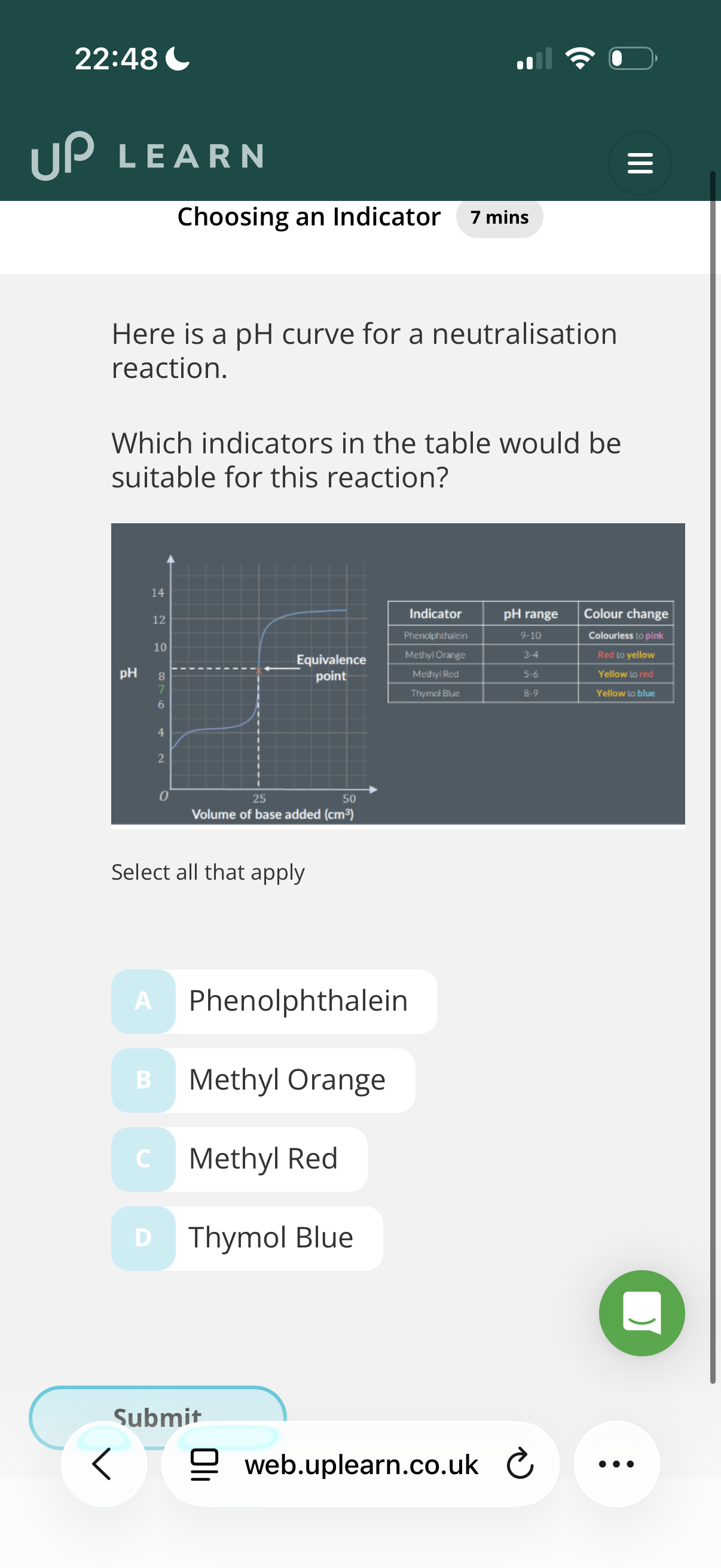
Info: an indicator is suitable if it’s pH range is within the vertical region of the pH curve
We can’t really use indicators to show us the equivalence point in a weak acid / weak base reaction. Why do you think this is?
A: Weak acid / weak base reactions occur too quickly for an indicator to be used.
B: pH curves for weak acid / weak base reactions do not have a vertical section where the indicator can change colour with just one drop of solution.
C: Weak acids and weak bases react with indicators in a different way from strong acids and strong bases.
The point at which an acid is completely neutralised by a base is called the… and The point at which an indicator changes colour is called the …3?
answer image questions
B (Not A because these reactions take place at a similar rate to other neutralisation reactions. Not C because It’s not a reaction with an acid or a base that makes the indicator change colour - it’s the movement of the equilibrium position)
Equivalence point
End point

Answer image q
note: to find the equivalence point, you use a ruler and find halfway between the top vertical part and bottom part of the vertical line.


Answer image a


Answer image questions?


The Half-Equivalence Point
What value do we need to work out the pH of a weak acid?
The pH at the half equivalence point is equal to …
What is the formula to convert pKa to Ka? → hence this helps us identify the exact weak acid just based on its pH curve
Answer image questions
Ka(acid dissociation constant-different for every weak acid)
pKa
Ka = 10−pKa


Answer image question?
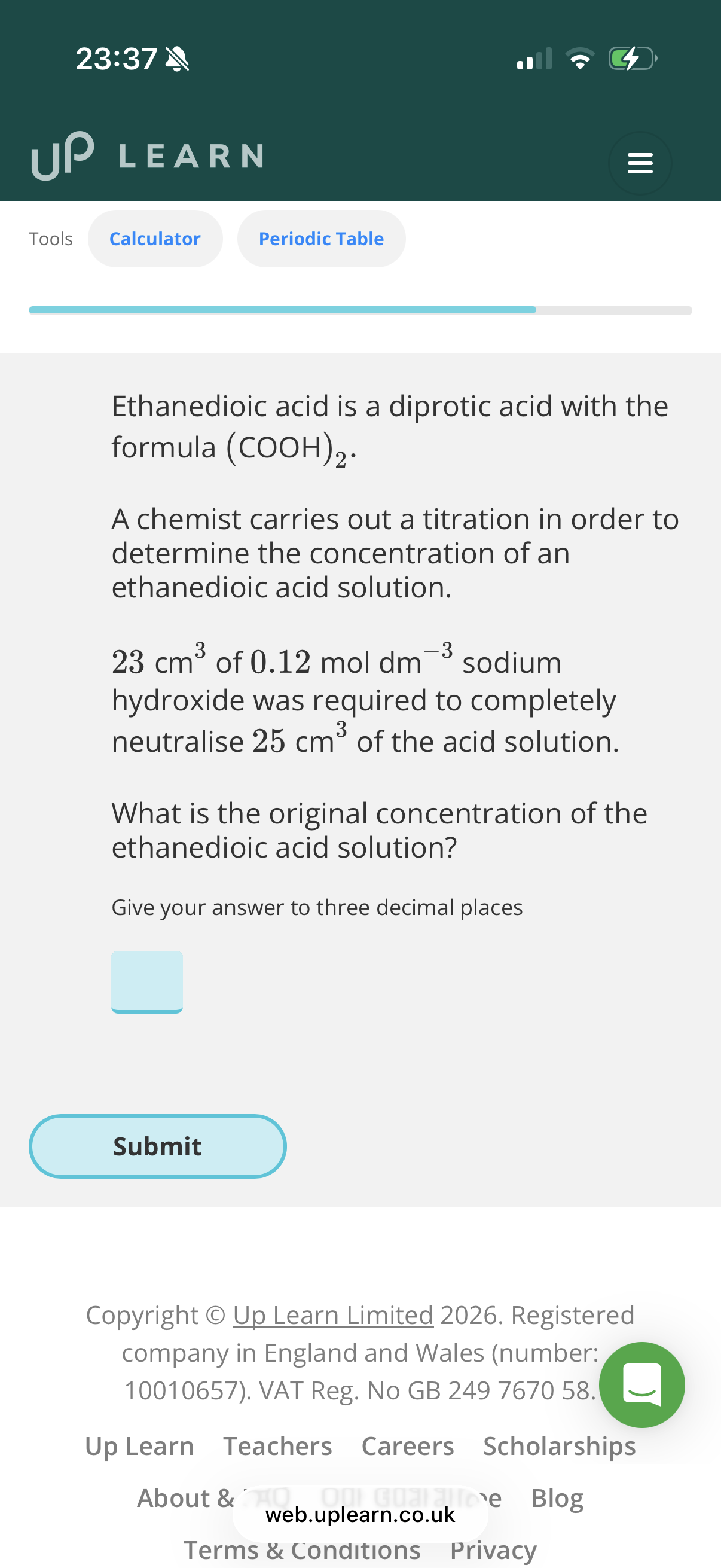
Paul has a solution of ethanoic acid with an unknown concentration. He wants to find its concentration.
To do this, he pours a solution of 25 cm3sodium hydroxide with a concentration of 0.8 mol dm−3 into a beaker alongside some indicator.
Paul then adds ethanoic acid solution to the beaker.
After adding 14.8 cm3 of ethanoic acid solution to his beaker, the indicator changes colour from red to yellow.
What is the concentration of Paul’s ethanoic acid solution? (2dp)
1.35 mol dm-3 (find moles of NaOH, then write equation and find molar ratio which is 1:1, then use the moles and volume to work out conc of acid)

Answer image question


Buffer solutions
Info: blood contains its own buffer solution(buffer) to keep its pH relatively the same.
What Do Buffer Solutions Do?
Concentrated hydrochloric acid is added to solutions A and B. As a result, we’d expect both of their pH values to…
What is a buffer solution
What Is a Buffer Solution Made Of?
Info: A buffer solution must contain both the undissociated acid and its conjugate base. Additionally, they both must be in high concentration.
A buffer solution must contain a high concentration of undissociated acid (HA)and its conjugate base (A−).
Based on this criteria, solutions of weak acids on their own cannot be buffers, and that’s because they…
A: don’t contain any A− ions.
B: contain only a low concentration of A− ions.
Why can’t strong acids be buffers?
A buffer solution must contain a …5? concentration of …6? acid, HA,and a …7?concentration of that acid’s …8? , A−.
How to Make a Buffer Solution I
What is 1 way of making a buffer?
Which of these pairs could be mixed to make a buffer solution?
A: LiF (s) and HF (aq)
B: CH3COOH (aq) and CH3COOK (s)
C: HCl (aq) and KCl (s)
D: HF (g) and NaF (s)
Info: You can also make the buffer solution by taking a solution of weak acid and adding a solution of the conjugate base to it.
Which of these pairs could be mixed to make a buffer solution?
A: HF (aq) and LiF (s)B: HF (aq) and LiF(aq)
C: CH3COOH (aq) and CH3COOK (aq)
D: H2SO4(aq) and Na2SO4(aq)
E: H2SO4(aq) and NaHSO4(s)
Summary: One way of making a buffer solution is to mix a …12? of …13? with the salt of its conjugate base.
The salt of the conjugate base can be either a …14? or in …15?.
Decrease
A solution that resists changes in pH when small amounts of acid or base are added to it.
B
They fully ionize into ions so there is a low concentration of acid remaining
High
Undissociated
High
Conjugate base
Taking a solution of a weak acid and mixing in a salt which contains its conjugate base
A and B (Not C because HCl is a strong acid, so it will not make a buffer solution. Not D because this does not contain a solution of weak acid, it contains HF in its gaseous form.)
A,B and C (Not D or E because it contains a strong acid)
Solution
Weak acid
Solid
Solution

How to Make a Buffer Solution II
Info: Another way to make a buffer is to take a weak acid and react it with a strong base(either solid or aqueous).→ This is because it will react to form a salt and water, and the salt will dissociate in the solution to form the acids conjugate base.
Which of these pairs of substances can react to make a buffer solution?
A: CH3COOH (aq) and NaOH (s)
B: HCl (aq) and NaOH (s)
C: HF(aq) and NaOH (aq)
D: CH3COOH (aq) and CH3COONa (aq)
Info: You must be careful with the amount of strong base you add because adding too much will neutralise the acid and so the conc of acid will be too low and the conjugate base conc will be too high.→Adding too little base is bad because there will be a high conc of acid but a low conc of base.→ Therefore adding around half the amount of strong base than the acid is approximately the perfect amount
Answer image question?
Summary:Another way to make a buffer solution is to…
A: roughly neutralise halfway a strong acid using a weak base.
B: roughly neutralise halfway a weak acid using a strong base.
What substance could be added to a solution of ethanoic acid, CH3COOH(aq), to make a buffer solution?
A: NaOH(s)B: CH3COONa(aq)
C: HCOONa(s)
D: HCl(aq)
What substance could be added to a solution of hydrochloric acid, HCl(aq), to make a buffer solution?
A: NaOH(s)
B: NaOH(aq)
C: NaCl(aq)
D: NaCl(s)
E: None of the above.
What substance could be added to a solution of sodium cyanide, NaCN(aq), to make a buffer solution?
A: HCl(aq)
B: HCN(aq)
C: CH3COOH(aq)
What substance could be added to a solution of hydrofluoric acid, HF(aq), to make a buffer solution?
A: NaF(s)B: NH3(aq)
C: HCl(aq)
D: LiF(aq)
What substance could be added to a solution of potassium hydroxide, KOH(aq), to make a buffer solution? A:CH3COOH(s)
B: H2O(l)
C: None of the above.
A and C(Not B because HCl is a strong acid and not D because These can be mixed to make a buffer solution, but they do not react to make one→It fits the description to making a buffer shown in the last flashcard, however it doesn’t react to make a buffer and the question asks which substances react.
B
A and B (Explanation
A buffer solution must contain a high concentration of a weak acid and that acid’s conjugate base. →
In this case, our weak acid is CH3COOH. This means the conjugate base we need to add/ produce to make a buffer is CH3COO−. →
H3COONa(aq) contains CH3COO− ions, so that will work.→
NaOH(s) can react with CH3COOH to form CH3COO−, so that will work too.→C is incorrect because This will break up to form HCOO− ions, not CH3COO− ions.)
E(HCl is a strong acid)
B(A buffer solution must contain a high concentration of a weak acid and that acid’s conjugate base. →
In this case, the conjugate base is CN−. This means we need to add its parent acid, which is the weak acid HCN.)A and D(In this case, our weak acid is HF. This means the conjugate base we need to add/ produce to make a buffer is F−.→
NH4F(s) and LiF(s) contain F− ions, so both will work.)
A strong base could also react with HF to form F− ions, but there are no strong bases in the options provided.A(A buffer solution must contain a high concentration of a weak acid and that acid’s conjugate base. →
KOH is a strong base and will react with a weak acid, such as CH3COOH(s), to produce a buffer solution.)

![<p><strong>Buffer Solutions and Titration Curves</strong></p><p>Info: The buffer region on a pH curve is the region where the acid is neutralised halfway→ and that means we have a buffer solution.Hence why the graph is flatter since it’s resisting the change in pH. (You will see it on every weak acid/strong base titration curve around the halfway neutralisation point.</p><p><strong>How Does a Buffer Solution Work?</strong></p><ol><li><p>HA⇌H+ + A−<br><br>A buffer solution HA,H+ and A− are in equilibrium with each other.<br>Adding a small amount of HCl(Will dissociate into H+ and Cl-) increases the concentration of H+ ions. As a result, the equilibrium…? —> therefore reducing the number of H+ ions( and due to the high concentration of H+ and A-,the position of equilibrium shifts so far to the left that it almost removes the same amount of H+ that was added)→ so overall the [H+] doesn’t change that much.→ so pH doesn’t change that much either</p></li><li><p>HA⇌H+ + A−<br><br>A buffer solution HA,H+ and A− are in equilibrium with each other.<br>Adding a small amount of NaOH decreases the concentration of H+ ions(since it dissociates into ions and OH- reacts with H+ to form water). As a result, the equilibrium…?→ so more H+ ions are formed(and due to the high concentration of H+ and A-,the equilibrium shifts so far to the right so it replenishes almost the same amount of H+ ions lost). → so overall the [H+] stays roughly the same and so the pH doesn’t change much either.</p></li></ol><p></p><ol start="3"><li><p>What happens if you add a large amount of base or acid to the buffer?</p></li><li><p>When a buffer can no longer remove or or replenish enough H+ ions to restore the concentrations to near the original amount, we say the buffer solution has become …?</p><p>•How does a buffer solution work:step by step answer for acid added (write equation first)</p><p>(1)When an acid is added to a buffer this increases the …5? of …6? ions in the buffer solution.</p></li></ol><p>(2) As a result the equilibrium shifts to the …7?,…8? the concentration of H+ ions back to around its original level</p><p>(3) Therefore the concentration of H+ ions remains almost constant</p><p>(4) and therefore the pH remains almost constant</p><p>•How does a buffer solution work: step by step answer for base added (write equation first)</p><p>(1) When a base is added to the …9?, the OH- …10? with the H+ ions in solution and …11? the concentration of H+ ions in the buffer solution</p><p>(2) As a result, the equilibrium position shifts to the …12?, which …13? the lost H+ ions and raises the H+ concentration back to its original level.</p><p>(3) Therefore the concentration of H+ ions remains almost …14?</p><p>(4)and therefore the ..15? remains almost constant.</p>](https://assets.knowt.com/user-attachments/b8535436-1c6f-43ff-84ea-a04e3015c3ed.jpg)
Buffer Solutions and Titration Curves
Info: The buffer region on a pH curve is the region where the acid is neutralised halfway→ and that means we have a buffer solution.Hence why the graph is flatter since it’s resisting the change in pH. (You will see it on every weak acid/strong base titration curve around the halfway neutralisation point.
How Does a Buffer Solution Work?
HA⇌H+ + A−
A buffer solution HA,H+ and A− are in equilibrium with each other.
Adding a small amount of HCl(Will dissociate into H+ and Cl-) increases the concentration of H+ ions. As a result, the equilibrium…? —> therefore reducing the number of H+ ions( and due to the high concentration of H+ and A-,the position of equilibrium shifts so far to the left that it almost removes the same amount of H+ that was added)→ so overall the [H+] doesn’t change that much.→ so pH doesn’t change that much eitherHA⇌H+ + A−
A buffer solution HA,H+ and A− are in equilibrium with each other.
Adding a small amount of NaOH decreases the concentration of H+ ions(since it dissociates into ions and OH- reacts with H+ to form water). As a result, the equilibrium…?→ so more H+ ions are formed(and due to the high concentration of H+ and A-,the equilibrium shifts so far to the right so it replenishes almost the same amount of H+ ions lost). → so overall the [H+] stays roughly the same and so the pH doesn’t change much either.
What happens if you add a large amount of base or acid to the buffer?
When a buffer can no longer remove or or replenish enough H+ ions to restore the concentrations to near the original amount, we say the buffer solution has become …?
•How does a buffer solution work:step by step answer for acid added (write equation first)
(1)When an acid is added to a buffer this increases the …5? of …6? ions in the buffer solution.
(2) As a result the equilibrium shifts to the …7?,…8? the concentration of H+ ions back to around its original level
(3) Therefore the concentration of H+ ions remains almost constant
(4) and therefore the pH remains almost constant
•How does a buffer solution work: step by step answer for base added (write equation first)
(1) When a base is added to the …9?, the OH- …10? with the H+ ions in solution and …11? the concentration of H+ ions in the buffer solution
(2) As a result, the equilibrium position shifts to the …12?, which …13? the lost H+ ions and raises the H+ concentration back to its original level.
(3) Therefore the concentration of H+ ions remains almost …14?
(4)and therefore the ..15? remains almost constant.
Shifts to the left
Shifts to the right
It cannot remove nor replenish enough H+ ions to bring its concentration close to its original levels
Saturated
Concentration
H+
Left
Reducing
Buffer
Reacts
Reduces
Right
Replenishes
Constant
pH


Read this info in the images on how to answer buffer explanation questions
Buffer solutions in everyday life
We use buffer solutions whenever it’s important that the...?
Alkaline buffer solutions
Info: buffer solutions contain a weak acid and its conjugate base and the weak acid is always uncharged.→These buffer solutions usually have a pH below 7 so we call them …2?
Info: You can also make a buffer solution with an uncharged weak base and a conjugate acid →These buffer solutions usually have a pH above 7 so we call them …3?
A buffer solution which contains a high concentration of NH3 and NH4+ ions can be made by… (similar to acidic buffer solution formation)
A: Mixing NH3(aq) and NH4Cl (s)
B: Mixing NH3(aq) and NH4Cl (aq)
C: Partially neutralising NH3(aq) with a strong acid
D: Partially neutralising NH3(aq) with a strong base
Acidic buffer solutions contain high concentrations of…
A: an uncharged weak acid
B: an uncharged weak base
And its…
C: conjugate acid
D: conjugate base
Alkaline buffer solutions contain high concentrations of…
A: an uncharged weak acid
B: an uncharged weak base
And its…
C: conjugate acid
D: conjugate base
The pH level stays relatively constant
Acidic buffer solutions
Alkaline buffer solutions
A,B and C (NH4Cl is the salt/solution conjugate acid)(Not d because NH3 is a weak base so acid is required to neutralize it)
A and D
B and C


Answer image questions

![<p><strong>Calculating the pH of a Buffer Solution I</strong></p><p>Info: We can find the pH of any buffer solution using the rearranged Ka formula.(where [H+] is the subject)</p><ol><li><p>Answer image questions</p></li></ol><p>Info: we are only asked to find the pH of acidic buffer solutions </p><p></p>](https://assets.knowt.com/user-attachments/fef04862-406f-475f-8535-f041b47b202c.jpg)
Calculating the pH of a Buffer Solution I
Info: We can find the pH of any buffer solution using the rearranged Ka formula.(where [H+] is the subject)
Answer image questions
Info: we are only asked to find the pH of acidic buffer solutions

![<p><strong>Calculating the pH of a Buffer Solution II</strong></p><ol><li><p>A mixture contains 100cm3 of 0.4moldm−3 CH3COOH and 4.1g of CH3COONa (molar mass=82g mol−1).<br><br>(A) How many moles of CH3COOH does this mixture contain?</p></li></ol><p>(B)How many moles of CH3COONa does this mixture contain?</p><p>(Note- The image shows the full calculation if it asked you to work out the pH of the buffer from these values but answer q2 first. (1) Work out the moles of the weak acid and salt. (2)Assume the moles of the conjugate base is the same as the moles of the salt that we just worked out. (3)C=mol/V so divide the moles of the weak acid by the total volume to find its concentration then do the same thing for the conjugate base. (4)Once you find the concentrations, put them in the Ka equation and rearrange to make [H+] the subject. (5)Then now use this value to work out pH</p><ol start="2"><li><p><span style="line-height: var(--ck-content-line-height); font-size: var(--ck-content-font-size); color: var(--ck-content-font-color);">A buffer solution has the following data: <br>[CH3COOH]=0.4mol dm−3<br>[CH3COO−]=0.5mol dm−3<br></span></p></li></ol><p><span style="line-height: var(--ck-content-line-height); font-size: var(--ck-content-font-size); color: var(--ck-content-font-color);">Ka(CH3COOH)=1.76×10⁻⁵mol dm−3<br>Calculate the pH of this buffer solution.<br></span><span style="line-height: var(--ck-content-line-height); font-size: inherit; color: var(--ck-content-font-color);">Give your answer to 3 significant figures</span></p><ol start="3"><li><p>A buffer solution is made by mixing:<br><br>∙ 100cm3 of 0.4mol dm−3 CH3COOH<br>∙ 50cm3 of 0.9mol dm−3 CH3COONa.<br><br>(A) Calculate the concentration of CH3COOH and (B) CH3COO− in the buffer solution.<br><br>Assume that CH3COONa fully dissociates in the buffer solution.<br><br>Assume that CH3COOH doesn’t dissociate in the buffer solution.<br><br>Assume any solid salt added does not change the volume of the solution.(3sf)<br><br>4. A buffer solution has the following data: <br>buffer solution has the following data:</p><p>[CH3COOH]=0.267mol dm−3<br>[CH3COO−]=0.3mol dm−3<br>Ka(CH3COOH)=1.76×10⁻⁵mol dm−3<br><br>Calculate the pH of this buffer solution.</p></li></ol><ol start="5"><li><p><span style="line-height: var(--ck-content-line-height); font-size: var(--ck-content-font-size); color: var(--ck-content-font-color);">What assumptions do we make when doing these buffer calculations?<br></span></p><p><span style="line-height: var(--ck-content-line-height); font-size: var(--ck-content-font-size); color: var(--ck-content-font-color);">A: the weak acid fully dissociates.</span></p></li></ol><p class="sc-hKwBjT gPwEHt"><span style="line-height: var(--ck-content-line-height); font-size: var(--ck-content-font-size); color: var(--ck-content-font-color);">B: all the conjugate base comes from the salt, which fully dissociates.</span></p><p class="sc-hKwBjT gPwEHt"><span style="line-height: var(--ck-content-line-height); font-size: var(--ck-content-font-size); color: var(--ck-content-font-color);">C: solid salts do not change the volume of the solution they are added to.</span></p><p></p><p></p>](https://assets.knowt.com/user-attachments/8f2d4801-f2f1-48a3-bc5e-b16dfa23be9e.jpg)
Calculating the pH of a Buffer Solution II
A mixture contains 100cm3 of 0.4moldm−3 CH3COOH and 4.1g of CH3COONa (molar mass=82g mol−1).
(A) How many moles of CH3COOH does this mixture contain?
(B)How many moles of CH3COONa does this mixture contain?
(Note- The image shows the full calculation if it asked you to work out the pH of the buffer from these values but answer q2 first. (1) Work out the moles of the weak acid and salt. (2)Assume the moles of the conjugate base is the same as the moles of the salt that we just worked out. (3)C=mol/V so divide the moles of the weak acid by the total volume to find its concentration then do the same thing for the conjugate base. (4)Once you find the concentrations, put them in the Ka equation and rearrange to make [H+] the subject. (5)Then now use this value to work out pH
A buffer solution has the following data:
[CH3COOH]=0.4mol dm−3
[CH3COO−]=0.5mol dm−3
Ka(CH3COOH)=1.76×10⁻⁵mol dm−3
Calculate the pH of this buffer solution.
Give your answer to 3 significant figures
A buffer solution is made by mixing:
∙ 100cm3 of 0.4mol dm−3 CH3COOH
∙ 50cm3 of 0.9mol dm−3 CH3COONa.
(A) Calculate the concentration of CH3COOH and (B) CH3COO− in the buffer solution.
Assume that CH3COONa fully dissociates in the buffer solution.
Assume that CH3COOH doesn’t dissociate in the buffer solution.
Assume any solid salt added does not change the volume of the solution.(3sf)
4. A buffer solution has the following data:
buffer solution has the following data:[CH3COOH]=0.267mol dm−3
[CH3COO−]=0.3mol dm−3
Ka(CH3COOH)=1.76×10⁻⁵mol dm−3
Calculate the pH of this buffer solution.
What assumptions do we make when doing these buffer calculations?
A: the weak acid fully dissociates.
B: all the conjugate base comes from the salt, which fully dissociates.
C: solid salts do not change the volume of the solution they are added to.
[A]0.04 moles(Mol=CXV). [B] 0.05moles(mol=mass/mr)
4.85pH
(A)-0.267moldm-3 (B)0.300moldm-3 (explanation:First, we can calculate the number of moles of CH3COOH and CH3COO−. Then after, we can calculate their concentrations by dividing the moles by the new total volume of 150cm3
pH is 4.81( We place these values in the Ka equation then rearrange for the [H+]. We then use that value to work out pH)
B and C
![<p><strong>Calculating the pH of a Buffer Solution III</strong></p><ol><li><p>A buffer solution is formed by the partial neutralisation of 100cm3 of 0.4mol dm−3 CH3COOH with 0.72g NaOH (molar mass=40.0g mol−1).Calculate the initial moles of each reactant.</p></li><li><p>Q1 continuation</p><p>CH3COOH+NaOH→CH3COONa+H2O<br><br>0.04mol CH3COOH reacts with 0.018mol NaOH to make a buffer solution.<br>(A) How much CH3COOH is in the resulting buffer solution?</p></li></ol><p>(B)How much CH3COONa is in the resulting buffer solution? (Note- with this information now, you can follow the steps of the last flashcard to work out pH,)</p><ol start="3"><li><p>CH3COOH+NaOH→CH3COONa+H2O<br><br>A buffer solution is made by taking 150cm3 of 0.6mol dm−3CH3COOH and partially neutralising it using 150cm3 of 0.2mol dm−3NaOH.<br><br>(A)How much CH3COOH is in the resulting buffer solution?</p></li></ol><p>(B)How much CH3COONa is in the resulting buffer solution? (The image also shows how to work this out,if u wanted to work out pH, you can follow the steps of the last flashcard to do so)</p><p>• Steps to find the pH of a buffer solution formed by partial neutralisation of a weak acid and a strong base: (1)work out initial moles of weak acid and strong base at the start of reaction (2) Use these values alongside the balanced equation to find the moles of weak acid and the salt of its conjugate base in the buffer that forms after the reaction (for the acid in buffer its initial moles of acid- initial mole of base)(For the moles of salt and therefore conjugate base, it’s equal to the initial moles of base) (3)From this point we can follow the same procedure as the last flashcard where we find the concentration and use the ka expression to find [H+] and then pH.</p>](https://assets.knowt.com/user-attachments/e38438bd-12db-4fd4-a14f-aad7b2e58b08.jpg)
Calculating the pH of a Buffer Solution III
A buffer solution is formed by the partial neutralisation of 100cm3 of 0.4mol dm−3 CH3COOH with 0.72g NaOH (molar mass=40.0g mol−1).Calculate the initial moles of each reactant.
Q1 continuation
CH3COOH+NaOH→CH3COONa+H2O
0.04mol CH3COOH reacts with 0.018mol NaOH to make a buffer solution.
(A) How much CH3COOH is in the resulting buffer solution?
(B)How much CH3COONa is in the resulting buffer solution? (Note- with this information now, you can follow the steps of the last flashcard to work out pH,)
CH3COOH+NaOH→CH3COONa+H2O
A buffer solution is made by taking 150cm3 of 0.6mol dm−3CH3COOH and partially neutralising it using 150cm3 of 0.2mol dm−3NaOH.
(A)How much CH3COOH is in the resulting buffer solution?
(B)How much CH3COONa is in the resulting buffer solution? (The image also shows how to work this out,if u wanted to work out pH, you can follow the steps of the last flashcard to do so)
• Steps to find the pH of a buffer solution formed by partial neutralisation of a weak acid and a strong base: (1)work out initial moles of weak acid and strong base at the start of reaction (2) Use these values alongside the balanced equation to find the moles of weak acid and the salt of its conjugate base in the buffer that forms after the reaction (for the acid in buffer its initial moles of acid- initial mole of base)(For the moles of salt and therefore conjugate base, it’s equal to the initial moles of base) (3)From this point we can follow the same procedure as the last flashcard where we find the concentration and use the ka expression to find [H+] and then pH.
CH3COOH: 0.04mol(mol=CXV
NaOH: 0.018mol(mol=mass/mr)
(A)0.022moles (B) 0.018mol(since NaOH is limiting reactant so affects how much product is formed)
[A]0.06 moles(0.09-0.03) [B]0.03 (1:1 ratio with limiting factor)

Answer image questions?

![<p><strong>Cancelling Volume</strong></p><p>•The image shows the shortened formula that we can use(we can skip finding concentration and instead substitute the moles of the acid and conjugate base in the Ka formula to find [H+].</p><ol><li><p><span style="line-height: var(--ck-content-line-height); font-size: var(--ck-content-font-size); color: var(--ck-content-font-color);">A buffer solution of unknown volume contains 0.40moles of CH3COOH and 0.56moles of CH3COO−.<br><br>Calculate the pH of this buffer solution.<br></span><span style="line-height: var(--ck-content-line-height); font-size: inherit; color: var(--ck-content-font-color);">The Ka of ethanoic acid is 1.76×10⁻⁵mol dm−3. (Other side image contains info on how to solve)</span></p></li></ol><p></p><p></p><p></p>](https://assets.knowt.com/user-attachments/6317974b-e3b1-4b44-9e96-b8cc37b636b5.jpg)
Cancelling Volume
•The image shows the shortened formula that we can use(we can skip finding concentration and instead substitute the moles of the acid and conjugate base in the Ka formula to find [H+].
A buffer solution of unknown volume contains 0.40moles of CH3COOH and 0.56moles of CH3COO−.
Calculate the pH of this buffer solution.
The Ka of ethanoic acid is 1.76×10⁻⁵mol dm−3. (Other side image contains info on how to solve)
4.9

![<ol><li><p>Answer image question</p></li></ol><p>Read: Last time we saw a clever shortcut that we can use to avoid having to calculate [HA] and [A<sup>-</sup>] during buffer calculations.</p><p></p><p>This shortcut saves a lot of time and, because of this, it’s often included in the mark schemes of buffer calculations.</p><p></p><p>However, it’s inclusion often makes the answers more confusing.</p><p></p><p>For example, take a look at this question and mark scheme: (other side image on the left)(the right one shows how to answer question)</p><p></p><p>This mark scheme is missing a crucial piece of information.</p><p></p><p>Currently, it implies that we should plug the <strong>moles </strong>of CH<sub>3</sub>COOH and CH<sub>3</sub>COO<sup>-</sup>into an equation that involves their <strong>concentrations</strong>.</p><p></p><p>In other words, they are using our shortcut, without<em> telling us</em> they’re using our shortcut!</p><p></p><p>They’re just expecting us to make that leap ourselves.</p><p></p><p>Now, this bizarre working still leads to the correct answer, but it is nonetheless pretty confusing.</p>](https://assets.knowt.com/user-attachments/ddf4b524-c94f-4535-96da-a9f94decd275.jpg)
Answer image question
Read: Last time we saw a clever shortcut that we can use to avoid having to calculate [HA] and [A-] during buffer calculations.
This shortcut saves a lot of time and, because of this, it’s often included in the mark schemes of buffer calculations.
However, it’s inclusion often makes the answers more confusing.
For example, take a look at this question and mark scheme: (other side image on the left)(the right one shows how to answer question)
This mark scheme is missing a crucial piece of information.
Currently, it implies that we should plug the moles of CH3COOH and CH3COO-into an equation that involves their concentrations.
In other words, they are using our shortcut, without telling us they’re using our shortcut!
They’re just expecting us to make that leap ourselves.
Now, this bizarre working still leads to the correct answer, but it is nonetheless pretty confusing.


Answer image questions?


Using Equations to Represent Equilibrium Shifts
• At A-level we can/should be more specific than saying the position of equilibrium shifts to the right or left so we represent this using equations.
CH3COOH ⇌ CH3COO− + H+
When an acid is added to a buffer solution of ethanoic acid and ethanoate ions the equilibrium shifts.
What equation do we use to represent this shift?
A: H+ + CH3COOH → CH3COOH2+
B: H+ + CH3COO− → CH3COOH
•Info- the image shows the whole process of base being added to a buffer→ the last image shows the equation we use to represent the process.
CH3COOH⇌CH3COO− + H+
When a base (OH−) is added to a buffer solution of ethanoic acid and ethanoate ions two things happen:
1) The base reacts with H+ ions
2) The equilibrium shifts
What equation do we use to represent the overall impact of these two changes?Correct answersYour answers
A: OH− + H+→H2O
B: CH3COOH + OH− →CH3COO− + H2O
C: CH3COOH→CH3COO− + H+
B
B
![<p><strong>Calculating the PH of a Buffer Solution After Acid Is Added</strong></p><ol><li><p>A buffer solution is made by mixing 100cm3 of 0.1mol dm−3 CH3COOH with 1.5g of CH3COONa(molar mass=82.0g mol−1)<br>Ka(CH3COOH)=1.76×10⁻⁵ mol dm−3<br><br>Calculate the pH of this buffer solution</p></li><li><p>A buffer solution is made by mixing 100cm3 of 0.1mol dm−3 CH3COOH with 1.5g of CH3COONa(molar mass=82.0g mol−1).<br><br>5cm3 of 0.1mol dm3 HCl was then added to the solution.<br>How many moles of HCl were added?</p></li></ol><p>• Step 1 is to find the intial moles of weak acid and conjugate base in the buffer, and strong acid added.</p><p>•Step 2 is to assume all the H+ from HCl react with CH3COO-(conjugate base):</p><p>H+ + CH3COO- → CH3COOH</p><p>•Step 3 is to use that assumption to find the moles of CH3COOH and CH3COO- after the addition</p><ol start="3"><li><p>A buffer solution contains 0.01mol of CH3COOH and 0.0183mol of CH3COO−.<br>0.0005mol of HCl is added to this solution.<br><br>How much CH3COOH and CH3COO− are present in the buffer solution after the addition of HCl?<br>Assume all the H+ ions from the added HCl react with CH3COO−.<br><br>• Step 4- Now that you know the amount of weak acid and conjugate base in the buffer in the resulting solution , you can substitute these values into the Ka equation to find the [H+] which can be used to find pH.</p></li><li><p>After the addition of HCl, the moles of CH3COOH and CH3COO− are 0.0105 and 0.0178 respectively. This means that the pH of our buffer solution after the addition of HCl is… (Ka=1.76×10⁻⁵for ethanoic acid)<br></p></li><li><p>Answer image questions</p></li></ol><p></p>](https://assets.knowt.com/user-attachments/9d47ca88-3431-4e7e-b1e0-fade5b281c1b.jpg)
Calculating the PH of a Buffer Solution After Acid Is Added
A buffer solution is made by mixing 100cm3 of 0.1mol dm−3 CH3COOH with 1.5g of CH3COONa(molar mass=82.0g mol−1)
Ka(CH3COOH)=1.76×10⁻⁵ mol dm−3
Calculate the pH of this buffer solutionA buffer solution is made by mixing 100cm3 of 0.1mol dm−3 CH3COOH with 1.5g of CH3COONa(molar mass=82.0g mol−1).
5cm3 of 0.1mol dm3 HCl was then added to the solution.
How many moles of HCl were added?
• Step 1 is to find the intial moles of weak acid and conjugate base in the buffer, and strong acid added.
•Step 2 is to assume all the H+ from HCl react with CH3COO-(conjugate base):
H+ + CH3COO- → CH3COOH
•Step 3 is to use that assumption to find the moles of CH3COOH and CH3COO- after the addition
A buffer solution contains 0.01mol of CH3COOH and 0.0183mol of CH3COO−.
0.0005mol of HCl is added to this solution.
How much CH3COOH and CH3COO− are present in the buffer solution after the addition of HCl?
Assume all the H+ ions from the added HCl react with CH3COO−.
• Step 4- Now that you know the amount of weak acid and conjugate base in the buffer in the resulting solution , you can substitute these values into the Ka equation to find the [H+] which can be used to find pH.After the addition of HCl, the moles of CH3COOH and CH3COO− are 0.0105 and 0.0178 respectively. This means that the pH of our buffer solution after the addition of HCl is… (Ka=1.76×10⁻⁵for ethanoic acid)
Answer image questions
pH is 5.02 (work out moles then substitute values into Ka equation)
0.0005
Moles of CH3COOH after addition of HCl:0.0105
Moles of CH3COO− after addition of HCl:0.0178 (Explanation
All added H+ ions react with CH3COO− to form CH3COOH.
0.0005moles of H+ ions are added.
This means the moles of CH3COO− should decrease by 0.0005 and the moles of CH3COOH should increase by 0.0005.)
pH is 4.98


Calculating the pH of a Buffer Solution After Base Is Added
•Step 1 is to calculate the initial moles of weak acid and conjugate base in buffer before base is added, and moles of strong base added.
•Step 2 is to assume all added OH- reacts with the weak acid: HA + OH- → A- + H2O
•Step 3 Follow the same steps as for the acid but know that when taking away the moles, we are adding moles to the conjugate base and reducing the moles from the weak acid(opposite to when acid is added).
A buffer solution is made by mixing 100cm3 of 0.1mol dm−3 CH3COOH with 1.5g of CH3COONa(molar mass=82.0g mol−1).
A)Calculate the moles of CH3COOH in the buffer?
Give your answer to 3 significant figures
B)Calculate the moles of CH3COO− in the buffer?
(C)5cm3 of 0.1mol dm−3 NaOH was then added to the solution.
Calculate the moles of NaOH that were added?
A buffer solution contains 0.01mol of CH3COOH and 0.0183mol of CH3COO−.
0.0005mol of NaOH is added to this solution.
How much CH3COOH and CH3COO− are present in the buffer solution after the addition of NaOH?
-Assume all the OH− ions from the added NaOH react with CH3COOH.
(A) Moles of CH3COOH after addition of NaOH?
(B)Moles of CH3COO− after addition of NaOH?
After the addition of NaOH, the moles of CH3COOH and CH3COO− are 0.0095 and 0.0188 respectively. This means that the pH of our buffer solution after the addition of NaOH is…?
The Ka of ethanoic acid is 1.76×10⁻⁵mol dm−3.
Give your answer to 3 significant figuresAnswer image questions
A: 0.0100 moles B:0.0183moles
C:0.0005moles
A: 0.0095moles. B:0.0188 (Explanation
•All added OH− ions react with CH3COOH to form CH3COO−.
•0.0005moles of OH− ions are added.
•This means the moles of CH3COO− should increase by 0.0005 and the moles of CH3COOHshould decrease by 0.0005)pH is 5.05 (substitute these values into the Ka expression then rearrange for [H+],Then use this value to work out pH)
![<ol><li><p><strong>A: 0.0100</strong><span> moles B:</span><strong>0.0183moles</strong></p></li></ol><p>C:<strong>0.0005</strong><span>moles</span></p><ol start="2"><li><p>A: <strong>0.0095moles. B:0.0188 (Explanation</strong></p><p class="sc-hKwBjT gPwEHt"><span style="line-height: var(--ck-content-line-height); font-size: var(--ck-content-font-size); color: var(--ck-content-font-color);">•All added OH− ions react with CH3COOH to form CH3COO−.<br>•0.0005moles of OH− ions are added. <br>•This means the moles of CH3COO− should increase by 0.0005 and the moles of CH3COOHshould decrease by 0.0005)</span></p></li><li><p>pH is 5.05 (substitute these values into the Ka expression then rearrange for [H+],Then use this value to work out pH)</p></li></ol><p></p>](https://assets.knowt.com/user-attachments/29af5970-6085-4a74-ac30-2cc7ec4d46f9.jpg)
![<p><span><strong>Calculating the pH of a Buffer Solution After Water is Added (Diluting Buffers)</strong></span></p><ol><li><p>Why does adding water/diluting a buffer solution not change the pH? (This is because we assume the moles of weak acid and conjugate base stay constant upon dilution → in real life this isn’t true but for our exam it’s true)</p></li><li><p><span style="line-height: var(--ck-content-line-height); font-size: var(--ck-content-font-size); color: var(--ck-content-font-color);">Adding water to a buffer solution doesn’t change its pH because…<br>A: </span><span style="font-size: var(--ck-content-font-size);">it doesn’t change the value of Ka</span></p><p class="sc-hKwBjT gPwEHt"><span style="line-height: var(--ck-content-line-height); font-size: var(--ck-content-font-size); color: var(--ck-content-font-color);">B: it doesn’t change the value of mol HA</span></p><p class="sc-hKwBjT gPwEHt"><span style="line-height: var(--ck-content-line-height); font-size: var(--ck-content-font-size); color: var(--ck-content-font-color);">C: it doesn’t change the value of mol A−</span></p><p class="sc-hKwBjT gPwEHt"><span style="line-height: var(--ck-content-line-height); font-size: var(--ck-content-font-size); color: var(--ck-content-font-color);">D: it doesn’t change the values of [HA] and [A−] </span></p></li></ol><p>(Explanation in image answer)</p><p>• For exams we are expected to say adding water to a buffer doesn’t change its pH( ideal example answer in image-there’s 2 ways to explain it but use the top image answer)</p><ol start="3"><li><p>Answer image question?</p></li></ol><p></p>](https://assets.knowt.com/user-attachments/b6113cd6-de2b-48ea-8c42-093005e3eaf5.heic)
Calculating the pH of a Buffer Solution After Water is Added (Diluting Buffers)
Why does adding water/diluting a buffer solution not change the pH? (This is because we assume the moles of weak acid and conjugate base stay constant upon dilution → in real life this isn’t true but for our exam it’s true)
Adding water to a buffer solution doesn’t change its pH because…
A: it doesn’t change the value of KaB: it doesn’t change the value of mol HA
C: it doesn’t change the value of mol A−
D: it doesn’t change the values of [HA] and [A−]
(Explanation in image answer)
• For exams we are expected to say adding water to a buffer doesn’t change its pH( ideal example answer in image-there’s 2 ways to explain it but use the top image answer)
Answer image question?
Adding water doesn’t changes the moles of weak acid and conjugate base, and the Ka stays the same because it’s a constant. → Therefore the concentration of [H+] stays the same and so the pH also stays constant
A,B,C (You were right not to select D.
The values of [HA] and [A−] will change as a result of dilution. Their ratio ([HA]:[A−]), on the other hand, remains constant
![<ol><li><p>Adding water doesn’t changes the moles of weak acid and conjugate base, and the Ka stays the same because it’s a constant. → Therefore the concentration of [H+] stays the same and so the pH also stays constant</p></li><li><p>A,B,C (<span style="line-height: var(--ck-content-line-height); font-size: var(--ck-content-font-size); color: var(--ck-content-font-color);">You were right not to select D.</span></p><p class="sc-hKwBjT gPwEHt"><span style="line-height: var(--ck-content-line-height); font-size: var(--ck-content-font-size); color: var(--ck-content-font-color);">The values of [HA] and [A−] will change as a result of dilution. Their ratio ([HA]:[A−]), on the other hand, remains constant</span></p></li></ol><p></p>](https://assets.knowt.com/user-attachments/914c5f57-2683-4449-9601-d09a33f9097e.jpg)
Designing Buffer Solutions
•in order to make a buffer with an exact pH, scientists need to know the amount of conjugate base salt they need to add to the weak acid.
•Step 1 is to find the concentration of H+ needed in the buffer using 10*-pH
Scientists are looking to produce a buffer solution with pH4.7.
What concentration of H+ ions will be present in this solution?
•Step 2 is to use the [H+] and Ka value to work out [HA]/[A-]. It can also be used to work out molHA/MolA-
Step 2 question is in the image?
•Step 3- since they added a solid salt to make the buffer in the first place(conjugate base), they can assume the volume of the solution doesn’t change → therefore the concentration of the the weak acid is the same as it was originally. → They can use this to find [A-].
Step 3 shown in question image
•Step 4- Since they now know the concentration of conjugate base(salt) ions,they can now use the values to work out the mass of salt added by multiplying the Conc by the volume to get moles,( using the assumption that all the conjugate base anions come from the solid/base) → then finding the Mr and multiplying it by the moles to get mass. Shown in the image
note: when doing step 2, we can also use the moles of the conjugate base and weak acid if it’s more helpful.
Note: in the other side image bottom right 4th picture shows the whole process of the question
Note: Only step 1 and 2 is common for all for these types of questions
[2 X 10*-5 mol dm-3] (10*-pH)
![<ol><li><p>[2 X 10*-5 mol dm-3] (10*-pH)</p></li></ol><p></p>](https://assets.knowt.com/user-attachments/a639002a-4188-4d16-acd6-8b3a94205d03.jpg)

Answer image questions?
A student adds a small volume of water to a buffer solution. The pH of the buffer will...
Stay the same


Answer image questions
CH3COOH ⇌ H+ + CH3COO-
Use the equation above to explain how a solution containing sodium ethanoate and ethanoic acid can act as a buffer when small amounts of alkali are added. (2 marks)
Alkali: OH- reacts with H+ ions, equilibrium moves to the right (to replace the H+ions) 1
Concentration of H+ remains (almost) constant) 1


Read the image info


Answer image question

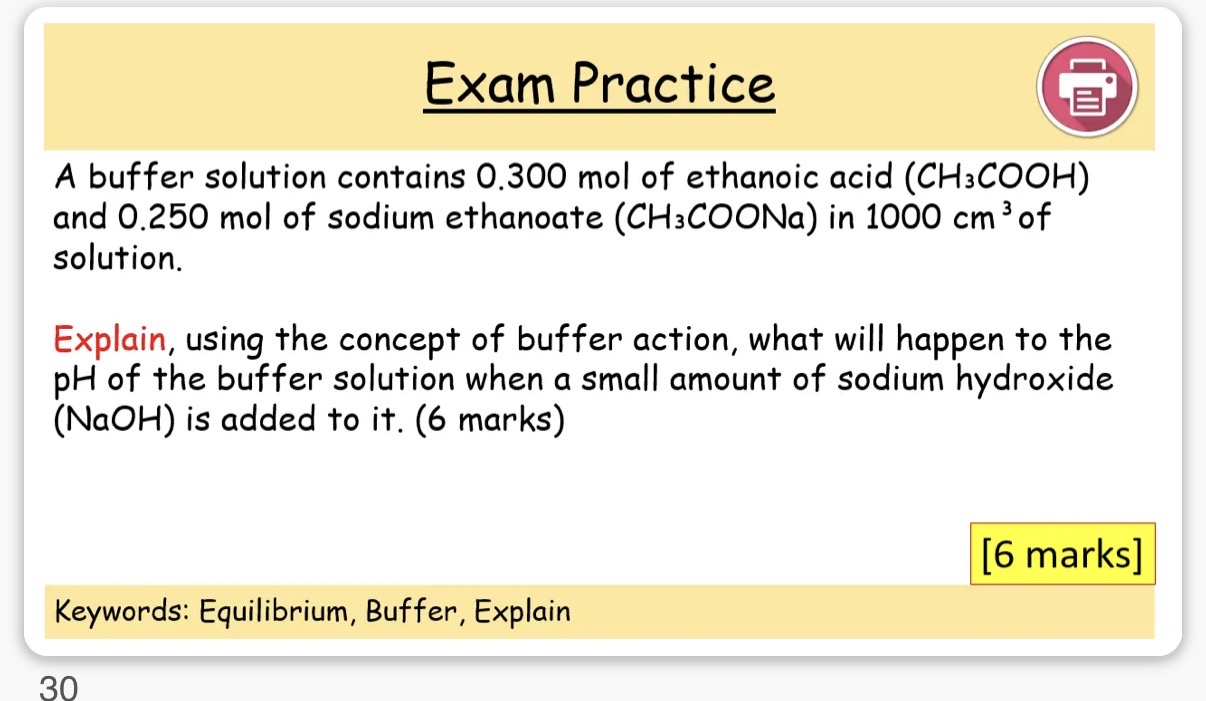
Answer image question


Answer image question?


Answer image question?
Note: We assume the conjugate base comes from all the salt


Answer image question?


Answer image question?
Note: Since Base is being added, it will react fully with the weak acid and therefore reduce the moles of weak acid in the buffer.And since base is being added, the OH- added will react with the weak acid to form more salt in the buffer e.g. HA + OH- → A-(salt/conjugate base) + H2O


Answer image question?
Note- same steps as last time even though the answer doesn’t show the full steps
Note: Since acid is being added, the H+ reacts fully with the conjugate base/salt to form weak acid. Hence why we add the moles of the added acid to the weak acid and subtract it from the salt/conjugate base. H+ + A- → HA(weak acid).


Answer image question?


Answer image question?


Titration practical y13
•Read image info
info: Before the practical we need to …1? the pH …2?, for example when we calibrate a balance, we set it to 0.
• As part of the practical you will be given buffer solutions of a known pH.(pH 4.00,7.00 and 9.20 3SF.)→ since we know the pH of the buffer solutions to 3SF, we can use them to see how far off the probe’s measurement is.
How do we calibrate the pH probe?
Calibrate
Probe
• Use a different pipette to put a bit of each of the buffer solutions into seperate beakers.
•We then take out the pH probe and rinse it thoroughly with distilled water.
•Then place it in the first buffer, wait a few seconds for the reading to stabilize, then write down the pH probe reading for that buffer on a table.
•We then rinse it with distilled water and repeat the steps with each of the other buffers.
• Since you now have all the pH probe readings, you can plot it on a graph where the the recorded pH reading(probe reading) is on the X-axis and the pH of the buffer (4.00,9.20,7.00) is on the y-axis.
• Plot the points on graph paper and draw a line of best fit.→ Now we call this a Calibration graph/curve (So once we record all the pHs during the titration, we use the calibration graph to compare our readings to combar our readings to the correct one.)


Method: Running the Titration
1) Use a …1? to measure out ethanoic acid.
• Explain this process
2) Strong base into burette
•Explain the process
Practical Considerations: Titrations
Safety
Throughout the titration, you must wear goggles and gloves, because acids and bases will cause …3? of the skin and eyes.
Rinsing
Before we close the tap of each burette, we rinse it with the same solution that we’re going to add. So, for the second burette, we rinse it with a bit of sodium hydroxide solution.
It’s important that we don’t rinse with …4?, because water droplets on the side of the burette will impact the …5? of our solution, and therefore the …6? that we measure.
Dry the beaker
The beaker that we add the acid to must be completely …7?. This is because any water will …8? the concentration of the acid, thereby ..9? our starting pH.
Changing the increments of base
For the first 18 cm3 of NaOH, we add 2.0 cm3 of NaOH at a time.
In between 18 cm3 and 22 cm3, we add 0.20 cm3 of NaOH at a time.
Then, between 22 cm3 and 40 cm3, we go back to adding 2.0 cm3 of NaOH at a time.
Why do we do this? Well, remember that our ethanoic acid and sodium hydroxide solutions both have concentrations of 0.100 mol dm-3, and that we start with 20.0 cm3 of ethanoic acid in our beaker. This means that, once we’ve added 20.0 cm3 of sodium hydroxide, our amounts of acid and base are approximately equivalent.
We saw in the Acids and Bases section that, around this equivalence point, we see a rapid …10? in pH, which corresponds to the …11? region of our titration curve.
So, between 18 cm3 and 22 cm3, we want to add very small increments, in order to record the shape of the curve around the equivalence point.
Burette
1) •Clamp a burette onto a stand and funnel in a little of the acid into the burette to rinse it, and make sure the valve is open and a beaker is underneath the burette.→ Then we close the valve
• Then fill the burette using a funnel with acid until the 0cm3 reading.
• Now place a clean beaker under the burette then open the valve until we let 20cm3 of acid into the beaker.
2)• We take a second burette,clamp it onto a stand and funnel in little of the strong base into the burette to rinse it, and make sure valve is open and a beaker is underneath the burette.→ Then close the valve
•Then you fill the burette using a funnel with the base to the 0cm3 reading.
• Then rinse the pH probe with distilled water and place it into the 20cm3 beaker of weak acid→ making sure the bulb of the probe is submerged.
• Then stir the solution with a stirring rod and record the pH reading once it has stabilized.
• Then we place this beaker underneath the burette with the base and add 2cm3 of base into the beaker→ we then stir the solution and record the pH reading of the probe once the reading has stabilized.
• Repeat this in 2cm3 increments and record the path everytime until we added 18cm3 of NaOH.
• Now we add the base in 0.2cm3 increments until we get to 22cm3 and make sure to stir and record the pH everytime base is added.
•Then we go back to 2cm3 increments until we added 40cm3 of base in total.
Irritation
Water
Concentration
pH
Dry
Decrease
Increasing
Increase
Vertical


Analysis: Drawing the Titration Curve
• Since we’ve carried out our titration, all we need to do is plot our titration curve.(which shows us how the pH changes as we add sodium hydroxide) but first we need to adjust our readings based on the calibration graph.
• As shown in the front images, we have to use the calibration graph that we intially drew(top image) and then we calbrate it using the recorded pH probe readings of the titration in order to get the pH reading after calibration(in order to calibrate we go up from the X-axis of our pH probe reading until we reach the line of best fit, then we match this part up with the reading of the y-axis to get the pH after calibration reading)
• As shown in these images, We now create a titration curve graph where pH is on the Y-axis with this part of the graph ranging from 0-14, and Volume of base(NaOH) added is on the X-axis with this ranging from 0→ 40 Cm3.
•As shown in these images, we use the pH after calibration readings to plot points on our graph and then we join the point with a curve to complete the titration curve
• Now we can make observations using our graph.
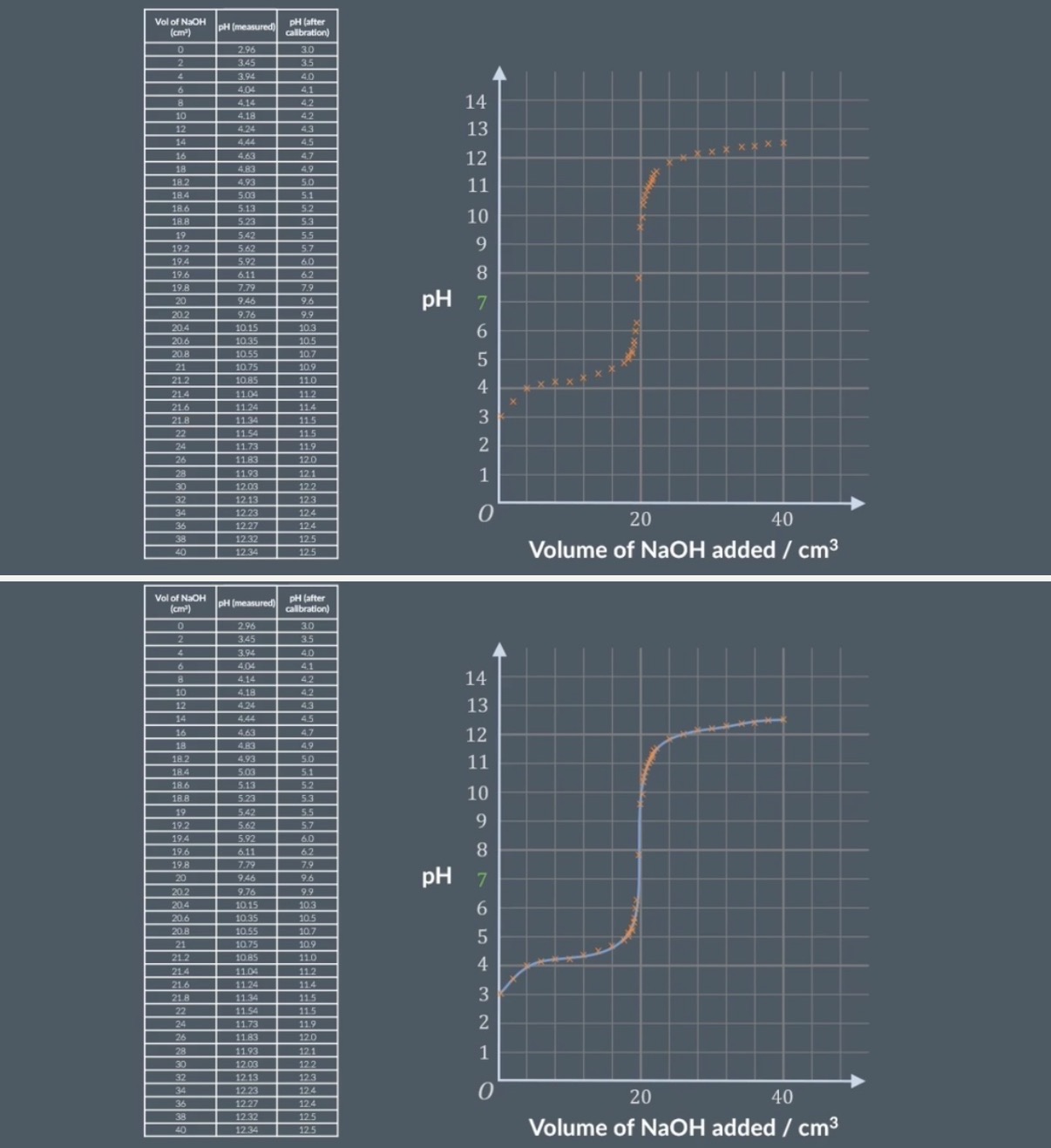

Answer image question
Describe the procedure for calibrating a pH probe?
A student measures out 22.0cm3 of ethanoic acid using a burette. The burette has a resolution of 0.1cm3.
Calculate the percentage uncertainty in this measurement.Give your answer to 2 significant figures
Model answer
1. Rinse the pH probe with distilled water.
2. Dip the pH probe in a standard buffer solution of known pH and record the pH reading.
3. Repeat with two other buffer solutions.
4. Plot a graph of buffer pH against recorded pH. Draw a line of best fit to complete the calibration graph.
5. At the end of the titration, use the calibration graph to convert the recorded pH readings to the true pH values.
0.45% (The uncertainty is ± half of the resolution of the apparatus, which is ±0.05cm3.
As we are making two measurements, the uncertainty in the volume measured is double the uncertainty in each individual reading. So, the uncertainty is ±0.1cm3.
(Uncertainty/value X100= percentage uncertainty) →. 0.1/22 times 100 = 0.45%


Answer image question?


Answer image questions?


Answer image question?
•Reason: Adding 4\text{ cm}^3 of water increases the total volume of the solution from 100\text{ cm}^3 to 104\text{ cm}^3. Because concentration (\text{mol dm}^{-3}) equals moles divided by volume, increasing the volume dilutes the solution and decreases the concentration of \text{H}_3\text{PO}_4.
•Reason: Ka is an equilibrium constant and is only affected by temperature. Diluting the solution with water does not alter temperature, so K_a remains constant.
•Reason: Adding water increases the total volume, decreasing both [\text{H}_3\text{PO}_4] and [\text{H}_2\text{PO}_4^-] by the same factor. Since the ratio \frac{[\text{H}_2\text{PO}_4^-]}{[\text{H}_3\text{PO}_4]} remains unchanged, the pH calculated via the buffer expression remains unchanged
![<p>•<span><em>Reason:</em> Adding 4\text{ cm}^3 of water increases the total volume of the solution from 100\text{ cm}^3 to 104\text{ cm}^3. Because concentration (\text{mol dm}^{-3}) equals moles divided by volume, increasing the volume dilutes the solution and decreases the concentration of \text{H}_3\text{PO}_4.</span></p><p><span><em>•Reason:</em> Ka is an equilibrium constant and is <strong>only affected by temperature</strong>. Diluting the solution with water does not alter temperature, so K_a remains constant. </span></p><p><span><em>•Reason:</em> Adding water increases the total volume, decreasing both [\text{H}_3\text{PO}_4] and [\text{H}_2\text{PO}_4^-] by the same factor. Since the ratio \frac{[\text{H}_2\text{PO}_4^-]}{[\text{H}_3\text{PO}_4]} remains unchanged, the pH calculated via the buffer expression remains unchanged</span></p>](https://assets.knowt.com/user-attachments/5ffb734b-af97-437a-8fd6-007ec11066ae.jpg)