MCB 493 – Quiz 5 Notes
 Call Kai
 Learn
 Practice Test
 Spaced Repetition
 Match
 Flashcards
 Knowt Play
1/28

Earn XP
Description and Tags
29 Terms
do most phages have a specific host range or a broad host range?
specific host range
what does a bacterium need to have in order to serve as a host?
a receptor that the phage receptor-binding protein (RBP) recognizes
compatible internal machinery to facilitate phage replication
an absence of bacterial immune systems that target the phage
when does the infection cycle start?
when the phage RBP (receptor-binding protein) binds to the bacterial cell surface receptor → this interaction triggers phage DNA injection into the bacterial cell
what indicates a productive phage infection?
the presence of plaques on the bacterial lawn
what does the term polyvalent refer to?
phages that can infect a variety of species
which type of phages typically have broad host ranges? which have narrow host ranges?
myophages typically have broad host ranges
siphophages and podophages typically have narrow host ranges
why is it necessary to include the original host strain when testing the host range of our phages?
because the original host strain serves as a positive control for plaque production
what is meant by lysis from without (LO)? what is LO caused by?
LO is the phenomenon where phages cause a general clearing of the bacterial lawn without apparent plaquing. this can be instead of or in addition to forming plaques on the lawn.
LO can be caused by various mechanisms:
phage infection could trigger an abortive infection pathway that leads to bacterial death before the phage has had the opportunity to complete its life cycle
the presence of lysins in the spent media that were carried over from lysis of the original host could cause cell death when applied to the outside of the bacterium and exhibit a broader spectrum of antibacterial activity than the phage itself
lysis from within (LI)
normal lysis of bacteria after phages have mounted a productive infection
lysis from without (LO)
general bacterial lysis by externally applied agents
LOV (virion-mediated lysis from without)
happens when very high MOI is applied
MOI = Multiplicity of Infection = the average number of phage particles per host cell
phage particles are not produced because cells do not survive the adsorption process
example: T-even phages have a lysozyme associated with a tail that damages the cell wall during adsorption. if too many phages are poking holes in the cell, neither cell nor phage will survive
direct consequence:
high MOI kills cells without phage release
low MOI kills cells with phage release
distinct from abortive infection
LOL (lysin-mediated lysis from without)
caused by lysin carryover in the media from previous round of infection
happens especially with gram positive hosts, which possess a cell wall that is accessible to the lysin from the outside
phage particles are not produced because cells do not survive externally-applied lysins
direct consequence:
can cause general clearing on bacterial lawn
individual plaques cannot be resolved
PICIs
phage-inducible chromosomal islands
10-15 kb
chromosomally-integrated elements
widespread in gram positive and gram negative organisms
many encode virulence factors
require specific helper phages to spread
decrease phage reproduction (only by ~2-3 orders of magnitude) to maintain helper phage load
briefly describe common PICI phage interference mechanisms
capsid size remodulation
some PICIs encode capsid proteins that are compatible with helper phage-encoded capsid proteins
when assembled together, the PICI-phage capsid is smaller → this smaller capsid cannot accommodate the phage genome
phage packaging interference
terminase (composed of TerL and TerS) recognizes phage DNA and catalyzes genome packaging
SAPIs encode their own TerS, which recognizes the SAPI DNA instead
SAPIs also encode Ppi proteins which bind and block the phage TerS
late transcription interference
phage late genes encode proteins involved in phage packaging and lysis
late gene transcription is regulated by specific phage-encoded activators
some PICIs encode their own regulators which change the timing of phage late gene
lysis inhibition disruption
in V. cholerae, PLEs are phage-like elements that parasitize a lytic phage called ICP1
PLEs hijack the phage replication machinery to drive PLE replication
PLEs encode the lid (lysis inhibition disruption) gene which causes premature cell lysis, thereby preventing phage progeny production
abortive infection systems
PICIs encode some accessory genes which are not necessary for PICI replication
some PICIs encode genes that cause Abi, which protects the cell population from phage infection
these Abi genes are under the control of their own promoter and may therefore protect against other non-helper phages
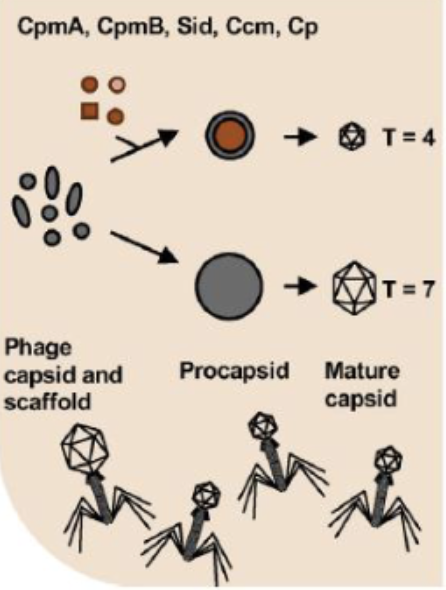
which PICI phage interference mechanism does this illustrate?
capsid size remodulation
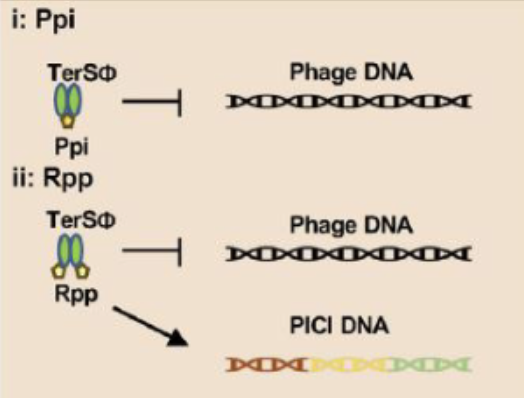
which PICI phage interference mechanism does this illustrate?
phage packaging interference
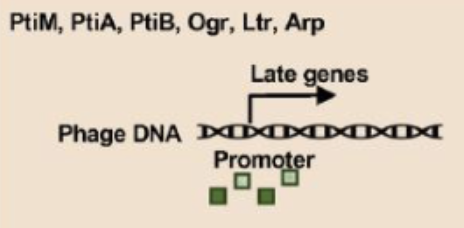
which PICI phage interference mechanism does this illustrate?
late transcription interference
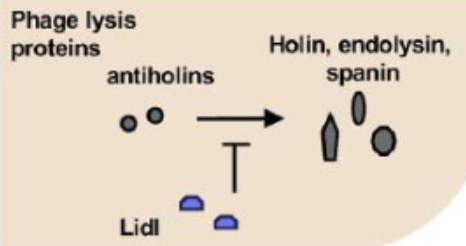
which PICI phage interference mechanism does this illustrate?
lysis inhibition disruption
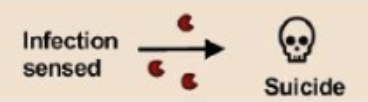
which PICI phage interference mechanism does this illustrate?
abortive infection systems
which host range in phages is better for therapeutics? what is the downside?
broader host ranges. if these polyvalent phages are found to encode an integrase and/or known virulence factors, then they are likely unsuitable for whole-phage therapeutic applications.
what is the purpose of DNase I and RNase A in our experiments?
they are enzymes that degrade DNA and RNA, respectively, which will help us clean up our phage lysates by eliminating contaminating nucleic acids from lysed bacterial cells. since the phage genome is protected within their capsids, these enzymes will not degrade them.
what is the purpose of polyethylene glycol 8000 and NaCl solution in our experiments?
this solution has a very low water concentration and when mixed with the phage lysate, will cause phages to aggregate and fall out of solution
what is the purpose of MgSO4 in our experiments?
it is a low salt buffer that will pellet and concentrate the precipitated phages
what is the purpose of proteinase K in our experiments?
this enzyme cleaves contaminating proteins that have carried over from the lysate. this helps prevent possible degradation of the phage DNA prep by heat-stable nucleases, i.e. nucleic-acid hydrolyzing enzymes.
what are the components of the DNA purification resin and what are their purposes in our experiments?
two components:
high concentration of guanidinium thiocyanate → denatures phage capsids
positively-charged beads → captures phage DNA once it is released
what are the gaps in knowledge that Keen et al. wanted to fill in?
what happens to free plasmids after phage infection and cell lysis?
what are the capacities of different phages to release intact host DNA? what are the mechanisms of release? what is the ultimate fate of phage-released host DNA?
what is the importance/significance of Keen et al.’s study?
the fate of plasmids after phage-mediated cell lysis has significant ecological and biomedical implications because:
natural transformation is a major form of horizontal gene transfer
plasmids frequently encode antibiotic resistance genes and other fitness factors
phages are being developed as alternative therapeutics to eliminate infections
what were the methods and results of Keen et al.’s study?
isolated a library of lytic phages that infect E. coli MG1655
obtained environmental samples (soil, feces, canal water, stream water)
plated samples directly atop lawns of E. coli MG1655
picked phages that formed clear plaques
purified phage DNA and digested with two restriction enzymes (HindIII and XbaI)
selected phages with unique restriction digest patterns
in total, 20 distinct phages were isolated and examined
quantified the ability of individual phages to promote transformation of a plasmid
combined E. coli cells bearing plasmid pBAD24 (confers Amp resistance) with each phage; 10:1 phage:bacteria
extracted DNA from phage lysate and combined the DNA with antibiotic sensitive E. coli cells
plated cells on amp-containing plates and counted transformant colonies
D and F, renames to SUSP1 and SUSP2, were ~50x more efficient at promoting plasmid transformation
assessed sequence specificity of plasmid transfer by SUSP1 and SUSP2
repeated previous assay with three addition plasmids: pSP102m5, pOAR31, and pπγ
phage T4 was used as a positive control
plasmid DNA extract kit was used as a negative control
results showed that SUSP1 and SUSP2 mediated plasmid transformation is a generalized effect, i.e. not sequence-specific
characterized phenotypic features of SUSP1 and SUSP2
used TEM to determine phage morphologies → myophage
sequenced the whole genomes of SUSP1 and SUSP2 and looked for genes that encode hydrolytic endonucleases
they do not seem to encode hydrolytic endonucleases similar to those in T4
tested the abilities of other phages lacking in hydrolytic endonucleases to promote plasmid transformation
results showed that unrelated phages lacking in hydrolytic endonucleases also promoted plasmid transformation
tested the ability of SUSP2 to transfer antibiotic resistance in a mixed population of soil bacteria
collected soil samples
extracted bacteria from samples via simple washing
bacteria mixtures were combined with SUSP1 and T4 lysates made from E. coli cells
plated cells on kanamycin-containing plates and counted transformant colonies
results shows that SUSP2 promotes transfer of antibiotic resistance to mixed population of soil bacteria
tested the ability of SUSP2 to transfer antibiotic resistance from E. coli to a natural isolate from soil in co-culture
isolated a single non-E. coli colony from soil bacteria mixture
tests bacterium to make sure it was resistant to SUSP2 and sensitive to kanamycin
sequenced the 16S rRNA to identify the bacteria → new Bacillus strain
co-cultured strain with E. coli cells and SUSP2 and counted transformant colonies
results shows that SUSP2 transfers of antibiotic resistance from E. coli to Bacillus while in co-culture
what was the discussion of Keen et al.’s study?
their research described an understudied form of phage-mediated horizontal gene transfer facilitated by “superspreader” phages
unlike transduction, this form of HGT is not restricted to phage host range, but rather to the host compatibility of the plasmid being transferred
due to the sheer number of phages in the biosphere, it is very likely that there are more superspreader phages and such phages may act as key drivers of HGT and bacterial evolution in natural environments
important therapeutic implications:
lytic therapeutic phages may facilitate the spread of antibiotic resistance, since many antibiotic resistance genes are encoded on plasmids
therapeutic phage candidates should be pre-screened for the superspreader phenotype before use