Module 2 Theory
 Call Kai
 Learn
Learn Practice Test
 Spaced Repetition
 Match
Match Flashcards
 Knowt Play
1/59

There's no tags or description
Looks like no tags are added yet.
Name | Mastery | Learn | Test | Matching | Spaced | Call with Kai | Chat |
|---|
No analytics yet
Send a link to your students to track their progress
60 Terms
Homeostasis
State of equilibrium maintained in the body to support and sustain life
Anatomical Terminology
Terms used to describe the human body (location, position, direction)
Anatomy
Ana/tome - apart/to cut
Cell
Basic building block of human body
Four Types of Tissue
Epithelial, Connective, Muscle, Nervous
Tissue
A group of similar cells working together to perform a specialized function
Where does epithelial tissue form?
Forms on the outer surfaces of the body, lining body cavities and tubes leading to the outside of the body
Functions of Epithelial Tissue (6)
Protection, Sensation, Secretion, Absorption, Excretion, and Diffusion
Epithelial Tissue - Protection; Specific Function and Example
Forms a physical barrier over underlying tissue, ex. skin
Epithelial Tissue - Sensation; Specific Function and Example
Interprets sensory stimuli; ex. 5-Senses
Epithelial Tissue - Secretion; Specific Function and Example
Secrete fluids from glands; ex. hormones
Epithelial Tissue - Absorption; Specific Function and Example
Absorb nutrients; ex. small intestine
Epithelial Tissue - Excretion; Specific Function and Example
Remove waste; ex. kidney
Epithelial Tissue - Diffusion; Specific Function and Example
Diffusion of gas, liquids, and nutrients; ex. capillaries and lungs
Connective Tissue; Function and Connections
Supports organs and muscle sheaths; connects muscles to bones and bones to joints
Types of Muscle Tissue
Skeletal, Smooth, Cardiac
Skeletal Muscle Function
Voluntarily controlled for movement and posture
Smooth Muscle; Function, Location, and Example
Involuntarily controlled and found in organs; ex. stomach
Cardiac Muscle Function and Location
Involuntarily controlled and found in heart
Autonomic Nervous System Controls
Smooth and Cardiac Muscle
Nervous Tissue
A group of nerve cells that work together to coordinate and control bodily functions through electric communication
Nerve Cells
Excitable cells that can conduct electricity
Organs
Body structures that perform specific purposes
Systems
Groups of different organs that work together to perform a specific function

Organizational Levels
Atoms, Molecules, Organelles, Cells, Tissues, Organs, Systems, Organisms
Integumentary System - Primary Functions and Features
Encloses internal body structures, helps regulate temperature, and site of many sensory receptors
Skeletal System - Primary Functions
Supports movement and shapes the body; provides protection and stores minerals
Muscular System - Primary Functions
Enables movement; maintains posture and body temperature
Nervous System - Primary Functions
Detects and processes sensory information; activates bodily responses by transmitting impulses in response to stimuli
Endocrine System - Primary Functions
Regulates bodily processes by producing hormones and chemical messengers
Cardiovascular System - Primary Functions
Deliver O2, nutrients, and hormones to tissues and remove CO2 and waste
Blood and Lymphatic System - Primary Functions
Defend against pathogens with immune response using chemical substances and cells; transport proteins, fluids, O2, and CO2
Respiratory System - Primary Functions
Delivers O2 to blood and tissue cells and removes CO2
Digestive System - Primary Functions
Digest and absorb nutrients from food, eliminate waste
Urinary System - Primary Functions
Controls electrolyte, water, and PH balance in the body by producing, transporting, and eliminating urine
Reproductive System - Primary Functions
Sexual characteristics and survival of human race
Body Cavities
Hollow spaces containing organs and enclosed with membranes
Posterior Cavities
Cranial and Spinal Cavity
Anterior Cavities
Thoracic and Abdominopelvic Cavity
Cranial Cavity; Contents and Protection
Contains the brain, protected by meninges and the skull
Spinal Cavity; Contents and Protection
Contains spinal cord, protected by meninges and cervical, thoracic, lumbar vertebrae
Thoracic Cavity; Contents, Protection, Separation
Contains THETAL - trachea, heart, esophagus, thymus gland, aorta, and lungs; protected by ribs; separated from abdominopelvic cavity by diaphragm
Thoracic Cavity Divisions
Mediastinum and Pleural Cavities
Mediastinum Cavity; Contents, Location
Contains THETA - trachea, heart, esophagus, thymus gland, and aorta; Central region of thoracic cavity
Pleural Cavities; Contents, Protection, and Location
Contains a lung; protected by pleura membrane; located lateral to the mediastinum cavity
Abdominopelvic Cavity Divisions
Abdominal and Pelvic Cavities
Abdominal Cavity; Direction and Contents
Superior; Contains SLuG SPaSm Li - stomach, liver, gallbladder, spleen, pancreas, small intestine, and most of the large intestine
Pelvic Cavity; Direction and Contents
Inferior; Contains U3BR Li - Ureters, urethra, urinary bladder, reproductive organs, and the last section of the large intestine
Male Reproductive Organs
Prostate gland, seminal vesicles, bulbourethral gland, and vas deferens
Female Reproductive Organs
Vagina, uterus, ovaries, and Fallopian tubes

Anatomical Abdominal Cavity Divisions
Right hypochondriac, epigastric, left hypochondriac, right lumbar, umbilical, left lumbar, right iliac, hypogastric, left iliac
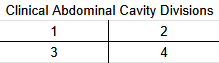
Clinical Abdominal Cavity Divisions
Right upper quadrant, left upper quadrant, right lower quadrant, left lower quadrant
Right Upper Quadrant Contents
Lost Kings Play Golf - Liver, Kidney, Pancreas, Gallbladder (and small and large intestine)
Left Upper Quadrant Contents
Some Super Pretty Losers Adore Kittens - Stomach, Spleen, Pancreas, Liver, Adrenal gland, Kidney (and small/large intestine)
Right Lower Quadrant Contents
For All Of Us - Fallopian tube, Appendix, Ovary, Ureter (and small/large intestine)
Left Lower Quadrant Contents
Oh U2 - Ovary, Ureter, Uterine tube (and small/large intestine)
Prone Position
Horizontal, face down, back superior
Supine Position
Horizontal, face up, back inferior
Lithotomy Position
Supine, buttocks at the end of the examination table, hips and knees flexed and feet supported by stirrups
Fowler Position
Semi-recumbent position; supine, head elevated 45 degrees