Costs & Firm Behavior Under Perfect Competition
 Call Kai
 Learn
 Practice Test
 Spaced Repetition
 Match
 Flashcards
 Knowt Play
1/35

There's no tags or description
Looks like no tags are added yet.
36 Terms
Define and give formula for:
Revenue, cost, and profit. Be specific for profit and cost.

Cost: Variable costs - Fixed costs
Profit: revenue - variables costs - fixed costs
Calc profit using


Is this profitable

No. Although revenue - cost is 800-400=400 profit, OC isnt considered. Cost considers OC.
Thus, its 400-500 OC=-100 so a loss

How do you calculate cost
r times k + w times l

What is the cost function equation and define cost function? look at more
Cost function is C(y). A cost function assigns the minimum costs to the production of y units of a good.
C(y)=Variable costs + fixed costs
What are average costs and whats the equation

The average costs of production equal the total costs of production divided by the quantity produced
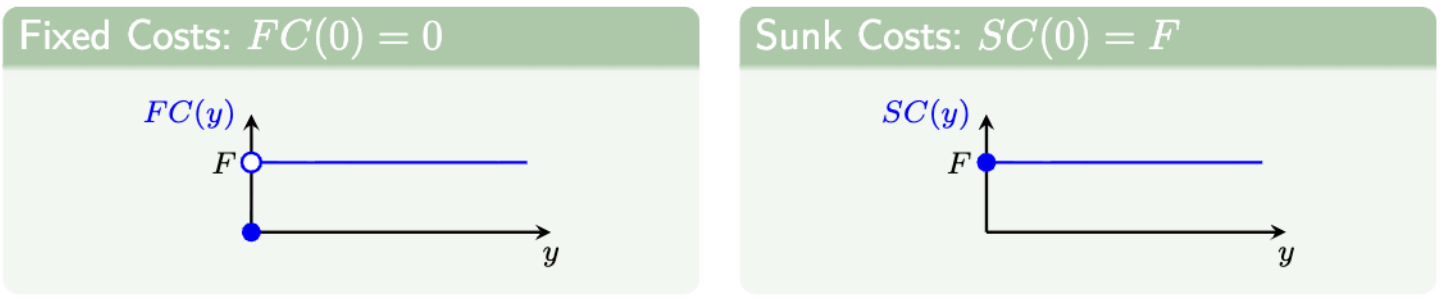
What are fixed costs
What are they when y=0
The fixed costs of production are the costs that occur once a firm
starts production and they are independent of the volume of
production.

When y=0, theres 0 fixed costs since theres no costs if you dont produce anything
What are sunk costs? How does it compare to fixed costs?
Sunk costs are costs that have already been incurred at a given point in time and thus cannot be recovered
Same as fixed costs (F), but it costs at y=0 since its already occured
What are variable costs?
Formula?
What part of the cost function is considered
The variable costs of production are the costs that vary with the quantity produced ie. y

Only the variable y. Since variables costs only look at the total cost that changes with output.
What are average fixed costs
Formula
The average fixed costs of production equal the fixed costs of production divided by the quantity produced

What are average variable costs?
Formula
Average variable costs of production equal variables costs of production divided by the quantity produced.

What are marginal costs?
Whats the formula.
The marginal costs of production are the costs that result from the production of an additional unit of output:

Derivative of cost function
Where does the average cost (AC) curve intersect the MC curve?
How do you find minimum AC and whats the assumption required to find the minimum
Draw the graph for this
How does this relate to finding the minimum AVC

To find minimum AC, you take the derivative of the average cost (Cy/y) and equal it to 0.
Assumption: y must be greater than 0

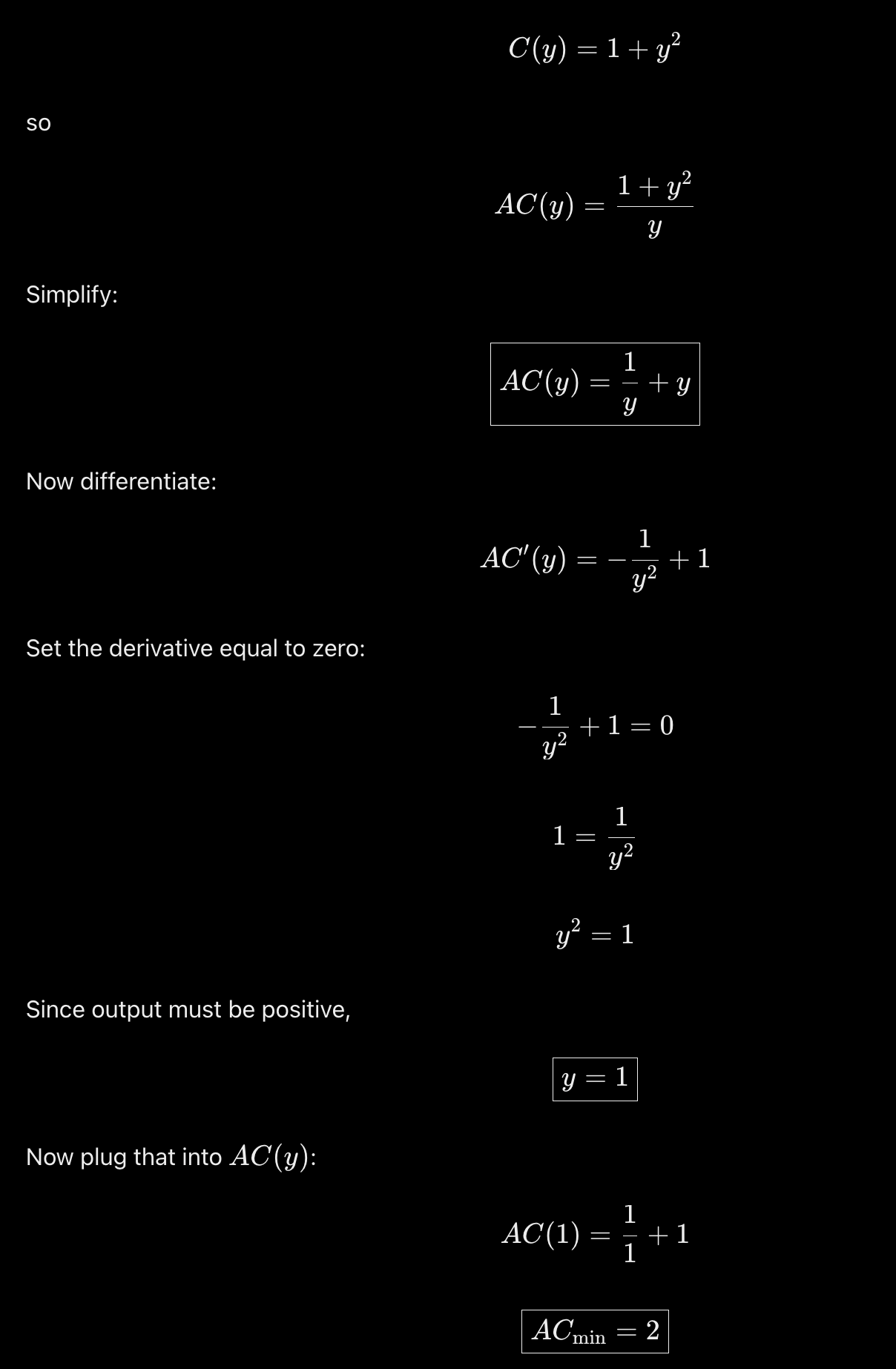
You find minimum AVC by taking its derivative and = 0
What is a firms behavior under perfect competiton.
What is i and yi for this.
Each firm is small relative to market size thus its a price taker.
i is the firm and yi is the firms output
What is marginal revenue? Formula
Whats MR for perfect competition.
Draw the graph for marginal revenue under perfect competition and where the revenue is.
The marginal revenue of production is the revenue the firm makes by an additional unit of production
MR = R’(y)

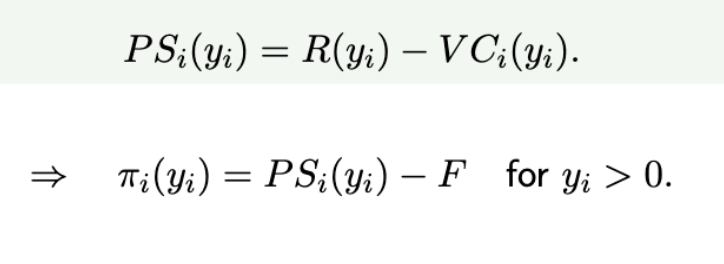
What is the producer surplus
Whats the formula for producer surplus
What the formula for profit in terms of producer surplus and what condition must be met
The producer surplus of firm i is equal to revenues minus variable costs:
At what point is profit maximised
Draw the graph for profit maximsiation for a PC market
How is profit maximisation calculated?
Why is this the profit max in PC?
At MR=MC.
In perfect competition, marginal revenue is a constant price.

To calculate max profit:
Profit=Revenue-Cost
π’(y)=0
R’(y*)-C’(y*)=0
R’(y*)=MR(y*) and C’(y*)=MC(y*)
Since in perfect competition MR(y*)=p
p=MC(y*)
It is profit max because in perfect competition producers are price takers and this is the best theyll get.
For the PC market graph, where is the producer surplus and where are the variable costs on a graph (Draw it)
Why is the area under MCi equal to VCi
How do you calculate variable costs in terms of marginal costs and marginal revenue in PC
A firm maximizes its producer surplus by producing the quantity where the market price equals marginal cost.

The area under the MC curve is the variable cost, because adding up the cost of each additional unit gives the total cost that varies with output.

Draw the graph when quantity of units (y) made is too little and too much compared to y* (profit max). Show the effect on PS, VC, and whats foregone and what the loss would be.

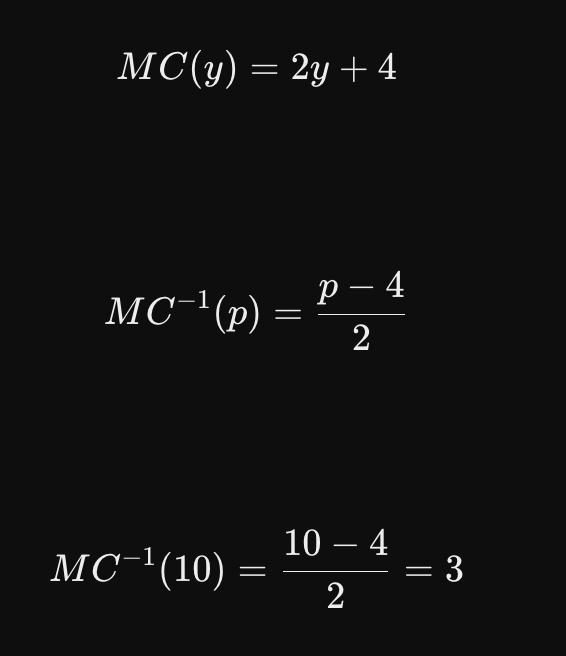
What does the inverse marginal cost function show.
How do you calculate it
Inverse MC uses the market price as the input to determine the output quantity supplied. You can find the quantity supplied using the price and MC function.
MC(y) uses quantity as the input to determine the price.
Set MC equal to p, then find the inverse by solving for y
What is the formula for profit
profit = Revenue (price x quantity sold) — Costs (variable costs + fixed costs)
What are avoidable fixed costs?
How does this relate to whether a firm should shut down.
Avoidable fixed costs are costs which can be avoided if the producer shuts down.
With avoidable fixed costs, when a firm shuts down it does not have to pay them.
If profit gives a negative profit, like -5, and the firm doesn’t produce anything, then its 0>-5 and it should shut down.
What are sunk costs?
How do sunk costs influence a firm to keep producing or shutting down
Costs that shutting down wont get back
If a firm produces y=0 and there are sunk costs of F=10, then the profit when shutting down is π(0)=-10.
But when producing gives: π(y)=-4 , the firm should keep producing and not shut down because -4>-10
Draw a graph showing the profits when the fixed costs are avoidable and when they’re sunk costs.

Fixed costs (avoidable): The firm can shut down without producing anything and paying the fixed costs
Sunk costs: when the fixed costs are already paid, they should produce until profit is maximised to minimise their loss.
What does revenue have to be greater than when there are avoidable fixed costs and sunk costs.
Avoidable:
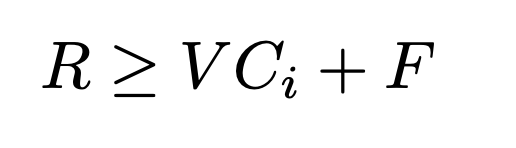
Sunk costs: the F cancels since it is already paid.

How does a firm know whether to keep producing if they have avoidable fixed costs and when there are sunk costs.
Avoidable fixed costs:

Sunk costs:

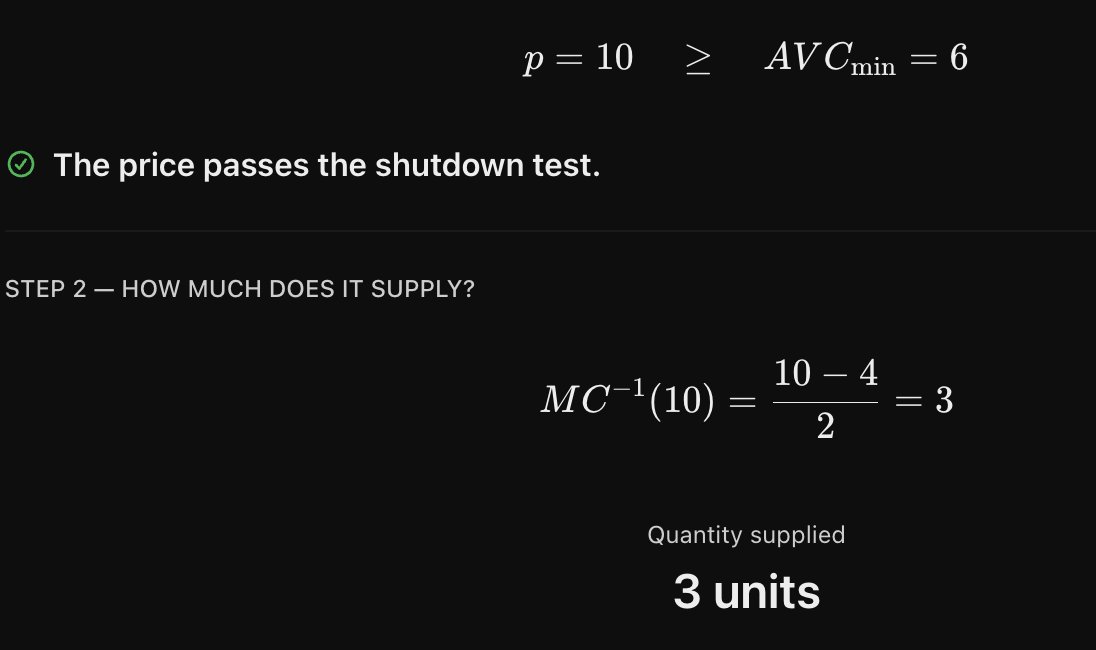
How to calculate the quantity supplied when p≥ACmin
And for p≥AVCmin
You use the inverse of MC to calculate the quantity at that price.
What is the short run and long run and when are there sunk costs.
When should you produce in the short run vs the long run
Short run: period of time where contractual obligations are binding (some sunk costs)
Long run: period of time where theres no binding obligations (no sunk costs)
Produce in short run if: p ≥ AVC minimum
Produce in long run if: p ≥ AC minimum
Draw the general cost curve

Draw the short run supply curve showing at what part of the supply function (inverse MC) should be supplied.
What does it mean for the quantity supplied if the price is below the AVC minimum and if its above

If the price is below the AVCmin, that means 0 is produced
If the price is above, you calculate the quantity supplied using the MCinverse of supply function, substituitng the price into it to find quantity.
Draw the long run supply curve showing what part of the supply function should be supplied.

How do you calculate the market supply with fixed number of firms
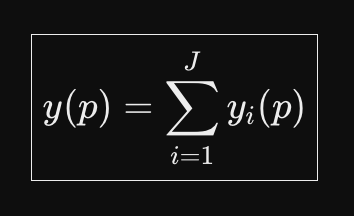
When do firms enter and exit a market if they’re identical with constant input prices. What does this mean for long run market supply

This means LR supply is horizontal.
What happens to ACmin in the longrun with the conditions of identical and exit leave
p=ACmin
Draw a graph showing what happens to the number of firms / market supply when p>ACmin and explain it.

Why is zero profit good for customers.
