theory of mind
 Call Kai
 Learn
 Practice Test
 Spaced Repetition
 Match
 Flashcards
 Knowt Play
1/12

There's no tags or description
Looks like no tags are added yet.
13 Terms
what is theory of mind? what is it sometimes called?
Theory of mind (ToM) is the human ability to understand that other people have their own thoughts, beliefs, desires and intentions which may be different from our own.
Our personal understanding/ our own theories of what other people are thinking and feeling.
sometimes called 'mind-reading
each of us has a theory of mind when we have a belief about what is right in someone else mind
Different methods are used to study ToM at different points in development.
evidence of simple ToM can be seen in toddlers through how?
A more sophisticated level of ToM can be assessed in 3-4-year-olds using what?
In older children and adults, advanced ToM has been tested with the what?, in which participants j_____ c_____ e____ with m____ i_____ about f____ e____.
Different methods are used to study ToM at different points in development.
evidence of simple ToM can be seen in toddlers through of intentional reasoning research.
A more sophisticated level of ToM can be assessed in 3-4-year-olds using false belief tasks. e.g Maxis Chocolate and the Sally-Anne study
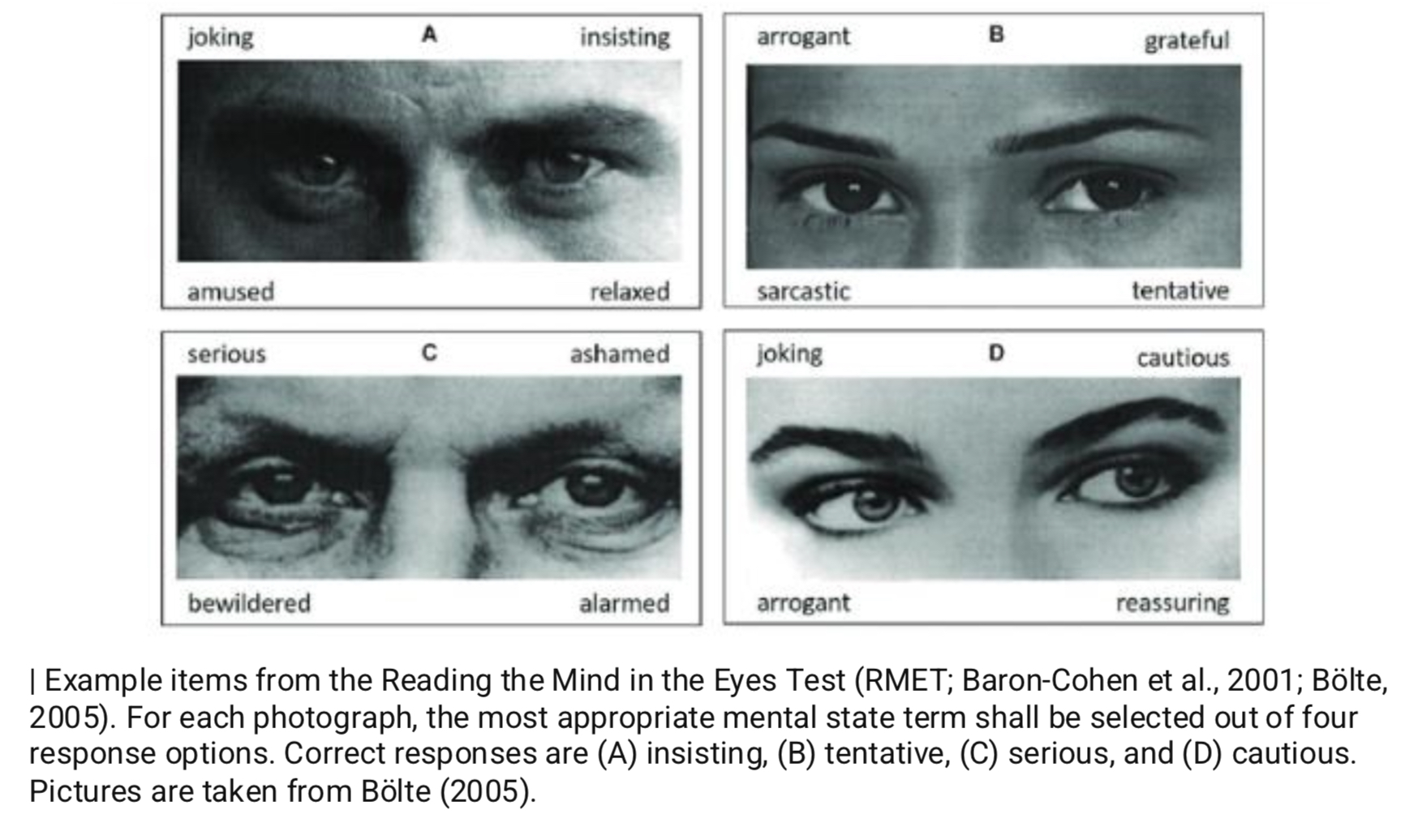
In older children and adults, advanced ToM has been tested with the Eyes Task, in which participants judge complex emotions with minimal information about facial expression.
intentional reasoning research
In one study M____ (1988) provided convincing evidence to show that toddlers (aged about ____ months) have an understanding of a____ i____ when carrying out s____ a_____
Children of ____ months observed what?
In the experimental condition ,what did the adults deliberately do?
In the control condition the adults what did the adults do?
In both conditions the toddlers did successfully did what?
This suggests they were imitating what?
This research shows what about young children?
intentional reasoning research
In one study Meltzoff (1988) provided convincing evidence to show that toddlers (aged about 18 months) have an understanding of adult intentions when carrying out simple actions.
Children of 18 months observed adults place beads into a jar
In the experimental condition the adults appeared to struggle with this and some beads fell outside the jar. (deliberate)
In the control condition the adults placed the beads successfully in the jar.
In both conditions the toddlers did successfully place the beads in the jar, they dropped no more beads in the experimental condition.
This suggests they were imitating what the adult intended to do rather than what the adults actually did.
This research shows that very young children have a simple ToM.
false belief tasks→ Maxi’s chocolate
False belief tasks were developed in order to test what?
First developed by W___ and P____ (1983).
They told 3-4-year-olds a story:
“ M____ left his c_____ in a b____ c____ in the k_____ and then went to the p____. Later, M___ m____ used some of the c____ in her c_____ and placed the r_____ in the g_____ c____. “
Children were asked what?
Most 3-year-olds incorrectly said what? because they are assuming what?
However, most 4-year-olds correctly identified what?
This suggests that ToM undergoes a s____ and becomes more a____ at around __ years of age.
false belief tasks→ Maxi’s chocolate
False belief tasks were developed in order to test whether children can understand that people can believe something that is not true.
First developed by Wimmer and Perner (1983).
They told 3-4-year-olds a story:
“ Maxi left his chocolate in a blue cupboard in the kitchen and then went to the playground. Later, Maxi's mother used some of the chocolate in her cooking and placed the remainder in the green cupboard. “
Children were asked where Maxi would look for his chocolate when he comes back from the playground.
Most 3-year-olds incorrectly said that he would look in the green cupboard because they are assuming that Maxi knows what they know, i.e. that Maxi's mother moved the chocolate.
However, most 4-year-olds correctly identified the blue cupboard.
This suggests that ToM undergoes a shift and becomes more advanced at around 4 years of age.
false belief tasks→ Maxi’s chocolate
This shows good ToM because they recognise that Maxi has a false belief (he believes the chocolate is where he left it).
They understand that Maxi does not know what they know (that the chocolate was moved).
3-year-olds fail because they assume Maxi shares their knowledge, showing limited ToM.
false belief tasks→ Maxi’s chocolate
how does the false belief task with Maxi’s chocolate demonstrate the ability of Theory of mind?
false belief tasks → Sally-Anne study
B____-C_____ et al. (1985) used a similar false belief task to Maxi called the Sally-Anne task
Children were told a story involving two d____, Sally and Anne.
Sally does what?, but when Sally is not looking Anne does what?
The task is to work out what?
Understanding that Sally does not know what? requires an understanding of what?
Therefore, how does passing the Sally–Anne task shows theory of mind ability?
false belief tasks → Sally-Anne study
Baron-Cohen et al. (1985) used a similar false belief task to Maxi called the Sally-Anne task
Children were told a story involving two dolls, Sally and Anne.
Sally places a marble in her basket, but when Sally is not looking Anne moves the marble to her box.
The task is to work out where Sally will look for her marble.
Understanding that Sally does not know that Anne has moved the marble requires an understanding of Sally's false belief about where it is.
Therefore, Passing the Sally–Anne task shows theory of mind ability because the child understands that another person can hold a belief that is false and different from their own.
false belief tasks → Sally-Anne study →Autism
B____-c____ and colleagues have explored the links between ToM d___ and a____ using f____ b____ t____.
Much of the research has made use of the Sally-Anne task, for example, the following study by B_____-C____ et al. (1985):
Procedure
The Sally-Anne task was given individually to ___ a___ children, ___ non-a___ children and ____ children with D____ S_____ (control groups).
Findings ___% of children in the control groups correctly identified what?
However, only ____% of the autistic children were able to answer this.
Baron-Cohen et al. argued that this difference showed that autism involves a what and that this may in fact be a complete explanation for autism.
false belief tasks → Sally-Anne study →Autism
Baron-Cohen and colleagues have explored the links between ToM deficits and autism using false belief tasks.
Much of the research has made use of the Sally-Anne task, for example, the following study by Baron-Cohen et al. (1985):
Procedure
The Sally-Anne task was given individually to 20 autistic children, 27 non-autistic children and 14 children with Down syndrome (control groups).
Findings 85% of children in the control groups correctly identified where Sally would look for her marble.
However, only 20% of the autistic children were able to answer this.
Baron-Cohen et al. argued that this difference showed that autism involves a ToM deficit and that this may in fact be a complete explanation for autism.
Eyes task → Testing ToM in older children and adults
Many autistic people who do not have l____ d____ have challenges with e____, s____ c_____ and i_____ but their l_____ d____ may be relatively unaffected.
Studies of older autistic children and adults without a learning disability showed that this group could succeed on f_____ b____ t___. This disapproved the idea that autism can be explained by ToM deficits.
However, Baron-Cohen and colleagues developed a more challenging task to assess ToM in a_____ and a___.
The Eyes Task involves reading c_____ e______ in pictures of faces just showing a small area around the eyes.
Baron-Cohen et al. (1997) found that many autistic adults without a learning disability struggled with the Eyes Task. This supports the idea that ToM deficits might be a cause of autism.
Eyes task → Testing ToM in older children and adults
Many autistic people who do not have learning disabilities have challenges with empathy, social communication and imagination but their language development may be relatively unaffected.
Studies of older autistic children and adults without a learning disability showed that this group could succeed on false belief tasks. This disapproved the idea that autism can be explained by ToM deficits.
However, Baron-Cohen and colleagues developed a more challenging task to assess ToM in adolescents and adults.
The Eyes Task involves reading complex emotions in pictures of faces just showing a small area around the eyes.
Baron-Cohen et al. (1997) found that many autistic adults without a learning disability struggled with the Eyes Task. This supports the idea that ToM deficits might be a cause of autism.
Evaluation → strengths
✓-One strength of ToM research is its application to what?
The tests used to assess ToM (e.g. false belief tasks) are c____ for some a____ people, possibly because they may not fully understand what?
This in turn offers an explanation for what?
In contrast, it is often assumed incorrectly that most neurotypical people can pick up another person's thoughts and feelings with little effort.
This means that ToM research has r____-w____ r___
Evaluation → strengths
✓-One strength of ToM research is its application to understanding autism.
The tests used to assess ToM (e.g. false belief tasks) are challenging for some autistic people, possibly because they may not fully understand what other people are thinking.
This in turn offers an explanation for why some autistic people may find social interaction difficult - it is hard to interact with someone if you don't get a sense of what they are thinking and feeling.
In contrast, it is often assumed (incorrectly - see below) that most neurotypical people can pick up another person's thoughts and feelings with little effort.
This means that ToM research has real-world relevance.
Evaluation → limitations
✘- One limitation of ToM research has been the reliance on what to test the theory?
Hundreds of studies have made use of f_____ b____ t___ like the S___-A____ task, however, false belief tasks may have serious problems of v____ (B____ and G____ 2000).
One reason for this is that false belief tasks require what?
Also, some children who can engage successfully in p____ p___$3, which requires some ToM ability, nonetheless find f___ b___ t____ difficult.
This means that f____ b_____ tasks may not really measure ToM and therefore ToM lacks key research evidence.
EXTENSION- How can Theory of Mind be seen as reductionist?
Evaluation → limitations
✘- One limitation of ToM research has been the reliance on false belief tasks to test the theory.
Hundreds of studies have made use of false belief tasks like the Sally-Anne task, however, false belief tasks may have serious problems of validity (Bloom and German 2000).
One reason for this is that false belief tasks require other cognitive abilities such as visual memory - failure on a false belief task may thus be due to a deficit in memory rather than ToM.
Also, some children who can engage successfully in pretend play, which requires some ToM ability, nonetheless find false belief tasks difficult.
This means that false belief tasks may not really measure ToM and therefore ToM lacks key research evidence.
EXTENSION- How can Theory of Mind be seen as reductionist?
Theory of Mind can be seen as reductionist because it explains social cognition mainly in terms of understanding other people's thoughts and beliefs.
Social cognition is much more complex-it also involves language, memory, and cultural influences.
Psychologists may ignore these other factors, giving an incomplete picture of how social skills develop.
For example, a child might pass a false belief task, showing ToM ability, but still struggle with empathy or emotional regulation, which are also crucial for successful social interaction.
Evaluation → limitations
✘- A further limitation is that research techniques fail to d____ ToM from perspective -taking.
Perspective-taking and ToM are r____ but are actually d____ c___ a____.
what is Perspective-taking?
what is Theory of mind?
Many ToM tasks may actually rely on perspective-taking, so it can be hard to tell what?
It can be very difficult to be sure we are m____ o___ and not the o___.
For example, in i____ r_____ tasks a child might be v___ the b___ task from the adult perspective rather than expressing a c_____ u_____ of their i____.
In the Sally-Anne task a child might be doing what?
This means that, with the exception of the Eyes Task, tasks designed to measure ToM may actually measure p____-t___.
Evaluation → limitations
✘- A further limitation is that research techniques fail to distinguish ToM from perspective -taking.
Perspective-taking and ToM are related but are actually different cognitive abilities.
Perspective-taking: the ability to see a situation from someone else’s physical or visual point of view.
Theory of mind (ToM): the ability to understand that other people have their own thoughts, beliefs, and intentions, which may be different from your own.
Many ToM tasks may actually rely on perspective-taking, so it can be hard to tell whether children are showing true ToM or just imagining someone else’s viewpoint.
It can be very difficult to be sure we are measuring one and not the other.
For example, in intentional reasoning tasks a child might be visualising the beads task from the adult perspective rather than expressing a conscious understanding of their intention.
In the Sally-Anne task a child might be switching perspective between Sally and Anne.
This means that, with the exception of the Eyes Task, tasks designed to measure ToM may actually measure perspective-taking.
Evaluation → limitations
✘- ToM does not provide a complete explanation for a____.
Not every a____ person experiences ToM issues (e.g. not always u____ what someone else is t____), nor are ToM problems limited to autistic people (T____-F____ 2007).
Also a lack of ToM cannot explain what?
This means that there must be other f_____ that are involved in a____, and the association between autism and ToM is not as strong as first believed.
Evaluation → limitations
✘- ToM does not provide a complete explanation for autism.
Not every autistic person experiences ToM issues (e.g. not always understanding what someone else is thinking), nor are ToM problems limited to autistic people (Tager-Flusberg 2007).
Also a lack of ToM cannot explain the cognitive strengths of autistic people (e.g. superior visual attention).
This means that there must be other factors that are involved in autism, and the association between autism and ToM is not as strong as first believed.
Evaluation → limitations
✘The Eyes Task is criticised because looking at a s___ p____ of e____ is different from what?
The tasks are a____ and may not reflect r____-w___ s____ c____. This raises questions about whether ToN research captures everyday p___-t____ and e____ Conclusions about ToM that result from the use of the task lack v____.
Evaluation → limitations
✘The Eyes Task is criticised because looking at a static pair of eyes is different from real-life experiences of seeing a face as part of a dynamic interaction.
The tasks are artificial and may not reflect real-world social cognition. This raises questions about whether ToN research captures everyday perspective-taking and empathy.
Conclusions about ToM that result from the use of the task lack validity.