Exam 1: Tophat Questions, Graphs, Purification Techniques, Review Sheet
 Call Kai
 Learn
 Practice Test
 Spaced Repetition
 Match
 Flashcards
 Knowt Play
1/64

There's no tags or description
Looks like no tags are added yet.
65 Terms
What is hydrophobic effect?
refers to the association of non-polar molecules in aqueous solution; not due to any intrinsic interaction
plays a signfigant role in
PROTEIN FOLDING
FORMATION OF LIPID BILAYERS
LIGAND BINDING
release of ordered water molecules drives formation of an enzyme + substrate complex
stabilizes the double helix
What is the difference between a nucleoside and a nucleotide?
side = a nitrogenous base + five carbon sugar
tide = a nucleoside with one or more phosphate groups
Which description correctly identifies 3'-dTMP?
3'-deoxythymidine monophosphate)
a nucleotide composed of a thymine nitrogenous base + a deoxyribose (five-carbon) sugar + single phosphate group attached specifically to the 3' carbon of the sugar ring.
How to determine which aqueous solutions has the lowest pH?
To determine which aqueous solution has the lowest pH, look for the one with the highest concentration of hydronium ions
What is the pH of a dilute solution of benzoic acid (pKa = 5) if the molar ratio of benzoic acid to sodium benzoate is 1 : 1?
5 (refer to Henderson Hasselbalch equation problems)
What is the pH of a dilute solution of benzoic acid (pKa = 5) if the molar ratio of benzoic acid to sodium benzoate is 1 : 100?
7 (refer to Henderson Hasselbalch equation problems)
hassel hasselbalch equation

The pKa of the carboxylic acid group in alanine is 2.34, and the pKa of the amino group is 9.69. Which of the following represents the predominant structure of alanine at pH 7?
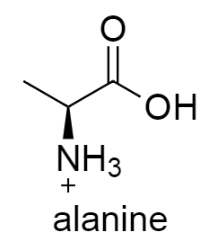
If an amino acid does not contain an ionizable group in its side chain, its net charge at physiological pH will be
0
A protein's primary structure is described by
the amino acid sequence of the protein (Afrin’s principle)
Consider the equilibrium between a folded and unfolded protein (folded ⇌ unfolded). What is an important statement about the process.
Protein folding is a dynamic process. At any given time, some folded proteins are in the process of unfolding, and some unfolded proteins are in the process of folding.
During protein folding, the formation of hydrogen bonds between backbone NH and C=O groups contributes to which of the following thermodynamic parameters?
negative value of ∆S
During protein denaturation, the carboxylate group in an aspartate side chain forms a hydrogen bond with water. The formation of this hydrogen bond corresponds to which of the following thermodynamic parameters?
positive
negative value of ∆H
When calculating the change in free energy for the process of protein folding, the increased randomness of the unfolded polypeptide corresponds to which of the following thermodynamic parameters?
positive ∆S
Protein folding is often described as a highly cooperative process. This means that
Which of the following chromatographic methods separates proteins on the basis of size?
Gel Filtration Chromatography
Which of type of protein would bind to an anion exchange column?
positively charged one
A protein with a pI of 8.5 would be _______________ at pH 7.
protonated or postively charged
Hemoglobin is a heme-containing globular protein present in erythrocytes (red blood cells). Which of the following accurately describes the primary function of hemoglobin?
oxygen transport
Each chain of hemoglobin can be viewed as existing in either the R state or the T state. What is the relationship between these two hemoglobin states and oxygen binding?
Oxygen binds with greater affinity to the R state, and oxygen binding converts hemoglobin to the R state.
Suppose you have a dimeric allosteric protein that follows the concerted model. Like hemoglobin, the quaternary states are called R and T. Which of the following statements cannot be true?
The protein can exist as an RT dimer.
What is the difference between pH and pKa
p = -log
so pH tells us -log [H+]
and pKa tells is -logKa
Titration Curve and What it tells us
Titration curve tells us how many equivalences of OH to reach that certain pH
What change can we make to the environment to increase the pKa (ex. histidine)?
adding a salt bridge (Glu or Asp) to have electrostatic interactions that would result in the deprotonation of histidine
make a more polar environment so the the positive charge would be stabilized by the charges
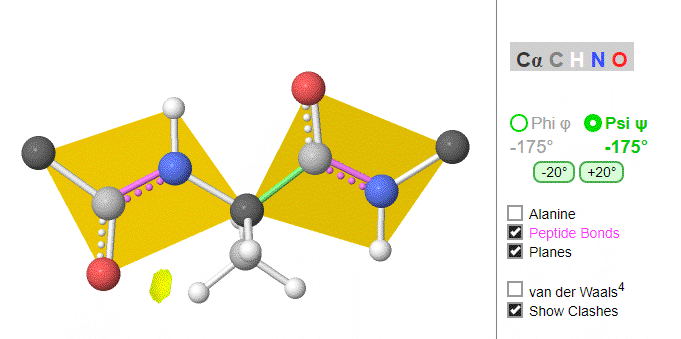
What is the connection between phi (𝜙) and psi (𝜓) angles and protein secondary structure?
these bond angles directly determine the conformation of the amino acid backbone
Phi angle: The torsion angle of rotation around the bond between the nitrogen atom and the alpha-carbon (N−C𝛼).
Psi (𝝍) angle: The torsion angle of rotation around the bond between the alpha-carbon and the carbonyl carbon (C𝛼−C).
C-N bond cannot rotate freely resonance character which restricts rotation
How does replacing a charged amino acid on the surface of a protein with a hydrophobic amino acid could impact the stability of the protein’s tertiary structure?
it would decrease stability because the hydrophobic amino acid would start to self associate with itself or other proteins which would lead to aggregation since there is no longer any electrostatic interactions
What are two variables that determine fractional saturation for a simple protein ligand interaction?
the free ligand and dissosciation constant

Hill plot
shows us the binding affinity to the ligand

Compare the O2 binding behavior of myoglobin and hemoglobin and explain the differences in their structures produce differences in the binding curves and biological functions?
the difference is the quartenary structure
there is difference in affinity
bio function reflects this (think sigmoidal curve of the hemoglobin)
what is the buffering range?
it is ± 1 ph unit around the pka
think blood buffer
Van der waals interactions
weak interactions between all atoms; reversible
additive force; pi stacking
stabilizing force for ssDNA and dsDNA
Ionic Interactions (electrostatic interactions)
stabilizes ssDNA and destabilizes dsDNA
hydrophobic bonding
stabalizes ssDNA and dsDNA
What are the bonds between amino acids called?
peptide bonds
What are the bonds between nucleic acids called?
phosphodiester bonds
What are the bonds between polysaccarides called?
glycosidic bonds
What are the bonds between lipids called?
non covalent association
Phi angle (C-N-Ca-C)
view down the N-Ca bond
angle between neighboring C=O
Psi (N-Ca-C-N)
view down C-Ca
angle between neighboring NH
Ramachandran plots
plots that show the distributions of phi and psi angles found in proteins
observed portions are observed proteins
quadrant I and III are alpha helixes
shaded combos minimize unfavorable steric crowding

alpha helixes
intrastrand bonding
do not have hydrogen bonding in the first 4 residues of the amino acid chain
B sheets
have inter strand hydrogen bonds
globular structure
compact
water or lipid soluble
wide variety of functions
fibrous quantenary structure
enlarged
insoluble
structural integrity
CHRISTIAN ANFINSEN (1961)
Did an experiment where urea denatures the protein and B-Me reduces S-S bonds
both urea and B-Me can be removed by dialysis
the primary amino acid sequence is enough to dictate protein structure
enzyme spontaneously refolds into catalytically active state without any help
Thiol Disulfide Exchange mechanism (PRACTICE ON YOUR OWN)
main takeaway - the disulfide bond of the protein is broken which increases the entropy of the protein and allows it to have more interactions
trance amounts of B-me catalyze rearrangements of disulfide pairings
delta G decreased as the reduced scrambled protein folds into a stable conformation
the disulfide bond stabilizes thermodynamically favorable structure

Protein folding summery
proteins fold to their lowest energy state (native state)
cannot be random according to Levinthal’s paradox
process of protein folding can be described as a free fall down a energy funnel
Why are hydrophobic residues dangerous for protein folding?
they start aggregating because there are no repulsion interacions which means they start self associating with each other due to strong LDFs and hydrophobic effects (ex. think Alzheimers or Parkingson’s)
Dielectric constant
the ability of a solvent to keep opposite charges apart
Gel Filtration Chromatography
separates proteins based on size
small molecules will enter the beads
the particles with larger molecular weight elute first
Affinity Chromatography
chromatography that uses molecules natural binding affinity for seperating the proteins
glucose residues are used to bind to proteins that bind to proteins which results in specifically isolating those proteins
What properties are utilized to isolate proteins?
solubility
ionic charge
polarity
molecular size
binding specificity
Ion Exchange Chromotography
separate proteins by charge
Cation exchange
there are anion or negatively charged beads while allow for positively changed molecules to bind while anions/negatively charged proteins pass through
Anion exchange
there are cation or positively charged beads while allow for negatively changed molecules to bind while cation/positively charged proteins pass through
Amino acids that are neutral before their pka = pH and then negative once the pH exceeds their pka
asp, glu, tyr, C - terminal
Amino acids that are positive before their pka = pH and then neutral once the pH exceeds their pka
his, N-terminal, lys, arg
Ka = association constant when it comes to proteins; higher it is the stronger the binding (kd = dissosiation constant which means higher = weaker binding)
[PL] / [P] + [L] = fractional saturation
O2 affinity can be tuned…
protein must have multiple binding sites that interact with each other
positive cooperatively (first binding event increases affinity at remaining spots)
Sigmoidal binding curves indicate positive cooperativity
O2 binds directly to a protein bound heme
non-covatently bound to each subunit, extends reactivity across 20 amino acids
binds O2 to Fe2+
T state
tense state caused by a lack of oxygen bonding; addn electrostatic interactions across interface and lower in free energy
R state
relaxed state referring to the high oxygen affinity conformation of hemoglobin and other allosteric proteins
Concerted cooperativity model
all or nothing
they are either R or T state
Sequential cooperativity model
intermediate subunits
process continues there will be a shift
phosphoester

phosphoahydride

glycosidic bonds
