Psyc 2010 Exam 1 study guide
0.0(0)
Studied by 14 people Call Kai
 Learn
 Practice Test
 Spaced Repetition
 Match
 Flashcards
 Knowt Play
Card Sorting
1/164

There's no tags or description
Looks like no tags are added yet.
165 Terms
1
New cards
What are three things do psychologists study?
Behavior, the mind, the brain
2
New cards
What tools do we have to investigate behavior?
naturalistic observation, interviews/questionnaires, & laboratory tasks
3
New cards
Naturalistic observation- strengths?
watching behavior in a natural setting in secret
4
New cards
Naturalistic observation- weaknesses?
not all behaviors are seen in public, or not often seen (ex. risk behavior)
5
New cards
Interviews/ questionnaires- strengths?
allows to assess behaviors and mental states that cannot be done through other means like natural observations
6
New cards
Interviews/ questionnaires- weaknesses?
people may try to make a ‘good impression’ and responses may vary depending on who is asking the questions; Another is that people’s memory is flawed. How questions are asked and who is asking them causes answers to vary.
7
New cards
laboratory tasks- strengths?
\
lab induced situations enable one to gain enough data where naturalistic observation cannot (ex. Risk taking behaviors not happen every day in natural world, lab prompts people to take a risk and allows to asses the same behavior for multiple people) often gives a survey beforehand and then compare to lab task results.
8
New cards
\
laboratory tasks- weaknesses?
must prove that lab assessment is relevant and mimics a person’s natural behavior
9
New cards
What makes a science a science
the scientific method (not what is being studied but how the subject is obtained). Theory, hypothesis, analyze data, report results, repeat
10
New cards
Who were the early pioneers of psychology?
William Wundt, William James, Mary Whiton Calkins, Margret Floy Washburn, John B. Watson, Rosalie Rayner, B.F. Skinner, Sigmund Freud
11
New cards
William Wundt- major focus/what did they contribute to psychology?
Established the first psychology laboratory at the university of Leipzig, Germany. Structuralist
12
New cards
William James- major focus/what did they contribute to psychology?
Legendary teacher-writer who authored an important psychology text. Mentored Mary Calkins. Functionalist
13
New cards
Mary Whiton Calkins- major focus/what did they contribute to psychology?
Memory researcher and the first female president of the American Psychology Association. Mentored by William James.
14
New cards
Margaret Floy Washburn- major focus/what did they contribute to psychology?
After Harvard refused to grant Calkins the degree she had earned, Washburn became the first woman to receive a psychology Ph.D. She focused on animal behavior research in *The Animal Mind*.
15
New cards
John B. Watson- major focus/what did they contribute to psychology?
Worked with Rayner. Championed psychology as the scientific study of behavior. Showed that fear could be learned in a controversial study on a baby that became famous at ‘Little Albert”
16
New cards
Rosalie Rayner- major focus/what did they contribute to psychology?
Worked with Watson on controversial study on a baby to show that fear can be learned
17
New cards
B. F. Skinner- major focus/what did they contribute to psychology?
A leading behaviorist rejected the idea of studying inner thoughts and feelings. Believed psychology should study how consequences shape behavior.
18
New cards
Sigmund Freud- major focus/what did they contribute to psychology?
Controversial ideas, personality theorist and therapist and influenced humanity’s self understanding. We really do not believe his theories anymore. Psychoanalytic psychology.
19
New cards
Structuralists- major focus
focused on the structure of the mind (Wundt)
20
New cards
\
Functionalists- major focus
how the mind functions (promoted by James)
21
New cards
Behaviorists- major focus
How we learn observable responses
22
New cards
psychoanalytic psychology- major focus
Emphasized the way our unconscious mind and childhood experiences affect our behavior. Sigmund Freud’s theory.
23
New cards
Cognitive revolution
in the 1960’s the field went back to the interest of how the mind processes and retains info.
24
New cards
What is the biopsychosocial approach?
Approach to understanding behavior and mental processes. Integrates three levels of analysis- biological, psychological, and social-cultural. Use this approach to study many of the field’s biggest issues.
25
New cards
Neuroscience focus
How the body and brain enable emotions, memories, and sensory expereinces
26
New cards
Evolutionary focus
How the natural selection of traits passed down through generations help to explain our similarities
27
New cards
Behavior Genetics focus
How our genes and our environment influence our individual differences
28
New cards
Psychodynamic focus
how behavior springs from unconscious drives and conflict
29
New cards
Behavioral focus
How we learn observable responses
30
New cards
Cognitive focus
How we encode, process, store, and retrieve information
31
New cards
Social-cultural focus
How Behavior and thinking vary across situations and cultures
32
New cards
biological psychologists
explore links between brain and mind
33
New cards
developmental psychologists
study our changing abilities from womb to tomb
34
New cards
cognitive psychologists
experimenting with how we perceive, think, and solve problems
35
New cards
personality psychologists
investigating our persistent traits
36
New cards
social psychologists
exploring how we view and affect one another
37
New cards
health psychologists
investigating the psychological, biological, and behavioral factors that promote or impair health
38
New cards
industrial-organizational psychologists
studying and advising on workplace-related behaviors and system product designs
39
New cards
Clinical psychology
studies, assesses, and treats people with psychological disorders but usually does not provide medical therapy
40
New cards
Psychiatry
branch of medicine dealing with psychological disorders
41
New cards
Community psychology
works to create social and physical environments that are healthy for all
42
New cards
What are three limits to common sense?
Hindsight bias, overconfidence, and confirmation bias
43
New cards
Hindsight bias
When looking back on events the outcome is obvious. “Well I could have told you that would happen”
44
New cards
Overconfidence
We think we know more than we do
45
New cards
Confirmation Bias
We often only want to look at or believe in things that support our beliefs.
46
New cards
Case Study
examines one individual or group in depth
47
New cards
Correlation does not equal what?
Causation
48
New cards
A *r* above 0 to +1.0 is what
positive correlation
49
New cards
A *r* below 0 to -1.0 is what
negative correlation
50
New cards
The closer the *r* value is to 0 the ____ the correlation
weaker
51
New cards
The closer the *r* value is to + or - 1 the ____ the correlation
stronger
52
New cards
What is a double-blind procedure?
neither those taking part in the study nor those collecting data know which group is receiving treatment or placebo
53
New cards
What are confounding variables
Other variables which could influence a study’s results
54
New cards
What is scientific attitude/ amiable skepticism
When one is presented with information as a fact they will clarify terminology used, question how it is known, look for evidence, and look at the weight of the evidence.
55
New cards
How does the scientific method help us deal with bias?
By testing a hypotheses using methods that stave to avoid biased or false answers. Using different forms of studies and accounting and adjusting for each variable.
56
New cards
What are the qualities of a good theory?
It must be falsifiable and parsimonious (explain as much as possible and as simply as possible)
57
New cards
Why should a theory be falsifiable?
Because if it cannot be proven false then how can it be proven correct
58
New cards
Why does a theory need to be parsimonious?
If the theory is only true under very specific circumstances then it is more likely explaining one occurrence rather than a causation.
59
New cards
Why should a hypothesis be stated a priori and not post hoc
“a priori” means before the experiment is conducted; one must predict a possible outcome of the study before preforming the study
“post hoc” means afterwards and if one forms a hypothesis after the experiment is conducted then they are just explaining the outcome.
60
New cards
Why is peer review of a study important?
It allows other experts in the field to find flaws in the study and report back to the potential publisher of the study. This ensures that a study has good grounds before it is released to the public.
61
New cards
What is a correlational cross-section study?
Performed at one point in time and is easier to do. This does not allow for tracking of changes.
Ex. How much coffee did you drink today and how do you feel?
62
New cards
What is a correlational longitudinal study?
Done at multiple points in time; asking the same question multiple times to track for change
Needs at least 2 points in time
63
New cards
What is experimental research
manipulation of one variable and measure its effects on another variable
Ex: give half a group 15mg coffee and other half 0mg coffee and measure how awake they feel at a later point in time
64
New cards
What is external validity
how the results of a study reflect compared to the general population
Can be shown through a correlational study
65
New cards
What is internal validity
Finding if two variables have causality, does A cause B?
experimental better for this
66
New cards
What is spuriousness
In an experiment testing A’s affect on B there can be a spurious variable C that can cause A & B to appear to cause each other but they are actually not related
67
New cards
What is correlation?
The relation of A and B occurring together
68
New cards
How to determine a correlation’s magnitude
The range of how a person will score on variable B given their score on variable A
69
New cards
How to determine a correlation’s direction?
Sloped down/ -*r* means inverse relation
Sloped up/ +*r* means positive relation
70
New cards
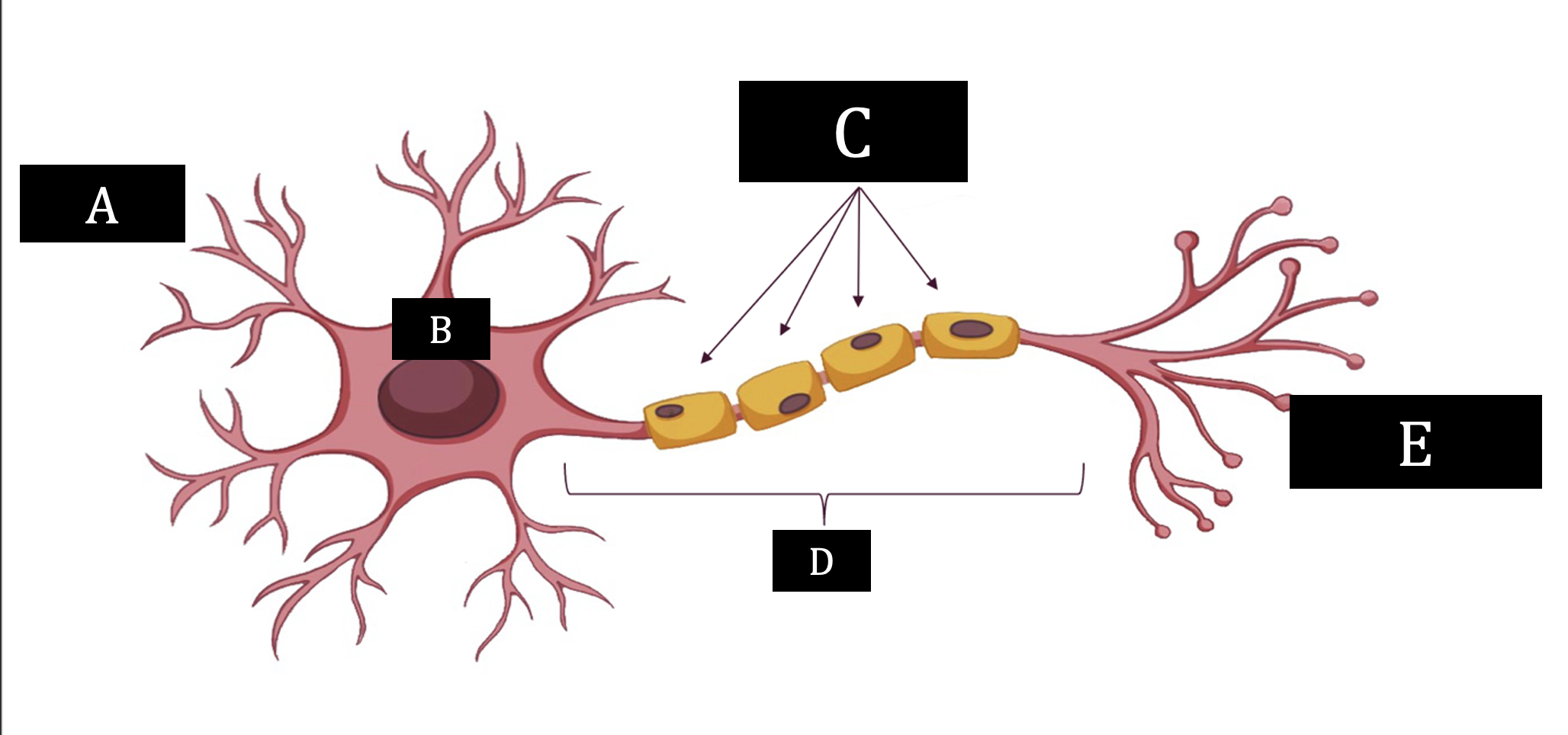
Label the neuron:
What is A?
Dendrites
71
New cards
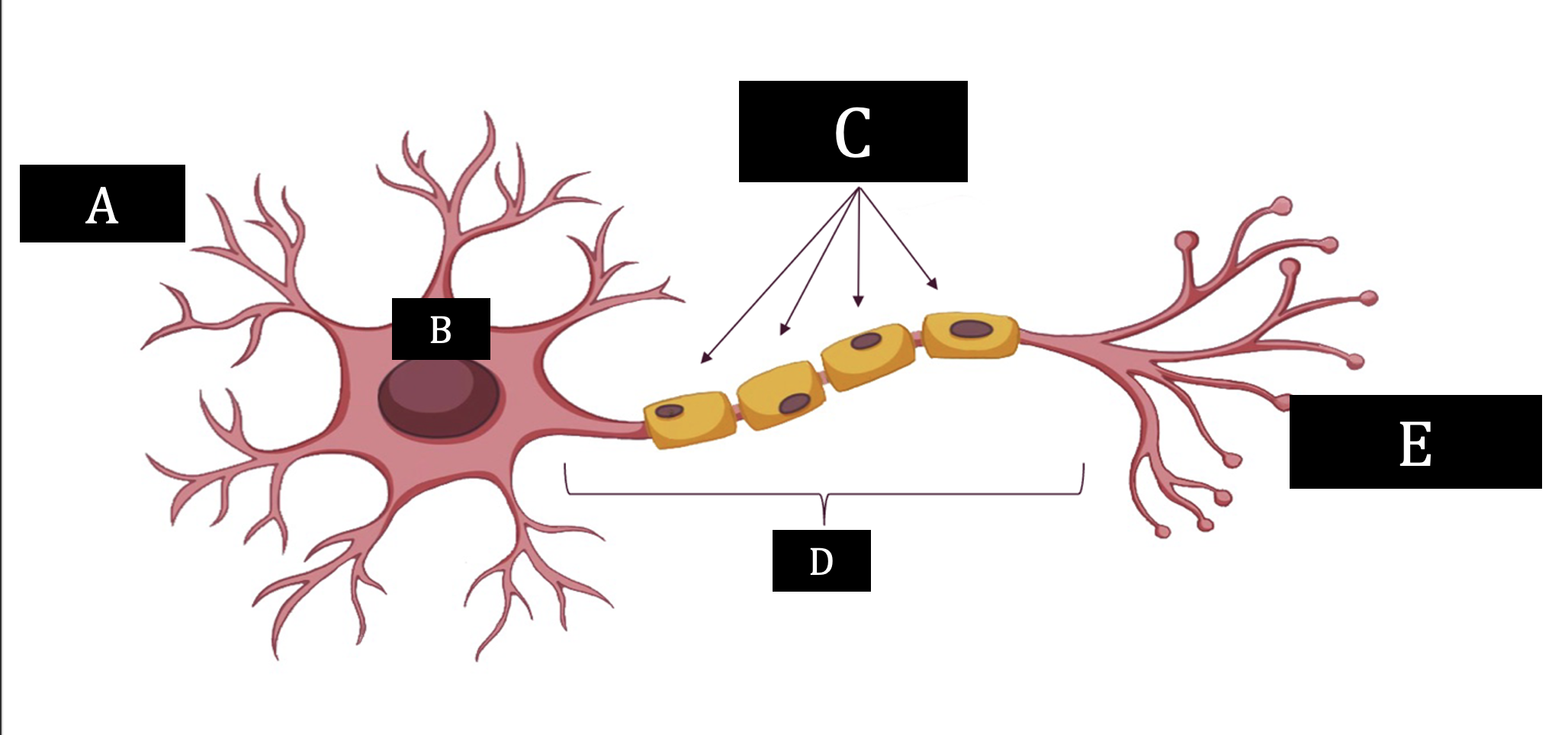
Label the neuron:
What is B
Soma
72
New cards
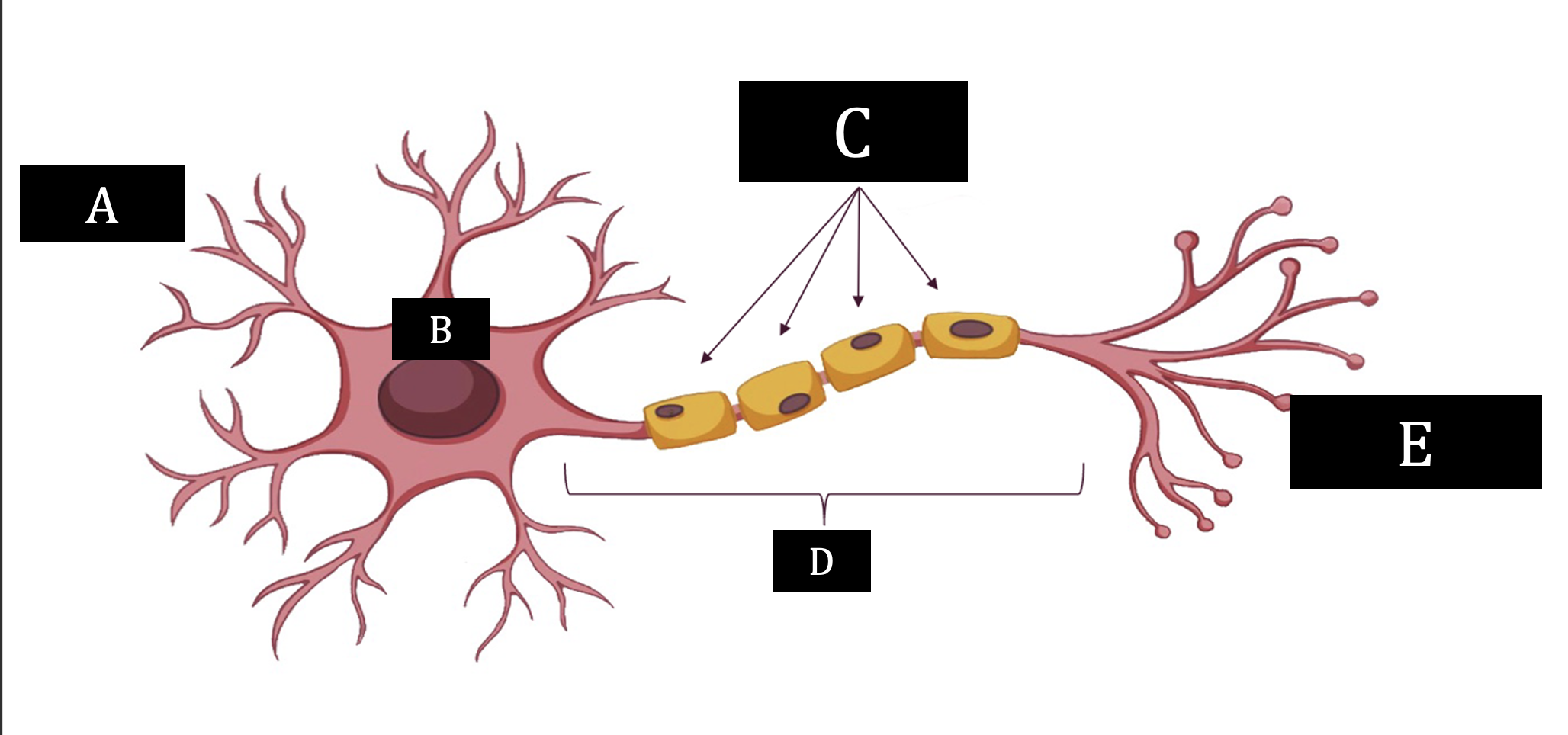
Label the neuron:
What is C
Myelin Sheath (Schwann cells)
73
New cards
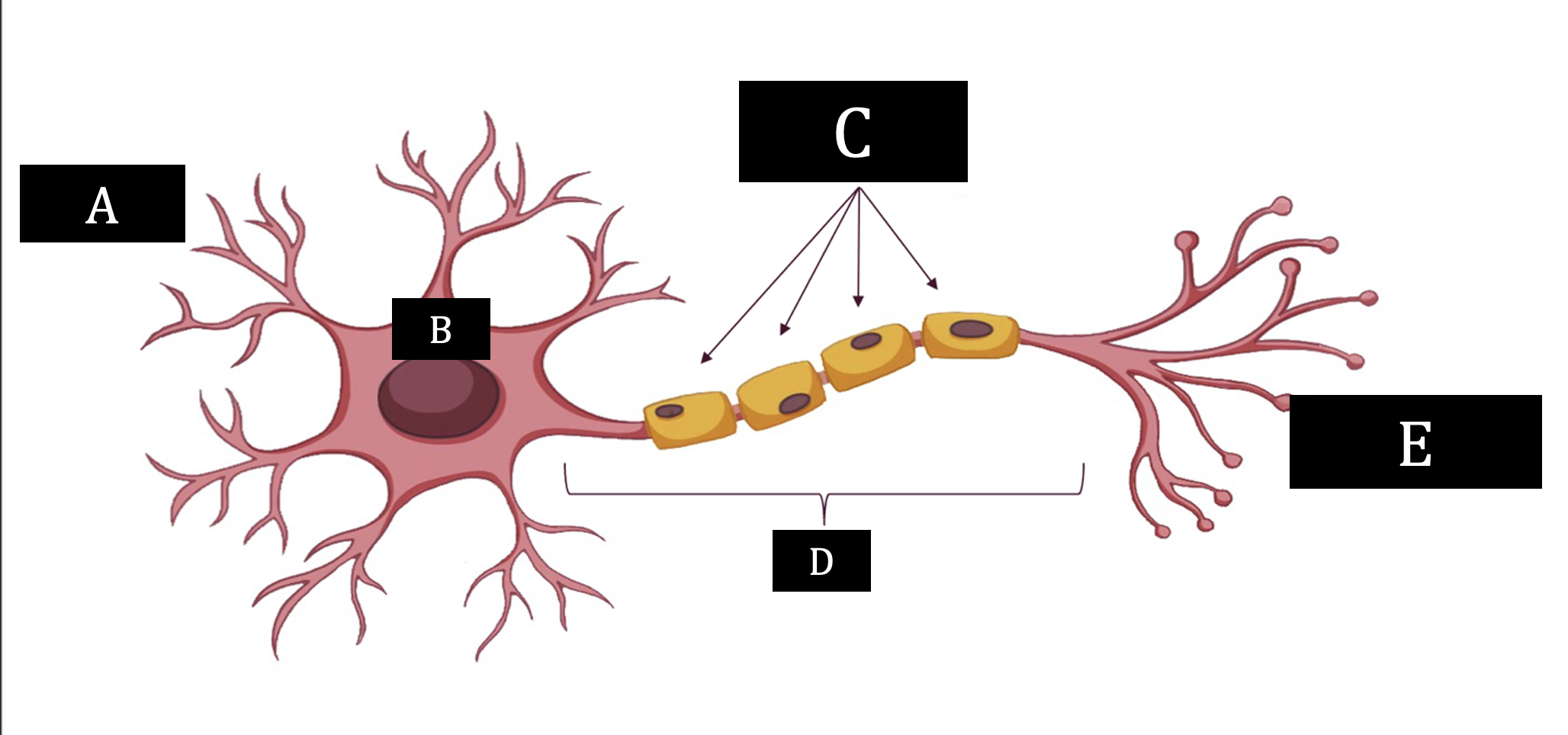
Label the neuron:
What is D?
Axon
74
New cards
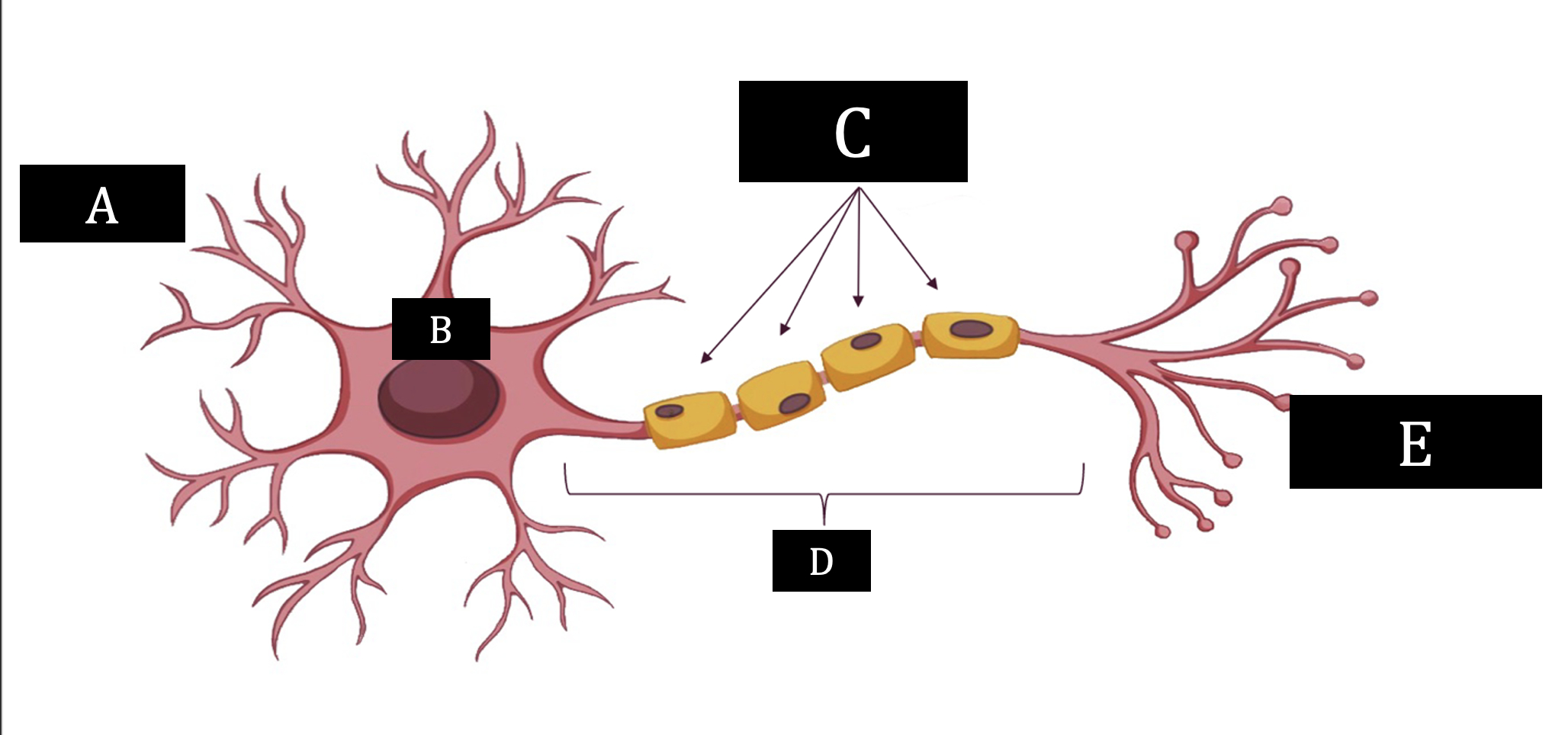
Label the neuron:
What is E?
Terminal Branches/Buttons
75
New cards
What is interneuron communication?
how neurons communicate with each other
76
New cards
What is synaptic transmission
action potential stimulates terminal fibers to release neurotransmitters to attach to dendrites and a message is sent across the synapse between each neuron
77
New cards
What are neurotransmitters
What neurons release in synaptic transmission; they have many different types and each one has multiple jobs
78
New cards
What is an acetylcholine neurotransmitter’s main job?
allows your brain to send signals to motor muscles; covers from gross to fine muscle control
79
New cards
What is Epinephrine (adrenaline) and morphinone (noradrenaline) neurotransmitter’s main job?
In the sympathetic nervous system response and get you ready for action
fight or flight response
80
New cards
What is GABA neurotransmitter’s main job?
more often will be an inhibitory neurotransmitter; slow activity down; prevents brain from being hyperactive; help prevent things like seizures; parasympathetic nervous response
* alcohol acts like this
81
New cards
What are endorphins neurotransmitter’s main job?
when the body experiences pain to a certain extent endorphins reduce the pain response; this is why people get a ‘runners high’ and doing extreme workouts can be harmful due to excessive amounts of endorphins making it easier to ignore pain and risk potential injury
* opioids act like this
82
New cards
What is serotonin neurotransmitter’s main job?
regulates mood, rewards you for doing an action; hinders impulsive behavior; regulates hunger; deficiency may cause increased aggression and suicidal behaviors
83
New cards
What is dopamine neurotransmitter’s main job?
regulates motivation, encourages your body to work more towards one thing; establishes reward pathways; deficiency may cause lack of motivation
84
New cards
How does interneural communication stop?
By auto-reception, reuptake, and enzyme degradation
85
New cards
What is auto-reception
auto receptor sites are at the end of a neuron and when there is an excess of neurotransmitters in the synapse they will bind with the auto receptors and this will tell the neuron to slow the release of neuron transmitters
86
New cards
What is reuptake
the sender neuron will take in the leftover neurotransmitters when it is time to stop interneural communication to be redeveloped for future uses
87
New cards
What is enzyme degradation?
when it is time to stop interneural communication enzymes bind with leftover neurotransmitters and will break them down into synaptic fluid
88
New cards
How is psychopharmacology used to influence neuronal communication?
it affects neural transition by affecting various functions in the communicator process; divided into agonists and antagonist
89
New cards
What is the Central Nervous System (CNS)?
The brain and spinal cord
90
New cards
What is the peripheral nervous system (PNS)
all other parts of body besides brain and spinal cord
gathers information from body and transmits it to the CNS
made up of Somatic and Autonomic nervous system
91
New cards
What is the autonomic nervous system
part of the PNS and controls your glands and the muscles of your internal organs (not under voluntary control)
Contains the sympathetic and parasympathetic nervous system
92
New cards
What is the somatic nervous system
monitors sensory input and triggers motor output, controlling your skeletal muscles (voluntary control)
93
New cards
What is the Sympathetic nervous system
under the autonomic system this will arouse you and make you more alert; increase heart rate, blood pressure, and blood-sugar level; slows digestion and increase sweat
94
New cards
What is the parasympathetic nervous system
under the autonomic nervous system
will calm you, conserve energy, decrease heart rate, lower blood sugar, enables you to rest and digest
95
New cards
What do agonists do?
enhance efficiency of neurotransmitters
96
New cards
What do antagonists do?
reduce efficiency of neurotransmitters
97
New cards
What is neurogenesis
growing of a new neuron upon learning new information- does NOT fit with what we know about neurons
98
New cards
What is synaptogenesis?
strengthen connections between existing neurons- have significant evidence that this does happen
99
New cards
What is synaptic pruning?
culling of less used connections between neurons to create the best and most efficient path
100
New cards
What is neural plasticity?
capability of the brain’s ability to reorganize itself; best during childhood and adolescence and decreases with age