Unit 2: Energy and Information
 Call Kai
 Learn
 Practice Test
 Spaced Repetition
 Match
 Flashcards
 Knowt Play
1/133

There's no tags or description
Looks like no tags are added yet.
134 Terms
Aerobic respiration general definition
A reaction, where glucose is “burned” in oxygen to produce CO2, H2O with the release of heat
Aerobic respiration specifically is?
is a series of coupled and redox reactions that release the free energy of glucose and transfers some of the released energy to other molecules
Coupled Redox Reactions
C6H12O6 + 6O2 → 6CO2 + 6H2O + “Energy”
What is occuring with the reactants and products?
Non-polar covalent (C-C, C-H, O=O) bonds in the reactants are broken
Polar covalent (C=O, O-H) bonds in the products are formed
Bonding electrons shared equally between the carbon atoms in glucose move farther away from the C nuclei in CO2 and so?
glucose is oxidized

Bonding electrons shared equally between the oxygen atoms in O2 move closer to the O nuclei in H2O so?
Oxygen is reduced

Chemoorganotrophy Overview diagram
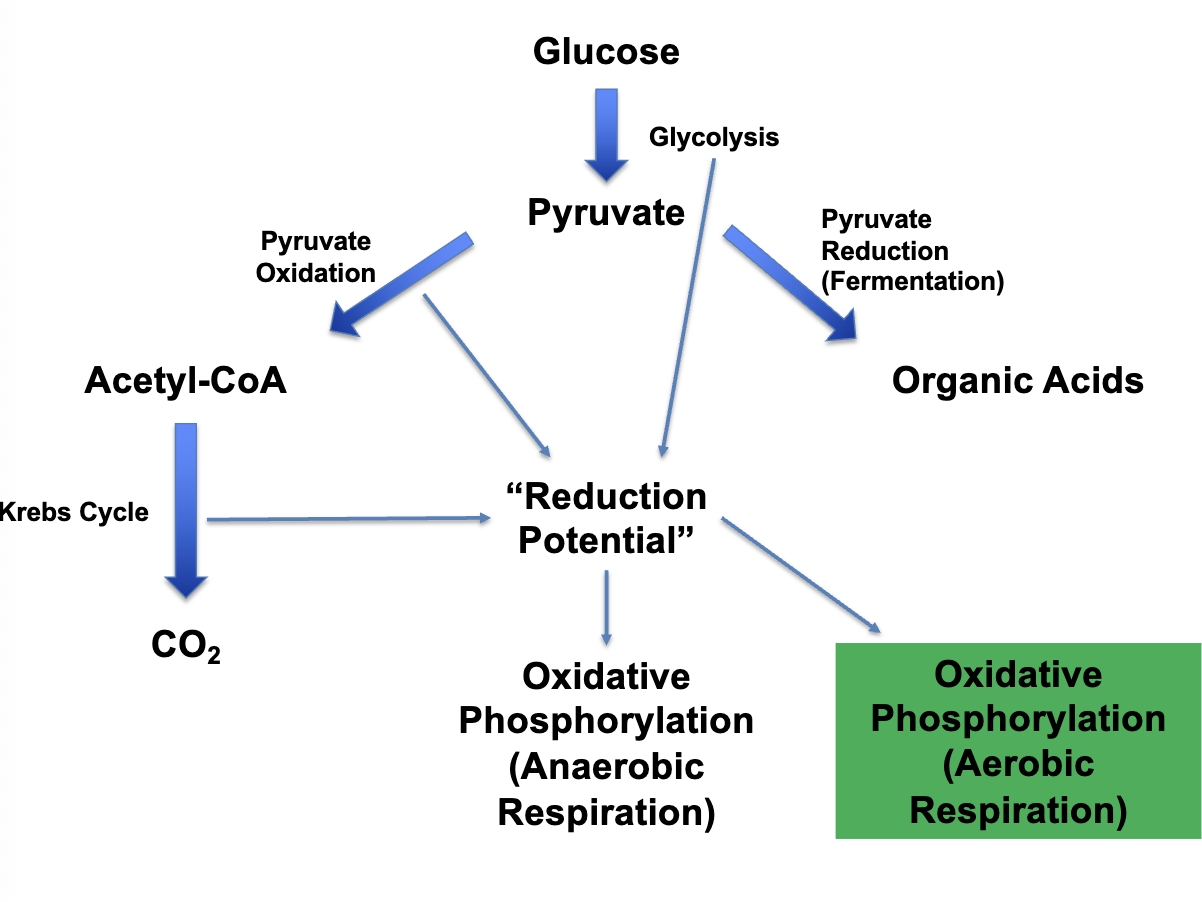
Biological redox reactions generate?
Redcution potential that is stored in electron carriers
Examples of electron carriers

We can think of reduced electron carriers as?
Free energy transport molecules

Glycolysis: Overview
Do not memorize intermediate names or structures, enzyme names
Do know:
• Partial glucose oxidation
• 10 connected rxns
• Each step requires a unique enzyme
• Notice the 2 coupled reactions that “energize” glucose
• Notice the 3 coupled reactions that yield high-energy products

Glycolysis: Simplified
Glucose (6C) →2 pyruvate (3C) (net 2 ATP)
2ATP → 2ADP
2NAD+ → 2NADH
4ADP → 4ATP

Electron carriers go through what process?
Reduction :)
NAD+ just floating around :)
6thstep in diagram :)

ATP is generated by:
Substrate-Level Phosphorylation
Must contain P

Glycolysis is partial glucose oxidation why?
1. Not much ATP has been made
• Most free energy is in pyruvate and NADH
2. The cell needs to remove pyruvate
• Don’t want delta G = 0
3. The cell needs to restore NAD +
• We need to oxidize the NADH as iNAD+ is not super abundant sp we need to recycle them and NADH needs to donate e- to make NAD+ again
To Breathe or not to Breathe: In many eukaryotic and prokaryotic organisms, there is
a checkpoint following glycolysis:
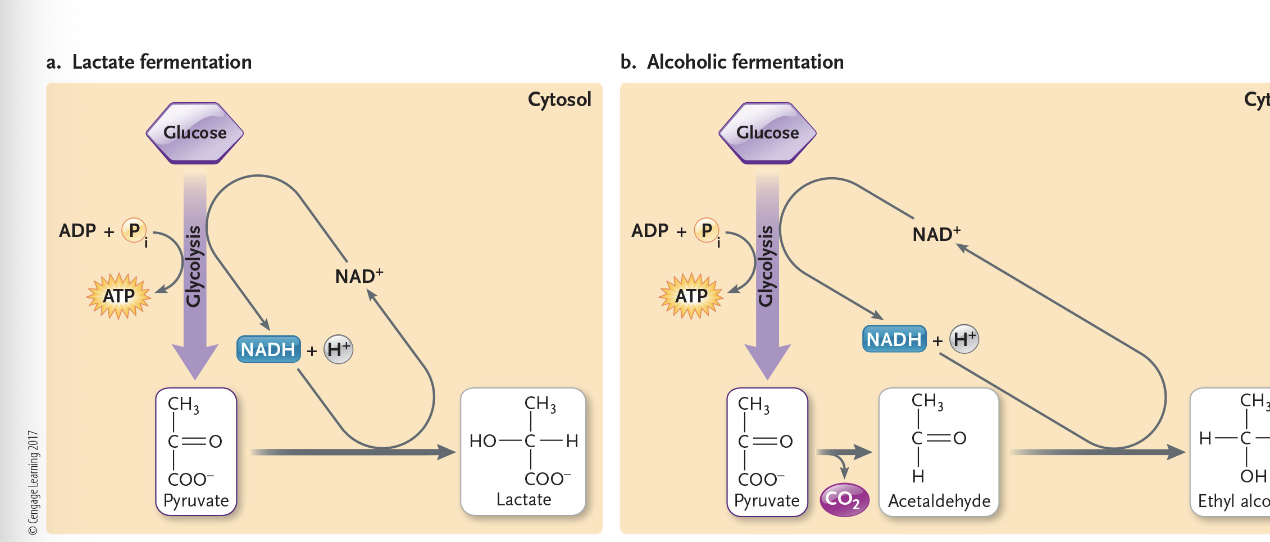
If oxygen is limiting; pyruvate is reduced
If oxygen is present; pyruvate is oxidized

Fermentation is the Anaerobic Reduction of Pyruvate: WHAT DOES IT NOT DO?
DOES NOT GENERATE ATP → GLYCOLISIS DOES
Eukaryotes Oxidize Pyruvate in the?
Mitochondria
Drawing for mitochondria
cytosol - outer membrane - intermembrane space (IMS) - inner membrane - matrix
Eukaryotes Transport Pyruvate into the?
Mitochondrial Matrix
Draw a picture for eukaryotes transporting pyruvate into the mitochondrial matrix:
Look at notes please (uses active symport) :)
Pyruvate Oxidation (Bridge Reaction) + practice drawing simple process
Pyruvate is oxidized to Acetyl-CoA in the matrix
(Check notes) :)

Citric Acid (Krebs) Cycle: Overview
8 connected reactions that each have enzymes
Also called tricarboxylic acid cycle

First intermediate of citric acid cycle
Citarte synthase
Citric Acid (Krebs) Cycle: Simplified drawing
Check notes :)

Citric Acid (Krebs) Cycle: NOT Just Glucose, why?
All proteins, complex carbohydrates (starch, glycogen), and fats also go into the cycle.
The Protein Complexes of the Electron Transport Chain (ETC)
There are 4! ATP synthase not part of ETC

Electron Flow is driven by?
REDOX

What occurs here?
e- will flow from the complex to comple through increasingly electronegative redox centers.
The ETC Pumps?
Protons which creates a H+ concentration gradient = Ep
Functions of complexes 1 and 2
NADH in the matrix donates e- to complex 1
H+ are pumped from matrix to IMS
FADH2 in the matrix donates e- to complex 2

Since complex 2 is a peripheral protein what cna it not do?
pump e- across membrane
Ubiquinone (UQ)
Is a Hydrophobic Electron Taxi
What does UQ move from complex 1 to 2?
Taxis e-
What does UQ move from complex 2 to 3?
Taxis e-
What happens when UQ reduces? oxidizes?
Will use H+ from the matrix
Will push the H+ into the IMS
What flows through complex 3 to cytochrome c (cyte)?
e-
Cyte
A hydrophilic e- taxi that moves e- from complex 3 to 4
What flows through complex 4 and what does this cause?
e- flow through complex 4 and H+ protons are pumped across the IM from matrix to IMS (NOT A PUMP)
How is complex 4 related to O2?
Complex 4 donates e- to O2 which is reduced to H2O
The ETC Generates an?
Electrochemical Gradient
[H+] is lowered in the matrix when they are:
Pumped (or transported) across the membrane
Used to reduce O2
The H+ electrochemical gradient is called:
Proton motive force (PMF)
pHs of IMS and matrix
5 and 7
Proton Motive Force is Used for Chemiosmosis how?
Using Ep of the PMF to power ATP Synthase
As H+ moves down [ ] gradient, the free energy released is used to phosphorylate ADP
In ATP Synthase what type of phosphate is used?
Inorganic Pi
What is the overall process for the ETC in the membrane?
Oxidative phosphorylation
ATP Synthase
Couples the flow of H+ through the Fo (in membrane/top/basal piece) channel part of the enzyme to the phosphorylation of ADP by the F1 catalytic part of the enzyme (head piece)


What is the delta G change in ATP synthase?
-5 kj/mol
Total ATP made in aerobic respiration =
~32 ATP. Can be as high as 38 ATP.

Why can there be variation in ATP yield?
Hard to measure since not all e- carriers go to make ATP and they go to different reactions
Metabolic Integration - What happens when you don’t need ATP and when you do?
Glucose can be stored as a polymer (glycogen-animals or starch-plants)
Triglycerides can be generated for even longer-term storage
If you need ATP, these processes can be reversed
What can form fatty acids for metabolism?
Acetyl-CoA
Why do organisms need carbon?
For macromolecules such as amino acids, nucleic acids, and lipids (Putting the Hetero in Chemoorganoheterotroph) :)
Acetyl-CoA can be used to generate?
Macromolecules instead of going through the Krebs cycle
What do prokaryotic organisms NOT have?
Membrane-bound organelles such as the mitochondria
Aerobic Respiration in Prokaryotes (where and what is the same)
All metabolism occurs in the cytosol and on the plasma (cell) membrane
Otherwise, it is “the same” by having glycolysis, bridge rxn, krebs : oxidative P
Anaerobic respiration is only known to occur in>
Prokaryotic organisms
What came first anaerobic or aerobic respiration?
Evolved at a time when oxygen was not abundant in the atmosphere
Likely before aerobic respiration
Anaerobic respiration uses final electron acceptors such as?
other than oxygen, SO4 (sulfate) or NO3 (nitrate)
How is anaerobic respiration the same as aerobic respiration?
Glycolysis, fermentation, bridge rxn, krebs, ETC oxidative P
Reduction of SO4 and NO3
NO3 → NO2
SO4 → SO3