[CV] 2. Image Formation 📸
 Call Kai
 Learn
Learn Practice Test
 Spaced Repetition
 Match
Match Flashcards
 Knowt Play
1/23

There's no tags or description
Looks like no tags are added yet.
Name | Mastery | Learn | Test | Matching | Spaced | Call with Kai | Chat |
|---|
No analytics yet
Send a link to your students to track their progress
24 Terms
What are geometric primitives and why are they important in Computer Vision?
Geometric primitive: basic elements (building blocks) to describe shapes, mainly points, lines, and planes.
Important in CV: many problems in CV involve finding their positions or relationships. E.g where a 3D point appears in an image or where 2 lines intersect
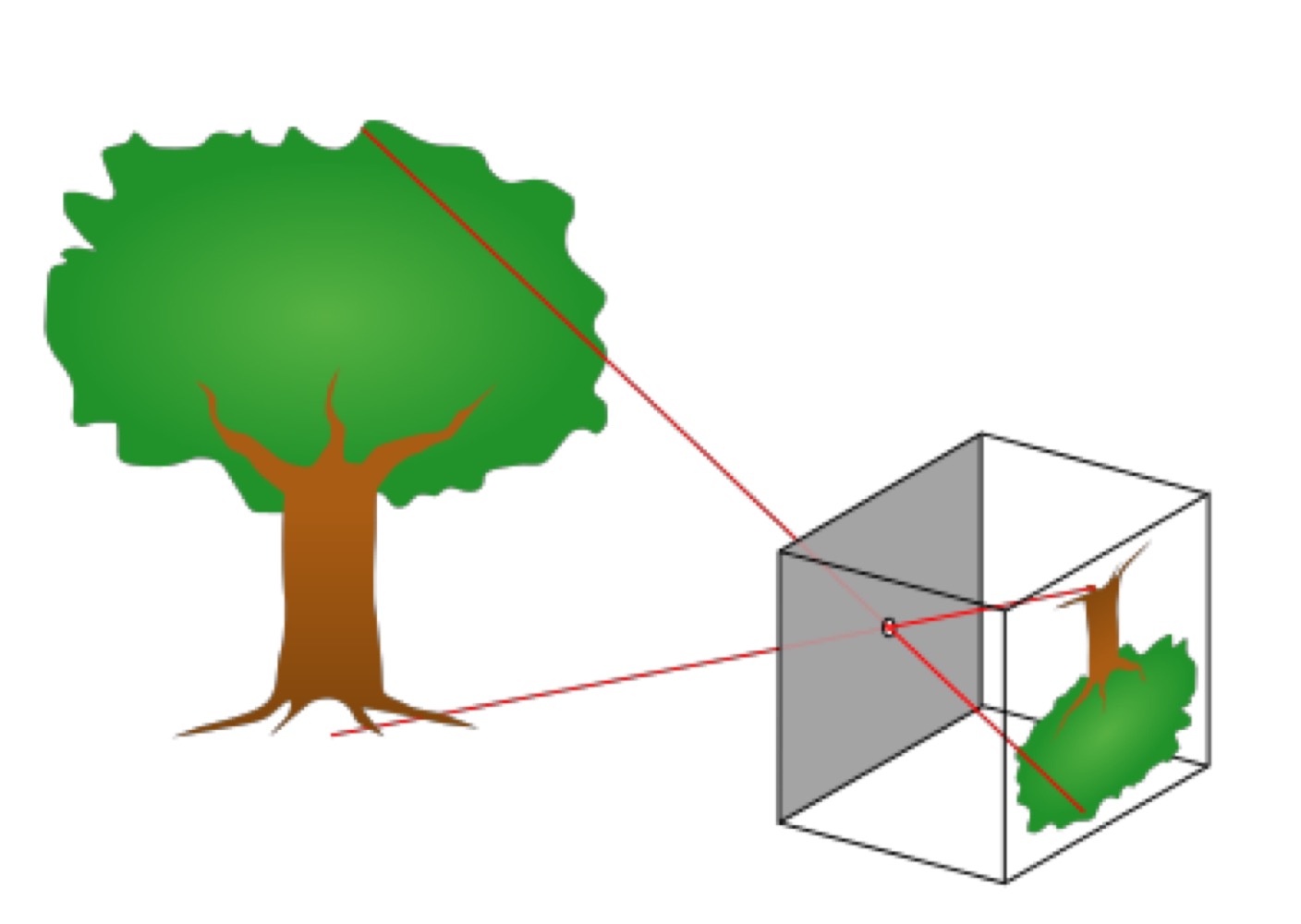
Why do parallel lines in 3D world appear to meet in 2D image?
because of perspective projection
A camera projects the 3D world onto a 2D image plane through a single focal point.
Parallel lines can therefore appear to converge at vanishing point

What are homogeneous coordinates and why do we use them?
Instead of represent 2D points with (x,y), we represent it as (wx,wy,w) where w is NOT 0
Useful because they allow us to represent points at infinity and express transformations such as translation and projection using matrix multiplication

Why can homogeneous vectors represent the same point?
Homogeneous coordinates are defined up to scale
e.g (x,y,1) ~ (2x,2y,2) ~ (5x,5y,5)
Dividing each by its last coordinate produces the same 2D point
The direction of the homogeneous vector matters, not its magnitude!!
How do we convert between inhomogeneous, augmented, and homogeneous coordinates?
Inhomogeneous: (x,y)
Augmented: (x,y,1)
Homogeneous: (wx,wy,w)
To convert homogeneous → inhomogeneous:
(x1,x2,x3) → (x1/x3 , x2/x3)

What does w=0 mean in homogeneous coordinates?
w = 0 represents a point at infinity
It cannot be converted into an ordinary finite 2D point
Allows homogeneous coordinates to represent the vanishing points of parallel lines
How is 2D line represented in homogeneous coordinates?
a Cartesian line is ax + by + c = 0 and its homogeneous representation is

How do we find the line joining 2 points using homogeneous coordinates?
Take their cross product (in the picture)
The result is homogeneous representation of the line passing through both points

How do we find the intersection of 2 lines?
take the cross-product of their homogeneous line vectors (in the picture)
So same cross-product idea handles both joining points and intersecting lines

What happens when 2 parallel lines are intersected in homogeneous coordinates?
Their cross product produces a point (x,y,0) because w=0, a point at infinity, corresponding to their vanishing point
What is the line at infinity?
It is set of all homogeneous points whose last coordinates is w=0.
Parallel lines meet at points at infinity, and all such points lie on the line at infinity
How are homogeneous coordinates extended from 2D to 3D?
a 3D point (x,y,z) becomes (wx,wy,wz,w)
A plane is represented by ax + by+ cz + d= 0
A points lies on the plane when the homogeneous inner product between plane and point is 0


What does a translation do to an object?
Translation shifts every point by a fixed vector:
x' = x+t
It changes the object’s position but preserves its orientation, size, and shape.


What does a 2D rotation do?
Rotation : rotates points around the origin by an angle theta:
Preserves distances and angles

What is Euclidean or rigid-body transformation?
Euclidean transformation: combines rotation and translation:
Moves and object without deforming it, → length and angles are preserved
In homogeneous coordinates, rotation and translation can be combined into one matrix multiplication


Difference of translation, Euclidean, affine, similarity, and projective in terms?

What is similarity transformation?
Similarity transformation: adds a uniform scale (s) to a rigid transformation:
Preserves angles and shape but objects’ size can change

What is an affine transformation?
affine transformation: allows stretching and shearing
Parallel lines remain parallel but angles nd relative lengths may change


What is a projective transformation or homography?
It preserves straight lines, but parallelism is NOT guaranteed.
Therefore, parallel lines can converge to vanishing points.

What is the hierarchy of 2D transformations and their degrees of freedom (DoF)?
Translation → 2 DoF
Euclidean → 3 DoF
Similarity → 4 DoF
Affine → 6 DoF
Projective → 8 DoF
As we move down the hierarchy, transformations become more flexible but preserve fewer geometric properties.
What does Degrees of Freedom (DoF) mean?
DoF : the number of independent parameters needed to specify a transformation.
More DoF → more flexibility, but generally the transformation is harder to estimate.
Do lines transform using the same matrix as points ?

How do 3D transformations differ from 2D transformations?
The concepts are the same, but:
Rotation: 2 × 2 → 3 × 3 matrix
Translation: 2D → 3D vector
In homogeneous coordinates, 3D transformations can be represented using 4 × 4 matrices.
All transformations in the hierarchy preserve straight lines.

How is a projective transformation used in panorama stitching?
The basic pipeline is:
1. Find correspondences
→ 2. Estimate a homography
→ 3. Warp and blend
The homography aligns overlapping images so they can be combined into one panorama.
