ANTIVIRALS - glycans and viruses
 Call Kai
 Learn
 Practice Test
 Spaced Repetition
 Match
 Flashcards
 Knowt Play
1/24

There's no tags or description
Looks like no tags are added yet.
25 Terms
Carbohydrates
simple sugars, monosaccharides, that cant be converted into smaller sugars by hydrolysis .
e.g) glucose
Complex carbohydrates
Carbohydrates made up of more than one monosaccharide linked by glycosidic linkage for example sucrose and cellulose
Oligosaccharides
: 3-10 units (monosaccharide units)
Amylose - a starch
insoluble in cold water
Consists of approximately 20% weight of starch
1→ 4 alpha linked linear structure
Amylopectin - a starch
soluble in water
Consists of approx 80% weight of starch
A branched structure consisting of 1-4 alpha linkage and 1-6 alpha linkage
SIALIC ACIDS
e.g) Muraminic acid
Neuraminic acids
9C sugars which are components of polysaccharides in cells walls and are important constituents of glycoproteins and glycolipids.
Tamiflu
Sialidase inhibitor
glycan
the sugar portion attached to a protein or lipid
ROLE OF GLYCANS-
providing structural components,
determining blood group compatibility,
modifying protein properties,
and playing key roles in cell signalling,
immune response,
and drug design.
peptidoglycans,
are essential components of cell walls, providing structural integrity.
proteoglycans are found in the extracellular matrix
are found in the extracellular matrix
Glycans can influence ______ of proteins
the solubility and stability
Glycans determine blood group compatibility
on the surface of blood cells determine blood groups. Receiving incompatible blood can cause agglutination (clumping of blood cells) which is dangerous.
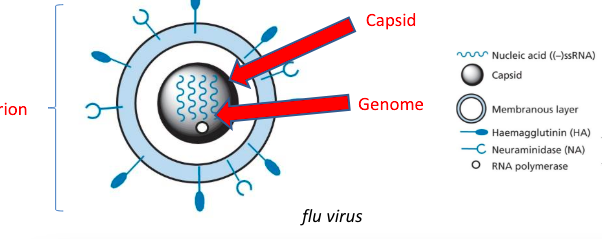
Structure of a virus
viral genome is contained and protected by a protein coat , known as a capsid. The complete structure is known as a virion.
Capsids in enveloped virus
nucleocapsid. (The envelope is a lipid bilayer membrane with glycoproteins)
RNA VIRUS -
replication occurs in the cytoplasm
RETROVIRUS -
synthesise viral DNA using RNA as a template
DNA-VIRUS -
viral mRNA is formed in the cell by viral DNA using the host cells polymerases
LIFE CYCLE OF VIRUSES
Virus enters a cell and transfers genetic material, sometimes also essential proteins
Viral genes lead to the production of viral proteins.
These viral proteins ensure that the genome replicates,
packages genomes into virions,
and affects the structure and/or function of the infected cell
Finally, new progeny viruses are released from the host cell.
Stages in virus life cycle
absorption
penetration and uncoating
replication and transcription (of DNA/RNA)
Virion release
during absorption
the virus binds to the outer surface of the host cell membrane, targeting a specific molecule, usually a glycoprotein with crucial cell function.
during penetration and uncoating,
different viruses have various approaches to introducing their nucleic acid (DNA or RNA) into the host cell, resulting in the release of the viral nucleic acid into the host cell
the replication and transcription of the viral DNA or RNA occurs,
the mechanism by which this happens varies from virus to virus. This leads to the synthesis and assembly of nucleocapsids.
virion release occurs
either through cell lysis or the process of budding, depending on the type of virus
4 properties of an ideal small molecule antiviral drug
Broad spectrum antiviral activity
Completely inhibits viral replication
Maintains efficacy against mutant viral strains
Reaches the target organ without interfering with normal cellular processes or the immune system of the host