suicide
 Call Kai
 Learn
 Practice Test
 Spaced Repetition
 Match
 Flashcards
 Knowt Play
1/63

There's no tags or description
Looks like no tags are added yet.
64 Terms
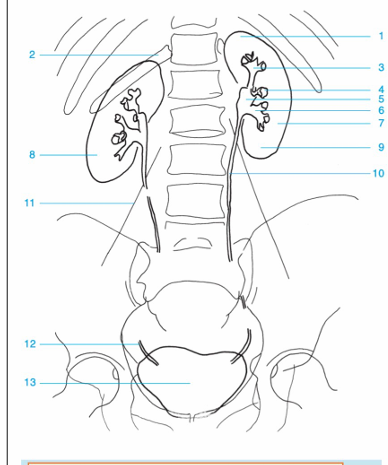
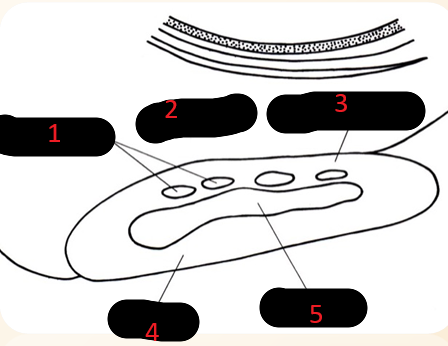
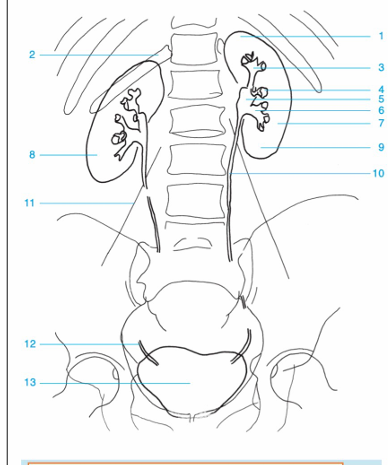
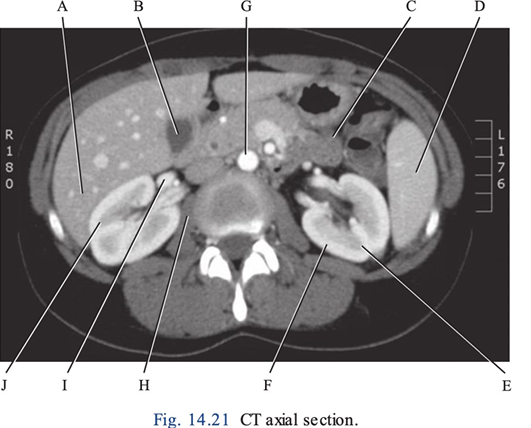
-located in the fatty capsule that surrounds each kidney
SUPRARENAL/ADRENAL GLAND
*lower rib cage forms a protective enclosure for the kidney
left kidney
follows the natural curve of the vertebral column
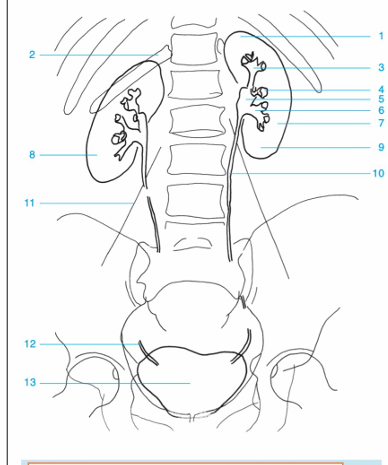
URETER
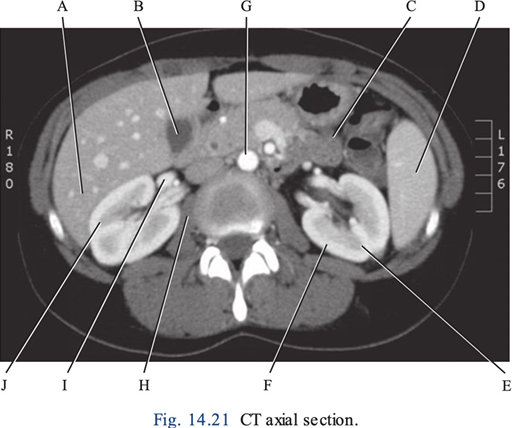
-are on each side just posterior to the kidneys.
quadratus lumborum
-deep muscles of the back on each side of the spine
ERECTOR SPINAE

6

5

7

G

H

E

K

G
is received by the kidneys directly from the abdominal aorta via the left and right renal arteries.
arterial blood

E
The renal veins connect directly to the inferior vena cava to return the blood to the right side of the hear
VENOUS BLOOD
Along the medial border of each kidney is a centrally located, longitudinal fissure termed the
HILUM
-forms the peripheral, or outer, portion of the kidney
CORTEX
composed of 8-18 conical masses, renal pyramids
MEDULLA
an opening where the renal pyramids tubules converge
RENAL PAPILLA/APEX
2
drainage of renal papilla-4 to 13 minor calyces
MINOR CALYX
2 to 3 major calyces are formed by 4 to 13 minor calyces
MAJOR CALYX
formed by union of major calyces
renal pelvis
used to describe the total functional portions of the kidneys,
RENAL PARENCHYMA
-tiny capillary tufts formed by small arteries in the renal cortex
GLOMERULI
-carries blood containing nitrogenous wastes
AFFERENT ARTERIOLES
-take blood away to a secondary capillary network in close relation to the straight and convoluted tubules
EFFERENT ARTERIOLES

1
3

4
4

7

1

8

3
-The triangular portion of the bladder along the inner, posterior surface
TRIGONE
numerous folds in the inner mucosa of the bladder
RUGAE

C

E

D

A

B

A

D
F
G

D

C
Entire renal parenchyma is visualized, with some filling of collecting system with contrast medium
NEPHROGRAPHY
The kidney on elevated side is placed in profile or parallel to the IR
RPO AND LPO POSITIONS

Entire urinary system is included, with only residual contrast medium visible
AP PROJECTION postvoid

In addition to the AP projection, what projection would most likely be included in the images for retrograde urography?
An oblique Projection
The musculomembranous tube that coneys urine from the urinary bladder to the outside the body is the
urethra
The hilum is located on the _______ border of the kidney
medial
What is the purpose of obtaining an AP projection
to demonstrate opacified renal cortex

4

10

5

6
12

11